Week 1 Understanding Different Battery Chemistry
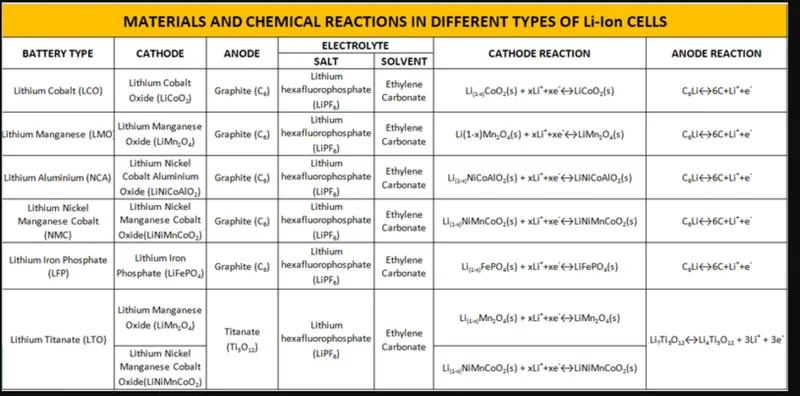
1.Prepare a table which includes materials & chemical reactions occurring at the anode and cathode of LCO, LMO, NCA, NMC, LFP and LTO type of lithium ion cells.Give your detailed explanation on it
A battery can be defined as an electrochemical device (consisting of one or more electrochemical cells) which can be charged with an electric current and discharged whenever required. Batteries are usually devices that are made up of multiple electrochemical cells that are connected to external inputs and outputs. Batteries are widely employed in order to power small electric devices such as mobile phones, remotes, and flashlights. Historically, the ‘term’ battery has always been used in order to refer to the combination of two or more electrochemical cells. However, the modern definition of the term ‘battery’ is believed to accommodate devices that only feature a single cell.
There are two types of battery-
- Primary battery- Primary batteries can only be charged once. When these batteries are completely discharged, they become useless and must be discarded. The most common reason why primary batteries cannot be recharged is that the electrochemical reaction that takes place inside of them is irreversible in nature. It is important to note that primary batteries are also referred to as use-and-throw batteries.
- secondary battery- secondary batteries are the batteries than can be charged and reused for many charging-discharging cycles. The electrochemical reactions that take place inside these batteries are usually reversible in nature. Therefore, secondary batteries are also known as rechargeable batteries. When discharging, the reactants combine to form products, resulting in the flow of electricity. When charging, the flow of electrons into the battery facilitates the reverse reaction, in which the products react to form the reactants.
The Lithium-Ion Battery (also known as the LIB Battery)
The lithium-ion battery, often abbreviated to LIB, is a type of secondary battery which is rechargeable. LIBs are known to have many applications in powering electric vehicles and is also known to be used extensively in the aerospace industry.
Within the batteries, during the discharging process, lithium ions are known to pass from the negative electrode to the positive electrode (through an electrolyte ). These lithium ions are also known to travel back when charging. Lithium-ion batteries usually employ an intercalated lithium compound in the positive electrode and usually graphite in the negative electrode as the fuel. Lithium-ion batteries are highly desirable due to their high energy capacity, no memory effect (with the exception of LFP cells), and low self-discharge.
Some key characteristics of LIBs are listed below.
- The lithium-ion battery is regarded to be one of the most stable and safe batteries. This battery is also known to have a very high energy capacity.
- LIBs are widely used in mobile phones and portable computers (such as laptops and tablets).
- This battery has a very slow self-discharge. Furthermore, it is known to have twice the energy capacity of the NiCad battery.
about anode and cathode-
| Anode | Cathode |
| The anode is the electrode where electricity moves into. | The cathode is the electrode where electricity is given out or flows out of. |
| The anode is usually the positive side. | A cathode is a negative side. |
| It acts as an electron donor. | It acts as an electron acceptor. |
| In an electrolytic cell, oxidation reaction takes place at the anode. | In an electrolytic cell, a reduction reaction takes place at the cathode. |
| In galvanic cells, an anode can become a cathode. | In galvanic cells, a cathode can become an anode. |
Separator-
In the structure of a lithium battery, the separator is one of the key inner layer components. The performance of the separator determines the interface structure and internal resistance of the battery, which directly affects the capacity, cycle and safety performance of the battery. The separator with excellent performance plays an important role in improving the overall performance of the battery.
The main function of the separator is to separate the positive and negative electrodes of the battery, prevent the two poles from contacting and short-circuit, and also have the function of allowing electrolyte ions to pass. The separator material is non-conductive and its physicochemical properties have a great influence on the performance of the battery. The type of battery is different, and the separator used is different. In the lithium battery series, since the electrolytic solution is an organic solvent system, a separator material resistant to an organic solvent is required, and a polyolefin porous film having a high strength thin film is generally used.
Electrolyte-
Electrolytes in lithium-ion batteries are mainly meant to help transport ions between the positive and negative electrodes. This can take place in a particular direction depending on the process being carried out, whether that includes charging or discharging.
During the discharging process, the chemical energy is converted into electrical energy. This makes use of the electrolyte to form compounds at the electrodes that help to power the battery.
During the charging process, the electrical energy gets reconverted into chemical energy, allowing the compounds to go back to their original forms such that the electrolyte gets back to its original state, although some losses are bound to take place.
1. Lithium Manganese Oxide
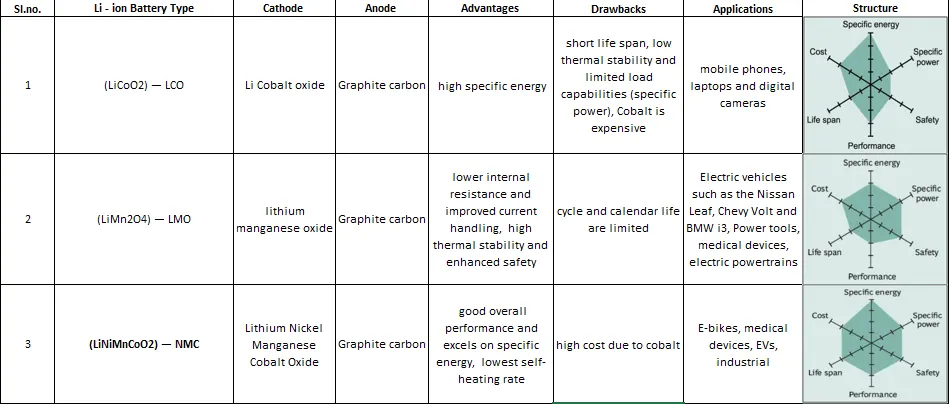
iLMO batteries, are a combination of Lithium-ion and Manganese Oxide. The idea of this type of battery was first developed in 1980. Later on, in 1996, it was manufactured by Moly Energy as commercial production. Some common names for this battery type are- lithium-ion manganese, lithium manganese, li-manganese, manganese spinel batteries.
Even though these lithium batteries have a high-temperature tolerance level, it is not the highest bid. Also, they have a moderate life span.
Uses
These batteries can endure a high level of temperature. So, they are widely used in products where the temperature needs to be maintained. Some common uses of Lithium Manganese Oxide Batteries are- medical equipment, electric cars, and various electronic devices. Other uses of this battery are- motorcycles, laptops, portable power tools like- drilling machines, HVAC tools, etc.
Benefits
You will find countless positive sides of the Lithium-ion Manganese Oxide batteries. The most prominent advantage of a Lithium Manganese Oxide battery is that it can take a great workload. These batteries have greater thermal stability. So, they are comparatively more enduring than Lithium Cobalt Oxide batteries at a higher temperature. Also, these batteris charge pretty fast. The LMO batteries can produce high specific energy.
Drawbacks
The most common problem with LMO batteries is that they only last 300 to 700 charge cycles. Its life cycle rate is lower than other Lithium batteries.
2. Lithium Cobalt Oxide
LCO batteries are a combination of lithium oxide and Cobalt. Lithium-ion cobalt batteries lithium cobaltate are some common names for this battery. These batteries are not the safest option even though they are being used in electronic products.
This type of battery comes with a graphite carbon anode and a cobalt oxide cathode. The charged ions travel from cathode to anode during a charge, while the opposite happens during a discharge.
Uses
The main use for this Lithium battery is for portable electronic devices. These batteries have excellent power storing capacity. Therefore, they are popular among electronic manufacturing companies to use in a variety of mobile electronic products. You can see them on laptops, mobile phones, tabs, digital cameras, video cameras, and other electronic devices.
Benefits
When used under low workloads, the Lithium Cobalt Oxide battery can deliver power for a long period.
Drawbacks
Cobalt is an expensive material. So, the Lithium Cobalt Oxide batteries are also quite expensive. This Lithium battery cannot run under an excessive workload. Also, there are some safety issues regarding this Lithium battery due to its low thermal capacity. They have a relatively short lifespan ranging from 500 to 1000 charge cycles.
3. Lithium Iron Phosphate (LFP)
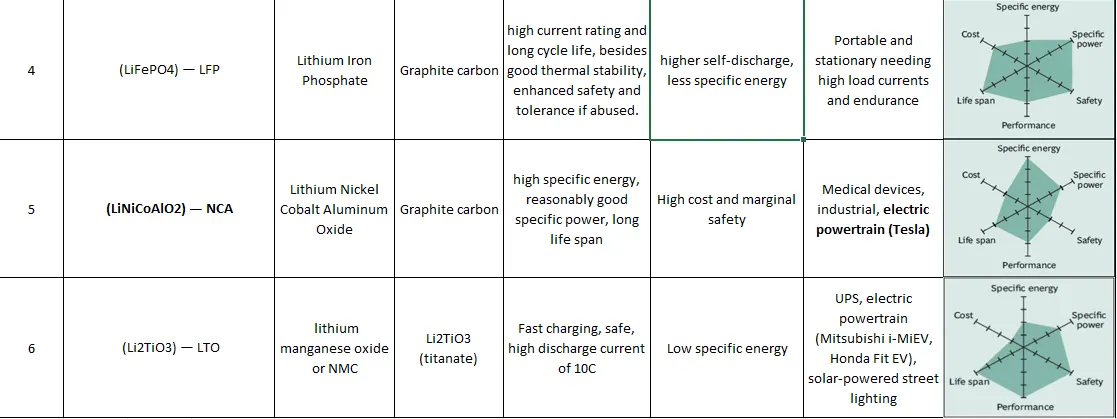
LiFePO4 is shortly known as LFP. This Lithium battery has Phosphate in the cathode. In the anode, it has graphitic carbon electrodes. The battery performance is outstanding because of its harmonic electrochemical balance. However, it has a lower energy density and a low voltage capacity. Depth of discharge or DOD has a minimal impact on it. Its cycle capability is 2750 to 12000 cycles during its lifetime.
Uses
LFP batteries are a common replacement for lead-acid batteries. Besides that, they are also used in large-scale power grids, solar energy storage, electric vehicles, and various power tools. These Batteries work as backups as well.
Benefits
The LFP batteries have excellent thermal endurance. So, they are great for high cranking amps. Also, these batteries have a long life cycle. The toxicity level of this Lithium battery is low. So, it is not as harmful as other types. Another advantage is they are not as expensive as Cobalt Oxide batteries and have a long life cycle, up to 10 years. Most LFP batteries have the capability of up to 80% depth of discharge, and some even 100% and the battery is not damaged. So, they are safe to use and worth your money.
Drawbacks
They are not a great fit for high cranking amps. These battery cells have a low power capacity, only 3.2 volts.
4. Lithium Nickel Manganese Cobalt Oxide (NMC)
This Lithium battery supplies a combined power of Manganese, Nickel, and Cobalt. These elements reside in the cathode of the battery. And it has a graphite anode. Each element has a particular feature that contributes to adding a greater value to it. And a reduced amount of Cobalt in the ratio has reduced its price.
Uses
NMC Lithium batteries have applications in electric productions. Electric vehicles- cars, scooters, e-bikes, mostly have this battery in them. Lithium NMC batteries are also used in power tools. Actually, this battery has more or less similar applications to Lithium Manganese Oxide batteries. And it is becoming popular due to the wide range of applications.
Benefits
NMC batteries have high thermal endurance. But the best thing about NMC batteries is their high power density because of their combination of three different materials. Also, this battery has a long cycle life.
Drawbacks
The only notable drawback of this Lithium battery is the lower voltage than a Cobalt-based battery.
5. Lithium Titanate
these battery have distinct characteristics from other types of lithium batteries. Lithium Titanate replaces graphite in a battery anode. In cathode, the combination is typically NMC or LMO. This unique combination in the battery system makes it the safest Lithium battery option available.
Uses
LTO batteries have a variety of applications due to their high-temperature tolerance. You will find them in charging stations, solar street lights, electric vehicles, spacecraft, military equipment, etc. Besides that, these batteries are great for storing electric power. So, they are used in wind and solar energy storing systems, power supplies, and telecommunication systems.
Benefits
These lithium ion battery hold charge for a long time and charge very fast. They have multipurpose use because of their high-temperature tolerance. And they have a long lifespan.
Drawbacks
The drawback of Lithium Titanate batteries is that they are highly expensive and have a low specific energy.
6. Lithium Nickel Cobalt Aluminum Oxide (NCA)
NCA battery is an upgraded version of the Lithium Nickel Oxide battery. This battery has high specific energy and stable power. The addition of Aluminum gave it extra strength and even longer life, but the cost became very high.
This Lithium battery is not that common to use in the day to day objects. Further research needs to be done to make this high-power battery widely available for broadened use.
Uses
The Lithium NCA battery is the electric powertrain for the popular electric car brand Tesla. Besides being used in electric vehicles, this battery is also useful in industrial equipment and medical devices.
Benefits
This Lithium battery has high specific energy and power. Its life expectancy is higher than other types of Lithium batteries.
Drawbacks
Two notable drawbacks of this Lithium battery are- expensive and not the safest option.
comparision-
2.Compare the differences between each type of Li+ion batteries based on their characteristics-