Week 1 Understanding Different Battery Chemistry
Prepare a table which includes materials & chemical reactions occurring at the anode and cathode of LCO, LMO, NCA, NMC, LFP and LTO type of lithium ion cells. Give your detailed explanation on it.
A number of Targray Cathode active materials, including our Nickel Manganese Cobalt (NMC 622, NMC 811, NMC 532), Lithium Manganese Spinel (LMO), and Lithium Nickel Manganese Spinel (LNMO) formulas, have been used by U.S.-based Argonne National Laboratory to achieve exceptional energy efficiency in lab tests. These materials are now being made available in large quantities to companies around the world focused on commercializing the next generation of battery energy storage technologies.
- NMC (NCM) – Lithium Nickel Cobalt Manganese Oxide (LiNiCoMnO2)
- LFP – Lithium Iron Phosphate (LiFePO4/C)
- LNMO – Lithiu Nickel Manganese Spinel (LiNi0.5Mn1.5O4)
- NCA – Lithium Nickel Cobalt Aluminium Oxide (LiNiCoAlO2)
- LMO – Lithium Manganese Oxide (LiMn2O4)
- LCO – Lithium Cobalt Oxide (LiCoO2)
NMC Powder for Battery Manufacturers
Targray’s high-performance NMC battery material is engineered to meet the quality, dependability, efficiency and safety demands of next generation lithium-ion cell manufacturers. For more information about NMC cathode powder, consult the table below. To review product specifications, or to learn about purchasing our NMC battery material in commercial quantities, contact the battery division.
Lithium Nickel Manganese Cobalt Oxide Batteries
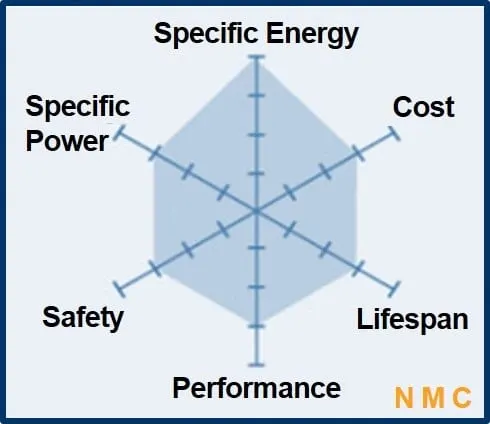
One of the most successful li-ion cathode formulas developed to date is obtained by combining nickel, manganese, and cobalt. Lithium-Nickel-Manganese-Cobalt-Oxide (LiNiMnCoO2), abbreviated as NMC, has become the go-to cathode powder to develop batteries for power tools, e-bikes and other electric powertrains. It delivers strong overall performance, excellent specific energy, and the lowest self-heating rate of all mainstream cathode powders, which makes it the preferred option for automotive batteries.
While NMC powder can refer to a variety of blends, the formula typically consists of 33% nickel, 33% manganese and 33% cobalt. This blend, sometimes referred to as 1-1-1, is a popular option for mass-produced cells in applications requiring frequent cycling (automotive, energy storage) due to the reduced material cost resulting from lower cobalt content.
NMC 333 Powder Specifications
| Product Code | SNMC
03001 |
|
| Material | NMC 333 | |
|
Physico-chemical properties |
D10/um | 4.2 |
| D50/um | 6.5 | |
| D90/um | 11 | |
| BET/m2/g | 0.48 | |
| TD/g/cm3 | 2.2 | |
| PH | 11.1 | |
| Li2CO3/% | 0.05 | |
| LiOH/% | 0.03 | |
|
Electro-chemical data 2.8-4.25V |
Capacity/ mAh.g-1 | 154.8 |
| Efficiency/% | 88.8 | |
| Rate capacity retention/% | 94.8 | |
| Cycle capacity retention @50 cycles/% | 98.3 | |
MC 532 Powder Specifications
| Product Code | SNMC
03002 |
SNMC
03010 |
SNMC
03009 |
|
| Material | NMC 532 | |||
|
Physico-chemical properties |
D10/um | 6.2 | 5 | 3.7 |
| D50/um | 11 | 10.1 | 6.4 | |
| D90/um | 20.7 | 18.2 | 10.7 | |
| BET/m2/g | 0.24 | 0.45 | 0.51 | |
| TD/g/cm3 | 2.63 | 2.25 | 1.78 | |
| PH | 11.56 | 11.5 | 11.15 | |
| Li2CO3/% | 0.08 | 0.13 | 0.08 | |
| LiOH/% | 0.09 | 0.10 | 0.02 | |
|
Electro-chemical data 2.8-4.25V |
Capacity/ mAh.g-1 | 166.9 | 166.1 | [email protected] |
| Efficiency/% | 89.3 | 88.1 | [email protected] | |
| Rate capacity retention/% | 93.4 | 94.9 | [email protected] | |
| Cycle capacity retention @50 cycles/% | 95.6 | 99.2 | [email protected] | |
NMC 622 Powder Specifications
| Product Code | SNMC
03006 |
|
| Material | NMC 622 | |
|
Physico-chemical properties |
D10/um | 7 |
| D50/um | 10 | |
| D90/um | 19 | |
| BET/m2/g | 0.28 | |
| TD/g/cm3 | 2.5 | |
| PH | 11.65 | |
| Li2CO3/% | 0.25 | |
| LiOH/% | 0.13 | |
|
Electro-chemical data 2.8-4.25V |
Capacity/ mAh.g-1 | 175.8 |
| Efficiency/% | 90.3 | |
| Rate capacity retention/% | 93.4 | |
| Cycle capacity retention @50 cycles/% | 98.1 | |
NMC 811 Powder Specifications
| Product Code | SNMC
03008 |
|
| Material | NMC 811 | |
|
Physico-chemical properties |
D10/um | 6.7 |
| D50/um | 13.8 | |
| D90/um | 25.1 | |
| BET/m2/g | 0.49 | |
| TD/g/cm3 | 2.31 | |
| PH | 12.13 | |
| Li2CO3/% | 0.64 | |
| LiOH/% | 0.43 | |
|
Electro-chemical data 2.8-4.25V |
Capacity/ mAh.g-1 | [email protected] |
| Efficiency/% | [email protected] | |
| Rate capacity retention/% | [email protected] | |
| Cycle capacity retention @50 cycles/% | [email protected] | |
ithium Iron Phosphate Batteries
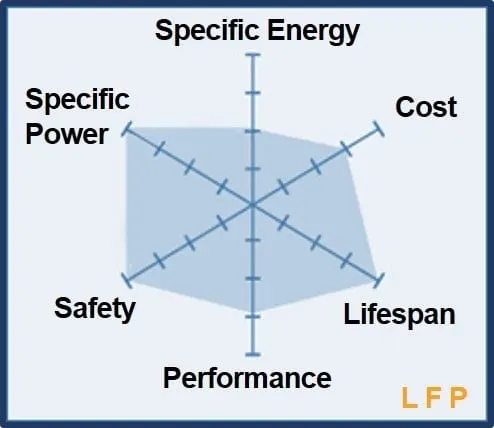
Lithium Iron phosphate (LFP) is a popular, cost-effective cathode material for lithium-ion cells that is known to deliver excellent safety and long life span, which makes it particularly well-suited for specialty battery applications requiring high load currents and endurance.
Discovered by University of Texas researchers in the mid-90s, LFP cathode offers several key advantages including a high current rating, long cycle life, and superior thermal stability, which makes it one of the safest and most abuse-tolerant cathode material options available to manufacturers. On the other hand, LFP delivers a lower nominal voltage, which results in lower specific energy when compared to other cathode materials on the market. Consequently, LFP batteries tend to have a higher self-discharge than other Li-ion battery types.
Targray LFP Cathode Features & Applications
| Product | Features and Applications |
| PLFP02113 |
Applications: High powered batteries; Batteries with low temperature requirements such as e-buses. |
| SLFP2002 |
Applications: High energy-density batteries; Batteries with significant temperature resistance requirements such as energy storage systems, power tools and electric vehicles. |
Targray LFP Cathode Product Specifications
| Items | Equipment/Method | Unit | SLFP02113 Specification |
SLFP02114 Specification |
SLFP02002 Specification |
| Surface Area | Mountech Macsorb – 1201 / BET | m²/g | 13±2 | 13±2 | 13±2 |
| Tapped Density | Quantachrome AT-2 | g/mL | 1.0±0.2 | 1.0±0.2 | 1.0±0.2 |
| Particle Size (D10) | MALVERN HYDRO 2000S | μm | <3.0 | <3.0 | <1.5 |
| Particle Size (D50) | 4.0±2.0 | 6.0±2.0 | 4.0±2.0 | ||
| Particle Size (D95) | <25 | <25 | <15 | ||
| Moisture | KEM MKC-520 ADP511S | ppm | <800 | <800 | <700 |
| Element Analysis | |||||
| Li | Perkin Elmer Optima 7200DV / ICP-OES | % | 4.2±0.5 | 4.2±0.5 | 4.2±0.5 |
| Fe | 35±1.5 | 35±1.5 | 35±1.5 | ||
| P | 20±1 | 20±1 | 20±1 | ||
| Carbon | 1.5±0.2 | N/A | N/A | ||
| Electrochemical | |||||
| 1st Charge @ C/10 | Arbin BT2000 | mAh/g | — | — | — |
| 1st Discharge @ C/10 | — | — | — | ||
| 2nd Charge @ C/10 | — | — | — | ||
| 2nd Discharge @ C/10 | 160±3 | 160±3 | N/A | ||
| Capaicty | Arbin BT2000 Discharge Capacity @ 25°C | N/A | N/A | 153±3 | |
| 1st Coulomb’s efficiency | Arbin BT2000 | % | >90 | >90 | >90 |
LNMO Cathode for Lithium-ion Battery Manufacturers
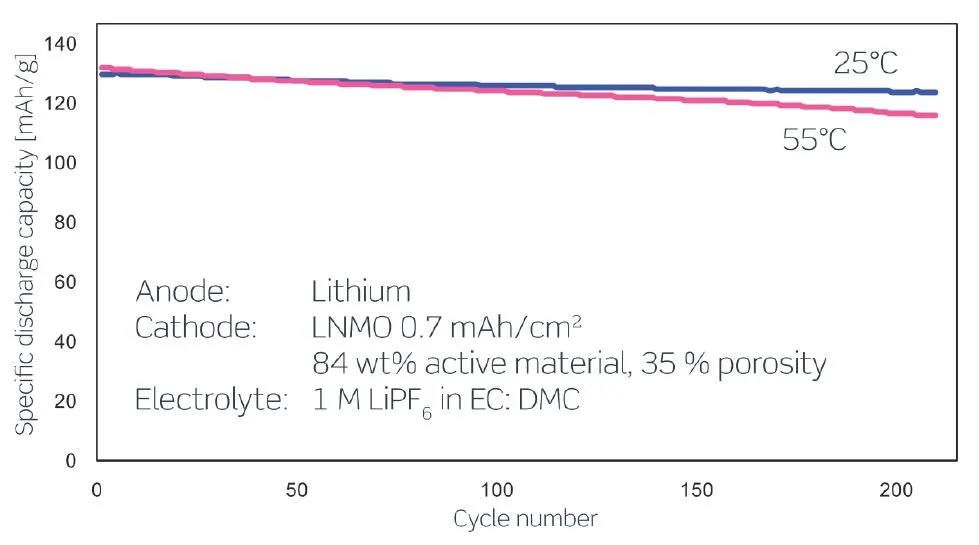
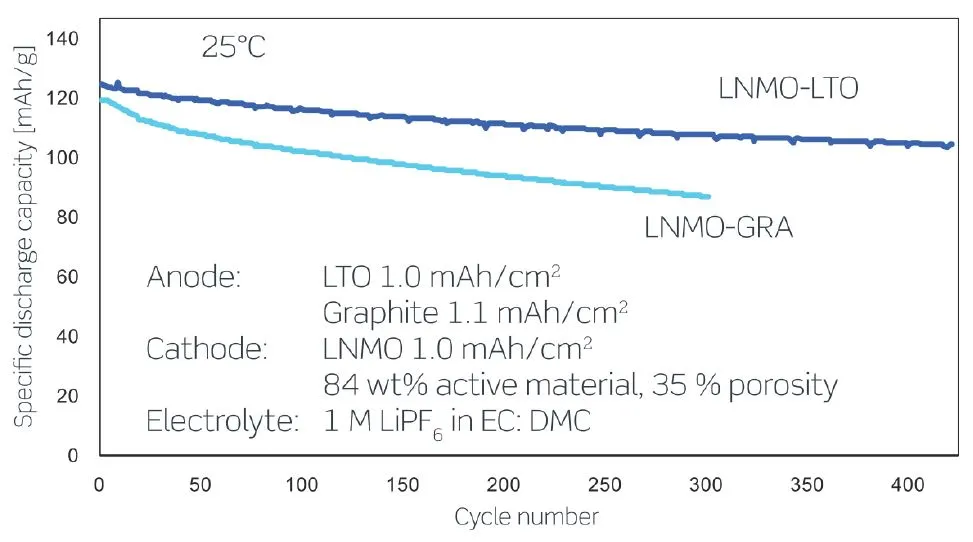
Our LNMO battery material is a high-performance cathode powder for next-generation lithium-ion cell manufacturers and energy storage technology developers. Cost-effective, cobalt-free and low in nickel content, LNMO cathode material offers exceptional energy density and a high voltage plateau due to its three-dimensional spinel structure and electrochemistry.
To view a summary of our LNMO cathode powder’s performance characteristics, consult the table below. For an in-depth review of product specifications, or to inquire about purchasing LNMO battery material for your research lab or lithium-ion cell manufacturing facility, contact the battery division.
LNMO Battery Material Specifications
| Phase purity | Above 96 % | |
| Surface area | Less than 0.5 m²/g | |
| Tap density | Above 2.3 g/cm³ | |
| Spherical particles Narrow particle size distribution | ||
| High capacity | 130 mAh/g at 1C, 3.5 V – 5.0 V 115 mAh/g at 1C, 4.4 V – 5.0 V |
|
| High power | Q10C/Q0.5C above 60% | |
| Low fade rate | Below 0.1% per cycle at 55 °C |
Half Cell
Full Cell
Lithium Cobalt Oxide(LiCoO2) — LCO
Its high specific energy makes Li-cobalt the popular choice for mobile phones, laptops and digital cameras. The battery consists of a cobalt oxide cathode and a graphite carbon anode. The cathode has a layered structure and during discharge, lithium ions move from the anode to the cathode. The flow reverses on charge. The drawback of Li-cobalt is a relatively short life span, low thermal stability and limited load capabilities (specific power). Figure 1 illustrates the structure.
The cathode has a layered structure. During discharge the lithium ions move from the anode to the cathode; on charge the flow is from cathode to anode. Source: Cadex
The drawback of Li-cobalt is a relatively short life span, low thermal stability and limited load capabilities (specific power). Like other cobalt-blended Li-ion, Li-cobalt has a graphite anode that limits the cycle life by a changing solid electrolyte interface (SEI), thickening on the anode and lithium plating while fast charging and charging at low temperature. Newer systems include nickel, manganese and/or aluminum to improve longevity, loading capabilities and cost.
Li-cobalt should not be charged and discharged at a current higher than its C-rating. This means that an 18650 cell with 2,400mAh can only be charged and discharged at 2,400mA. Forcing a fast charge or applying a load higher than 2,400mA causes overheating and undue stress. For optimal fast charge, the manufacturer recommends a C-rate of 0.8C or about 2,000mA. (See BU-402: What is C-rate). The mandatory battery protection circuit limits the charge and discharge rate to a safe level of about 1C for the Energy Cell.
The hexagonal spider graphic (Figure 2) summarizes the performance of Li-cobalt in terms of specific energy or capacity that relates to runtime; specific power or the ability to deliver high current; safety; performance at hot and cold temperatures; life span reflecting cycle life and longevity; and cost. Other characteristics of interest not shown in the spider webs are toxicity, fast-charge capabilities, self-discharge and shelf life. (See BU-104c: The Octagon Battery – What makes a Battery a Battery).
The Li-cobalt is losing favor to Li-manganese, but especially NMC and NCA because of the high cost of cobalt and improved performance by blending with other active cathode materials. (See description of the NMC and NCA below.)
Li-cobalt excels on high specific energy but offers only moderate performance specific power, safety and life span. Source: Cadex
Summary Table
| Lithium Cobalt Oxide: LiCoO2 cathode (~60% Co), graphite anode Short form: LCO or Li-cobalt. Since 1991 |
|
| Voltages | 3.60V nominal; typical operating range 3.0–4.2V/cell |
| Specific energy (capacity) | 150–200Wh/kg. Specialty cells provide up to 240Wh/kg. |
| Charge (C-rate) | 0.7–1C, charges to 4.20V (most cells); 3h charge typical. Charge current above 1C shortens battery life. |
| Discharge (C-rate) | 1C; 2.50V cut off. Discharge current above 1C shortens battery life. |
| Cycle life | 500–1000, related to depth of discharge, load, temperature |
| Thermal runaway | 150°C (302°F). Full charge promotes thermal runaway |
| Applications | Mobile phones, tablets, laptops, cameras |
| Comments 2019 Update: |
Very high specific energy, limited specific power. Cobalt is expensive. Serves as Energy Cell. Market share has stabilized. Early version; no longer relevant. |
Table 3: Characteristics of Lithium Cobalt Oxide.
Lithium Manganese Oxide (LiMn2O4) — LMO
Li-ion with manganese spinel was first published in the Materials Research Bulletin in 1983. In 1996, Moli Energy commercialized a Li-ion cell with lithium manganese oxide as cathode material. The architecture forms a three-dimensional spinel structure that improves ion flow on the electrode, which results in lower internal resistance and improved current handling. A further advantage of spinel is high thermal stability and enhanced safety, but the cycle and calendar life are limited.
Low internal cell resistance enables fast charging and high-current discharging. In an 18650 package, Li-manganese can be discharged at currents of 20–30A with moderate heat buildup. It is also possible to apply one-second load pulses of up to 50A. A continuous high load at this current would cause heat buildup and the cell temperature cannot exceed 80°C (176°F). Li-manganese is used for power tools, medical instruments, as well as hybrid and electric vehicles.
Figure 4 illustrates the formation of a three-dimensional crystalline framework on the cathode of a Li-manganese battery. This spinel structure, which is usually composed of diamond shapes connected into a lattice, appears after initial formation.
The cathode crystalline formation of lithium manganese oxide has a three-dimensional framework structure that appears after initial formation. Spinel provides low resistance but has a more moderate specific energy than cobalt. Source: Cadex
Li-manganese has a capacity that is roughly one-third lower than Li-cobalt. Design flexibility allows engineers to maximize the battery for either optimal longevity (life span), maximum load current (specific power) or high capacity (specific energy). For example, the long-life version in the 18650 cell has a moderate capacity of only 1,100mAh; the high-capacity version is 1,500mAh.
Figure 5 shows the spider web of a typical Li-manganese battery. The characteristics appear marginal but newer designs have improved in terms of specific power, safety and life span. Pure Li-manganese batteries are no longer common today; they may only be used for special applications.
Although moderate in overall performance, newer designs of Li-manganese offer improvements in specific power, safety and life span. Source: Boston Consulting Group
Most Li-manganese batteries blend with lithium nickel manganese cobalt oxide (NMC) to improve the specific energy and prolong the life span. This combination brings out the best in each system, and the LMO (NMC) is chosen for most electric vehicles, such as the Nissan Leaf, Chevy Volt and BMW i3. The LMO part of the battery, which can be about 30 percent, provides high current boost on acceleration; the NMC part gives the long driving range.
Li-ion research gravitates heavily towards combining Li-manganese with cobalt, nickel, manganese and/or aluminum as active cathode material. In some architecture, a small amount of silicon is added to the anode. This provides a 25 percent capacity boost; however, the gain is commonly connected with a shorter cycle life as silicon grows and shrinks with charge and discharge, causing mechanical stress.
These three active metals, as well as the silicon enhancement can conveniently be chosen to enhance the specific energy (capacity), specific power (load capability) or longevity. While consumer batteries go for high capacity, industrial applications require battery systems that have good loading capabilities, deliver a long life and provide safe and dependable service.
Summary Table
| Lithium Manganese Oxide: LiMn2O4 cathode. graphite anode Short form: LMO or Li-manganese (spinel structure) Since 1996 |
|
| Voltages | 3.70V (3.80V) nominal; typical operating range 3.0–4.2V/cell |
| Specific energy (capacity) | 100–150Wh/kg |
| Charge (C-rate) | 0.7–1C typical, 3C maximum, charges to 4.20V (most cells) |
| Discharge (C-rate) | 1C; 10C possible with some cells, 30C pulse (5s), 2.50V cut-off |
| Cycle life | 300–700 (related to depth of discharge, temperature) |
| Thermal runaway | 250°C (482°F) typical. High charge promotes thermal runaway |
| Applications | Power tools, medical devices, electric powertrains |
| Comments 2019 Update: |
High power but less capacity; safer than Li-cobalt; commonly mixed with NMC to improve performance. Less relevant now; limited growth potential. |
Table 6: Characteristics of Lithium Manganese Oxide
Lithium Nickel Cobalt Aluminum Oxide (LiNiCoAlO2) — NCA
Lithium nickel cobalt aluminum oxide battery, or NCA, has been around since 1999 for special applications. It shares similarities with NMC by offering high specific energy, reasonably good specific power and a long life span. Less flattering are safety and cost. Figure 11 summarizes the six key characteristics. NCA is a further development of lithium nickel oxide; adding aluminum gives the chemistry greater stability.
High energy and power densities, as well as good life span, make NCA a candidate for EV powertrains. High cost and marginal safety are negatives. Source: Cadex
Summary Table
| Lithium Nickel Cobalt Aluminum Oxide: LiNiCoAlO2 cathode (~9% Co), graphite anode Short form: NCA or Li-aluminum. Since 1999 |
|
| Voltages | 3.60V nominal; typical operating range 3.0–4.2V/cell |
| Specific energy (capacity) | 200-260Wh/kg; 300Wh/kg predictable |
| Charge (C-rate) | 0.7C, charges to 4.20V (most cells), 3h charge typical, fast charge possible with some cells |
| Discharge (C-rate) | 1C typical; 3.00V cut-off; high discharge rate shortens battery life |
| Cycle life | 500 (related to depth of discharge, temperature) |
| Thermal runaway | 150°C (302°F) typical, High charge promotes thermal runaway |
| Cost | ~$350 per kWh[1] |
| Applications | Medical devices, industrial, electric powertrain (Tesla) |
| Comments 2019 Update: |
Shares similarities with Li-cobalt. Serves as Energy Cell. Mainly used by Panasonic and Tesla; growth potential. |
Table 12: Characteristics of Lithium Nickel Cobalt Aluminum Oxide
Lithium Titanate (Li2TiO3) — LTO
Batteries with lithium titanate anodes have been known since the 1980s. Li-titanate replaces the graphite in the anode of a typical lithium-ion battery and the material forms into a spinel structure. The cathode can be lithium manganese oxide or NMC. Li-titanate has a nominal cell voltage of 2.40V, can be fast charged and delivers a high discharge current of 10C, or 10 times the rated capacity. The cycle count is said to be higher than that of a regular Li-ion. Li-titanate is safe, has excellent low-temperature discharge characteristics and obtains a capacity of 80 percent at –30°C (–22°F).
LTO (commonly Li4Ti5O12) has advantages over the conventional cobalt-blended Li-ion with graphite anode by attaining zero-strain property, no SEI film formation and no lithium plating when fast charging and charging at low temperature. Thermal stability under high temperature is also better than other Li-ion systems; however, the battery is expensive. At only 65Wh/kg, the specific energy is low, rivalling that of NiCd. Li-titanate charges to 2.80V/cell, and the end of discharge is 1.80V/cell. Figure 13 illustrates the characteristics of the Li-titanate battery. Typical uses are electric powertrains, UPS and solar-powered street lighting.
Li-titanate excels in safety, low-temperature performance and life span. Efforts are being made to improve the specific energy and lower cost. Source: Boston Consulting Group
Summary Table
| Lithium Titanate: Cathode can be lithium manganese oxide or NMC; Li2TiO3 (titanate) anode Short form: LTO or Li-titanate Commercially available since about 2008. |
|
| Voltages | 2.40V nominal; typical operating range 1.8–2.85V/cell |
| Specific energy (capacity) | 50–80Wh/kg |
| Charge (C-rate) | 1C typical; 5C maximum, charges to 2.85V |
| Discharge (C-rate) | 10C possible, 30C 5s pulse; 1.80V cut-off on LCO/LTO |
| Cycle life | 3,000–7,000 |
| Thermal runaway | One of safest Li-ion batteries |
| Cost | ~$1,005 per kWh[1] |
| Applications | UPS, electric powertrain (Mitsubishi i-MiEV, Honda Fit EV), solar-powered street lighting |
| Comments 2019 Update: |
Long life, fast charge, wide temperature range but low specific energy and expensive. Among safest Li-ion batteries. Ability to ultra-fast charge; high cost limits to special application. |
Table 14: Characteristics of Lithium Nickel Cobalt Aluminum Oxide
2.Compare the differences between each type of Li+ion batteries based on their characteristics
Lithium-ion batteries are used in most aspects of our everyday lives. Most devices like smartphones and laptops cannot operate without these batteries. Lithium-ion batteries have also become very important in the field of electromobility as it is now the battery of choice in most electric vehicles. Its high specific energy gives it an advantage over other batteries.
There are different types of lithium-ion batteries and the main difference between them lies in their cathode materials. Different kinds of lithium-ion batteries offer different features, with trade-offs between specific power, specific energy, safety, lifespan, cost, and performance.
The six lithium-ion battery types that we will be comparing are Lithium Cobalt Oxide, Lithium Manganese Oxide, Lithium Nickel Manganese Cobalt Oxide, Lithium Iron Phosphate, Lithium Nickel Cobalt Aluminum Oxide, and Lithium Titanate. Firstly, an understanding of the key terms below will allow for a simpler and easier comparison.
Specific energy: This defines the battery capacity in weight (Wh/kg). The capacity relates to the runtime. Products requiring long runtimes at moderate load are optimized for high specific energy.
Specific power: It's the ability to deliver a high current and indicates loading capability. Batteries for power tools are made for high specific power and come with a reduced specific energy.
A high specific power usually comes with reduced specific energy and vice versa. The pouring of bottled water in a glass is a perfect analogy of the relationship between specific power and specific energy. The water in the bottle can be thought of as specific energy. Pouring the water at a slow rate doesn’t provide enough force (low specific power) but the water lasts longer in the bottle (high specific energy). On the other hand, if we pour the water out at a faster rate it provides a greater impact (high specific power). However, the water wouldn’t last very long in the bottle ( low specific energy).
Performance: This measures how well the battery works over a wide range of temperatures. Most batteries are sensitive to heat and cold and require climate control. Heat reduces life, and cold lowers performance temporarily.
Lifespan: This reflects cycle life and longevity and is related to factors such as temperature, depth of discharge, and load. Hot climates accelerate capacity loss. Cobalt blended lithium-ion batteries also usually have a graphite anode that limits the cycle life.
Safety: This relates to factors such as the thermal stability of the materials used in the batteries. The materials should have the ability to sustain high temperatures before becoming unstable. Instability can lead to thermal runaway in which flaming gases are vented. Fully charging the battery and keeping it beyond the designated age reduces safety.
Cost: Demand for electric vehicles has generally been lower than anticipated and this is mainly due to the cost of lithium-ion batteries. Hence cost is a huge factor when selecting the type of lithium-ion battery.
The 10 Most Dangerous Chemicals Known to Man
Now that we have an understanding of the major battery characteristics, we will use them as the basis for the comparison of our six types of lithium-ion batteries. The characteristics are rated as either high, moderate, or low. The table below provides a simple comparison of the six lithium-ion battery types.
It is important to note that the six types of lithium-ion batteries are compared relative to one another.
| Lithium-ion battery Types | SP | SE | SF | LS | CS | PF |
|---|---|---|---|---|---|---|
|
Lithium Cobalt Oxide |
L |
H |
L |
L |
L |
M |
|
Lithium Manganese Oxide |
M |
M |
M |
L |
L |
L |
|
Lithium Nickel Manganese Cobalt Oxide |
M |
H |
M |
M |
L |
M |
|
Lithium Iron Phosphate |
H |
L |
H |
H |
L |
M |
|
Lithium Nickel Cobalt Aluminum Oxide |
M |
H |
L |
M |
M |
M |
|
Lithium Titanate |
M |
L |
H |
H |
H |
H |
- SP stands for specific power
- SE stands for specific energy
- SF stands for safety
- LS stands for lifespan
- CS stands for cost
- PF stands for performance
- L stands for low
- M stands for moderate
- H stands for high
Summary of the Table
Lithium Cobalt Oxide has high specific energy as compared to the other batteries which make it the preferred choice for laptops and mobile phones. It also has a low cost and a moderate performance. However, it is highly unfavorable in all the other aspects when compared to the other lithium-ion batteries. It has low specific power, low safety, and a low lifespan.
Lithium Manganese Oxide has moderate specific power, moderate specific energy, and a moderate level of safety when compared to the other types of lithium-ion batteries. It has the added advantage of a low cost. The downsides are its low performance and low lifespan. It is usually used in medical devices and power tools.
Lithium Nickel Manganese Cobalt Oxide has two major advantages as compared to the other batteries. The first one is its high specific energy which makes it desirable in electric powertrains, electric vehicles, and electric bikes. The other is its low cost. It is moderate in terms of specific power, safety, lifespan, and performance when compared to the other lithium-ion batteries. It can be optimized to either have high specific power or high specific energy.
Lithium Iron Phosphate only has one major disadvantage when compared to other types of lithium-ion batteries and that is its low specific energy. Other than that, it has moderate to high ratings in all the other characteristics. It has high specific power, offers a high level of safety, has a high lifespan, and comes at a low cost. The performance of this battery is also moderate. It is often employed in electric motorcycles and other applications that require a long lifespan and a high level of safety.
Lithium Nickel Cobalt Aluminum Oxide offers one strong advantage as compared to the five other batteries and that is high specific energy. It is pretty moderate in the rest of the characteristics like performance, cost, specific power, and lifespan. The only downside to this battery type is its low level of safety. Its high specific energy and moderate lifespan make it a good candidate for electric powertrains.
Lithium Titanate offers high safety, high performance, and a high lifespan which are very important features every battery should have. Its specific energy is low compared to the five other lithium-ion batteries but it compensates for this with moderate specific power. The only major disadvantage of lithium titanate as compared to the other lithium-ion batteries is its extremely high cost. Another important feature of this battery worthy of mention is its remarkably fast recharge time. It can be used for storing solar energy and creating smart grids.
Much work is still being done on lithium ion batteries in various laboratories. Lithium vanadium phosphate (LVP) battery is a proposed type of lithium-ion battery that uses a vanadium phosphate in the cathode. It has already made its way into the Subaru prototype G4e, doubling energy density.