Week 1 Understanding Different Battery Chemistry
AIM:
Understanding Different Battery Chemistry
Objective:
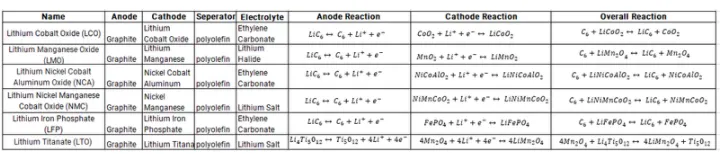
1.Prepare a table which includes materials & chemical reactions occurring at the anode and cathode of LCO, LMO, NCA, NMC, LFP and LTO type of lithium ion cells.Give your detailed explanation on it.
2.Compare the differences between each type of Li+ion batteries based on their characteristics.
Cathode Active Materials
Li-ion battery materials including NCA, NMC, LFP, LMO & LCO Cathodes
Delivering Next-Generation Energy Efficiency
We create innovative supply chain solutions for suppliers and distributors of energy storage systems (ESS) in the residential, commercial and utilities segments.
Our energy storage supply chain programs feature innovative warehousing and inventory management services designed to help energy storage industry participants broaden their market reach and gain a competitive advantage through improved cash flow and working capital optimization.
introducion :
lithium -ion their most common from ,consist of graphite anode ,a lithium metal oxide cathode ,and an electrolyte of a lithium salt and organic solvent. lithium is a good choice for an electrochemical cell due to its standard electrode potential
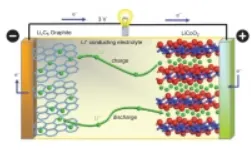
Fig2
Internal construction of a typical cylindrical cell (1)
fig3
internal construction of a typical pouch cell 1
fig 4
CAD of disassembled battery module ,assembled module and whole battery package 1
Many countries have now put in place binding carbon dioxide emissions targets for cars, for example in Europe the requirements are for fleet average CO2 emissions of 130 g km–1 by 2015 and 95 g km–1 by 2021 (3). It will be shown in Section 2 of this paper that by using a (lithium-ion) battery it is possible to significantly reduce a car's CO2 emissions. More lithium-ion batteries are now being used in automotive applications for this reason.
2. Automotive Applications for Lithium-ion Batteries
There are a range of applications for batteries in passenger cars (4). The ones that will be considered here were selected either because they already use lithium-ion batteries or because they could potentially do so in the future. Note that there are a number of standard automotive requirements that all lithium-ion batteries used in cars need to meet: these include life (8–15 years are typical requirements), temperature range (–40°C to at least +60°C, ideally 80°C) and vibration resistance (at least 4.5 root-mean-square-acceleration (grms)) (5). Each application will now be briefly described
The structure of this paper is as follows. In section2 a number of automotive passenger car applications for lithium-ion batteries are presented and their key requirements listed. section3 will give a brief overview of the capabilities of a number of lithium-ion chemistries currently in use for automotive applications and section4 will compare the requirements (from section2) with the capabilities listed in section 2,5 will look at future developments, while section6 will offer some conclusions.
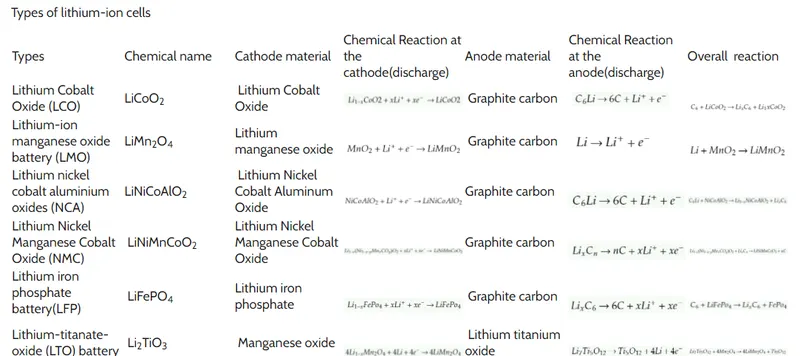
1.Lithium cobalt oxide (LCO) battery
2.Lithium -ion manganese oxide (LMO)battry
3.Lithium nickel cobalt aluminium oxides (NAC) battery
4.Lithium nickel manganese cobalt oxide (NMC ) battery
5.Lithium iron phosphate battery (LFP) batteries
6.Lithium -titanate -oxide (LTO) battery.
2.Compare the differences between each type of Li+ion batteries based on their characteristics
ANS:
CONCLUSIONS:
future of lithium cells
1-overall most analysts agree there will be a more balanced market for lithium in 2021.''we expect the to be largely balanced in 2021''; leary of CRU said ,with mine supply to largely track demand growth.