Week 1 Understanding Different Battery Chemistry
Objective: Create a Table on various types of Lithium Ion based Battery and their materials used at anode and cathode, also the chemical reactions at the same.
Introduction to Lithium Ion type of Batteries:
Lithium ion Batteries are the ones which are categorized under secondary type of Batteries, where in it can be discharged and charged several times.
Construction of a Lithium Based Battery:
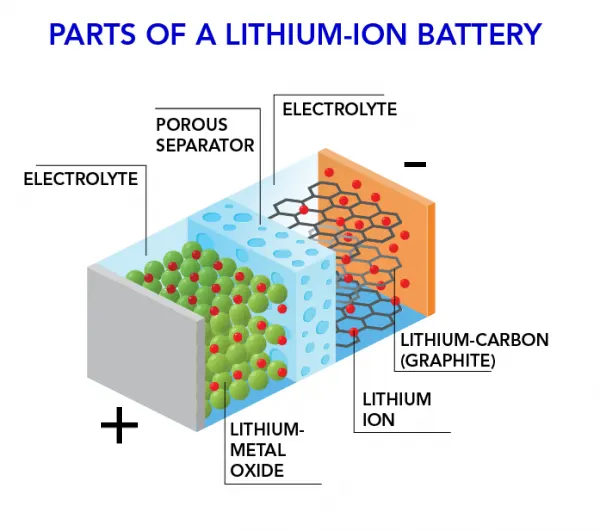
- Anode, Cathode, Electrolyte and seperator are the main elements of a rechargable Lithium ion Battery.
- The two electrodes are immersed in the electrolyte and are seperated by the seperator.
- Usually the anode is made up of graphite(carbon)
- Since Lithium is an unstable element in the periodic table, it can't be directly used as a cathode material. It is often mixed with the materials as discussed in the table shown.
- The seperator is a physical barrier which keeps Positive and negative electrodes seperately.
Working Principle of a Lithium based Battery:
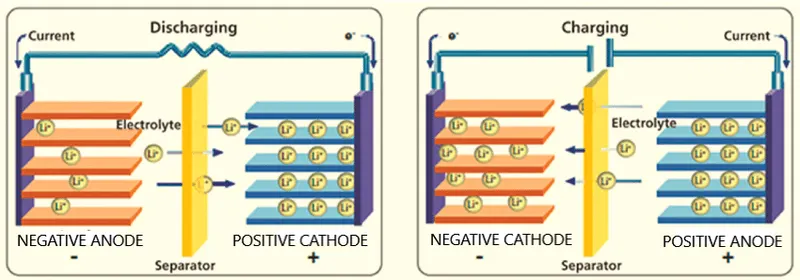
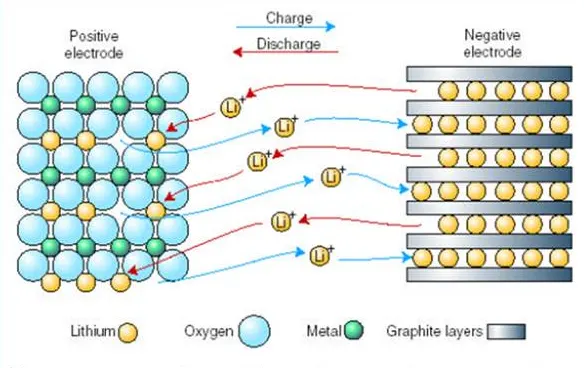
- In these type of Batteries, Lithium ions moves from negative towards the positive electrode through an Electrolyte during the discharge process and it moves from positive towards the negative electrode during charging process.
- The type of cathode material used determines the various parameters of a Battery like Nominal Voltage, Energy Density, Power Density etc.,
- Charging Process: Negative Electrode accepts electrons and gets reduced.
- Discharging Process: (opposite of charge process) Negative electrode gives up electrons and gets oxidized.
- Due to the chemical reactions shown in the table, the Electricity is produced.
DIFFERENT TYPES OF LITHIUM ION BATTERY AND THE PARTICULARS:
| CELL TYPE/PARTICULARS | LCO (Lithium Cobalt Oxide) | LMO (Lithium Manganese Oxide) | NCA (Nickle Cobalt Aluminium) | NMC (Nickle Manganese Cobalt) | LFP (Lithium Iron Phosphate) | LTO (Lithium Titinate Oxide) |
| Anode Material | LiC6 | LiC6 | LiC6 | LiC6 | LiC6 | Li4+Ti5O12 |
| Cathode Material | LiCoO2 | LiMn2O4 | LiNi0.8Co0.15Al0.05.O2 | LiNi1-x-yCoxMnyO2 | LiFePO4 | LiMn2O4 |
| Chemical Reaction at Anode | LixC6 -> xLi+xe-+C6 | LixC6 -> xLi+xe-+C6 | LixC6 -> xLi+xe-+C6 | LixC6 -> xLi+xe-+C6 | LixC6 -> xLi+xe-+C6 | Li4+Ti5O12 -> Ti4O12+4Li+ 4e- |
| Chemical Reaction at Cathode |
Li(1-x)CoO2+xLi+xe- -> LiCoO2 |
Li(1-x)Mn2O4+xLi+xe- -> LiMn2O4 |
Li(1-x)NiCoAlO2+xLi+xe- -> LiNiCoAlO2 |
Li(1-x)Ni(0.8)Mn(0.1)Co(0.1)O2+xLi+xe- -> LiNi(0.8)Mn(0.1)Co(0.1)O2 |
Li(1-x)FePO4+xLi+xe- ->LiFePO4 |
4Li(1-x)Mn2O4+4Li+4e- -> 4LiMn2O4 |
| Nominal Voltage |
3.6V |
3.7V |
3.7V |
3.7V |
3.2V |
2.4V |
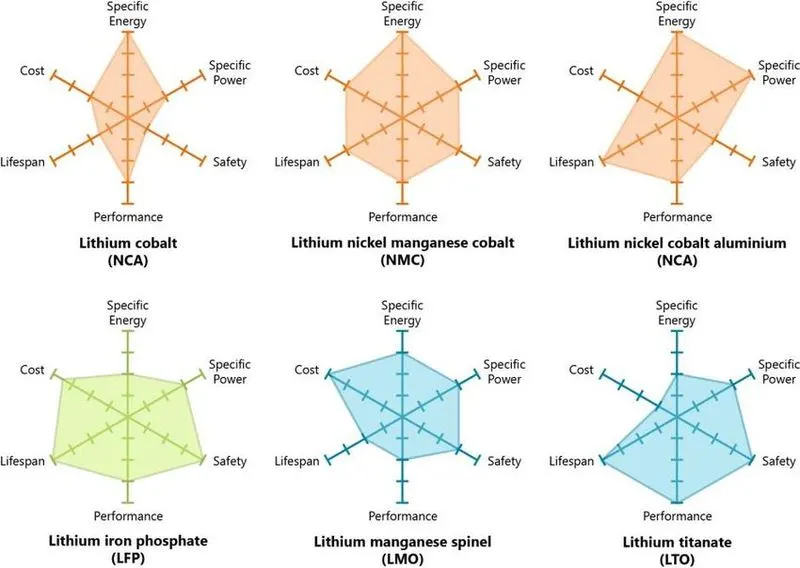
The above comparision image shows various Battery cells and their characteristics. The parameters considered for the comparision are
- Energy Density (Wh/kg-Gravimetric))
- Power Desnsity W/kg)
- Life span ("N" Number of charge/discharge cycles)
- Safety (behaviour under working/non working conditions)
- Performance (Measured under various Environmental conditions)
- Cost ($/kWh)
As it can be observed from the above comparision in the image:
- LCO type has Higher Energy Desnsity (Higher it is, higher will be the range of the vehicle) but, has limitations in safety and lifespan.
- NCA has good in lifespan, Energy and Power density, but the cost and safety are of concern.
- LFP is the most suitable among all the other cells but the only limitation is, it has marginally less Energy density compared to others.
- LMO is has the marginally good balance between all parameters but lifepsan and perormance are of concern.
- LTO has the best lifespan, best safety and performance but, it has the least Energy density and the costliest.
- NMC type of Battery also has limitations but has the near perfect balance between all the parameters. So it is the widely used type of Lithium ion Battery in EV industry.