Week 1 Understanding Different Battery Chemistry
PROBLEM:
Prepare a table which includes materials & chemical reactions occurring at the anode and cathode of LCO, LMO, NCA, NMC, LFP and LTO type of lithium ion cells.Give your detailed explanation on it
SOLUTION:
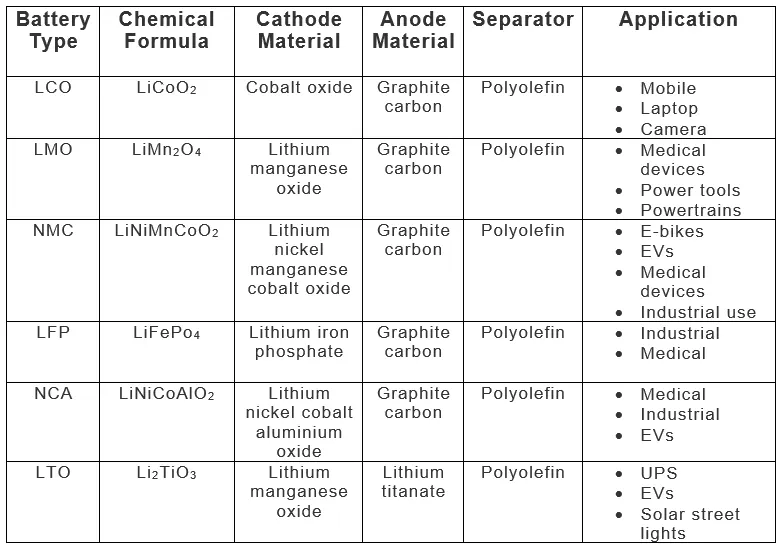
Discussing about different Lithium batteries in details,
1. Lithium Cobalt Oxide (LCO)
- Its high specific energy makes Li-cobalt the popular choice for mobile phones, laptops, and digital cameras.
- The battery consists of a cobalt oxide cathode and a graphite carbon anode.
- The drawback of Li-cobalt is a relatively short life span, low thermal stability, and limited load capabilities (specific power)
CHEMICAL REACTION:
At Anode:
LiC6 → xLi++xe−+ C6
At Cathode:
Li1−xCoO2 + xLi+ + xe- → LiCoO2
Overall Reaction:
C6+LiCoO2↔LixC6+Li1−xCoO2
2. Lithium Manganese Oxide (LMO)
- The architecture forms a three-dimensional spinel structure that improves ion flow on the electrode, which results in lower internal resistance and improved current handling.
- Another added advantage of spinel is high thermal stability and enhanced safety,
- The cycle and calendar life is limited for LMO batteries.
CHEMICAL REACTION:
At Anode:
Li → Li+ + e−
At Cathode:
Mn2O4 + Li+ + e− → LiMn2O4
Overall reaction:
Li + MnO2 → LiMnO2
3. Lithium Nickel Manganese Cobalt Oxide (NMC)
- Similar to Li-manganese, these systems can be tailored to serve as Energy Cells or Power Cells.
- A silicon-based anode will go to 4,000mAh and higher but at reduced loading capability and shorter cycle life.
- Silicon added to graphite has the drawback that the anode grows and shrinks with charge and discharge, making the cell mechanically unstable.
CHEMICAL REACTION:
At Anode:
LixCn → nC + xLi+ + xe−
At Cathode:
Li1−xMO2 + xLi+ + xe− → LiMO2
Redox Reaction:
Li1−xMO2 + LixCn → LiMO2 + nC
4. Lithium Iron Phosphate (LFP)
- Li-phosphate offers good electrochemical performance with low resistance.
- This is made possible with nano-scale phosphate cathode material.
- The key benefits are high current rating and long cycle life.
- Besides hold good thermal stability, enhanced safety.
CHEMICAL REACTION:
At Anode:
LiC6 → Li+ + e− + C6
At Cathode:
LiFe(III)PO4 + xLi+ + xe− → LiFe(II)PO4FePO4 + Li+ + e− → LiFePO4
Overall Reaction:
LiFePO4 + 6C → LiC6 + FePO4
5. Lithium Nickel Cobalt Aluminium Oxide (NCA)
- NCA shares similarities with NMC by offering high specific energy, reasonably good specific power, and a long life span.
- Less flattering are safety and cost.
- NCA is a further development of lithium nickel oxide.
- Adding aluminum gives the chemistry greater stability.
CHEMICAL REACTION:
At anode:
C6Li → 6C + Li+ + e-
At cathode:
NiCoAlO2 + Li+ + e- → LiNiCoAlO2
Overall reaction:
C6Li + NiCoAlO2 → Li1-xNiCoAlO2 + LixC6
6. Lithium Titanium Oxide (LTO)
- Li-titanate replaces the graphite in the anode of a typical lithium-ion battery and the material forms into a spinel structure.
- The cathode can be lithium manganese oxide or NMC.
- Li-titanate has a nominal cell voltage of 2.40V, can be fast charged, and delivers a high discharge current of 10C, or 10 times the rated capacity.
- The cycle count is said to be higher than that of a regular Li-ion.
- Li-titanate is safe, has excellent low-temperature discharge characteristics, and obtains a efficiency of 80 percent at –30°C (–22°F).
CHEMICAL REACTION:
At anode:
Li7Ti5O12 → Ti15O12 + 4Li + 4e-
At cathode:
4Li1-xMn2O4 + 4Li + 4e- → 4LiMn2O4
Overall reaction:
Li7Ti5O12 + 4Mn2O4 → 4LiMn2O4 + Ti5O12
PROBLEM:
Compare the differences between each type of Li+ion batteries based on their characteristics
SOLUTION:
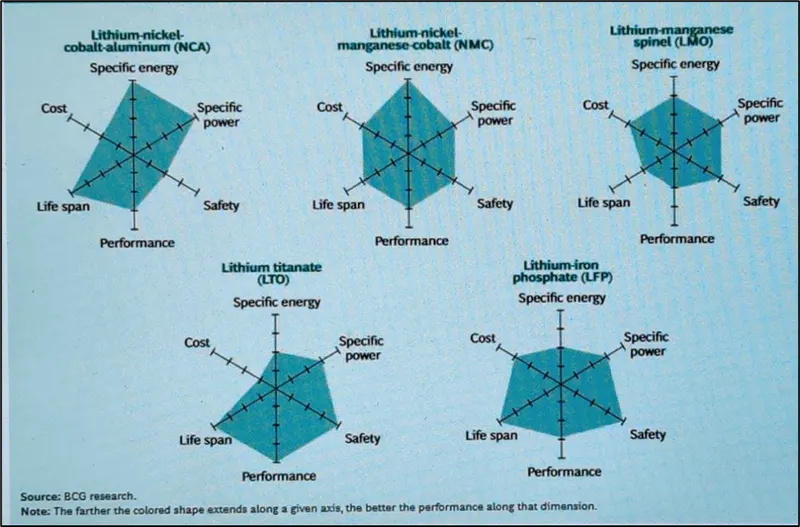
COMPARISON-1:
- Based on 0-4, 0 being low and 4 being highest. (ie. Safety -1 : Less safe, Lifespan-4: Highly durable)
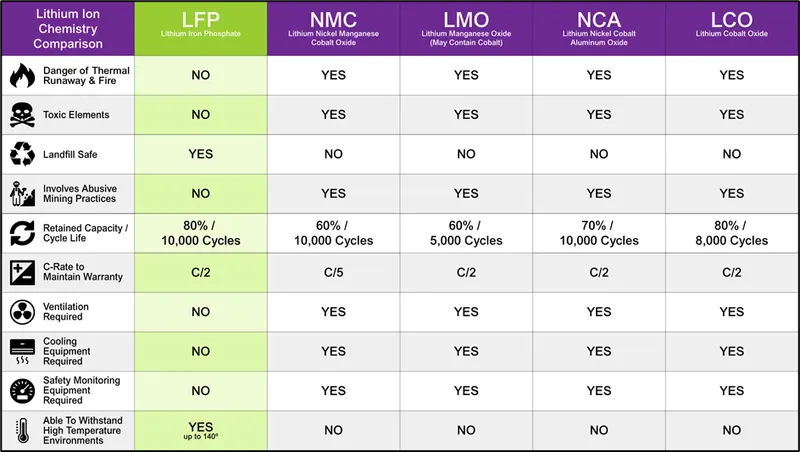
COMPARISON-2:
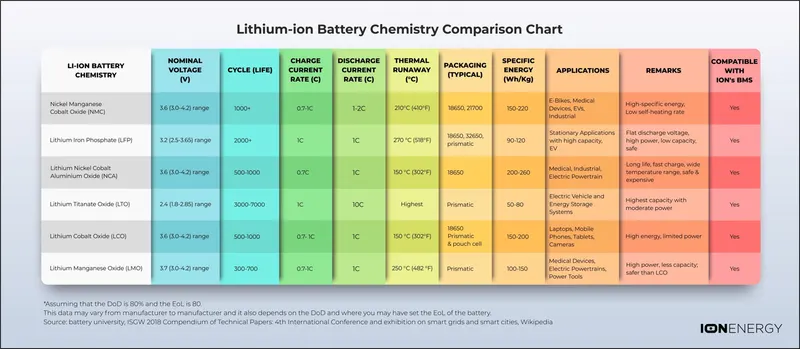
COMPARISON-3:
LEARNING OUTCOME
- We have learned about different types of lithium-ion batteries and the reactions happening in them.
- Li-ion is going to be widely used in future technologies due to its wide range of applications.