Week 1 Understanding Different Battery Chemistry
| Chemistry | Lithium iron phosphate | Lithium nickel manganese cobalt oxide | Lithium cobalt oxide | Lithium manganese oxide | Lithium–titanate | Lithium nickel cobalt aluminium oxides |
| General Name | LFP | NMC | LCO | LMO | LTO | NCA |
| Anode(-ve) | Graphite | Graphite | Graphite | Graphite | Lithium Titanite | Graphite |
| Cathode(+ve) | Lithium iron phosphate | Lithium nickel manganese cobalt oxide | Lithium cobalt oxide | Lithium manganese oxide | Lithium manganese oxide or Lithium nickel manganese cobalt oxide | Lithium nickel cobalt aluminium oxide |
| Rechargable | Yes | Yes | Yes | Yes | Yes | Yes |
| Commercialised year | 1996 | 2008 | 1991 | 1999 | 2008 | 1999 |
| Cutoff Voltage | 2 | 2.5 | 2.5 | 2.5 | 1.6–1.8 | 3 |
| Nominal Voltage | 3.2 | 3.6 | 3.7 | 3.9 | 2.3–2.4 | 3.6 |
| 100 % SOC voltage | 3.65 | 4.2 | 4.2 | 4.2 | 2.8 | 4.3 |
| Energy density (WH/KG) | 80-150 | 150-220 | 160-210 | 100-130 | 50-80 | 150-300 |
| Energy density (WH/L) | 300 | 580-750 | 340-580 | 220-430 | 157 | 680-760 |
| Specic power (W/kg) | 200–1,200 | 3,000–5,100 | ||||
| Charging Rate | 1C | 0.7 -1C | 0.7 -1C | 0.7 -1C | 1C | 0.7C |
| Discharge Rate | 1C | 1C,2C | 1C | 1C | 10C | 1C |
| Cycles | 2000-4000 | 1000-2000 | 500-1000 | 300-700 | 3000-7000 | 500 |
| Cost($/KWH) | 580 | 420 | 520 | 480 | 1005 | 350 |
| Thremal Runaway(°C) | 270 | 250 | 150 | 250 | No thermal Runaway | 150 |
Lithium cobalt oxide:
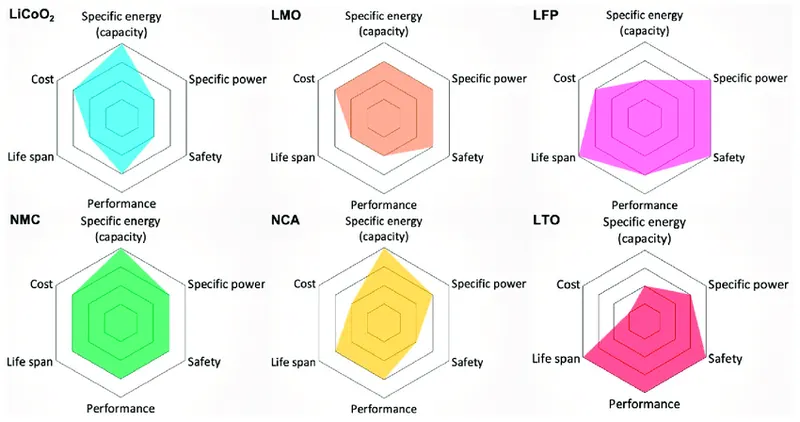
In lithium cobalt oxide batteries cobalt oxide is used as cathode end graphic carbon is used as an anode. Lithium ions move from Cathode to anode and this flow is reversed during charging. This battery technology has relatively shorter lifespan end low thermal stability. Load capabilities are also limited for this technology.The major reasons for this is as graphite as an anode which limits the cycle life by changing solid electrolyte interface. lithium plating occurs while fast charging or charging at low temperatures.
These batteries should not be charged or discharged higher than their C rating. Moreover another drawback is cost of cobalt is HIGH. Newer technologies like NCA and NMC also uses cobalt but by blending with other active cathode materials to improve performance end decreases the cost to some extent.
Lithium manganese oxide:
Lithium manganese oxide cell uses lithium manganese oxide as cathode material and graphite as an anode. In this technology the ion flow is highly improved because of 3 dimensional spinal Structure, which in turn lower the internal resistance. The current handling is also improved. Thermal stability is also improved because of spinal. The main disadvantage of this technology is number of cycles and power density of the battery is comparatively lesser than other technologies.
This battery’s show excellent behavior during fast charging and discharging. They can be charged and discharged at higher C rates with out causing greater heat buildup in the cells. these batteries are mostly used in power tools medical instruments and hybrid electric vehicles.
One more major advantage with lithium manganese battery’s is they can be designed asper over requirements. Battery lifespan, Specific power, specific energy can can be customize as per our requirements.
Lithium nickel manganese cobalt oxide:
This technology is one of the most successful technology that is available in the market today. this uses lithium nickel magnes cobalt oxide as cathode material and graphite as anode material.the main advantage of this battery is combination of Nikhil an manganese. Nickel is is known for its high specific energy, poor stability whereas manganese has the benefit of forming a spinal structure with less internal resistance that is greater stability but offers less specific energy. Combining these both enhances specific energy and stability.
The cathode contains 1/3 manganese 1/3 cobalt 1/3 nickel. The other combination is five parts of nickel, three parts of cobalt, two parts of manganese. these unique blends how significant impact on cost cutting. Find disadvantage is they are available in slightly lower voltages.
Lithium iron phosphate:
Lithium iron phosphate is one of the promising technologies which are on their way to replace SLI battery. in this technology lithium iron phosphate is used as a cathode material and graphite he’s used as anode. Lithium phosphate offer good electrochemical performance with low resistance mainly because of nanoscale ability.
the main advantage of this technology is it’s tolerance too full charge condition when compared to other technologies. they show very less stress when they left on charging for prolonged time. The specific energy offered by this technology is comparatively less then other lithium ion technologies. The self discharge property is also very high in these cells..
This technology offers discharge rates up to 25C . cycle life is also higher with greater thermal stability they provide solid endurance.
lithium nickel cobalt aluminum oxide:
We have lithium nickel cobalt aluminum oxide as a cathode material in this technology end graphite as in anode material. this technology is same as NMC with aluminim addition to give greater chemistry end better stability. this contains the same features as of an NMC.
It has better cost savings becausr aluminim is a bit cheaper element comparing to the rest of all the elements. they are mainly used in medical devices industrial and electrical powertrains. Tesla in their vehicles use this battery.
Lithium titanate:
Lithium titanate battery construction is a bit different to the rest of the lithium I ION based battery technologies. In this technology lithium titanate is used add anode material compared to other technologies where graphite is used. the cathode material can be lithium manganese oxide. the main advantage of this battery is it can be operated at higher charge and discharge rates.
it has excellent thermal stability and has excellent characteristics even at low temperatures. another advantage of this battery is there is no need for sci film formation and also no lithium plating occurs. the disadvantages of this technology are it is expensive end energy density is very low. The cell voltages are also very low. They are mainly used in electric powertrains UPS end solar powered streetlighting.