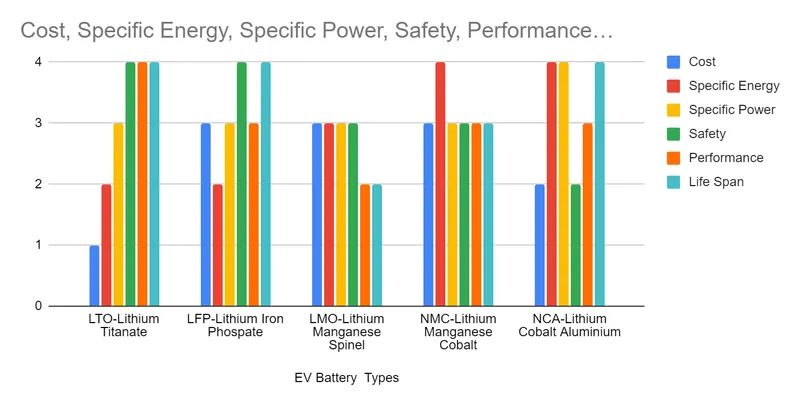
Week 1 Understanding Different Battery Chemistry
Lithium Cobalt Oxide, LCO
The Lithium Cobalt Oxide, LiCoO2, battery is a type of lithium ion battery that find uses in many consumer items of electronic equipment. It provides a very high level of specific energy density along with a good level of safety.
The battery consists of a cobalt oxide cathode with a layered structure. The anode is graphite (carbon). During the discharge cycle, lithium ions move from the anode to the cathode, and in the reverse direction during charge.
The graphite anode limits the battery life as the solid electrolyte interface changes and also as a result of anode thickening. Newer batteries may incorporate nickel or manganese to improve the lifetime as well as reducing manufacturing costs.
Lithium Iron Phosphate Battery, LFP
The Lithium Iron Phosphate, LFP type of lithium ion battery provides a low internal resistance and high current capability.
In order to provide its high of current capability, this type of li-ion battery uses a nano-scale phosphate cathode material.
In terms of performance this type of lithium ion battery provides a slightly lower terminal voltage and it has a slightly higher self-discharge rate than other forms. However against this it provides a high current rating, and good thermal stability combined with a good level of, and good thermal stability
Lithium Manganese Oxide, LMO
This type of lithium ion battery uses Lithium Manganese Oxide, LiMn2O4 as its cathode material. This type of lithium ion battery is structured to allow high currents to flow and this enables it to provide very high current levels and also to be fast charged as well.
It generally uses a three-dimensional spinel structure, i.e. one in which the crystal structure in the cubic, isometric, system, with the oxide anions arranged in a cubic close-packed lattice. This structure improves the flow of ions on the electrode, thereby increasing he current capability and lowering the internal resistance of the cell. A typical 1500mAh battery may be able to deliver steady currents of up to 20 A, obviously for a relatively short time because of the overall battery capacity.
Lithium Nickel Cobalt Aluminium Oxide, NCA
The Lithium Nickel Cobalt Aluminium Oxide battery, or NCA, is a li-ion battery type that is rarely seen in consumer applications but is being investigated for the automotive industry. Its main advantage is that it has a good life span and high energy and power density figures.
However these features come at a cost and in view of the safety elements, it must be used with care. Further development is also required to bring it to a state where this type of li-ion battery can be more widely used.
Lithium Nickel Manganese Cobalt Oxide, NMC
The lithium nickel manganese cobalt oxide lithium battery type uses a cathode comprising of a combination of nickel, manganese, and cobalt.
The key to this lithium ion battery type is the combination of nickel and manganese. Nickel is known for its high specific energy, but poor stability whereas manganese provides low internal resistance but at the cost of low specific energy. Combining both in a cell in the correct manner is able to provide the required balance of the properties of both metals.
The cathode combination often consists of a combination of nickel, manganese and cobalt in equal proportions in a combination known as 1-1-1. This combination reduces cost by reducing the cobalt content, whilst still retaining some of the key performance parameters.
Another popular combination consists of 5 parts nickel, 3 parts cobalt & 2 parts manganese (5-3-2).
The NMC type of lithium ion battery can be optimised for either to high specific power or high specific energy. With the high cost of cobalt, manufacturers are trying to move away from its use, often increasing the use of nickel, so this is often a major fact in the choice of composition of the battery.
Li-Ion battery characteristics by chemistry
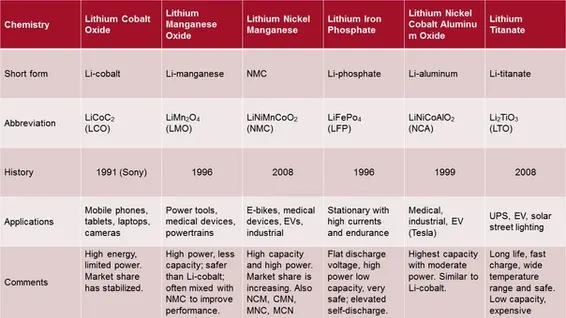
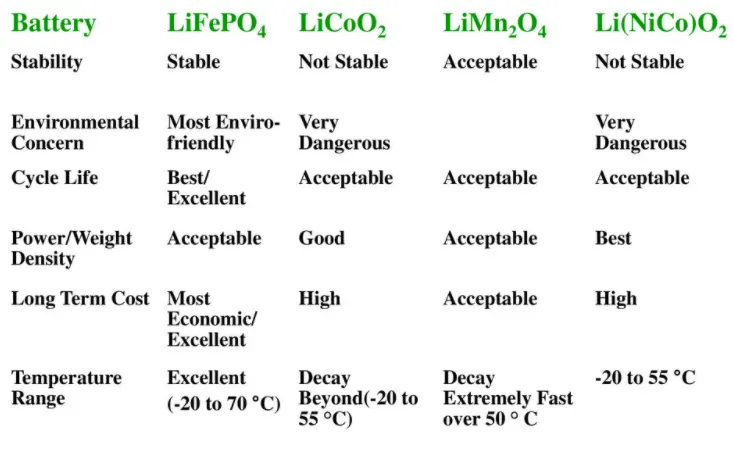
Characteristics of Li-ion cells:
| S.No | Parameters | LMO | NMC | LFP | NCA | LTO |
| 1 | Voltage | 3 - 4.2/cell | 3 - 4.2/cell | 2.5 - 3.65/cell | 3 - 4.2/cell | 1.8 - 2.5/cell |
| 2 | Specific Energy(Capacity) | 100 - 150 wh/kg | 150 - 220 wh/kg | 90 - 120 wh/kg | 200 - 260 wh/kg | 50 - 80 wh/kg |
| 3 | Charge(C-rate) | 0.7C to 3C | 0.7C to 1C | 1C | 0.7C | 1C to 5C |
| 4 | Discharge(C-rate) | 1C to 10C | 1C to 2C | 1C, 25C on some cells | 1C | 10C |
| 5 | Cycle Life | 300 - 700 | 1000 - 2000 | 2000 and higher | 500 | 3000 - 7000 |
| 6 | Thermal runaway | 250 deg | 210 deg | 270 deg | 150 deg | <150 deg |
| 7 | Applications | Medical,Power trains | Ebikes,EVs,Medical,Industrails | High Load Current applications | Power Train(Tesla),Medical | Mitsubisi,Honda EV |
| 8 | Comments | High Power but less capacity safer than Li-cobalt,commonly mixed with NMC to improve Performance | Provide high capacity and high power.Serves as hybrid cell.Fovorite chemistry for many uses,Market share is increasing | Low Capacity but Safest | Similar to NMC,serve as energy cell used by Tesla and Panasonic | Expensive,Long life,Fast charge,Safest of all |
Chemical reaction Occurs at Anode and Cathode:
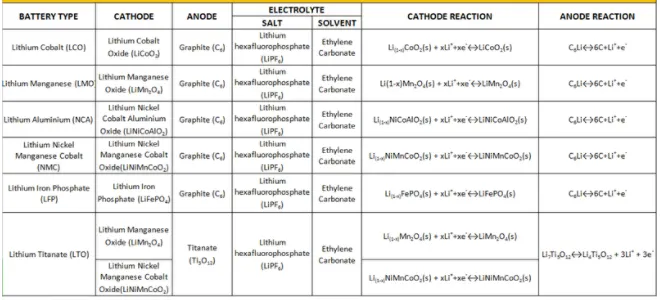
GRAPH: