Week 1 Understanding Different Battery Chemistry
A lithium-ion battery or Li-ion battery is a type of rechargeable battery. Lithium-ion batteries are commonly used for portable electronics and electric vechicles .lithium-ion batteries use lithium ions to generate power required by our devices. It is a very light metal with high energy density.Lithium-ion batteries use an intercalated lithium compound as the material at the positive electrode and typically graphite at the negative electrode .There are different types of lithium ion cells used in batteries.
Lithium cobalt oxide, LiCoO2 (LCO):
Lithium cobalt oxide, sometimes called lithium cobaltate or lithium cobaltite, its chemical compound is LiCoO₂.It is an inorganic compound commonly used as a cathode material for lithium ion batteries and graphite used as a anode material.
When a typical consumer lithium cobalt oxide, LCO battery or cell needs to be stored it should be partially charged - around 40% to 50% and kept in a cool storage area. Storage under these conditions will help increase the life. its current capability in both charge and discharge is limited.it should not be charged or discharged at a greater rate than its capacity.
Lithium manganate oxide,LiMnO 2(LMO):
A lithium ion manganese oxide battery is a lithium-ion cell that uses manganese dioxide, MnO 2, as the cathode material.Lithium manganate oxide battery is widely used for its low cost and good safety. Lithium manganese oxide battery has low cost, good safety, and nice low-temperature performance, but the material itself is not so stable, and easy to decompose and produce gas, so it tend to be used with other materials, in order to reduce the cost of batteries
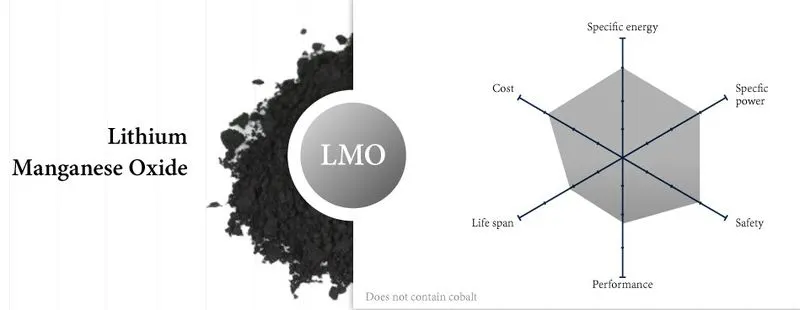
They are also inexpensive and non-toxic materials which make them attractive candidates as positive insertion electrodes. Manganese oxides can provide voltages up to 5 V vs. metallic lithium.This kind of battery has ordinary energy density and cycling life. It has environmental protection and no patent limitation.
Lithium nickel cobalt aluminium oxides,LiNiCoAlO2 (NCA):
Lithium Nickel-Cobalt-Aluminum Oxide (NCA) is used as the cathode material for lithium ion batteries and graphite as a anode material mainly used in electric automobiles. Due to a high nickel content of the NCA manufactured by the company, the capacity of batteries can be increased, which contributes to a longer distance that can be covered with a single-time charging.
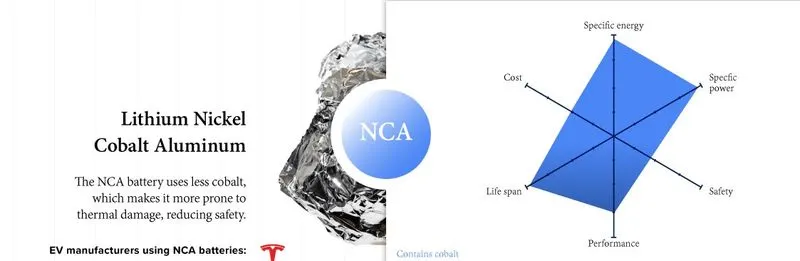
Lithium nickel cobalt aluminum oxide batteries are not conventional in the consumer industry but have promise for EV manufacturer, as they provide high-specific energy options, reasonably good specific power, and a decent lifespan.
Lithium nickel manganese cobalt oxide (NMC):
One of the most successful Li-ion systems is a cathode combination of NMC.It is a class of electrode material that can be used in the fabrication of lithium-ion batteries. Lithium-ion batteries consist of anode, cathode, and electrolyte with a charge-discharge cycle. These materials enable the formation of greener and sustainable batteries for electrical energy storage.
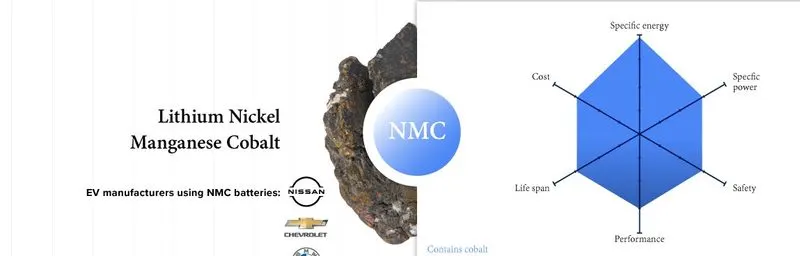
In nickel-manganese-cobalt ternary material, the incorporation of manganese element can enhance the stability of the material, so that the structure will not collapse due to lithium ion embedding. The addition of nickel can increase the capacity and become a new valence element. This system can be used to operate as power cells or energy cells. The components of NMC are combined and made with nickel and manganese.
Lithium iron phosphate ,LiFePO 4 (LFP):
It is a type of lithium-ion battery using lithium iron phosphate as the cathode material, and a graphitic carbon electrode with a metallic backing as the anode.It is one of the safest lithium battery chemistries, and is not prone to thermal runaway Most 'lithium' home storage batteries use the LFP chemistry for reasons of cost and fire safety. The lower energy density than other lithium chemistries is not significant in this static application.
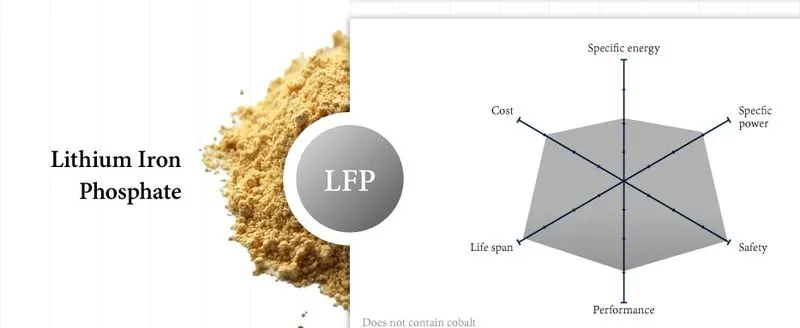
LFP contain neither nickel nor cobalt both of which are supply-constrained and expensive.LFP are available at Mouser Electronics. Mouser offers inventory, pricing, & datasheets.
Lithium-titanate-oxide (LTO):
Lithium Titanate Battery technology utilizes new Li4Ti5O12 material instead of traditional graphite as the negative electrode of the lithium battery, that achieve innovative features in terms of extraordinary safety, longer life, fast charge, high rate discharge and wider working temperature. It replaces the graphite in the anode of the typical Li-Ion battery and forms the materials into a spinel 3D crystal structure. Having a nominal a cell voltage of 2.40V, it releases a high current discharge current that is 10 times the capacity of the other types of lithium batteries.
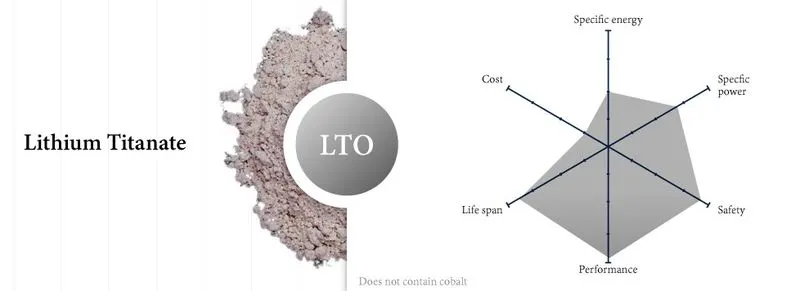
It has the advantage of being faster to charge than other lithium-ion batteries, but the disadvantage of having a much lower energy density high safety, high stability, super long cycle life and strong temperature tolerance.
Differences between each type of Li+ion batteries based on their characteristics:
Lithium-ion batteries are used in most aspects of our everyday lives. Most devices like smartphones and laptops cannot operate without these batteries. Lithium-ion batteries have also become very important in the field of electromobility as it is now the battery of choice in most electric vehicles. Its high specific energy gives it an advantage over other batteries.There are different types of lithium-ion batteries and the main difference between them lies in their cathode materials. Different kinds of lithium-ion batteries offer different features, with trade-offs between specific power, specific energy, safety, lifespan, cost, and performance.
Specific energy: This defines the battery capacity in weight (Wh/kg). The capacity relates to the runtime. Products requiring long runtimes at moderate load are optimized for high specific energy.
Specific power: It's the ability to deliver high current and indicates loading capability. Batteries for power tools are made for high specific power and come with reduced specific energy.
A high specific power usually comes with a reduced specific energy.
Performance: This measures how well the battery works over a wide range of temperature. Most batteries are sensitive to heat and cold and require climate control. Heat reduces the life, and cold lowers the performance temporarily.
Lifespan: This reflects cycle life and longevity and is related to factors such as temperature, depth of discharge and load. Hot climates accelerate capacity loss. Cobalt blended lithium ion also usually have a graphite anode that limits the cycle life.
Safety: This relates to factors such as the thermal stability of the materials used in the batteries. The materials should have the ability to sustain high temperatures before becoming unstable. Instability can lead to thermal runaway in which flaming gases are vented. Fully charging the battery and keeping it beyond the designated age reduces safety.
Cost: Demand for electric vehicles has generally been lower than anticipated and this is mainly due to the cost of lithium-ion batteries. Hence cost is a huge factor when selecting the type of lithium-ion battery.
| Lithium-ion battery Types |
SPECIFIC POWER |
SPECIFIC ENERGY |
SAFETY |
LIFE SPAN |
COST | PERFOMANCE |
|---|---|---|---|---|---|---|
|
Lithium Cobalt Oxide |
L |
H |
L |
L |
L |
M |
|
Lithium Manganese Oxide |
M |
M |
M |
L |
L |
L |
|
Lithium Nickel Manganese Cobalt Oxide |
M |
H |
M |
M |
L |
M |
|
Lithium Iron Phosphate |
H |
L |
H |
H |
L |
M |
|
Lithium Nickel Cobalt Aluminum Oxide |
M |
H |
L |
M |
M |
M |
|
Lithium Titanate |
M |
L |
H |
H |
H |
H |