Week 1 Understanding Different Battery Chemistry
What is Battery ?
Batteries are a collection of one or more cells whose chemical reactions create a flow of electrons in a circuit. All batteries are made up of three basic components: an anode (the '-' side), a cathode (the '+' side), and some kind of electrolyte (a substance that chemically reacts with the anode and cathode). When the anode and cathode of a battery are connected to a circuit, a chemical reaction takes place between the anode and the electrolyte. This reaction causes electrons to flow through the circuit and back into the cathode where another chemical reaction takes place. When the material in the cathode or anode is consumed or no longer able to be used in the reaction, the battery is unable to produce electricity. At that point, your battery is "dead". In short, it is a device that is able to store electrical energy in the form of chemical energy and convert that energy into electricity
Batteries that must be thrown away after use are known as primary batteries. Batteries that can be recharged are called secondary batteries. Primary batteries most commonly use a reaction between Li and MnO2 to produce electricity while secondary batteries use a reaction in which lithium from a lithium/graphite anode is incorporated into LiCoO2 at the cathode.
What are Lithium-ion Batteries?
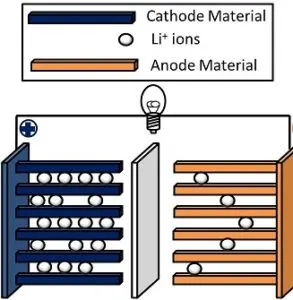
A lithium-ion (Li-ion) battery is an advanced battery technology that uses lithium ions as a key component of its electrochemistry. During a discharge cycle, lithium atoms in the anode are ionized and separated from their electrons. The lithium ions move from the anode and pass through the electrolyte until they reach the cathode, where they recombine with their electrons and electrically neutralize. The lithium ions are small enough to be able to move through a micro-permeable separator between the anode and cathode. In part because of lithium’s small size (third only to hydrogen and helium), Li-ion batteries are capable of having a very high voltage and charge storage per unit mass and unit volume.
Li-ion batteries can use a number of different materials as electrodes. The most common combination is that of lithium cobalt oxide (cathode) and graphite (anode), which is most commonly found in portable electronic devices such as cellphones and laptops. Other cathode materials include lithium manganese oxide (used in hybrid electric and electric automobiles) and lithium iron phosphate. Li-ion batteries typically use ether (a class of organic compounds) as an electrolyte.
Lithium-ion batteries have higher specific energies than batteries made from other materials such as zinc and lead due to the relatively lightweight and low density of lithium. Lithium batteries are also more stable overcharge/recharge cycles due to the small radii of lithium ions, which causes fewer disruptions of the electrode structure during ion transfer. Because lithium is involved in the reactions at both electrodes, the battery can be recharged by running the reactions in reverse
Types of Lithium-ion batteries are:
LCO- Lithium Cobalt oxide (LiCoO2)
The battery consists of a cobalt oxide cathode with a layered structure. The anode is graphite (carbon). During the discharge cycle, lithium ions move from the anode to the cathode, and in the reverse direction during charge. The graphite anode limits the battery life as the solid electrolyte interface changes and also as a result of anode thickening. Newer batteries may incorporate nickel or manganese to improve the lifetime as well as reducing manufacturing costs.
One of the drawbacks of the LCO battery is that its current capability in both charge and discharge is limited. As a guide, it should not be charged or discharged at a greater rate than its capacity, i.e. a 2400mAh battery should not be charged or discharged with a current greater than 2400mA. Often figures of 0.8 of the charge level are recommended. It provides a very high level of specific energy density along with a good level of safety.
LMO- Lithium Manganese oxide (LiMn204)
This type of lithium-ion battery is structured to allow high currents to flow and this enables it to provide very high current levels and also to be fast-charged as well.
It generally uses a three-dimensional spinel structure, i.e. one in which the crystal structure in the cubic, isometric, system, with the oxide anions arranged in a cubic close-packed lattice. This structure improves the flow of ions on the electrode, thereby increasing the current capability and lowering the internal resistance of the cell. A typical 1500mAh battery may be able to deliver steady currents of up to 20 A, obviously for a relatively short time because of the overall battery capacity.
The structure of this type of lithium-ion battery also has the advantage that it improves thermal stability and improves the safety of the cell.
However, the disadvantage of the cell is the limited number of charge-discharge / cycles as well as the limited calendar life, i.e. the degradation over time since manufacture.
NCA- Nickel Cobalt Aluminium oxide (LiNiCoAl)2)
Its main advantage is that it has a good life span and high energy and power density figures. However these features come at a cost and in view of the safety elements, they must be used with care. NCA is a further development of lithium nickel oxide; adding aluminum gives the chemistry greater stability.
NMC- Nickel Manganese Cobalt (LiNiMnCoO2)
The key to this lithium-ion battery type is the combination of nickel and manganese. Nickel is known for its high specific energy, but poor stability whereas manganese provides low internal resistance but at the cost of low specific energy. Combining both in a cell in the correct manner is able to provide the required balance of the properties of both metals.
The cathode combination often consists of a combination of nickel, manganese, and cobalt in equal proportions in a combination known as 1-1-1. This combination reduces cost by reducing the cobalt content, whilst still retaining some of the key performance parameters.
Another popular combination consists of 5 parts nickel, 3 parts cobalt & 2 parts manganese (5-3-2).
The NMC type of lithium-ion battery can be optimized for either high specific power or high specific energy. With the high cost of cobalt, manufacturers are trying to move away from its use, often increasing the use of nickel, so this is often a major fact in the choice of composition of the battery.
LFP- Lithium Iron Phosphate (LiFePO4)
The Lithium Iron Phosphate, LFP type of lithium-ion battery provides low internal resistance and high current capability.
In order to provide its high current capability, this type of li-ion battery uses a nano-scale phosphate cathode material.
In terms of performance, this type of lithium-ion battery provides a slightly lower terminal voltage and has a slightly higher self-discharge rate than other forms. However against this, it provides a high current rating, and good thermal stability combined with a good level of and good thermal stability.
LTO - Lithium Titanate (Li2TiO3)
LTO (commonly Li4Ti5O12) has advantages over the conventional cobalt-blended Li-ion with graphite anode by attaining zero-strain property, no SEI film formation, and no lithium plating when fast charging and charging at low temperature. Thermal stability under high temperature is also better than other Li-ion systems; however, the battery is expensive. At only 65Wh/kg, the specific energy is low, rivaling that of NiCd. Li-titanate charges 2.80V/cell and the end of discharge is 1.80V/cell. Typical uses are electric powertrains, UPS, and solar-powered street lighting.
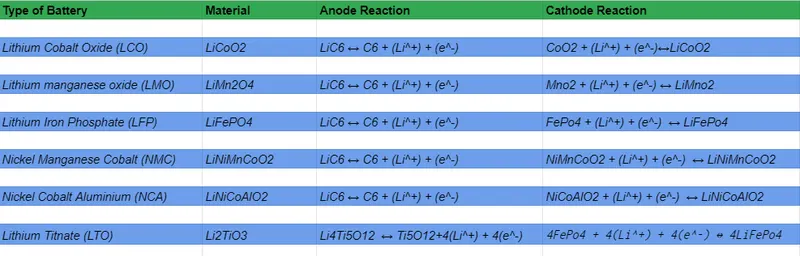
Tabular Form of Lithium-Ion Cells that we have discussed above:
References :
https://batteryuniversity.com/learn/article/types_of_lithium_ion