Week 1 Stress Concentration on a Plate with hole
Objective- Perform a static structural analysis using Ansys workbench on a plate with two different types of holes. The main objective is to measure the stress and deformation-induced on the plate with the same dimension of the plate with a different number of holes and compare it for better design and manufacturing point of view.
Steps Have to be taken during the analysis.
1- Open the Ansys Workbench.
2- Select the proper engineering data (material)
3- Create a geometry.
4- Mesh the geometry.
5- Give the boundary conditions.
6- Apply the solver to solve.
7- Results analysis.
Procedures-
1- First we need to open the workbench from the computer.
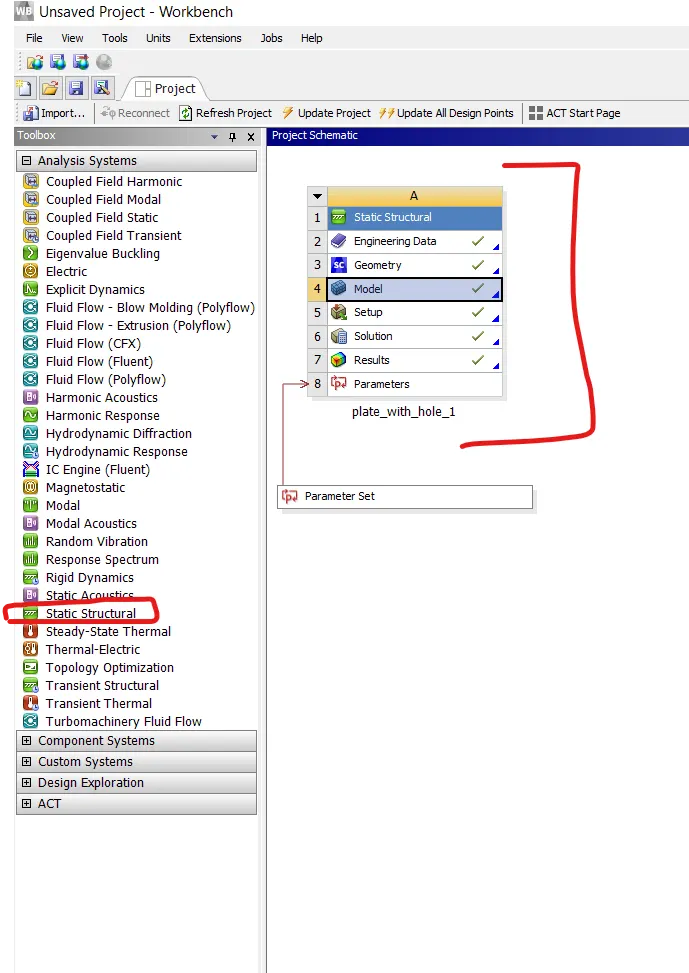
2- Select the static structural module.
3- Now from the tab select the engineering data for material selection.
4- Create a geometry as per the given dimension from the next geometry module.
5- After creating the geometry come on the same tab and go to the Model module and update the model.
6- After updating the model choose the edit Edit option in the model tab.
7- It will open the mechanical tab, where we going to perform the analysis.
8- In this module, we have to mesh the model as per requirement.
9- Then after meshing give the material as per requirement.
10- Now come with the boundary condition, here we gave fixed and force to opposite faces for tensile test.
11- After giving the boundary condition we need to assign an output request so that we can see what we want from the results.
Steps were taken for this challenge-
1- Design a plate as per the given dimensions for two cases-
A- Plate with single hole
B- Plate with three holes.
2- Assign material as structural steel.
3- Apply boundary condition- Force and fixed support at opposite faces.
4- Assign the output request.
4- Solve the analyze the solution.
Case-1-
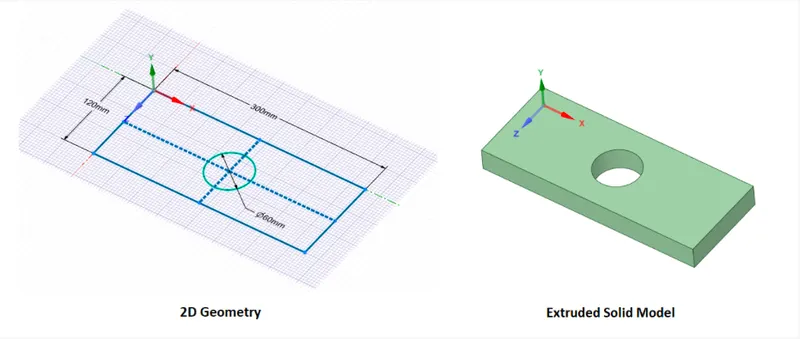
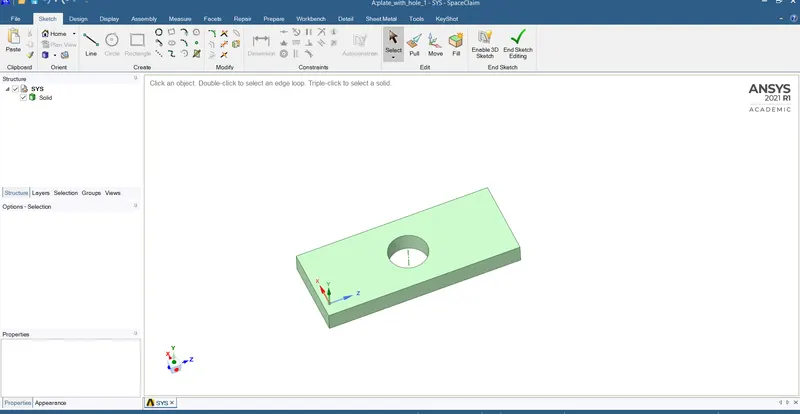
Design a plate with a single hole-
Software- Ansys SpaceClaim
Dimensions-
Length= 300mm
Height= 120mm
Thickness= 30mm
Hole Diameter= 60mm
Appling Material=
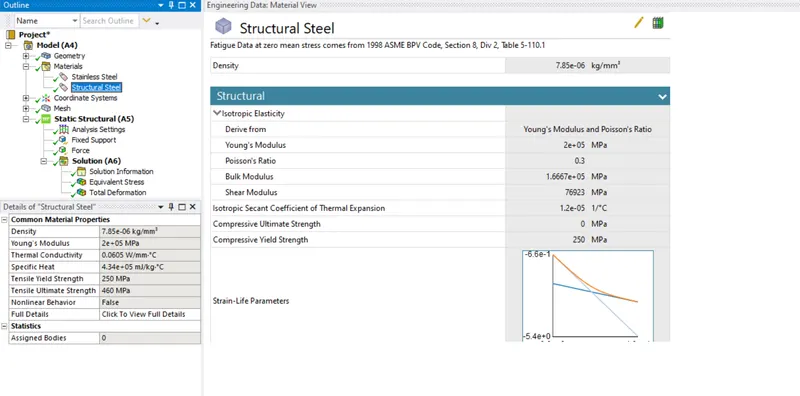
Structural Steel used as a material-
Young Modulus= 2e+05 MPa
Poission Ratio= 0.3
Bulk Modulus= 1.667e+05 MPa
Shear Modulus= 76923
Tensile Ultimate Stremgth= 460 MPa
Tensile Yield Strength= 250 MPa
Density= 7.80e-9 tonne/mm3
Boundry Conditions=
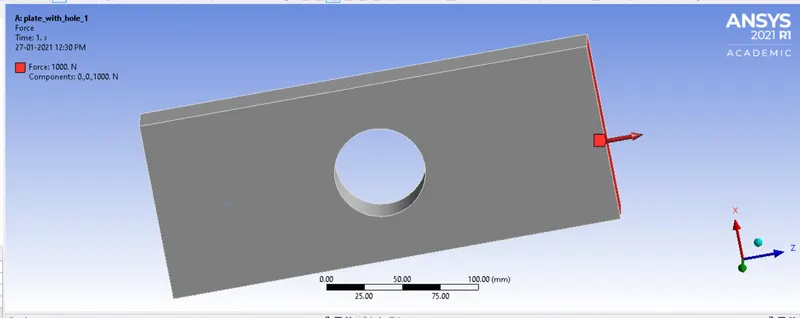
1- Force applied to the one faces as 1000N.
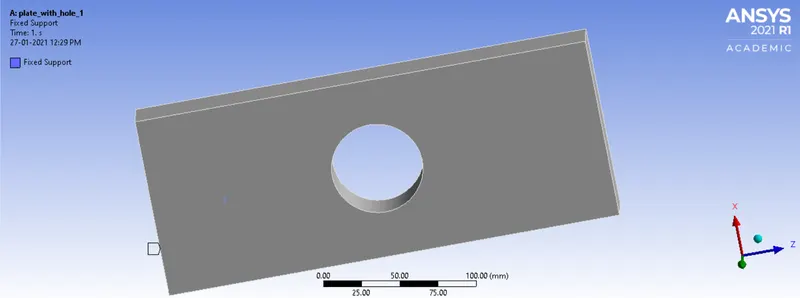
2- fixed support is given to another face.
Meshing=
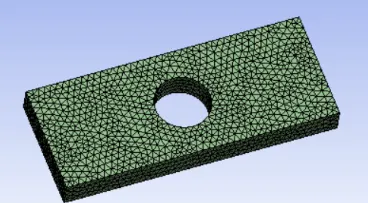
Tetra mesh has been used to mesh the solid with a 7mm element size.
Results=
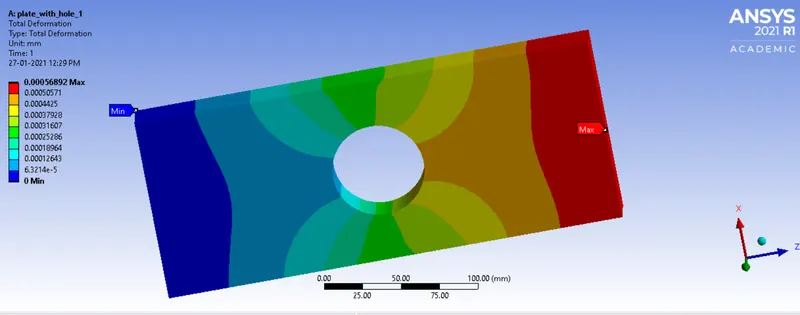
1- Von-misses stress has been analyzed.
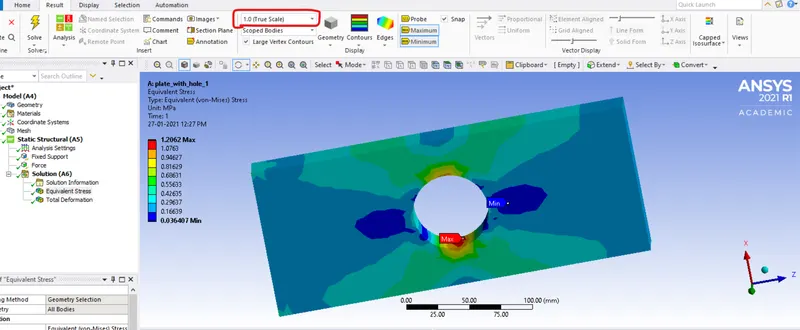
2- Deformation due to force has been analyzed also.
Case-2
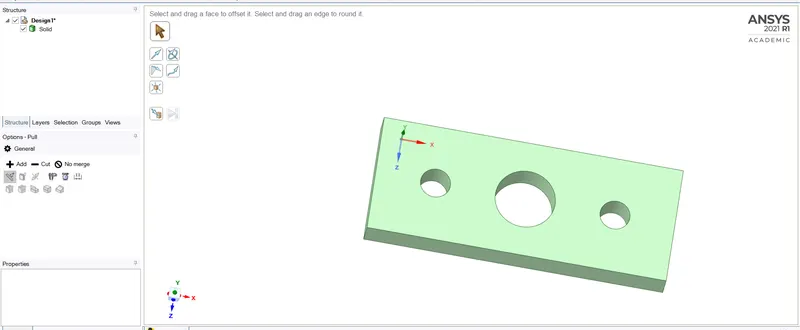
Dimensions of the plate with three holes-
Length= 300mm
height= 120mm
Thickness= 30mm
Centre hole dia= 60mm
Small hole dia= 30mm
Boundary Condition-
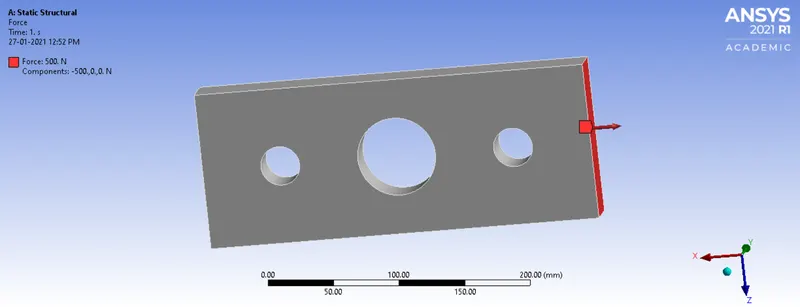
1- Force Applied to the one face.
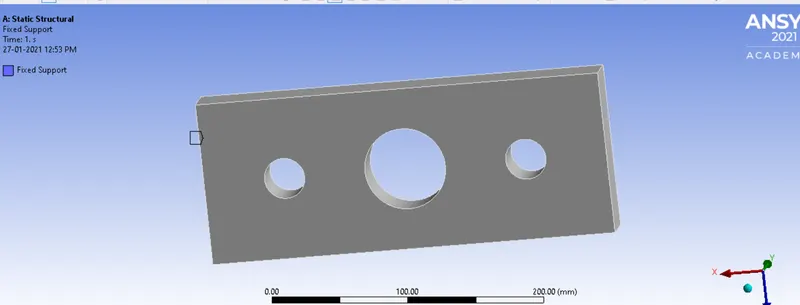
2- Fixed support applied to the opposite face.
Meshing -
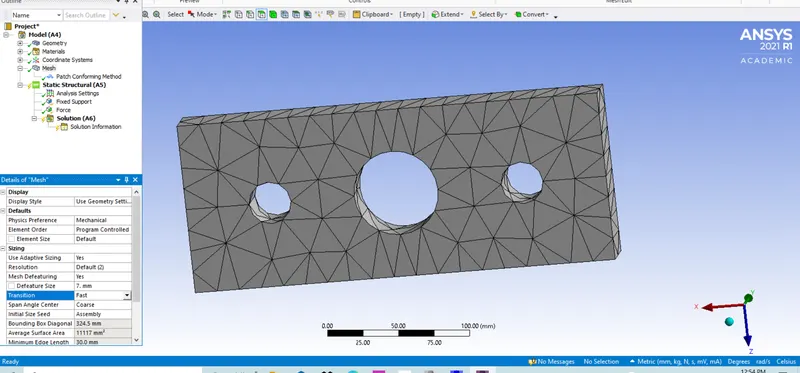
Mesh has been deployed to the component.
Tetra mesh applied to the component with a 7mm element size.
Results-
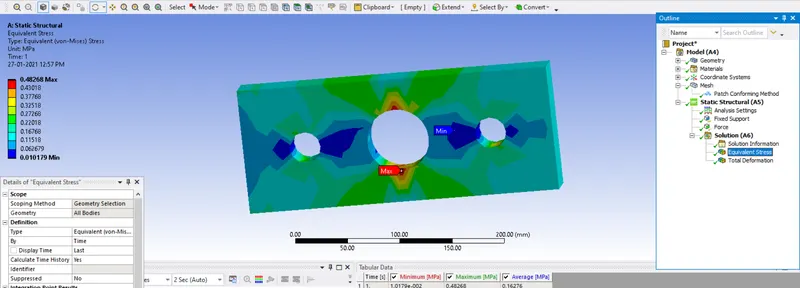
1- Von-misses stress has been investigated.
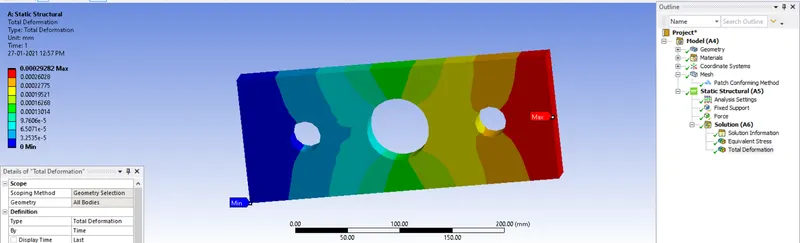
2- Total Deformation also has been investigated.
Deformation Comaparision-
By comparing both cases the total deformation is slightly higher in case-2, due to the number of holes in case-2. The more no. of holes, deformation will be more.
Stress Comparison-
By comparing both cases the stress is slightly higher in case-2, due to the number of holes in case-2. The more no. of holes, stress will be more.
Selection of design as per manufacturing point of view.- ( Case-1 is better)
From the manufacturing point of view, case-1 with a single hole will be better for design because it has a single hole, which means it takes less time as well as investment to come to the final product.
Selection of design as per analysis point of view. - (case-2 is better)
From an analysis point of view, case-2 is better because it has 3 holes to distribute the stress so we the stress can be distributed to all the component equally and component has less chance to fail.
Conclusion-
From the analysis of both the cases, we have successfully investigated the von-misses stress and deformation with some boundary conditions. We can clearly see that case-1 is better from the manufacturing point of view and case-2 is good from the stress distribution point of view. All the boundary condition has been applied and simulation has run successfully without any error. Both two cases have been compared as per the given instruction.