Week 1 Spur Gear Challenge
Objective-
Structural analysis of spur gear with three different materials and investigate Von misses stress, Defrofatiom, Stress Intensity. Compare the results from these analyses.
Spur Gears-
Spur gears or straight-cut gears are the simplest types of gear. They consist of a cylinder or disk with teeth projecting radially. Though the teeth are not straight-sided (but usually of special form to achieve a constant drive ratio, mainly involute but less commonly cycloidal), the edge of each tooth is straight and aligned parallel to the axis of rotation. These gears mesh together correctly only if fitted to parallel shafts. No axial thrust is created by the tooth loads. Spur gears are excellent at moderate speeds but tend to be noisy at high speeds.
Material Used-
1- Cast-Steel
2- Cast- Bronze
3- Cast-Iron
Procedure-
1- First we need to start a workbench and define and add the material for all these three cases.
2- Post we need to import the cad file.
3- Assign the material property to the model.
4- Apply the boundary conditions.
5- Assign the output request to the model.
6- Solve and plot the graphs and contour.
Steps-
1- Opened the Workbench environment, and worked one by one module.
2- First we define the material.
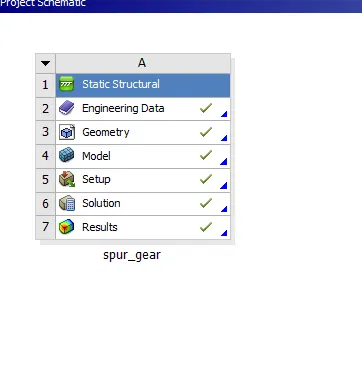
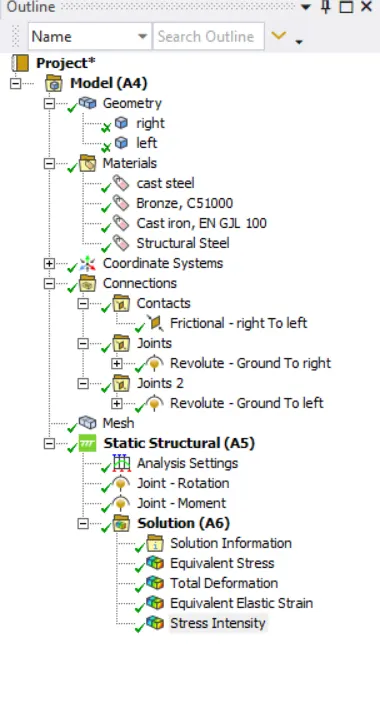
3- Here are the defined material and boundary and other parameters needed for the simulation-
A- Material defined to the model, we need to assign different materials for all the simulation one by one.
B- We can assign the material to the geometry and selecting the parts.
C- After assigning the material we went to the connection module.
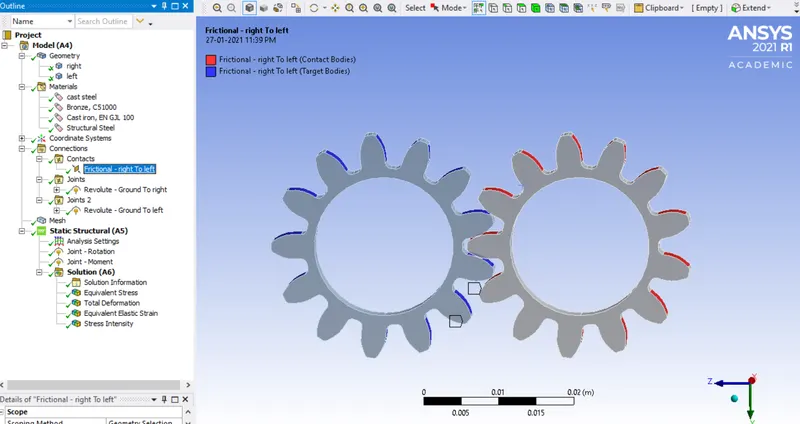
D- In the connection module, we have defined contact between both of the gears as a frictional contact and other parameters.
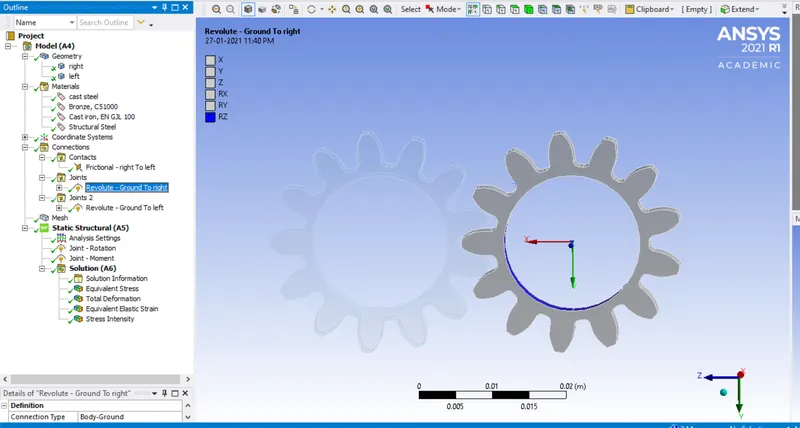
E- Revolute joint has been assign so that the gear will rotate along that joint.
F- Joint rotation defined as the one gear and moment for the second gear for the rotation.
G- Now from the statical analysis module we have given the termination time and step time to the model.
H- In last we need to assign output database to see the results.
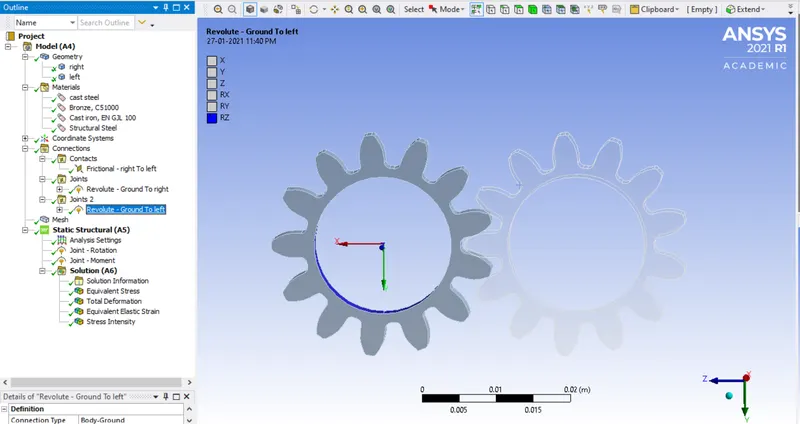
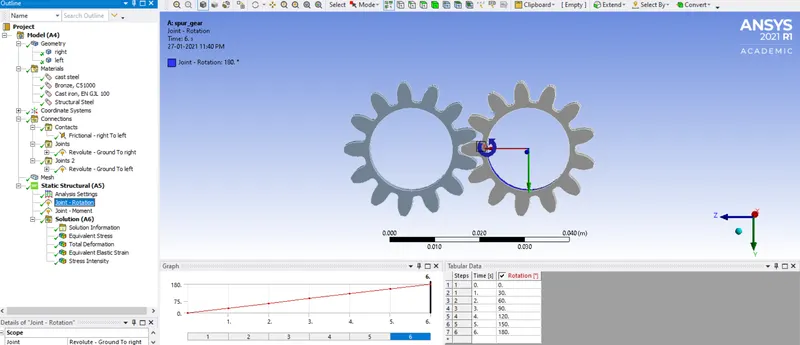
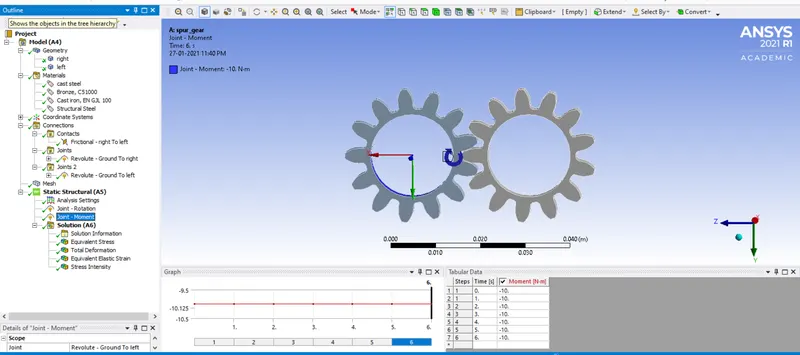
Case-1
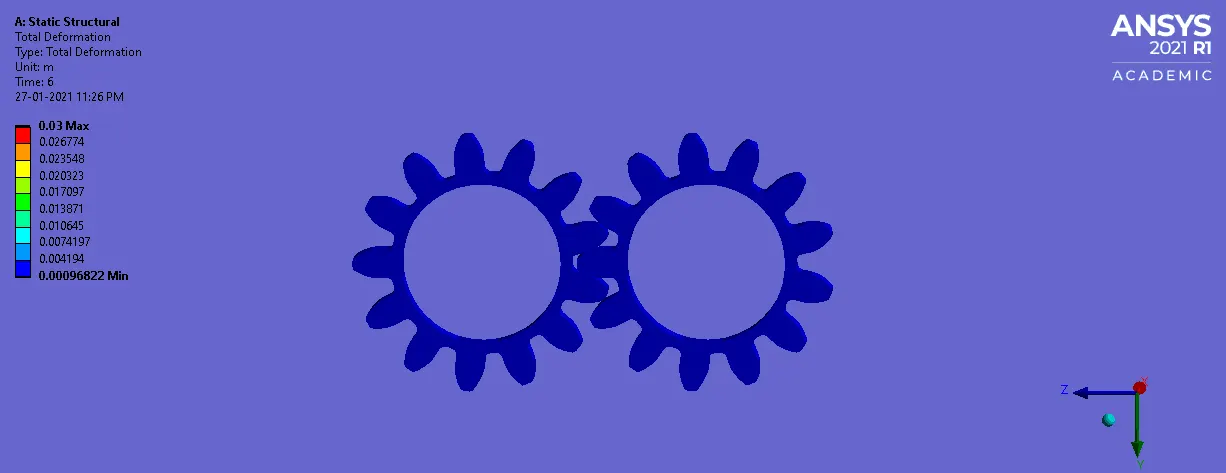
Here in this case cast-iron used as material.
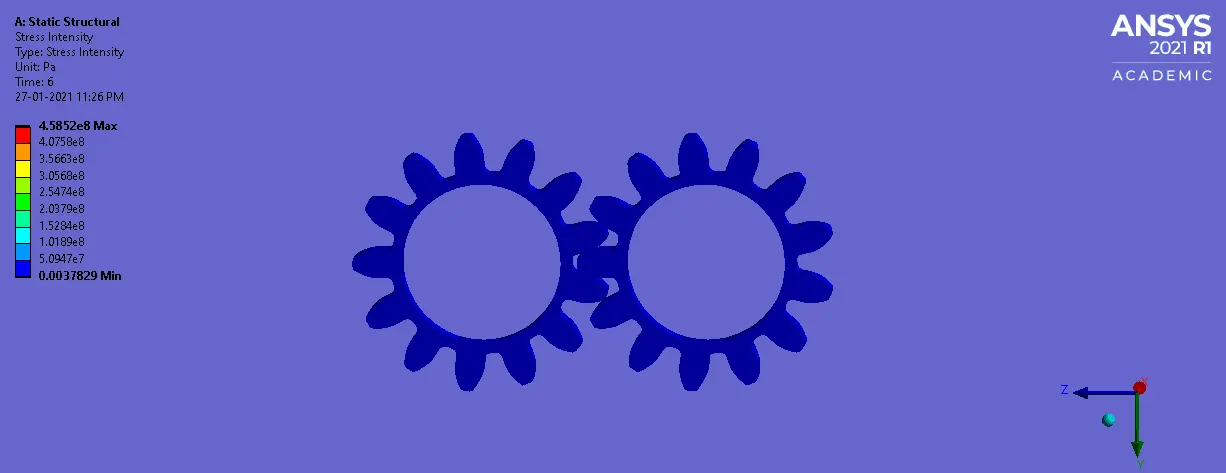
Case-2
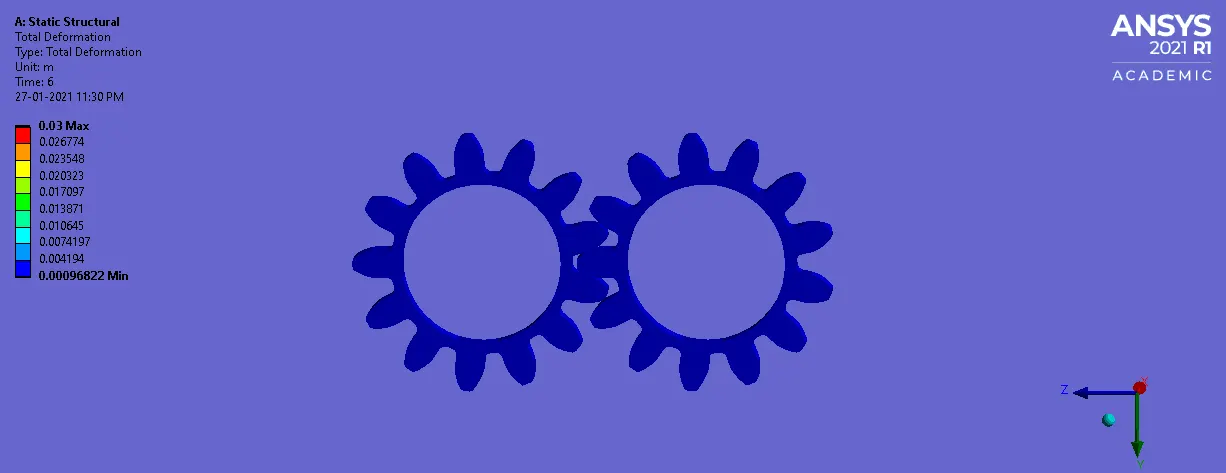
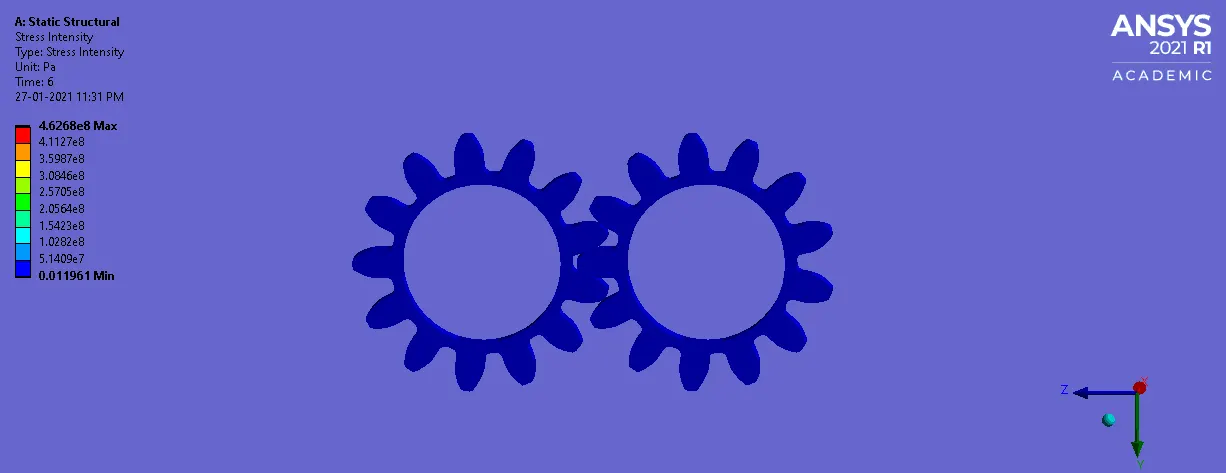
Here in this case cast-Steel used as material.
Case-3
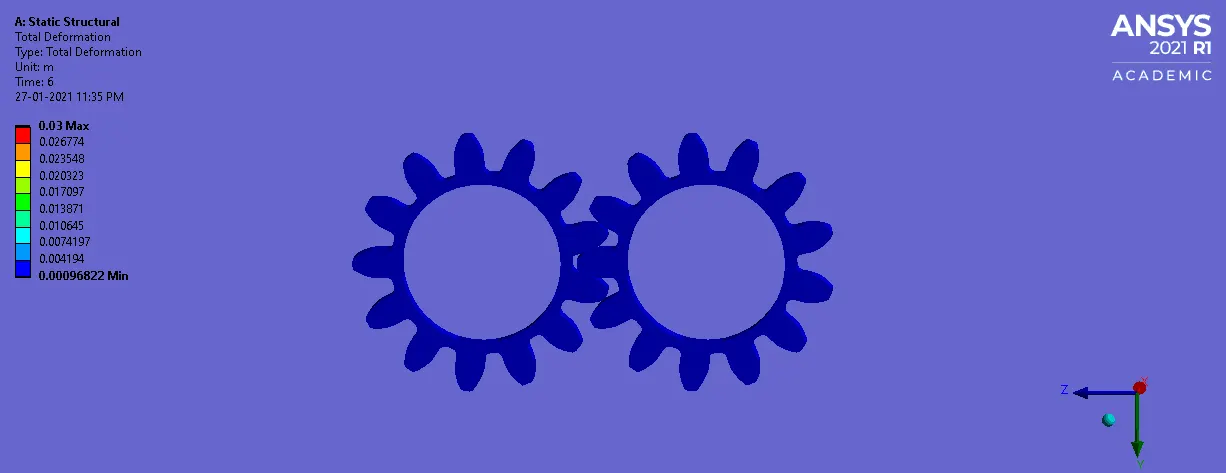
Here in this case cast-Bronze used as material.
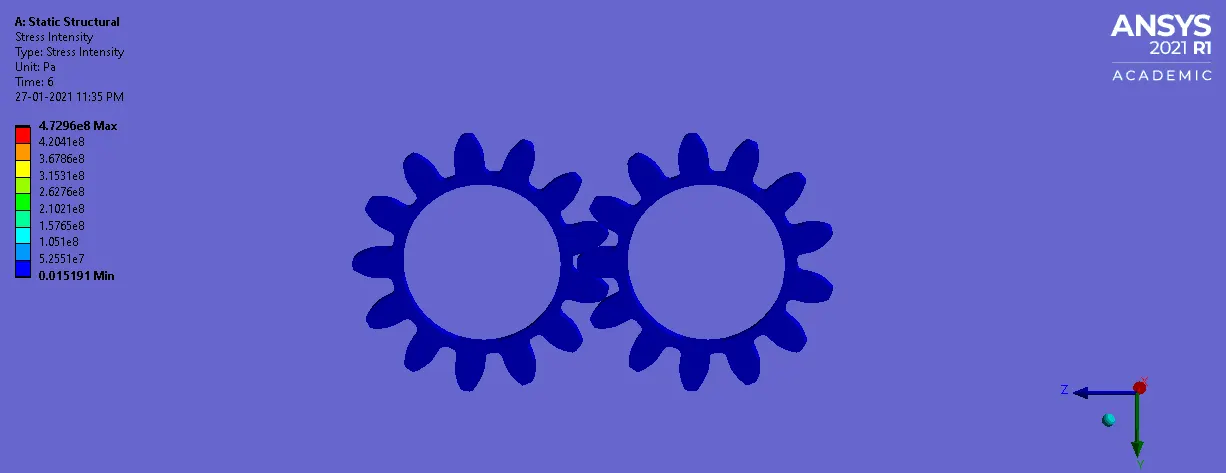
Comparing-
Here we compare all the output we got from the analysis.
| Material | Min Stress (Pa) | Max Stress (Pa) | Min Deformation (m) | Max Deformation (m) | Min Stress Intensity (Pa) | Max Stress Intensity (Pa) |
| Cast Iron | 10.12 | 1.88e+8 | 0.00096 | 0.03 | 0.0038 | 4.58e+8 |
| Cast Steel | 8.77 | 1.85e+8 | 0.00096 | 0.03 | 0.01196 | 4.62e+8 |
| Cast Bronze | 6.41 | 1.85e+8 | 0.00096 | 0.03 | 0.01519 | 4.72e+8 |
Conclusion-
We have successfully investigated stress, deformation, and stress intensity for all the three materials we have assigned. All the boundary conditions successfully assigned to the model and output also requested. Simulation has been successfully run without any error and we have captured the animation file for all three cases.