Spur Gear Analysis using Ansys
Aim :
In this task, we will carry out a static structural analysis with the three different materials assigned here on a spur gear, keeping the boundary conditions constant and implementing the tests for different materials accordingly.
Case 1:
Using Cast Iron(ductile) as a material, carry out a static structural analysis to find out Equivalent stress, Total deformation, and stress intensity.
Case 2:
Using Cast Steel as material, perform the same analysis for the results as in Case 1.
Case 3:
Using Cast Bronze as material, perform the same analysis for the results as in Case 1.
Introduction :
Spur gears or straight-cut gears are the simplest types of gear. They consist of a cylinder or disk with teeth projecting radially. Though the teeth are not straight-sided (but usually of special form to achieve a constant drive ratio, mainly involute but less commonly cycloidal), the edge of each tooth is straight and aligned parallel to the axis of rotation. These gears mesh together correctly only if fitted to parallel shafts.No axial thrust is created by the tooth loads. Spur gears are excellent at moderate speeds but tend to be noisy at high speeds.
Spur gear teeth are manufactured by either involute profile or cycloidal profile. Most of the gears are manufactured by an involute profile with a 20° pressure angle. When two gears are in mesh at one instant there is a chance to mate involute portion with a non-involute portion of the mating gear. This phenomenon is known as "interference" and occurs when the number of teeth on the smaller of the two meshing gears is less than a required minimum. To avoid interference we can have undercutting, but this is not a suitable solution as undercutting leads to weakening of tooth at its base.
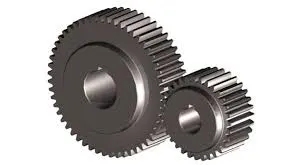
The spur gears can be classified into two main categories: External and Internal. The gears with teeth cut outside of the cylinder are known as external gears. The gears with teeth cut on the internal side of the cylinder are known as internal gears. An external gear can mesh with external gear or an internal gear. When two external gears mesh together they rotate in the opposite directions. An internal gear can only mesh with an external gear and the gears rotate in the same direction. Due to the close positioning of shafts, internal gear assemblies are more compact then external gear assemblies.
Model:
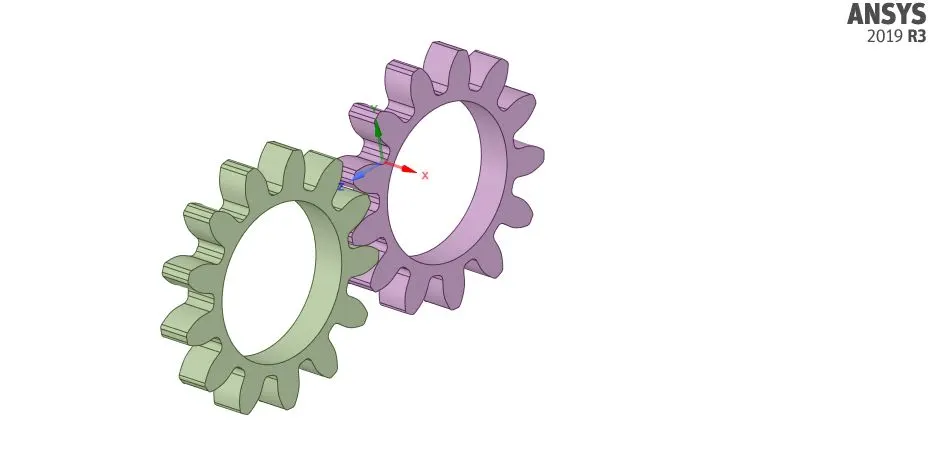
In order to perform simulation for the above model, we have assigned three cases of different materials. The materials and properties that we have used we will be using are
- Cast Iron
- Cast steel
- Cast Bronze
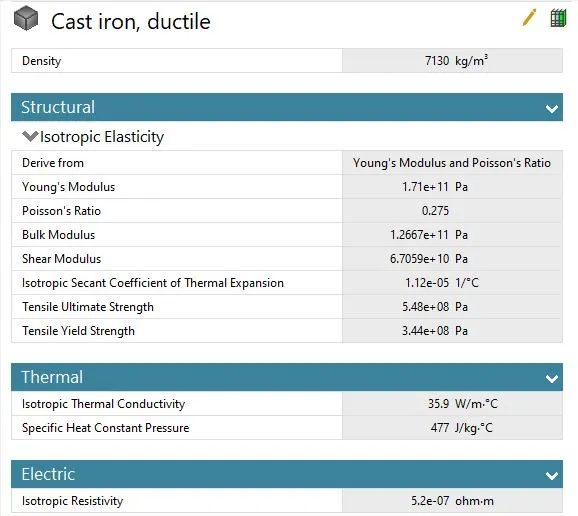
Cast-Iron:
Cast iron is a group of iron-carbon alloys with a carbon content of more than 2%. Its usefulness derives from its relatively low melting temperature. The alloy constituents affect its color when fractured: white cast iron has carbide impurities which allow cracks to pass straight through, grey cast iron has graphite flakes which deflect a passing crack and initiate countless new cracks as the material breaks, and ductile cast iron has spherical graphite "nodules" which stop the crack from further progressing.
Cast-steel:
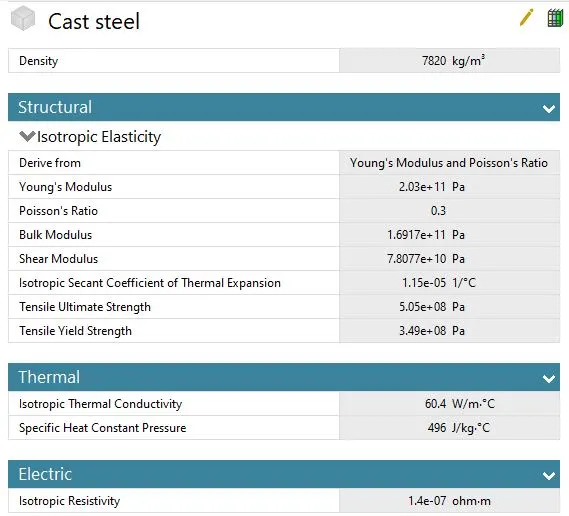
Cast steel is a ferrous alloy with a maximum carbon content of approximately 0.75%. Steel castings are solid metal objects produced by filling the void within a mold with liquid steel. They are available in many of the same carbon and alloy steels that can be produced as wrought metals.
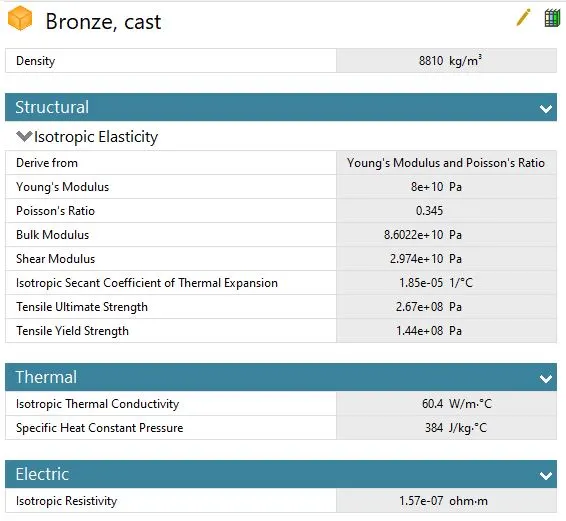
Cast Bronze :
Bronze is the most popular metal for cast metal sculptures a cast bronze sculpture is often called simply a "bronze". It can be used for statues, singly or in groups, reliefs, and small statuettes and figurines, as well as bronze elements, to be fitted to other objects such as furniture.
Connections:
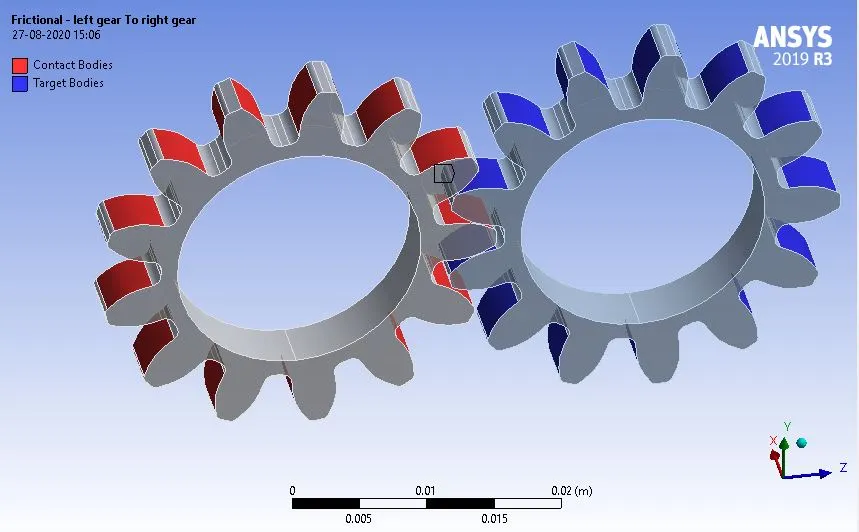
A Frictional contact is defined between the tooth faces of the teeth in contact for both the gears with the behavior being set the symmetric and "Augmented Lagrange" being used to reduce the chatter and the interface treatment being set to "Adjust to Touch"
Meshing:
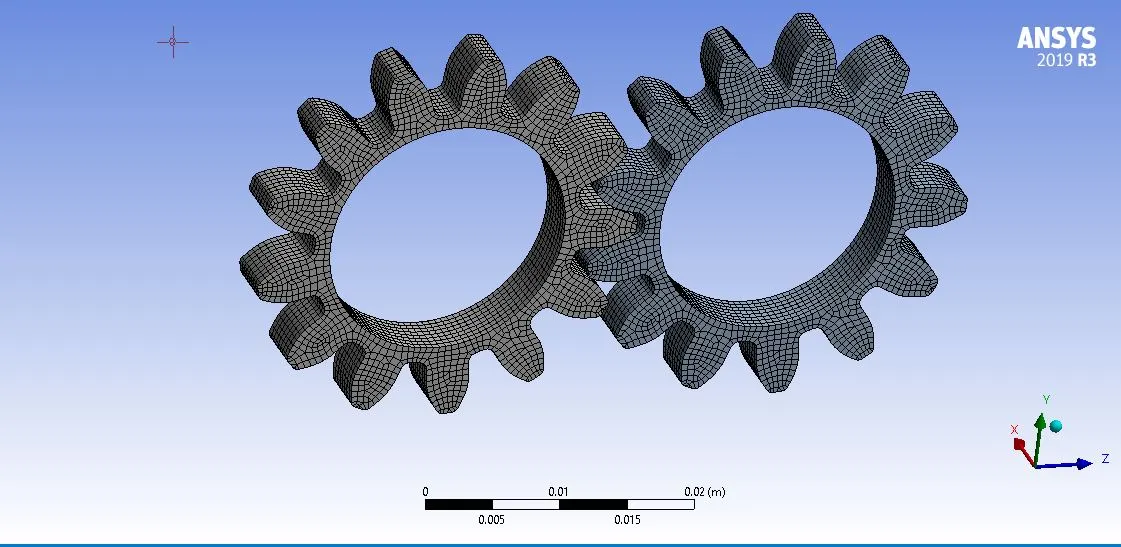
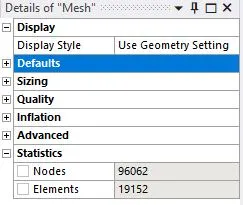
The appropriate element size was finalized by iteration 0.5 mm element size was finalized and the total no of nodes and elements are shown below.
The meshed model image and mesh metric graph can be seen below:
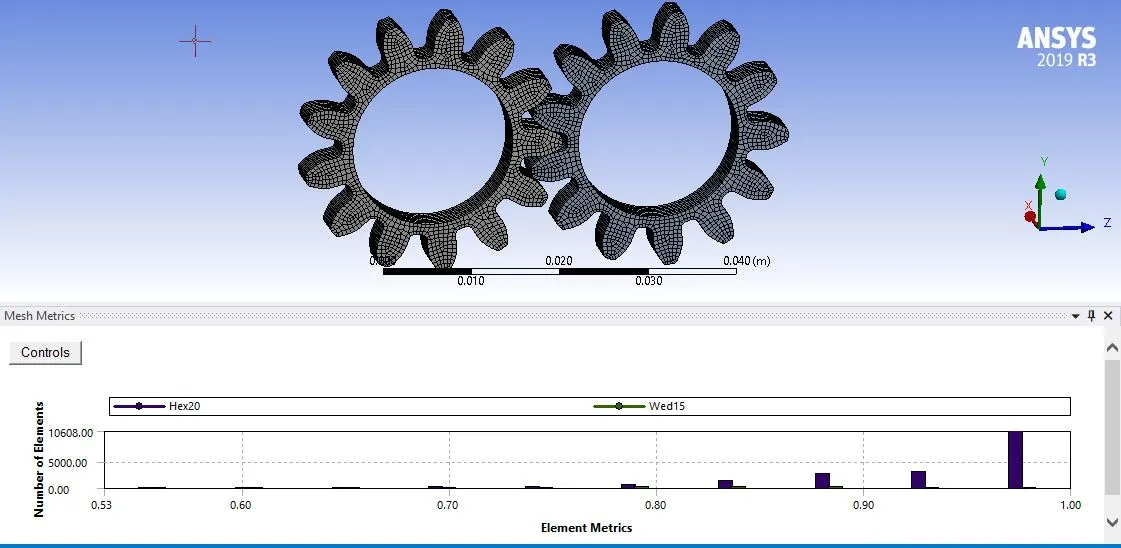
The mesh metric is utilized to identify the elements according to their quality. The quality of the mesh is acceptable as most of the elements lie within a high-quality range of 0.8-1.0.
Analytical settings:
To achieve static equilibrium and carry out static simulation at each time instant the configuration fo the gears id defined at the end and beginning of each step. Both the gears are jointed to the ground body with the help of revolute bodies for rotation about their own axis.
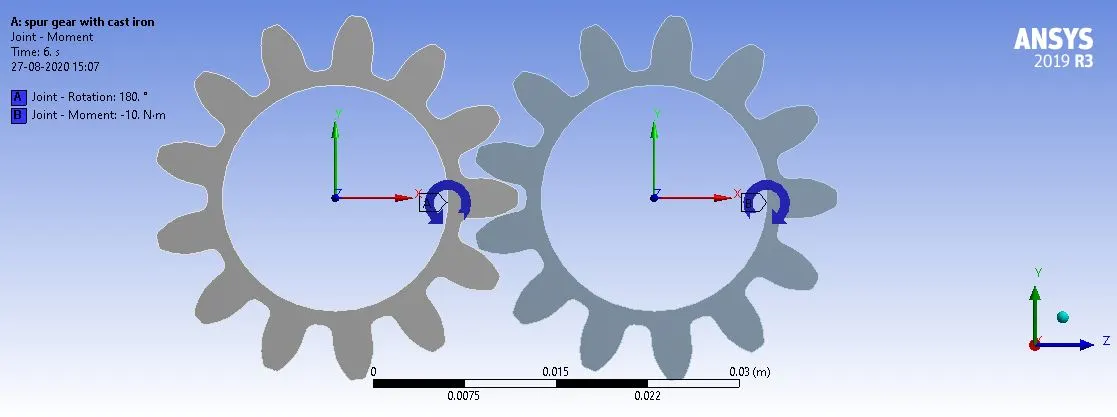
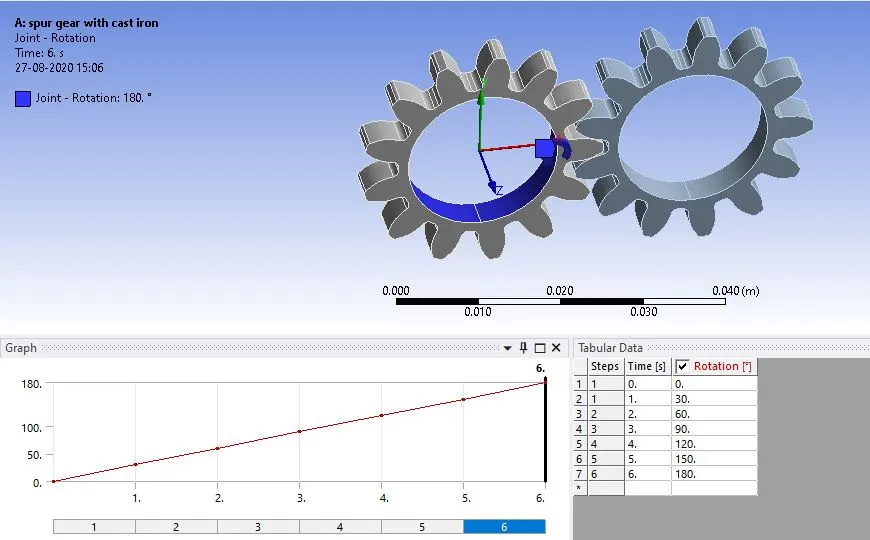
The rotation of each spur gear is divided into 6 steps with such a length of 1 second each and all steps are divided into time steps in which the solver performs a static stimulation and provides us the exact results.
The simulation runs at the end of each step and for each step the initial time step is 0.2 seconds, meaning that we also get results at (0.2,1.2,2.2,3.2,4.2)seconds. The time steps within the steps range from 0.05 seconds to 0.5 seconds
The left gear is held as the driven gear with its rotational motion, and at the beginning and end of each phase the driving right gear is defined.
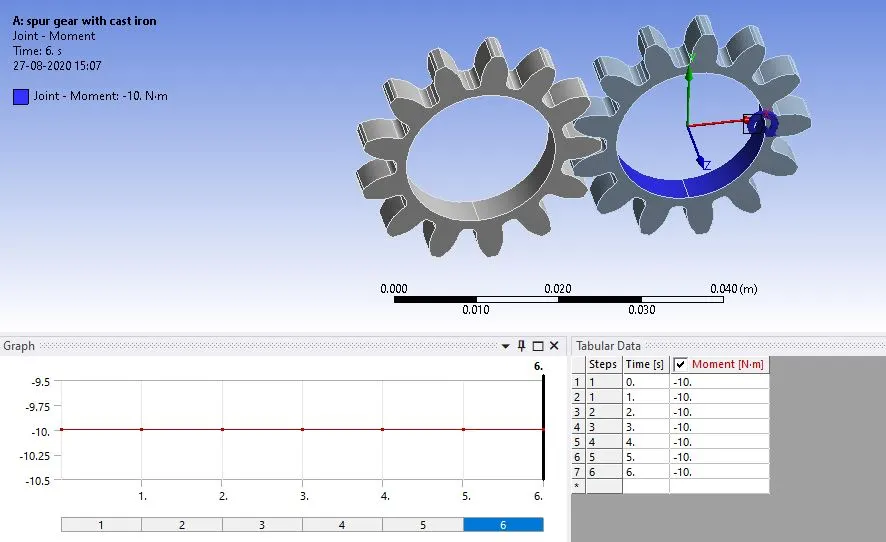
The right gear is maintained as the drive gear which induces a constant torque into its revolute joint. Since the torque at each stage is constant, the momentary joint load value of 10Nm is stated.
Results:
For each of the necessary outputs, the minimum, average and maximum values are determined at each time step and, in contrast, only the maximum output values are considered for simplicity
Case-1: Cast Iron
Cast-Iron:
Cast iron is a group of iron-carbon alloys with a carbon content of more than 2%. Its usefulness derives from its relatively low melting temperature. The alloy constituents affect its color when fractured: white cast iron has carbide impurities which allow cracks to pass straight through, grey cast iron has graphite flakes which deflect a passing crack and initiate countless new cracks as the material breaks, and ductile cast iron has spherical graphite "nodules" which stop the crack from further progressing.
Total deformation:
The total deformation gives the outputs for all directions for each node in the mesh generation data.
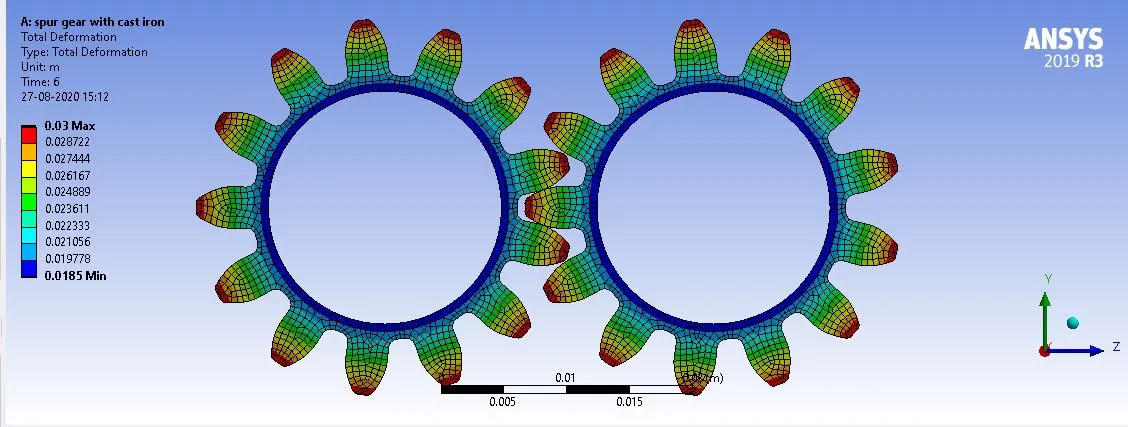
Max and Min values for the Total deformation:
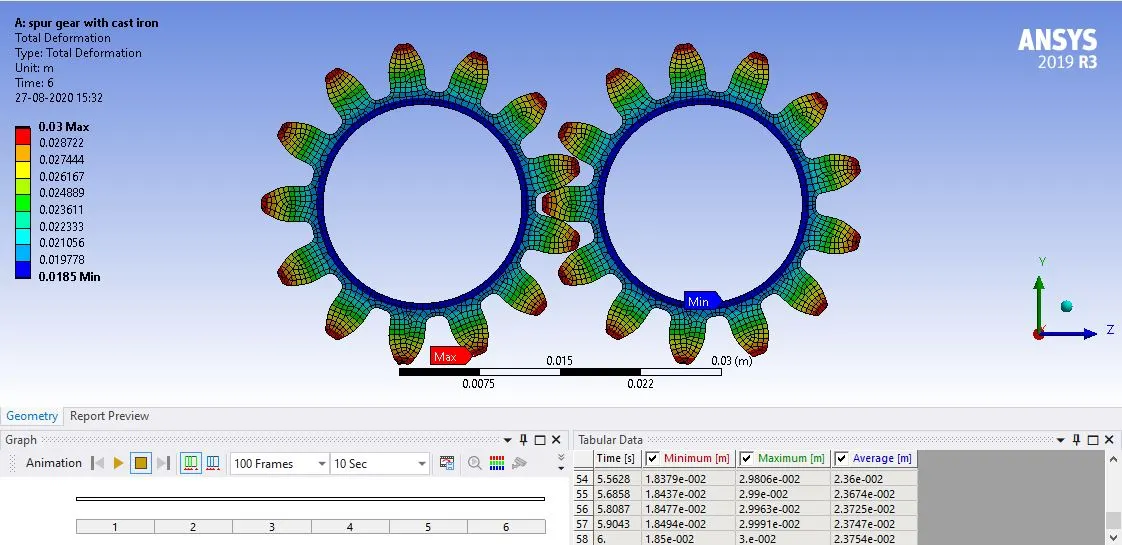
The max total deformation values are shown above in the figure.
Animation for the total deformation for the cast iron:
Equivalent Stress:
As the name suggests, the equivalent non-directional stress values produced in the material of the gear were. More simply it is the energy of distortion / Shear strain in the gear.
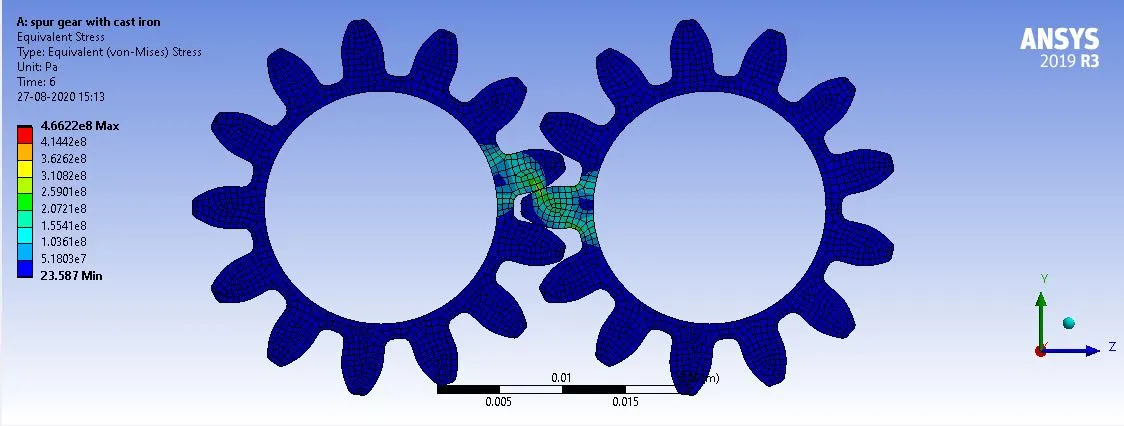
Max and Min values for Equivalent Stress:
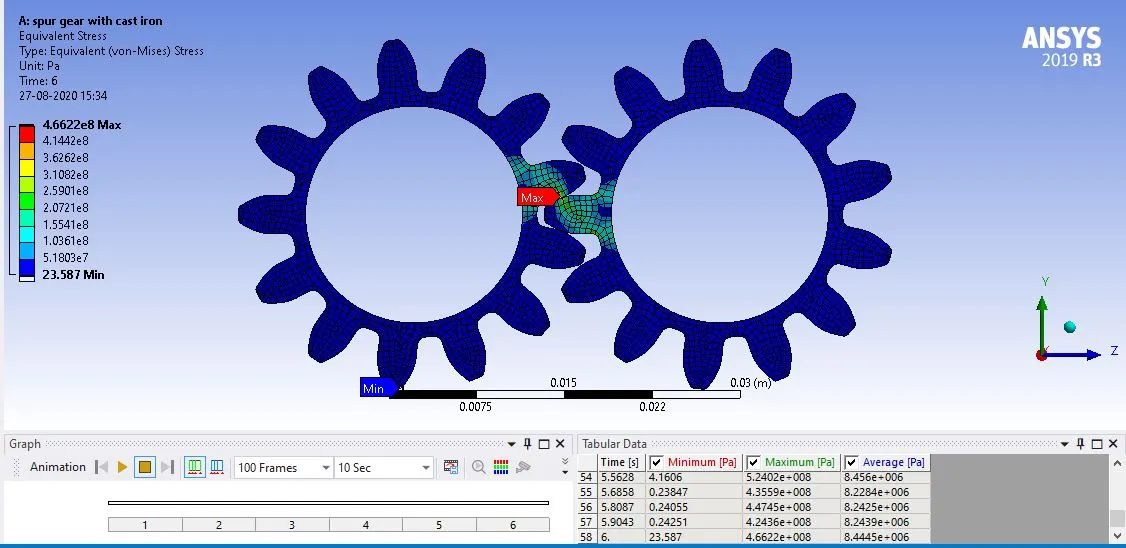
Animation for the Equivalent stress for the cast iron:
Stress Intensity:
The stress intensity is a measure of the stress fields and distribution around a formed crack in terms of fracture mechanics and is a fundamental parameter used to study crack propagation leading to failure.
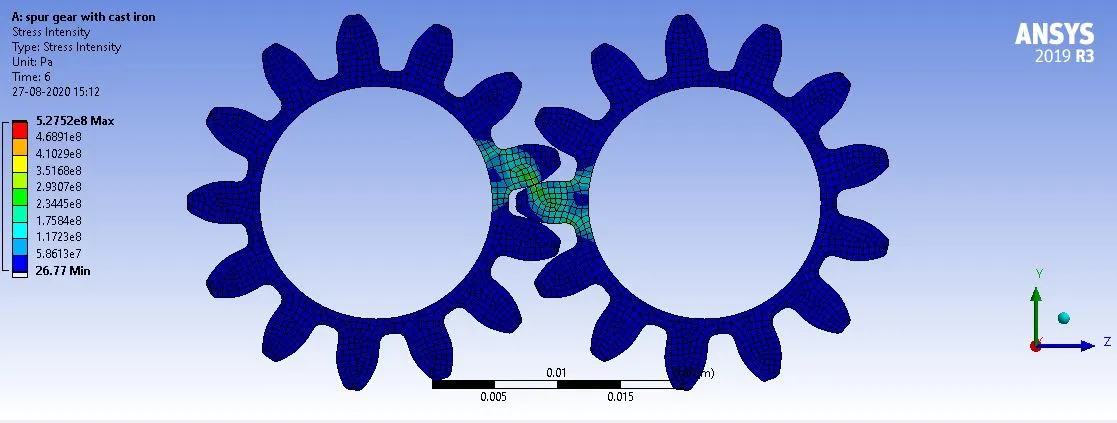
Max and min values of Stress Intensity:
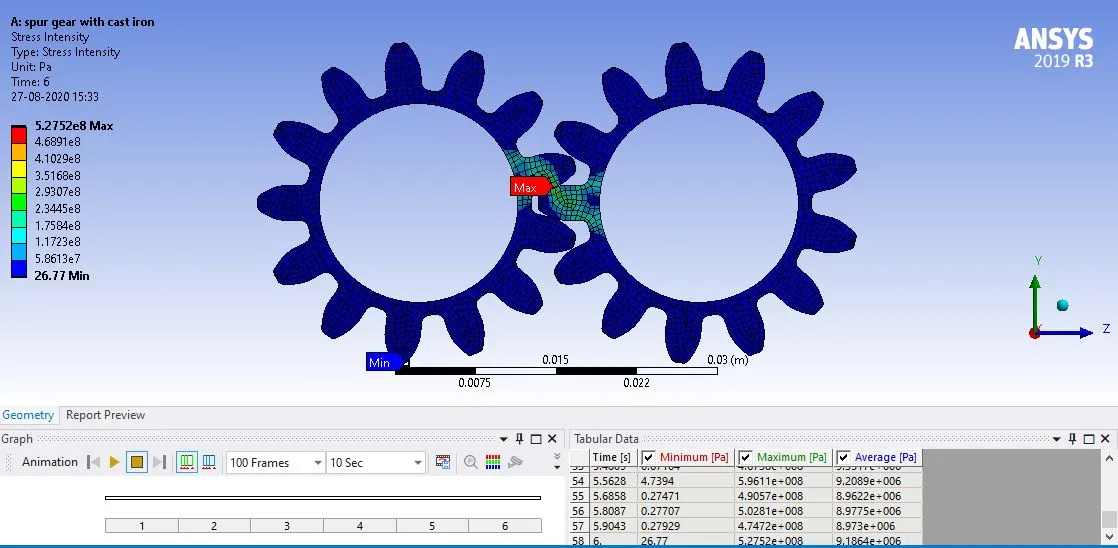
Animation for the stress Intensity for the cast iron:
Case-2: Cast Steel
Cast-steel:
Cast steel is a ferrous alloy with a maximum carbon content of approximately 0.75%. Steel castings are solid metal objects produced by filling the void within a mold with liquid steel. They are available in many of the same carbon and alloy steels that can be produced as wrought metals.
Total deformation:
The total deformation gives the outputs for all directions for each node in the mesh generation data.
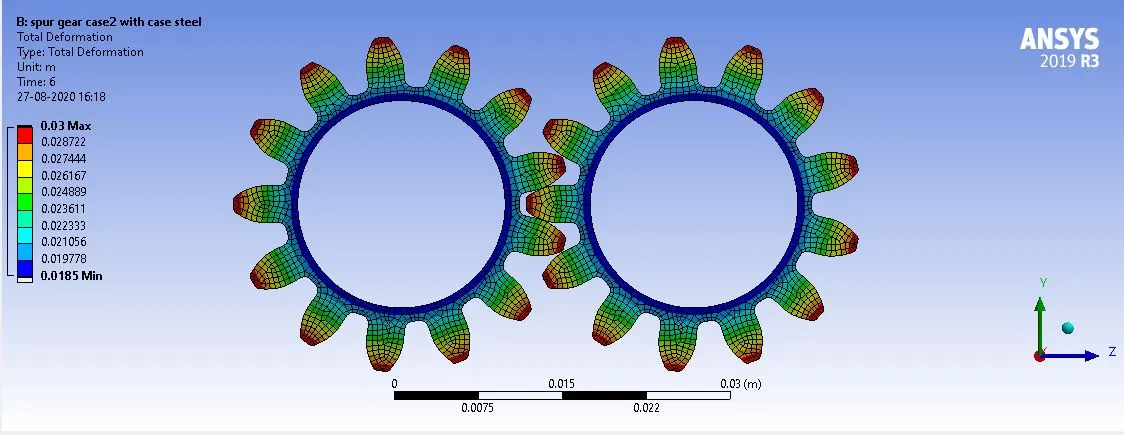
Max and Min values for the Total deformation:
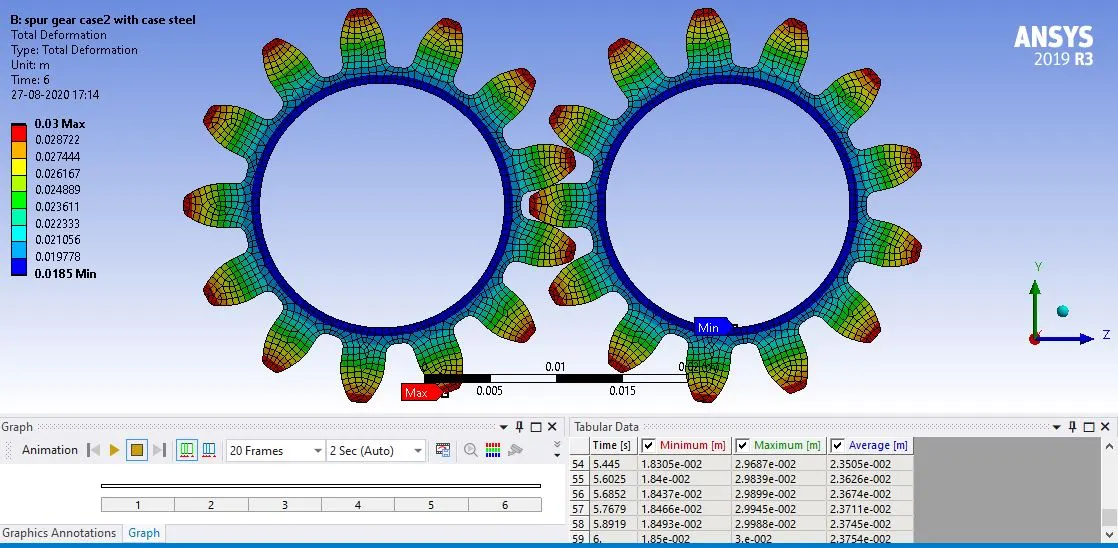
The max total deformation values are shown above in the figure.
Animation for the total deformation for the cast Steel:
Equivalent Stress:
As the name suggests, the equivalent non-directional stress values produced in the material of the gear were. More simply it is the energy of distortion / Shear strain in the gear.
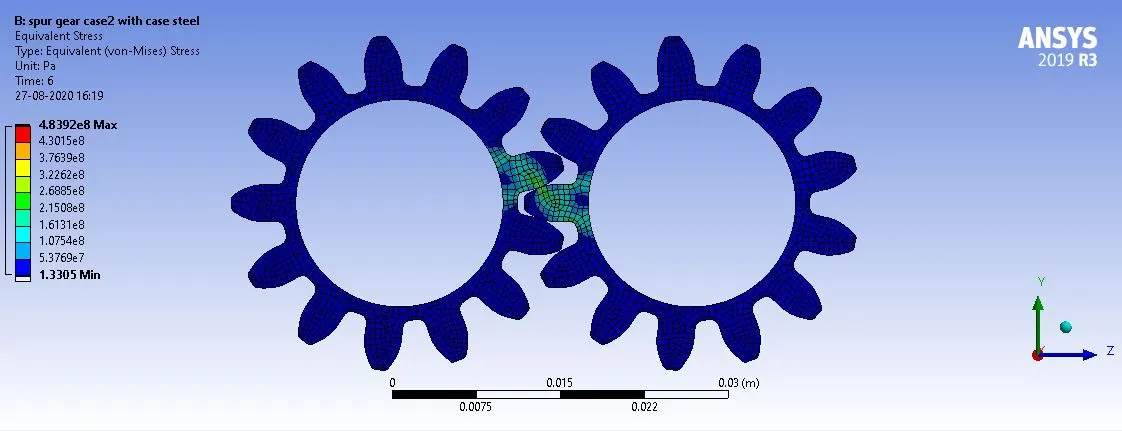
Max and Min values for Equivalent Stress:
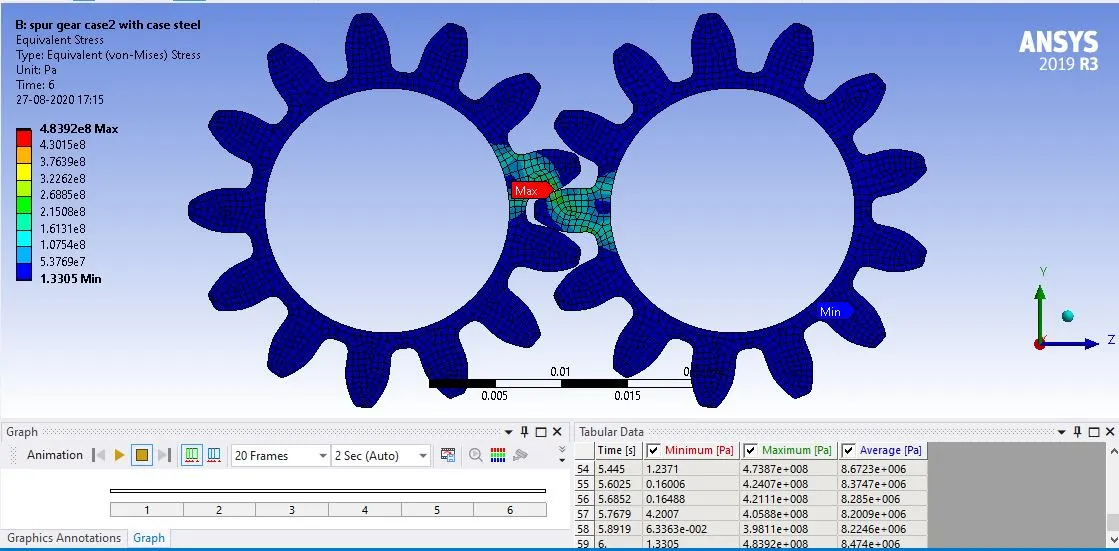
Animation for the Equivalent stress for the cast Steel:
Stress Intensity:
The stress intensity is a measure of the stress fields and distribution around a formed crack in terms of fracture mechanics and is a fundamental parameter used to study crack propagation leading to failure.
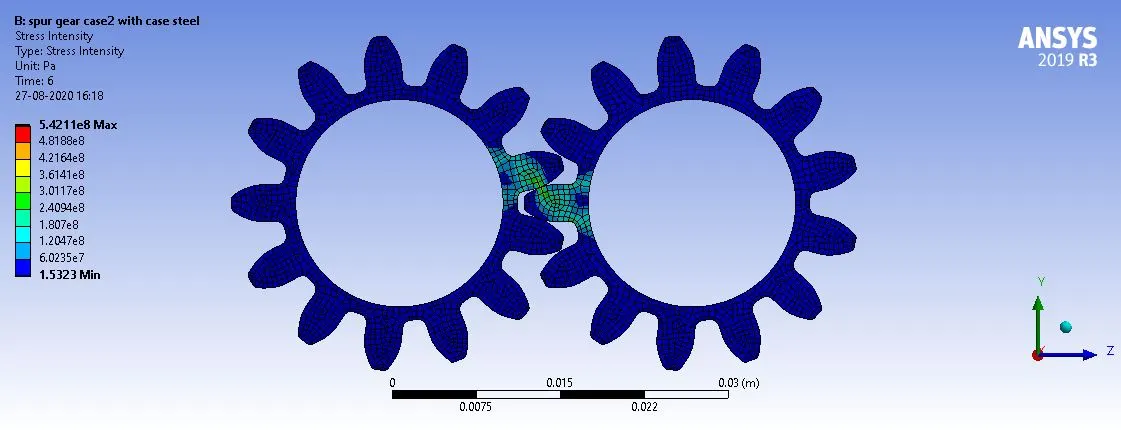
Max and min values of Stress Intensity:
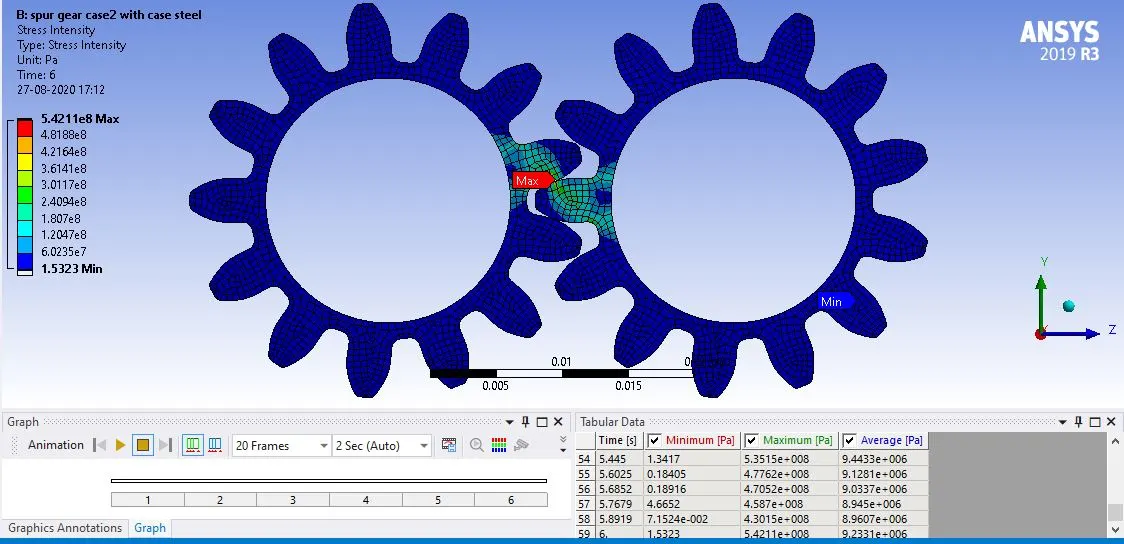
Animation for the stress Intensity for the cast steel:
Case-3: Bronze Steel
Cast Bronze :
Bronze is the most popular metal for cast metal sculptures a cast bronze sculpture is often called simply a "bronze". It can be used for statues, singly or in groups, reliefs, and small statuettes and figurines, as well as bronze elements, to be fitted to other objects such as furniture.
Total deformation:
The total deformation gives the outputs for all directions for each node in the mesh generation data.
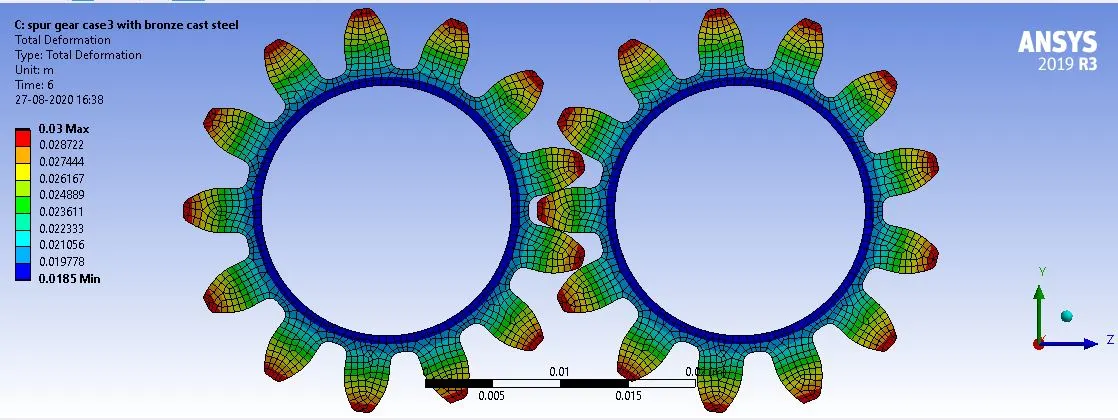
Max and Min values for the Total deformation:
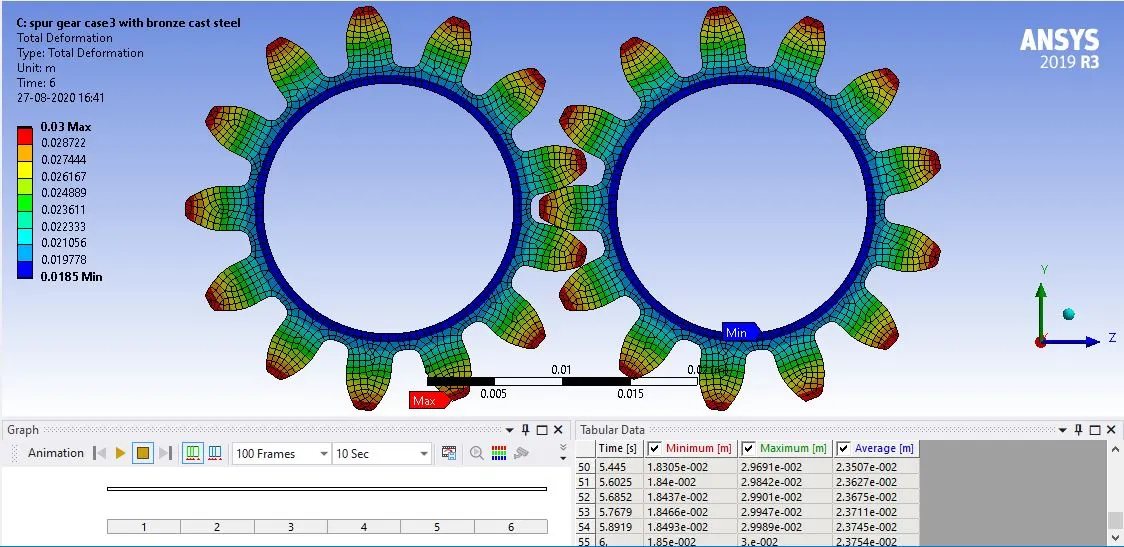
The max total deformation values are shown above in the figure.
Animation for the Equivalent stress for the Bronze steel:
Equivalent Stress:
As the name suggests, the equivalent non-directional stress values produced in the material of the gear were. More simply it is the energy of distortion / Shear strain in the gear.
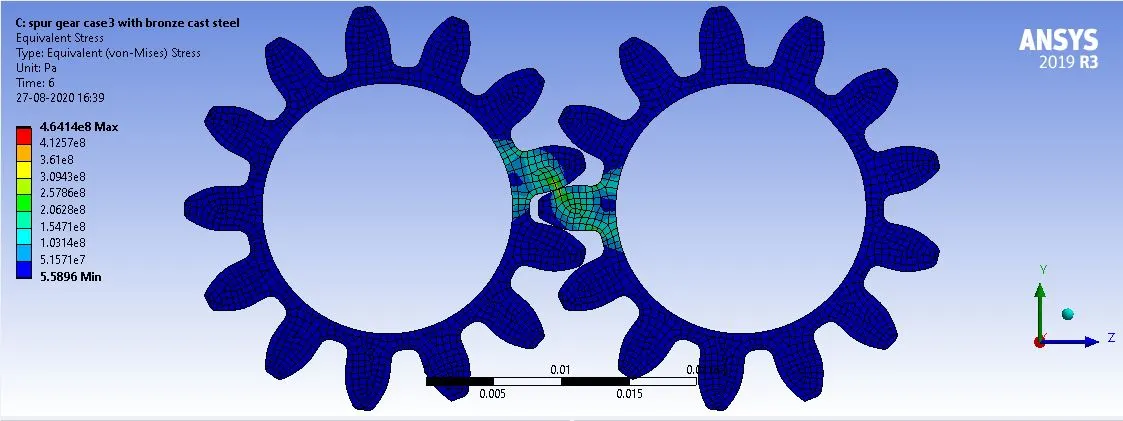
Max and Min values for Equivalent Stress:
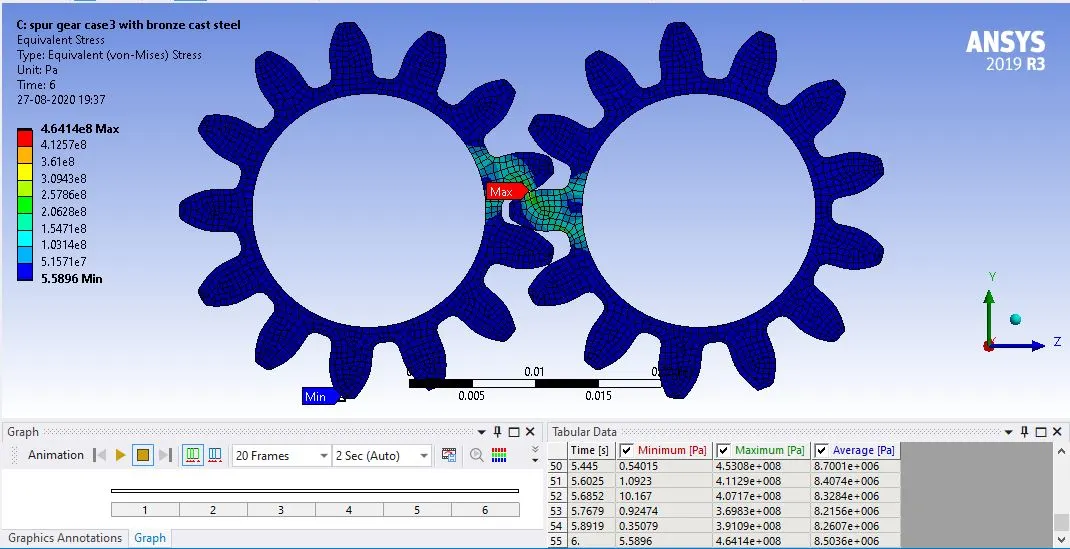
Animation for the Equivalent stress for the Bronze Steel:
Stress Intensity:
The stress intensity is a measure of the stress fields and distribution around a formed crack in terms of fracture mechanics and is a fundamental parameter used to study crack propagation leading to failure.
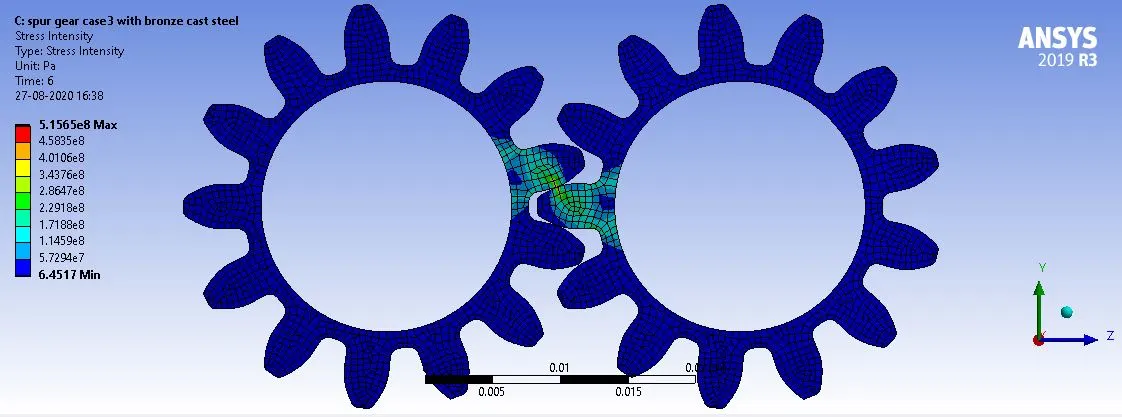
Max and Min values for Stress Intensity:
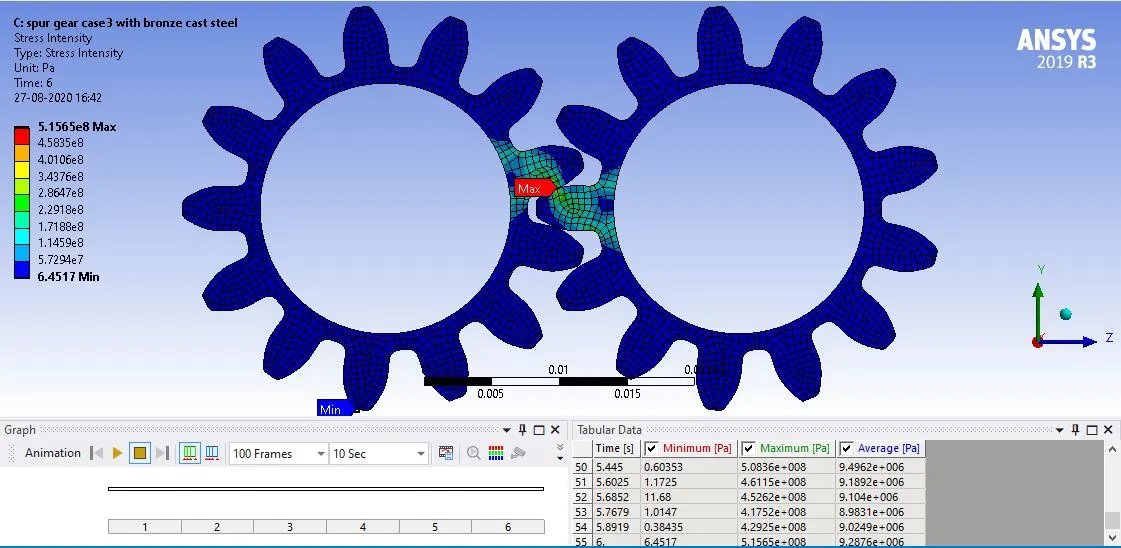
Animation for the stress Intensity for the Bronze steel:
Graphs:
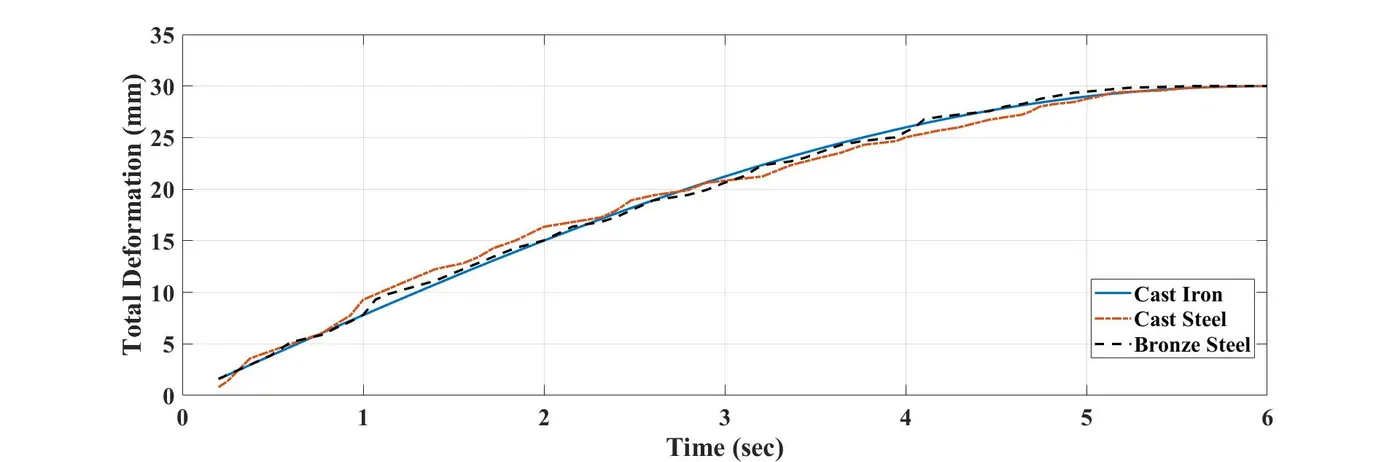
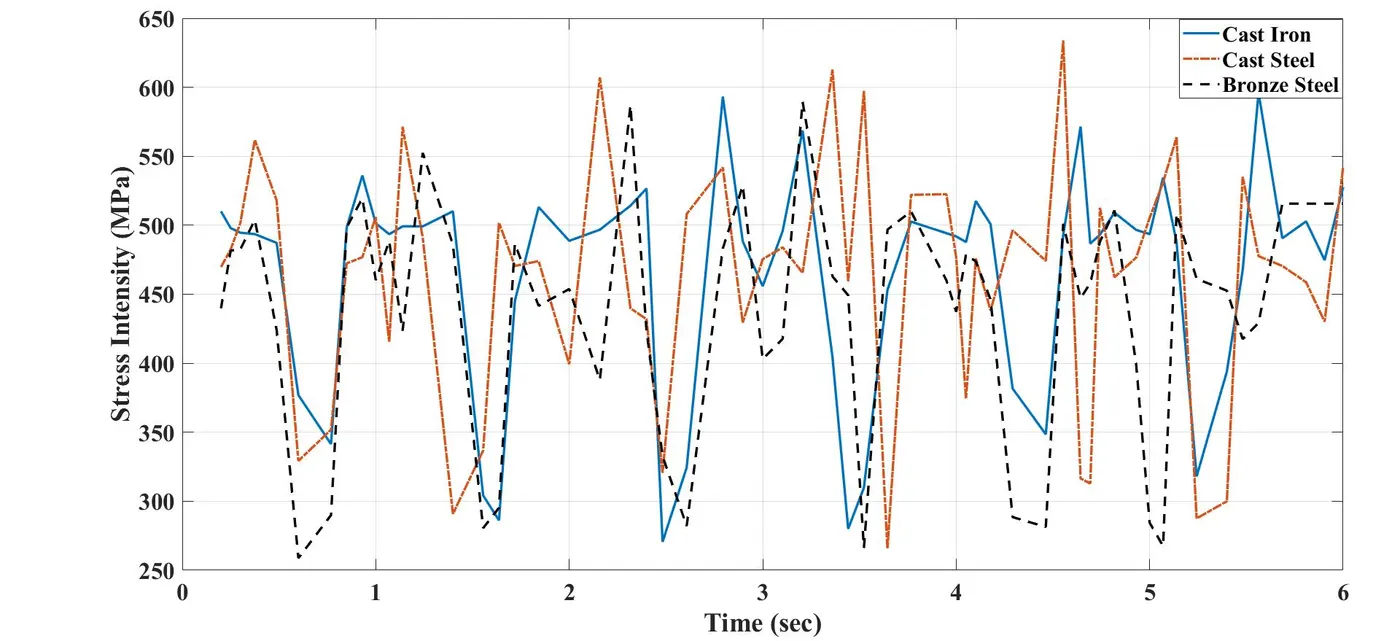
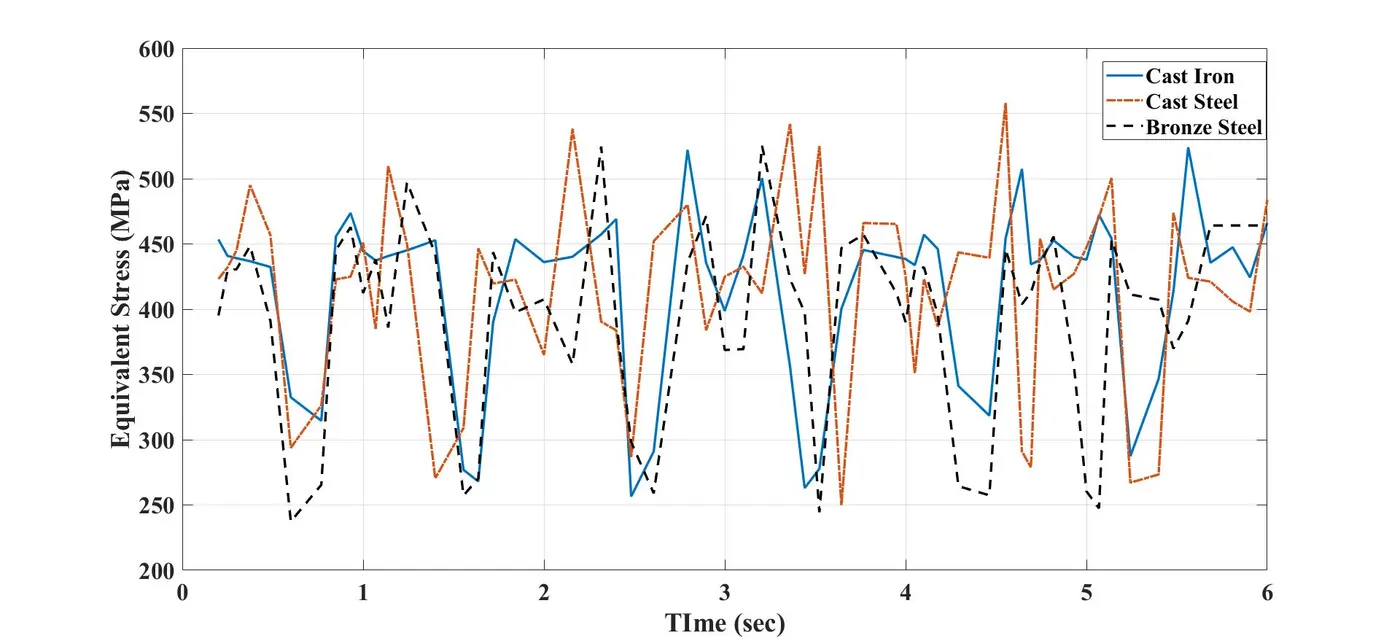
The maximum values of the three variables were made into consideration accordingly as per the materials that have been shown below
Total deformation
Stress Intensity:
Equivalent Stress:
Conclusion:
we have converted the units
Meter to Millimeter and Pascal to Mega-pascals
| Title | Cast iron (Ductile) | Cast steel | Cast Bronze |
| Maximum Total Deformation (mm) | 30 | 30 | 30 |
| Max Equivalent VM Stress (MPa) | 466.22 | 483.92 | 464.14 |
| Max Stress Intensity (MPa) | 527.52 | 542.11 | 515.65 |
At the root of the tooth is most likely to occur crack. Since stress intensity is often used in the process of fracture where the greater the pressure the greater the probability of fracture occurring.
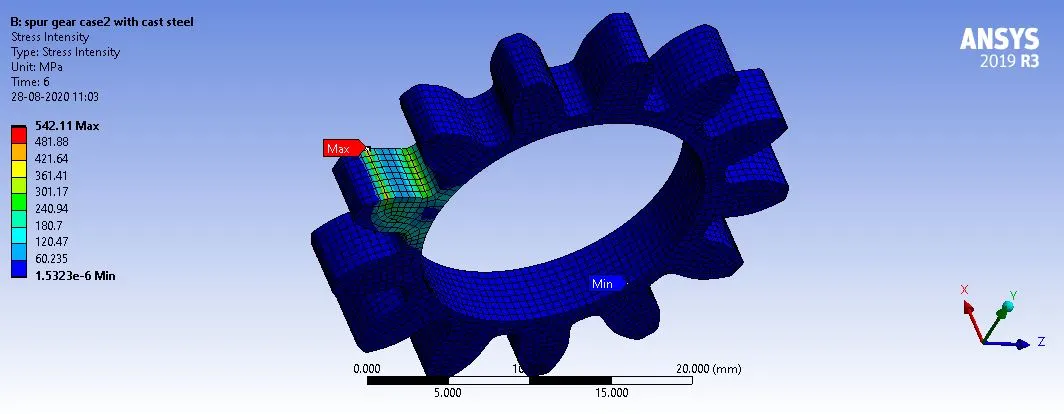
Therefore the stress intensity for cast steel is maximum such that it is likely to fail under the same load. Consideration of affordability and availability cast iron should be used, but in the case of machinability, bronze should be used because it is more ductile than cast-iron.