Week 1 Spur Gear Challenge
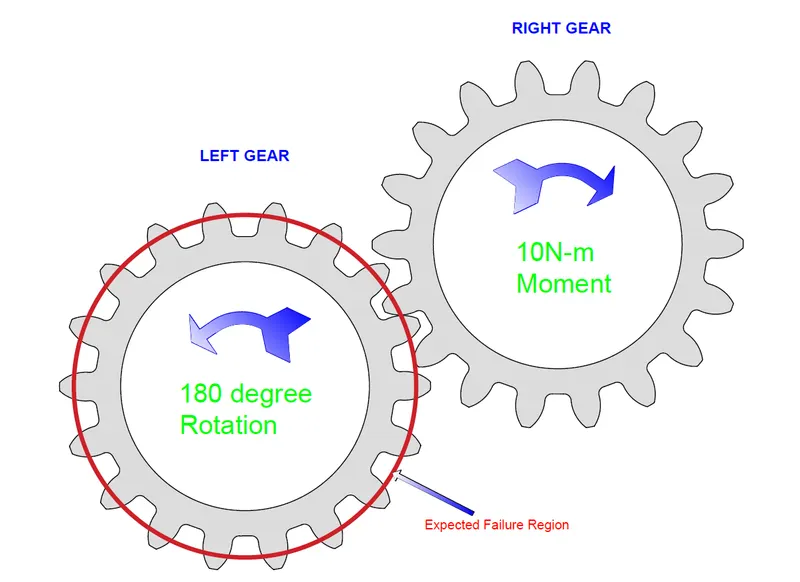
Objective: To recommend material (Cast Iron, Bronze and Steel) based on static structural analysis for Equivalent stress, Total deformation and Stress intensity and to locate possible fracture of the given spur gears.
Software Used: Ansys Workbench.
Given Materials: Cast iron, Bronze and Steel.
Theory
Cast Iron
Cast iron is a group of iron-carbon alloys with a carbon content of more than 2%. Its usefulness derives from its relatively low melting temperature. Iron alloys with lower carbon content are known as steel. Cast iron tends to be brittle, except for malleable cast irons.
Carbon (C) from 1.8 to 4% by weight and silicon (Si) from 1 to 3% by weight are the most important alloying elements of cast iron.
Cast iron tends to be brittle, with the exception of malleable cast iron. With its relatively low melting point, good flowability, castability, excellent machinability, resistance to deformation and wear resistance.
Types Of Cast Iron
There are four types of main cast Iron as explain below:
- Gray Cast iron
- White Cast iron
- Malleable Cast Iron
- Ductile Cast iron
Bronze
Bronze is an alloy consisting primarily of copper, commonly with about 12–12.5% tin and often with the addition of other metals (such as aluminium, manganese, nickel or zinc) and sometimes non-metals or metalloids such as arsenic, phosphorus or silicon. These additions produce a range of alloys that may be harder than copper alone, or have other useful properties, such as strength, ductility, or machinability.
Bronzes are typically ductile alloys, considerably less brittle than cast iron. They are generally about 10 percent denser than steel. Bronze is a better conductor of heat and electricity than most steels
Types of Bronze:
- Silicon Bronze
- Phosphor Bronze
- Aluminium Bronze
- Manganese Bronze
- Bearing Bronze
- Copper-Nickel
- Bismuth Bronze
Steel
Steel is an alloy made up of iron with typically a few tenths of a percent of carbon to improve its strength and fracture resistance compared to other forms of iron. Many other elements may be present or added. Stainless steels that are corrosion and oxidation-resistant need typically an additional 11% chromium.
Types of Steel:
- Carbon Steel
- Alloy Steel
- Tool Steel
- Stainless Steel
Physical Properties of Materials:
|
Properties |
Cast Iron |
Bronze |
Steel |
|
Tensile strength (MPa) |
250 |
620-740 |
276-1882 |
|
Young’s Modulus (GPa) |
105 |
116-124 |
190-210 |
|
Poisson’s ratio |
0.33 |
0.30 |
0.27-0.3 |
|
Hardness (HB) |
179-202 |
170-187 |
86-388 |
|
Heat Conductivity (W/mK) |
48 |
38-42 |
25 |
Equivalent Stress:
In evaluation of stress results, we need 9 contour plots to visualize stress tensor. Equivalent stress allows one to view stress of the structure by one plot. Equivalent stress can be used as a scalar indicator to determine material failure. Von Mises stress is best explained in principal coordinate system, because of easier visualization. Equivalent stress is widely used to represent a material’s status for ductile material.
Equivalent Strain:
A scalar quantity called the equivalent strain, or the von Mises equivalent strain, is often used to describe the state of strain in solids.
Total Deformation:
A total deformation theory capable of analysing a sequence of linear non-proportional load steps is proposed. This method estimates the necessary stress fields using conventional deformation plasticity. These stresses are then used in the proposed total deformation formulation to predict plastic strains.
Analysis:
Boundary Conditions:
- Required material is applied.
- An anti-clockwise rotation of 180 degree is applied to left gear.
- 10 N-m Moment is given to right gear.
Mesh Size: 1mm
Case-1: Cast Iron spur gears with 10 N-m Moment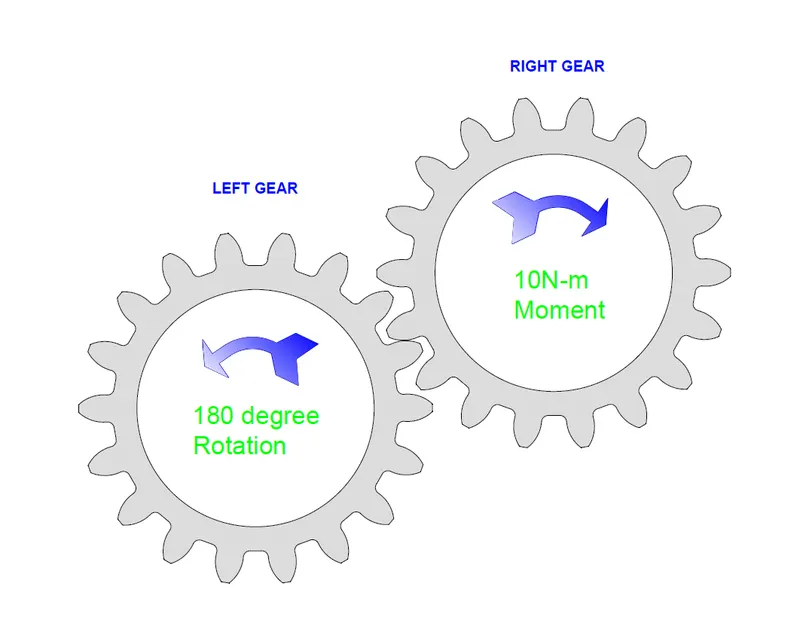
Results:
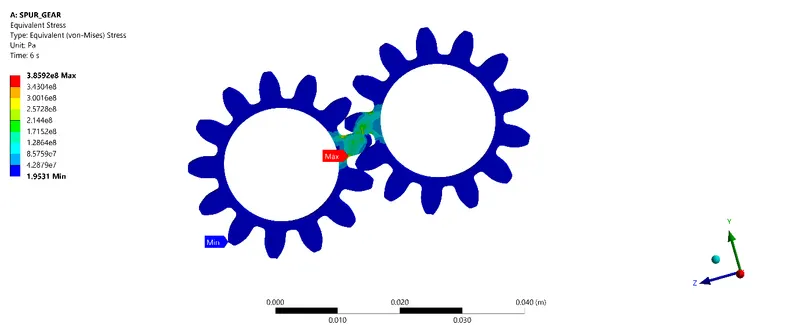
1. Equivalent Stress.
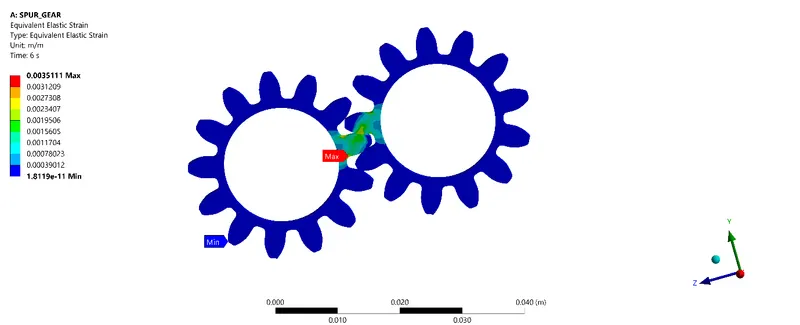
2. Equivalent Strain
3. Total Deformation.
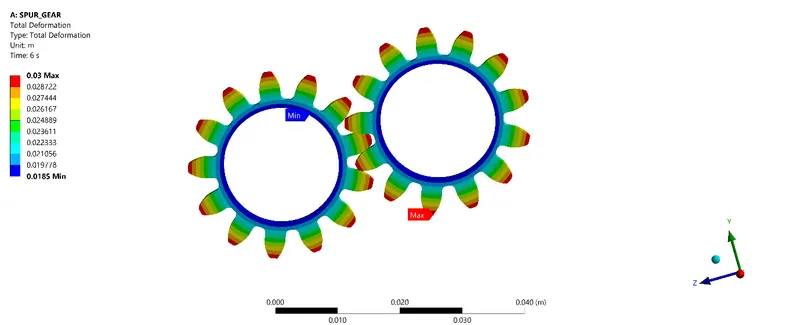
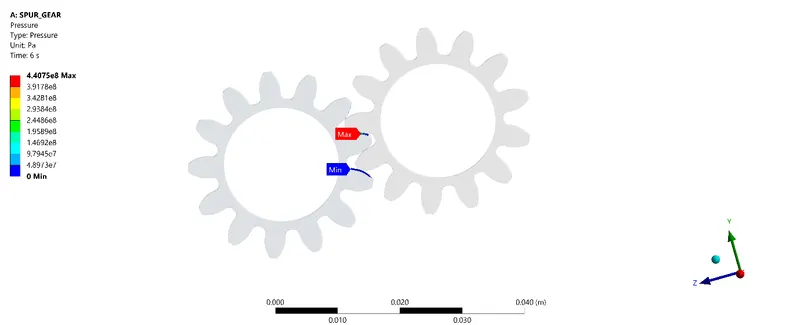
4. Pressure
Case-2: Bronze spur gears with 10 N-m Moment
Results:
1. Equivalent Stress
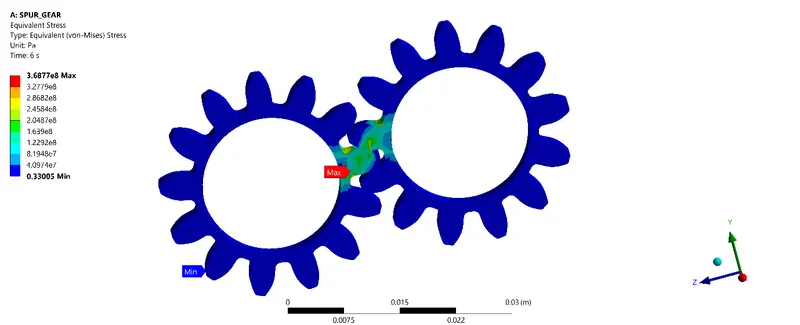
2. Equivalent Strain
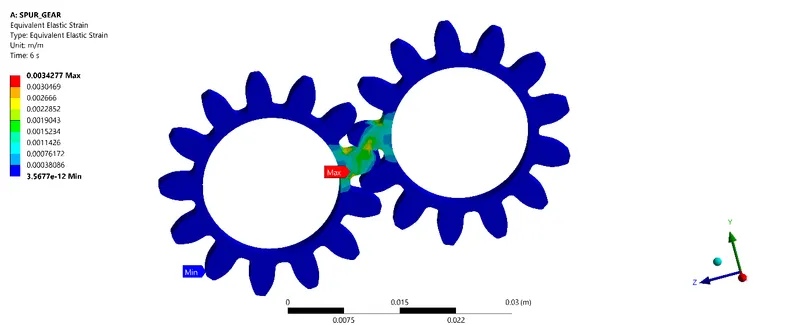
3. Total Deformation
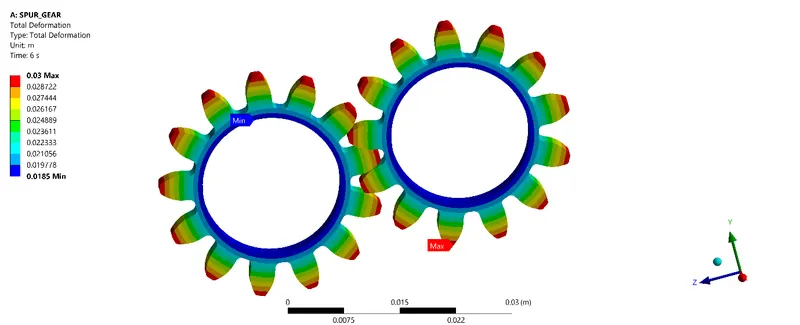
4. Pressure
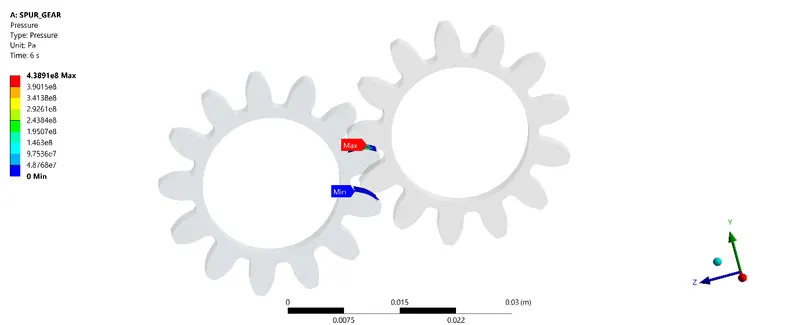
Case-3: Steel spur gears with 10 N-m Moment
Results:
1. Equivalent Stress
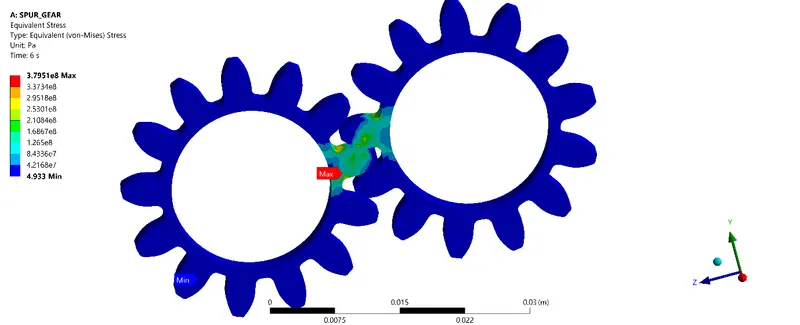
2. Equivalent Strain
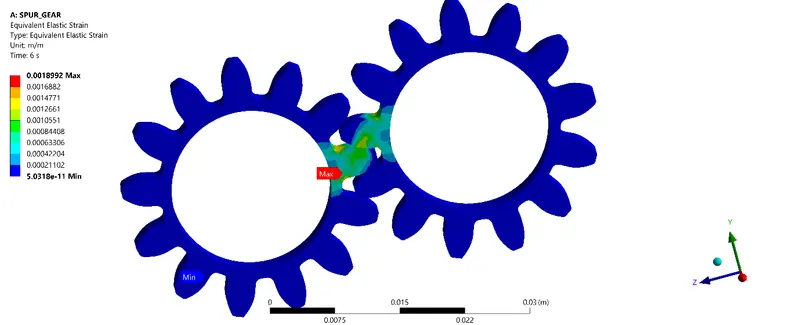
3. Total Deformation
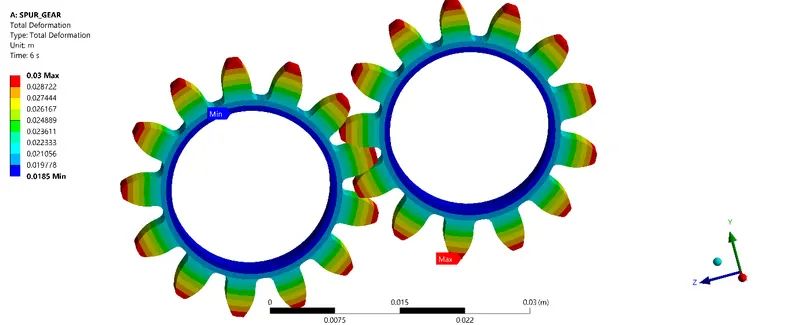
4. Pressure
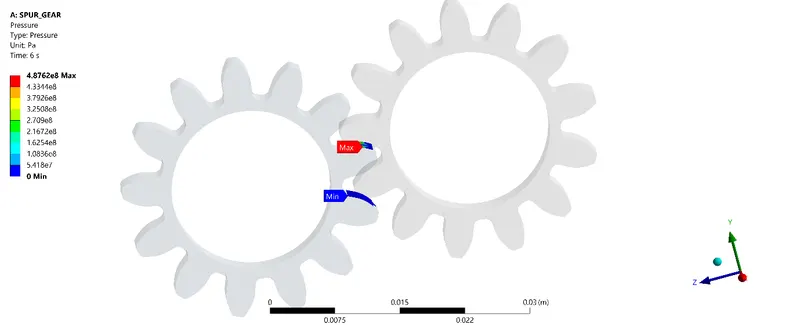
Overall Result:
|
S.No |
Type of Analysis/Material |
Cast Iron |
Bronze |
Steel |
|||
|
Max |
Min |
Max |
Min |
Max |
Min |
||
|
1 |
Equivalent Stress (Pa) |
3.8592e8 |
1.9531e8 |
3.6877e8 |
0.33005 |
3.7951e8 |
4.933 |
|
2 |
Equivalent Elastic Strain (m/m) |
0.0035111 |
1.811e-11 |
0.0034277 |
3.5677e-12 |
4.3891e8 |
5.0318e-11 |
|
3 |
Total Deformation (m) |
0.03 |
0.0185 |
0.03 |
0.0185 |
0.03 |
0.0185 |
|
4 |
Pressure (Pa) |
4.4075e8 |
0 |
4.3891e8 |
0 |
4.8762e8 |
0 |
Conclusion:
Considering 4 physical properties of Materials and its values after analysis, it is clear that bronze has less accumulated stress and strain comparing to cast iron and steel.
Hence, I recommend bronze as a material for the given spur gears.
Failure Region: