Week 1:- Introduction to BiW and Fixtures Challenge
- What is BIW & define its parts?
BIW stands for "Body in White" in the automotive industry. It refers to the stage in the manufacturing process where a car body's sheet metal components have been assembled but before any painting or trim has been applied. The term "Body in White" comes from the fact that the car body is typically unpainted at this stage, and it usually consists of welded metal components.
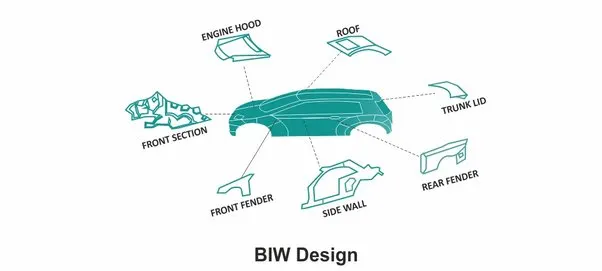
The key parts of the BIW include:
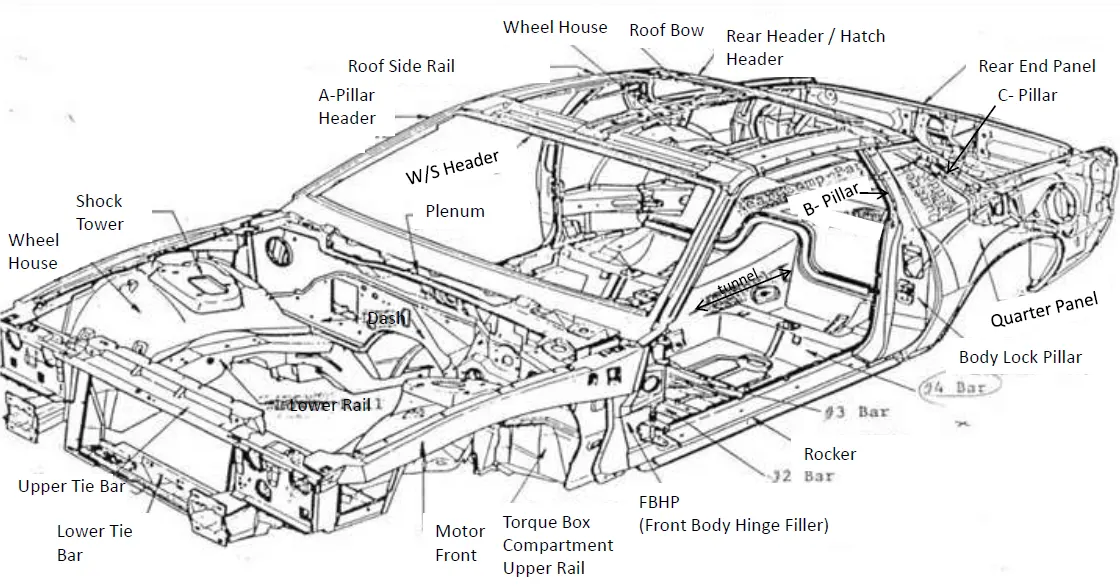
1. **Body Structure:**
- **Frame/Chassis:** The frame or chassis forms the structural foundation of the vehicle. It provides support and rigidity to the entire structure.
- **Body Panels:** These are the outer metal panels that form the shape of the car. Examples include the roof, doors, hood, fenders, and trunk.
2. **Closure Panels:**
- **Doors:** Attached to the body structure, doors are an essential part of the BIW. They include inner and outer panels, hinges, latches, and other components.
- **Hood:** The front cover of the engine compartment.
- **Trunk Lid:** The rear cover of the cargo area.
3. **Interior Components:**
- **Pillars:** Vertical supports that connect the roof to the body structure. Common pillars include A-pillars (front), B-pillars (between front and rear doors), C-pillars (at the rear of the car).
- **Floor Pan:** The bottom part of the vehicle that provides a foundation for the seats and other interior components.
4. **Welded Joints and Seam Sealing:**
- The various components are joined using welding techniques. Welded joints are crucial for the structural integrity of the BIW.
- Seam sealing is applied to protect against corrosion and to provide a finished appearance.
5. **Structural Reinforcements:**
- In some cases, additional components such as braces, gussets, and reinforcements are added to enhance the overall strength and safety of the vehicle.
6. **Roof Structure:**
- The roof structure includes the roof panel and its supporting components. Convertible models will have a different roof structure.
7. **Suspension Mounting Points:**
- Mounting points for the suspension system are integrated into the BIW to connect the body to the vehicle's wheels and provide support for the suspension components.
8. **Apertures:**
- Openings for windows, doors, and other features are included in the BIW.
The Body in White assembly is a critical phase in automotive manufacturing, setting the stage for subsequent processes such as painting, assembly of the vehicle's interior, and the installation of various components and systems
BIW stands for "Body in White" in the automotive industry. It refers to the stage in the manufacturing process where a car body's sheet metal components have been assembled but before any painting or trim has been applied. The term "Body in White" comes from the fact that the car body is typically unpainted at this stage, and it usually consists of welded metal components.
2 .What do you understand by BIW nomenclature?
In the context of automotive manufacturing, BIW nomenclature refers to the naming or identification system used for different components and parts within the Body in White (BIW) stage of the vehicle production process. This system helps streamline communication, documentation, and assembly by providing a standardized way to refer to specific elements of the car body.
BIW nomenclature typically involves a combination of letters, numbers, and codes to uniquely identify each component. The naming convention may vary between automotive manufacturers, but it generally follows a systematic approach. For example:
1. **Alphanumeric Codes:** Components may be assigned alphanumeric codes to represent different categories or types of parts. For instance, "A" might represent body panels, "C" could stand for closures (doors, hood, trunk), and "F" might denote the floor pan.
2. **Numeric Sequences:** Numeric sequences may be used to differentiate between specific components within a category. For example, within the "A" category for body panels, "A001" could represent the front fender, while "A002" might be the rear door panel.
3. **Abbreviations:** Abbreviations or acronyms might be used to represent certain features or materials used in the BIW. For instance, "HSS" could stand for High-Strength Steel, and "AL" might represent Aluminum.
4. **Location Indicators:** Codes or letters may be used to indicate the location of a specific component on the vehicle. For example, "L" might denote the left side, and "R" could represent the right side.
5. **Modification or Variation Codes:** Additional codes may be added to indicate specific modifications, variations, or options for a particular component. This is especially relevant when different models or trim levels share a common BIW but have slight variations.
A standardized BIW nomenclature system helps ensure clarity and precision in communication among design engineers, manufacturers, suppliers, and other stakeholders involved in the automotive production process. It facilitates efficient assembly, quality control, and documentation, ultimately contributing to the overall effectiveness of the manufacturing workflow.
3.What is fixture & its types?
In manufacturing and assembly processes, a fixture is a specialized tool or device used to securely hold and locate a workpiece during machining, assembly, inspection, or other industrial processes. Fixtures are designed to ensure accuracy, repeatability, and efficiency in the production of parts. They play a crucial role in maintaining the proper alignment and positioning of workpieces, reducing errors, and improving overall productivity. There are various types of fixtures based on their specific applications:
1. **Jigs:**
- **Definition:** A jig is a type of fixture that guides and supports tools, allowing for the precise positioning and alignment of the workpiece.
- **Application:** Jigs are commonly used in machining operations, such as drilling, milling, and welding, to control the movement of cutting tools.
2. **Fixtures:**
- **Definition:** Fixtures are devices used to securely hold and support a workpiece during manufacturing or assembly processes. Unlike jigs, fixtures primarily focus on holding the workpiece in place.
- **Application:** Fixtures are used in various processes, including welding, assembly, and inspection, to ensure accurate and repeatable positioning of parts.
3. **Assembly Fixtures:**
- **Definition:** Assembly fixtures are specialized fixtures designed for the assembly of multiple components. They provide precise positioning and alignment to facilitate the assembly process.
- **Application:** Assembly fixtures are commonly used in industries such as automotive manufacturing for assembling components like chassis, body panels, and other complex structures.
4. **Welding Fixtures:**
- **Definition:** Welding fixtures are fixtures specifically designed for holding and aligning parts during welding processes. They ensure that components are securely positioned for accurate and consistent welds.
- **Application:** Welding fixtures are used in industries where welded assemblies are a critical part of the manufacturing process, such as automotive and aerospace.
5. **Machining Fixtures:**
- **Definition:** Machining fixtures are designed for use in machining operations, such as milling, drilling, or grinding. They securely hold the workpiece in place during these processes.
- **Application:** Machining fixtures are critical in precision machining industries to maintain tight tolerances and achieve accurate dimensions in the finished parts.
6. **Inspection Fixtures:**
- **Definition:** Inspection fixtures are used in quality control and inspection processes. They hold the workpiece in a specific orientation to facilitate accurate measurement and inspection.
- **Application:** Inspection fixtures are employed to ensure that manufactured parts meet specified tolerances and quality standards.
7. **CMM Fixtures (Coordinate Measuring Machine Fixtures):**
- **Definition:** CMM fixtures are designed for use with coordinate measuring machines. They securely hold parts in a fixed position to enable accurate measurement using a CMM.
- **Application:** CMM fixtures are crucial in industries where precise measurement and inspection of parts are essential, such as aerospace and precision engineering.
Fixtures are tailored to the specific needs of the manufacturing or assembly process, and their design is influenced by factors like the geometry of the workpiece, production volume, and the required level of precision.
4.What is the basic principle of fixture design?
The basic principle of fixture design revolves around ensuring that workpieces are securely and accurately held in a consistent position during manufacturing or assembly processes. The primary goals of fixture design are to enhance the efficiency of production, reduce errors, and improve the overall quality of the manufactured parts. Here are the fundamental principles of fixture design:
1. **Stability and Rigidity:**
- Fixtures must provide a stable and rigid support for the workpiece. This stability prevents movement during machining or assembly, ensuring that the part is held securely in place.
2. **Accuracy and Repeatability:**
- Fixtures should enable accurate positioning and alignment of the workpiece to meet design specifications. Repeatability ensures that the same accurate positioning can be achieved consistently for multiple parts.
3. **Accessibility:**
- The design should allow easy and unobstructed access to the workpiece for the necessary machining or assembly operations. This includes considerations for tool access, visibility, and ease of loading and unloading parts.
4. **Clamping and Locating:**
- Clamping elements secure the workpiece in place, while locating elements ensure proper alignment. The design must incorporate effective clamping and locating mechanisms to achieve the desired accuracy.
5. **Interchangeability:**
- Fixtures should be designed to accommodate variations in workpiece sizes and shapes, allowing for flexibility and adaptability. This is particularly important in environments with frequent changes in production requirements.
6. **Ergonomics:**
- Consideration should be given to the ease of use and safety for operators. Ergonomically designed fixtures contribute to a more efficient and comfortable working environment.
7. **Cost-Effectiveness:**
- Fixture design should strike a balance between functionality and cost. Optimal designs minimize material usage, simplify manufacturing processes, and reduce overall production costs.
8. **Standardization:**
- Standardizing fixture components where possible can streamline production and maintenance processes. Commonly used elements, such as clamps or locating pins, can be standardized to promote efficiency and reduce lead times.
9. **Modularity:**
- Modular fixture designs allow for flexibility and reusability. Components can be easily rearranged or replaced to accommodate different workpieces or changes in production requirements.
10. **Clear Documentation:**
- Thorough and clear documentation of fixture designs, including drawings and specifications, is essential. This documentation aids in manufacturing, maintenance, and troubleshooting.
11. **Balancing Forces:**
- Consideration should be given to balancing cutting forces, clamping forces, and other forces involved in the machining process to maintain stability and prevent distortion of the workpiece.
By adhering to these principles, fixture designers can contribute to the optimization of manufacturing processes, leading to increased productivity, improved product quality, and reduced lead times in production.
5.Elaborate types of BIW Stations?
In automotive manufacturing, the Body in White (BIW) assembly process involves various stations where different components of the car body are assembled and welded together. These stations are crucial for building the structural foundation of the vehicle. The specific types of BIW stations can vary depending on the manufacturing processes and the complexity of the vehicle design. Here are some common types of BIW stations:
1. **Blanking Station:**
- **Function:** This station involves the cutting of sheet metal blanks into the required shapes for forming different components of the car body. Presses and dies are often used in the blanking process.
2. **Piercing and Trimming Station:**
- **Function:** This station is dedicated to piercing holes and trimming excess material from the formed sheet metal components. It ensures that the components have the necessary openings and achieve the correct final shape.
3. **Punching Station:**
- **Function:** The punching station is responsible for creating holes, slots, or other openings in the sheet metal components. These openings are essential for accommodating various features and components in the final assembly.
4. **Flanging Station:**
- **Function:** Flanging involves forming a flange or a raised edge on the sheet metal. This station is used to create flanges that will later be used for joining or attaching components in the assembly process.
5. **Hemming Station:**
- **Function:** Hemming involves folding or bending the edges of sheet metal components to create a smooth and safe edge. This station ensures that edges are properly hemmed for safety and aesthetics.
6. **Spot Welding Station:**
- **Function:** Spot welding is a common method for joining sheet metal components in BIW assembly. This station is equipped with spot welding robots or machines that apply localized welds to bond components together.
7. **MIG/MAG Welding Station:**
- **Function:** Metal Inert Gas (MIG) or Metal Active Gas (MAG) welding stations use a continuous feed of wire to join metal components through a gas shield. These stations are used for welding seams and joints in the BIW assembly.
8. **Arc Welding Station:**
- **Function:** Arc welding stations use electric arcs to melt and join metal components. They are employed for specific welding applications in the BIW assembly process.
9. **Body Framing Station:**
- **Function:** This station is where the main structural frame of the vehicle is assembled. It involves joining various components, such as side rails and cross members, to form the basic structure of the car body.
10. **Closures Assembly Station:**
- **Function:** The closures assembly station focuses on assembling components like doors, hood, and trunk lid. Hinges, latches, and other necessary hardware are installed in this station.
11. **Underbody Assembly Station:**
- **Function:** In this station, the underbody components, including the floor pan, are assembled. This forms the base of the vehicle and provides additional structural support.
12. **Final Line Station:**
- **Function:** The final line station is where various BIW components come together for final assembly. This includes the integration of the chassis, powertrain, interior components, and finishing touches before the vehicle moves to the next stage of production.
These stations collectively contribute to the assembly of the Body in White, which serves as the foundation for the complete vehicle assembly process. Each station plays a specific role in shaping, joining, and preparing components for the next stage of manufacturing.
6.What are the basic terminologies used in the BIW fixture?
In the context of Body in White (BIW) fixtures, several basic terminologies are commonly used to describe components, features, and concepts related to the design and function of the fixtures. Here are some key terminologies used in BIW fixture:
1. **Locator:**
- **Definition:** A locator is a device or feature on the fixture designed to precisely position and align the workpiece in a specific orientation. It ensures accurate and repeatable placement of the part.
2. **Clamp:**
- **Definition:** A clamp is a mechanism used to secure the workpiece firmly in place within the fixture. Clamps prevent movement during machining or assembly processes.
3. **Datum:**
- **Definition:** A datum is a reference point or surface used as a base for measurements and alignments. In BIW fixtures, datums are critical for establishing a consistent coordinate system for accurate positioning.
4. **Index Pin:**
- **Definition:** An index pin is a cylindrical pin used for aligning and locating the workpiece. It helps ensure that the part is positioned correctly for machining or assembly operations.
5. **Gauge Hole:**
- **Definition:** A gauge hole is a precisely sized and located hole in the fixture used for verifying the accuracy of the workpiece dimensions. It allows for the inspection of critical features.
6. **Support Surface:**
- **Definition:** The support surface refers to the area of the fixture that contacts and supports the workpiece. It is designed to maintain stability and prevent deformation during machining or assembly.
7. **Shim:**
- **Definition:** Shims are thin, flat pieces inserted between the fixture and the workpiece to make fine adjustments in height or alignment. They help achieve the desired position and orientation.
8. **Locating Pin:**
- **Definition:** Similar to an index pin, a locating pin is a cylindrical pin used for accurately positioning and aligning the workpiece within the fixture.
9. **Toe Clamp:**
- **Definition:** A toe clamp is a type of clamp with a pivoting "toe" that presses against the workpiece. It is often used for securing irregularly shaped or contoured parts.
10. **Receiver:**
- **Definition:** A receiver is a receptacle or feature on the fixture that receives a corresponding locating pin or index pin on the workpiece, ensuring proper alignment.
11. **Swing Clamp:**
- **Definition:** A swing clamp is a type of clamp that can be swung into position to secure the workpiece and then swung away for easy loading and unloading.
12. **Finger Clamp:**
- **Definition:** A finger clamp is a clamp with multiple fingers that can be adjusted to grip the workpiece securely. It is often used for holding thin or delicate components.
13. **Fixture Base:**
- **Definition:** The fixture base is the foundation of the fixture, providing stability and support. It is the part of the fixture that is mounted to the machining or assembly equipment.
14. **Weld Nut:**
- **Definition:** A weld nut is a threaded nut that is welded to the fixture. It provides a threaded attachment point for bolts or other fasteners used in the fixture.
These terminologies are fundamental to understanding the design, functionality, and operation of BIW fixtures in automotive manufacturing. They play a crucial role in ensuring precision, repeatability, and efficiency in the assembly and welding processes.