Week 1:- Introduction to BiW and Fixtures Challenge
- What is BIW & define its parts?
BIW :
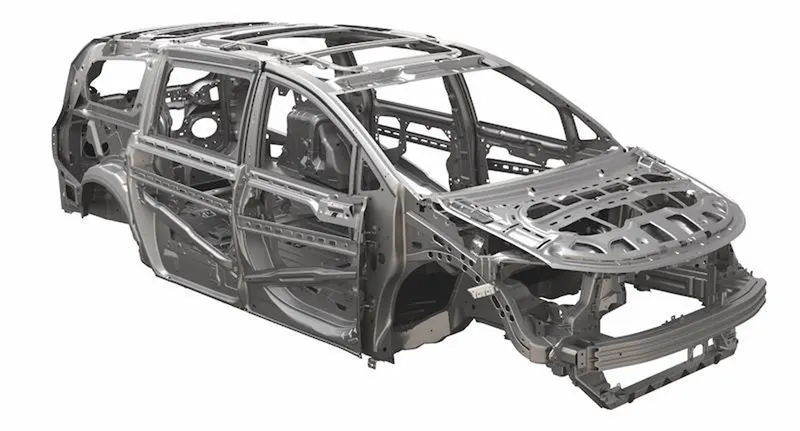
- This Term is used in the automotive domain, BIW stands for Body in White.
- When all the strengthening sheet metal components are welded together, they form a complete BIW body.
- Engine, windscreen, seats, windscreen, etc. do not include in BIW structures
- Before the painting process, the complete welded structure is dipped into the greyish-white primer coat. hence it is specifically called Body in ''white''
Below image is an example of the BIW structure of a Vehicle.
Key Parts of BIW Structures:
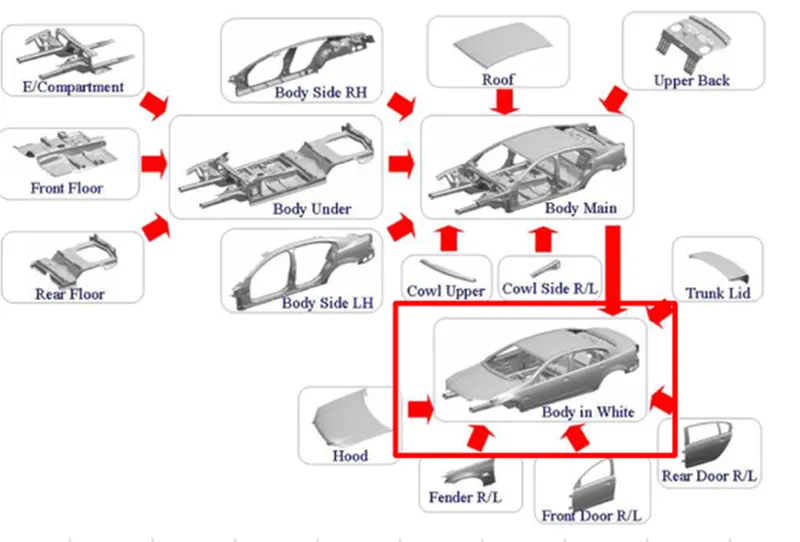
- Under Body - This includes the Front end frame for the engine compartment, Rear End frame for the Boot compartment, Main Floor for the Seat compartment
- Body side- This includes the Right and Left sides (Inner) of the vehicle (A, B, C pillars).
- Closures- This includes all the doors (Front & Rear), Trunk Lid, Hood
- Top Roof - This includes the outer, inner and outer part
- Fender - This includes parts above the wheel that connect to side bodies, head and tail lamps, etc.
Refer to the following image for a better understanding
- What do you understand about BIW nomenclature?
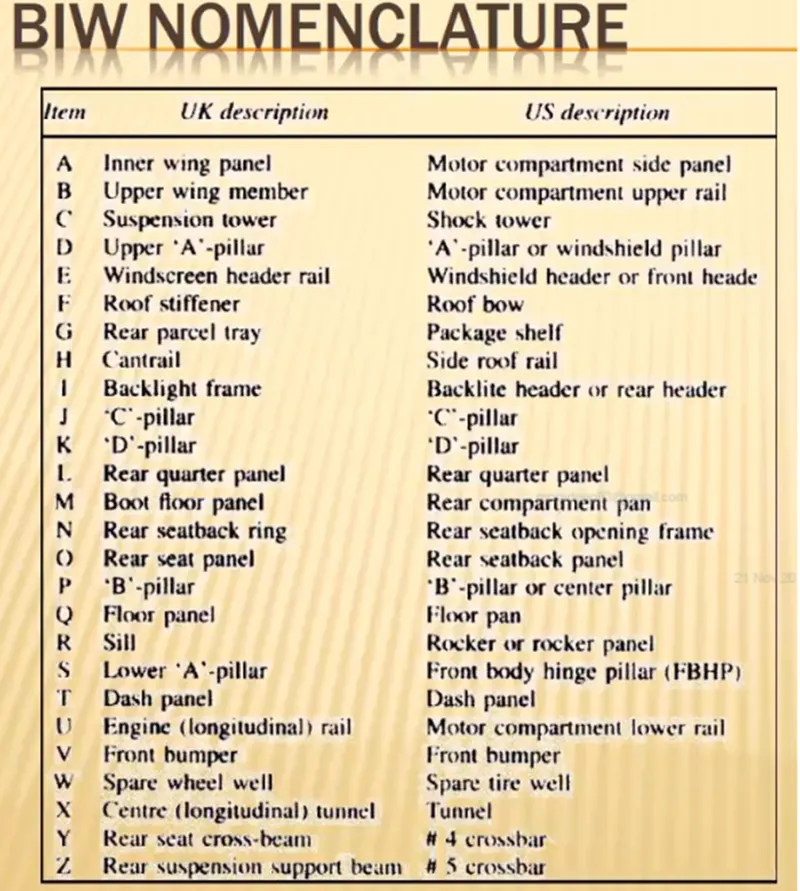
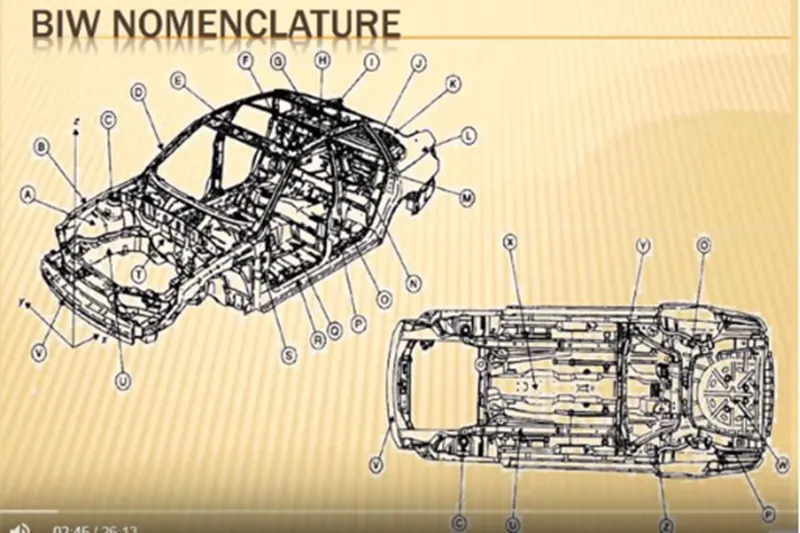
- BIW nomenclature is a list of BIW components with their basic description for industry reference in a different country.
- In BIW nomenclature all the components are assigned in alphabetical later to standardize the identification in the industry
The following table shows the Part description as per UK and US standards.
- What is a fixture & its types?
- The fixture is a device that holds components or structures for joining (welding, hemming, gluing, etc) for inspection purposes.
- To hold/correctly secure the part, the 3-2-1 principle is followed.
- This principle ensures the component or structure is in a fully constrained stage with zero degrees of freedom.
Types of Fixtures:
- Production fixtures:
- A fixture that is used for mass production is termed a Production Fixture.
- Pre-Production fixtures:
- This is a prototype fixture made for initial batch production to study the feasibility and further improve
- The industry usually avoids designing this fixture to reduce overall expenses. And time.
- Checking fixtures:
- A fixture that is used for inspections of components or assembly is termed a Checking fixture.
- This fixture helps to find deviations in dimensions, gaps, and tolerances.
4 What is the basic principle of fixture design?
- In fixture design to achieve the desired function, it is necessary to hold a part by constraining it to zero degrees of freedom.
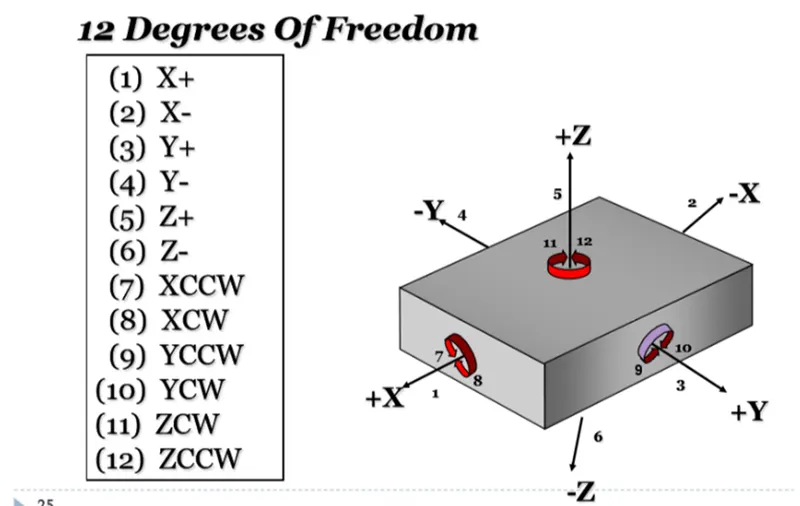
- For any free body, there are 12 degrees of Freedom which consist of 6 transitional and 6 rotational moments.
Refer to the image below to understand 12 Degrees of Freedom:
- 3-2-1 Principle
- To secure a part in a fixture, the Designer must use the minimum number of Pins to restrict the maximum degree of freedom.
- To achieve this, the 3-2-1 Principle/ Six Point Location Principle is followed
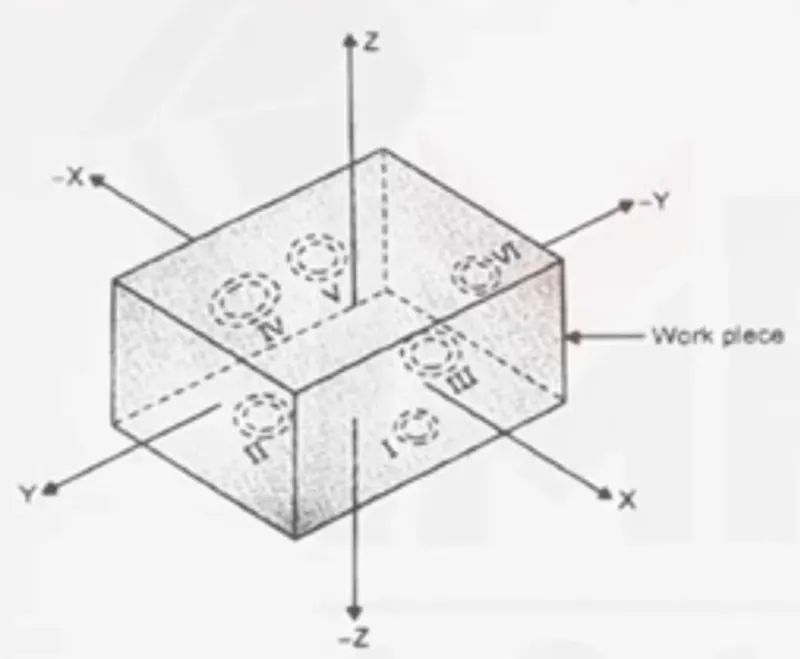
As shown in the image above:
- On the bottom plane (XY), there are 3 pins provided ( I, II, III )
It restricts - direction, rotation along with X and Y (Anticlockwise and Clockwise)
Hence, pins restrict 5 degrees of freedom.
- On the front plane (YZ), there are 2 pins provided IV V
It restricts -X direction, rotation along Z (Anticlockwise and Clockwise)
Hence, pins restrict 3 degrees of freedom.
- On the side plane (YZ), there is 1 pin provided ( VI)
It restricts - direction
Hence, pin restrict 1 degree of freedom.
So, following this principle 9 out of 12 Degrees of freedom can be restricted.
The remaining 3 Degrees of freedom are to be restricted by the clamping method for
Convenient parts for loading and unloading.
5. Elaborate type of BIW Stations?
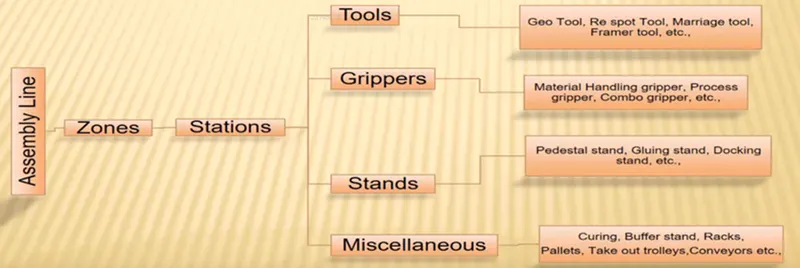
In automotive manufacturing, assembly lines are divided into different zones as per the different categories (e.g. Side bodies, underbodies)
For each zone, there will be at least 4 major stations such as:
- Tooling
- Grippers
- Stands
- Miscellaneous
- Tooling - These stations consist of different fixtures that are required for the assembly process.
- Geo Tool
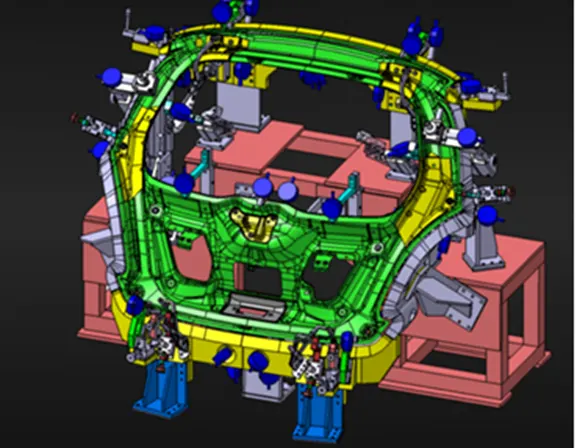
- In this Station geometry of mating, components are defined precisely with the help of the joining process.
- Locating pins used in this tool has a tolerance of 0 / -0.15.
- At this station, only major joining spots - which restrict at least all degrees of freedom - are carried away.
- Join the rest of the spots in the re-spot tool.
- Re-spot tool
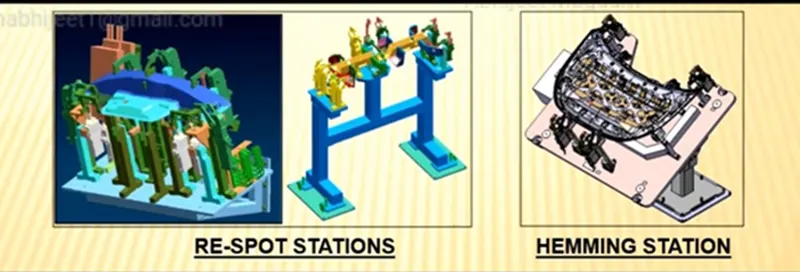
- This station covers the joining of all remaining spots from the Geo tool.
- Since Components are already fully defined in the Geo tool,
Locating pins used in this tool has a tolerance of 0 / -0.28.
- Also, an additional clamp plan, balancing cycle time is achieved at this station
- Marriage tool
- At this station, the inner panel and outer panel are joined together by Hemming, Gluing, and welding operations.
- To prevent the tip impression on the outer surface, copper strips are used between the weld tip and outer surface. (class - A surface)
- Framer tool
- At this station, the Roof will be attached to the output of the marriage tool
- Attaching a roof forms a Frame of a vehicle
- Hence it called as Framer tool
.
- Checking station
-
- At this station, Panels are inspected for quality assurance by checking the fixture
- Panels are secured in a fixture using various clams and gauge pins.
- A coordinate measuring machine (CMM) is used to check the coordinate of critical features of panels and verify with given tolerance data.
- CMM tools generate reports so that panels with errors can be rectified or rejected.
- Grippers:
- A gripper is a fixture that holds the panels of a vehicle.
- A panel that is large in size or heavier in weight can be handled by Gripper efficiently
- Grippers are mounted on robots or servo systems for actuation.
- The ideal Gripper should have as little curb weight as possible, to achieve this lighter material profile is preferred.
Different types of Gripper are explained below:
Material Handling Grippers: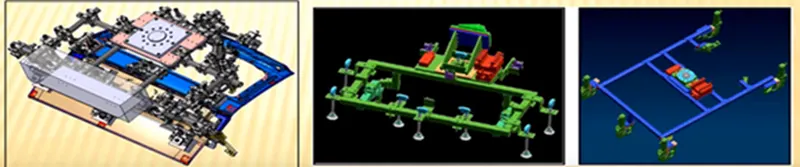
- It only handles material from one station to another station
Process Gripper:
- Along with material handling, this Gripper also holds additional process tools like Gluing, welding, riveting, etc.
- In the Process gripper, only a single task at a time can be carried out (Material handling or Processing)
Combo Gripper: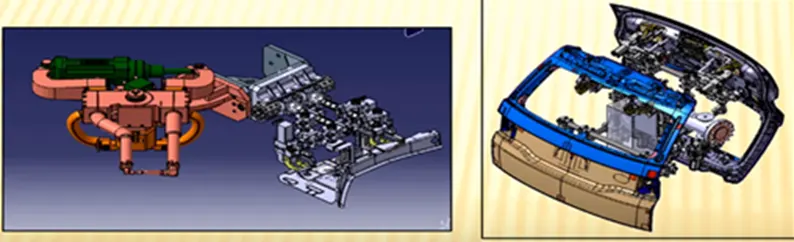
- Combo grippers also hold the material handling fixtures and process tools within a station.
- But this gripper can do both operations simultaneously.
Dual Gripper: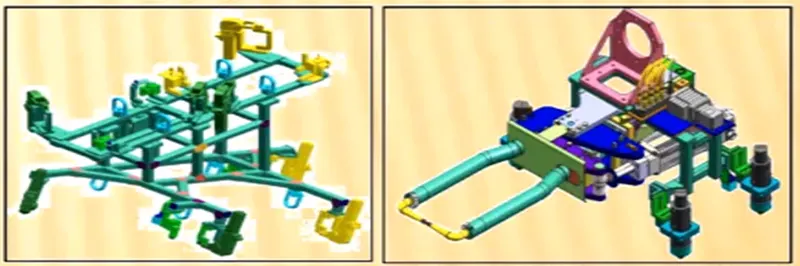
- The Gripper can hold two panels LH/RH at the same time.
- Stands:
- A stand is an arrangement fixed to the floor that is used to hold the tool for various processes like welding, gluing, sealing, etc.
Various types of stands are as below:
- Pedestal stands
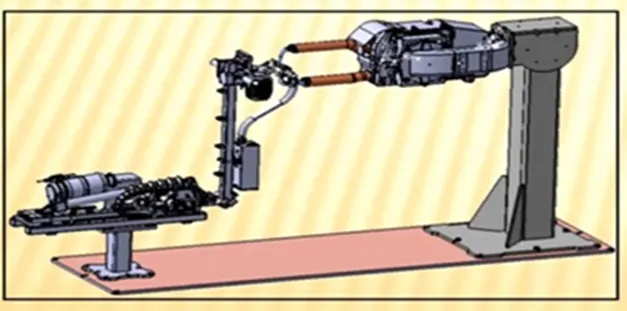
Fix the stand on which the robot is mounted to perform the required operation
- Gluing stand
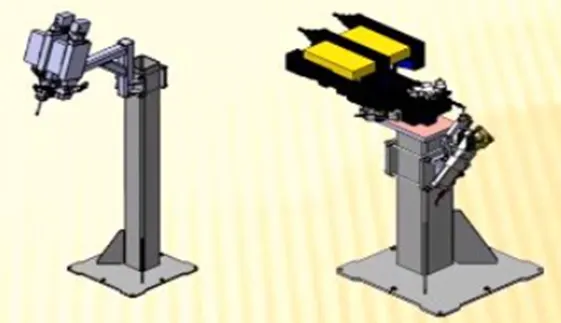
A fixed stand with a gluing gun is mounted.
- Docking stand
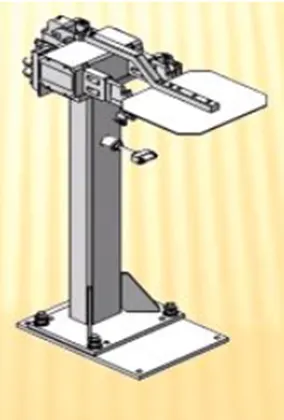
* Stand where grippers or tools can be dropped or picked up with tools by a robot arm for further process
- Date stamp stand
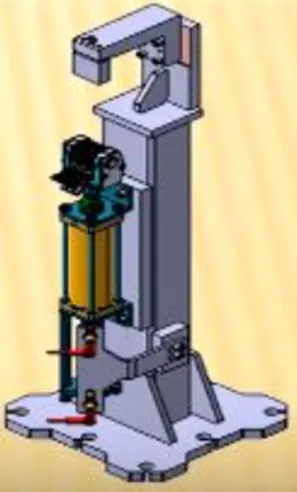
Fix stand with data stamping/embossing device is mounted
- Miscellaneous
- Curing
It's a chemical process where adhesive gets fully crystallized forming a strong bond
After Gluing, process panels/assembly are made to pass through the curing process to cool down the adhesive and form a strong bond while reaching the next station
- Buffer stand /Racks/ Pallet
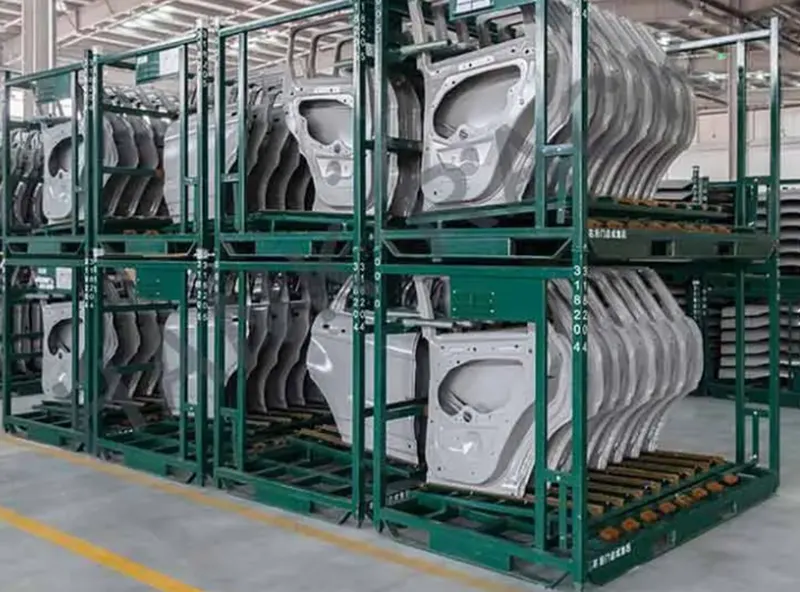
Buffer stands where buffer stocks (panels) can be stored securely and move together to the next station.
- Takeout trolley:
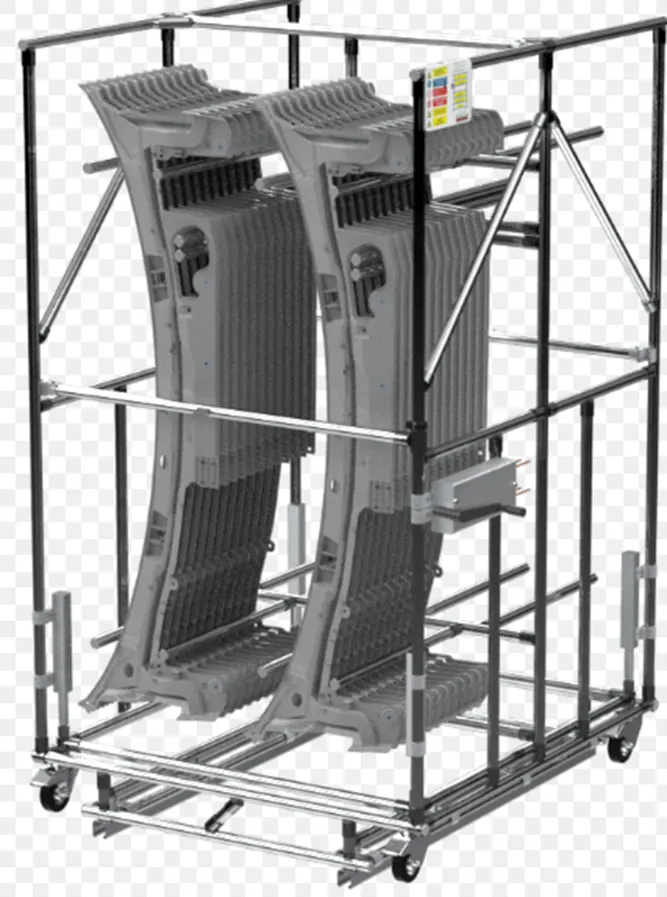
These trolleys are used to carry panels for periodic inspection to the QC department.
- Conveyors:
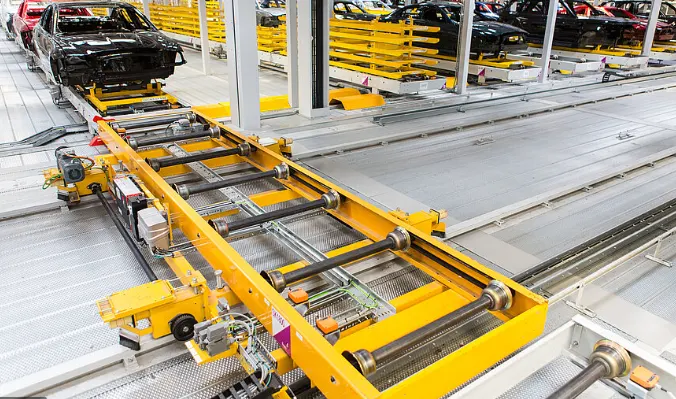
It's a continuously moving belt or chain on which panels can be placed to transfer from one station to another station
- What are the basic terminologies used in the BIW fixture?
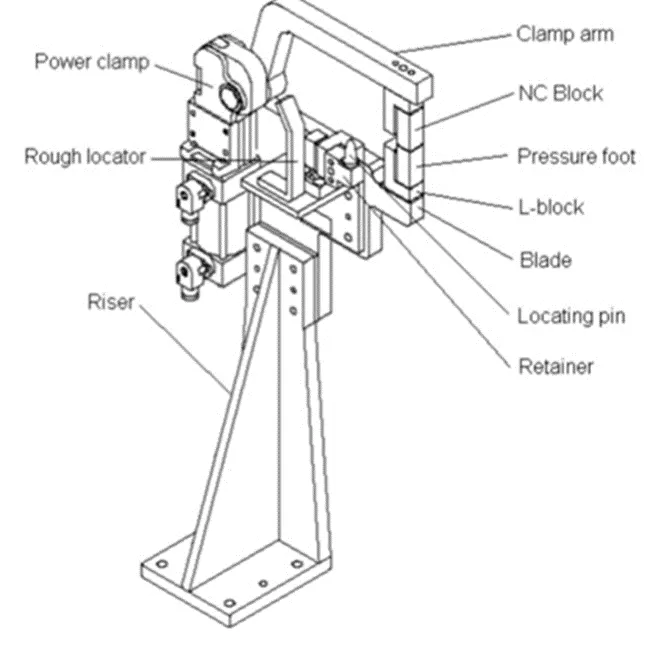
- NC / Mylers / Fingers:
- These are the blocks that hold the panel from top to bottom.
- For each claiming myler, there will be one resting myler underneath.
- Mylers prevent distortion in the panel due to the welding process.
- PLP (Principle Locating Point)
It's a location Point of the hole where pins are used to locate the panel to achieve dimensional accuracy of panel or assembly.
- Blade: it’s a plate that is attached to Riser on which clamps and other items are mounted.
- Riser: is vertical support mounted on the base unit, on which the blade and other items are mounted.
Risers can be custom-made or standard.
- Shim: a set of thin plates of thickness as low as 0.5mm (SPCC, SPRING Steel)
Using shims in between mylers and pin units helps to prevent dimensional inaccuracy caused due to stacking up tolerance and wear of plate
- Rough locator: -This is a guide used in manual fixtures to roughly locate a panel on fixtures
- Hardware: it's bought-out parts such as Fasteners, Bolts, etc.
- CMM: A highly precise Coordinate Measuring Machine is used to inspect the coordinates of fixtures or panels for drawing data.
- Unit: It's a sub-assembly of Fixture assembly. (Ex. Pin unit. Clamp Unit)
- Number plate: It's an aluminum plate on which part number is embossed to identify the correct units.
- Coordinate plate: The master hole or reference hole is provided on the base unit, from where all the other coordinates are measured in CMM. These holes are covered by a coordinate plate to prevent any damage to holes.
- Nameplate: A plate mounted on the visible face of the Base unit. Basic information such as company name, panel name, and fixture type is mentioned on the Nameplate.
- Clamp arm: It’s a unit that holds the panel with the help of Mylers using actuators.
- Pivot: The point of the axis about which the Clamp arm is rotated.
- Class a surface / Skin surface: The outer aesthetic surface of car panels is visible to end customers.
- Reed switch: An electromagnetic switch mounted on the cylinder detects the position of the cylinder’s Pistons for further process decisions.
- Sensors: It's an electrical device that mountains a fixture, underneath panels.
It detects if the panel is loaded in a fixture and sends the signals to proceed with the further operation.
There are different types of sensors used in Fixtures such as proximity sensors, photovoltaic sensors etc.