Week 1:- Introduction to BiW and Fixtures Challenge
Question 1:- What is BIW & define its parts
Answer 1:-Automotive Industry, BIW is kind of common terminology used to mention the stage where the car body sheet metal components have been welded together
it's having a part like Hood, Roof, Fender, Body Side, Backdoor, Side Doors and Floor of a vehicle. The “White” in the terminology refers to the stage before painting the car.it deipped in a primer solution which has a greyish colour closer to look like a White colour.that why it caaled body in white
BIW Components are developed from a Styling Surface called the Class-A surface. We develop the Outer and Inner panel including the reinforcements for each BIW component that plays a major role in the structural integrity and safety of the vehicle.
BIW having major categorized like
- Bodyside
- Under body
- Closures/ Door
- Roof
- Fender
- Reinforcement
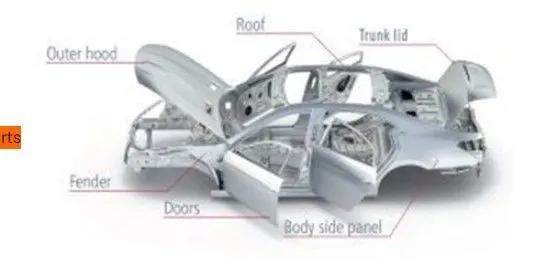
Body Side consists of
1. Body side outer
2.body side inner
Under body consiste of
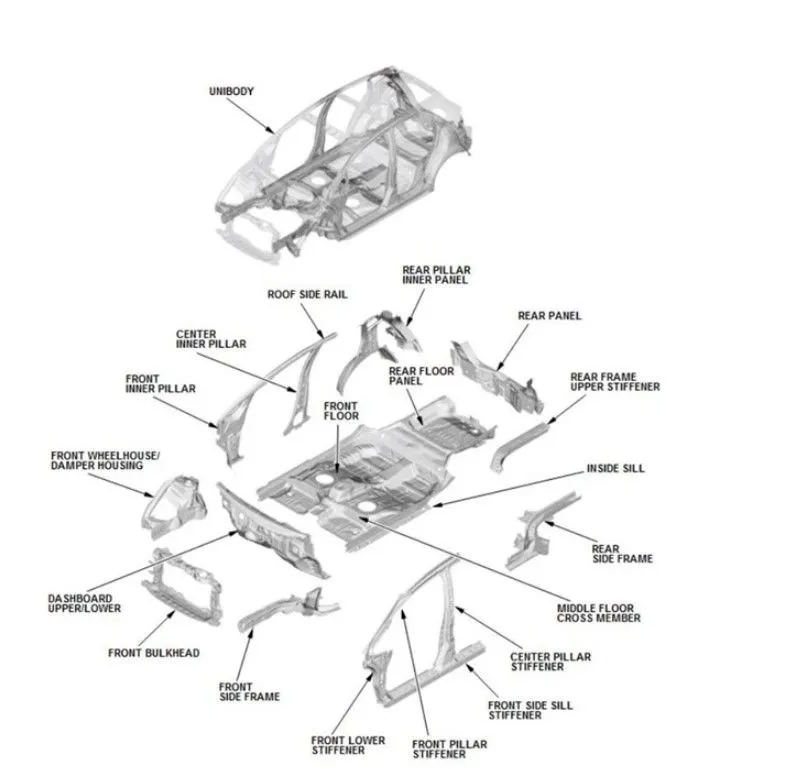
- Front end under frame
- Main floor
- Rear End Under frame
Closure components consist of :
- Front door
- Rear door
- Hood
- Truck lid
Roof consists of
- Roof inner
- roof outer
Four Fender
Question 2:-What do you understand by BIW nomenclature?
Answer 2:-
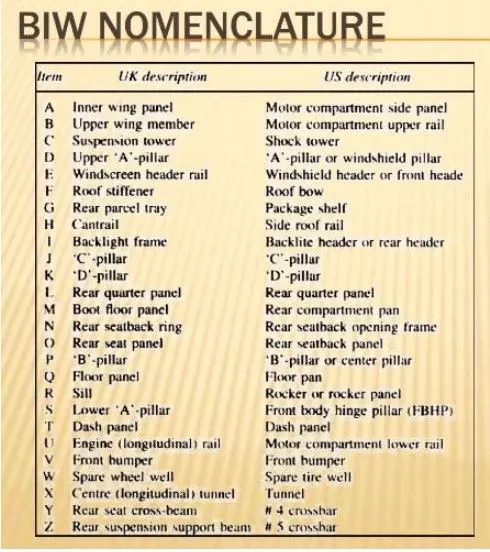
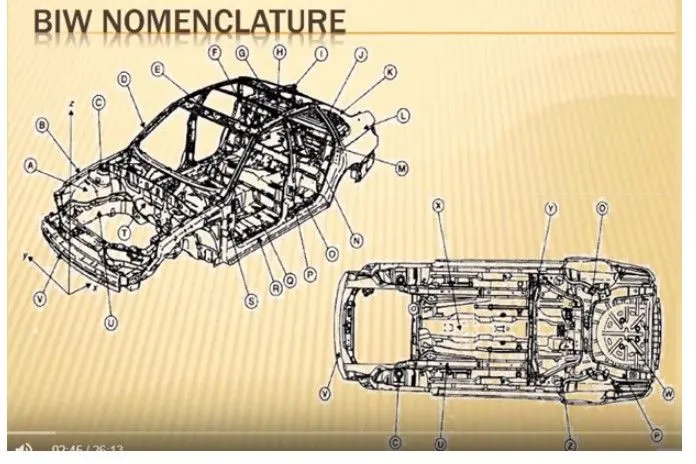
- The terms are standard but they varies in some countries
- body in white nomenclature Basically the name of the part assembly and the sub assembly
Question 3:What is fixture & its types?
Answer 3:-
Fixture
Its is a device which hold the workpiece for perform operational process.Fixtures are used to securely locate (position in a specific location or orientation) and support the work, ensuring that all parts produced using the fixture will maintain conformity and interchangeability
We have to place our fixture using the 3,2,1 principle.
- Fixture may be defined as a device used to increase manufacturing efficiency and productivity in mass production.
- It locates the workpiece in the correct position and holds it firmly but it does not have provision for guiding the cutting tool.
- Set blocks and feeler or thickness gauges are used with fixtures to reference the cutter to the workpiece.
Types of Fixtures
- Production Fixture-
- It is used for mass production and easy for maintenance
- They should be simple, rigid and hard .
- This fixture should be periodically maintained in regular intervals for repairs
- Pre Production operation Fixtures-
- It is the basic fixture for checking our install production or initall batch production to study the feasibility
- These can be referred as the prototype fixtures .Once the pre production operation fixture functions properly then modification are made to improve the production simple and reliable
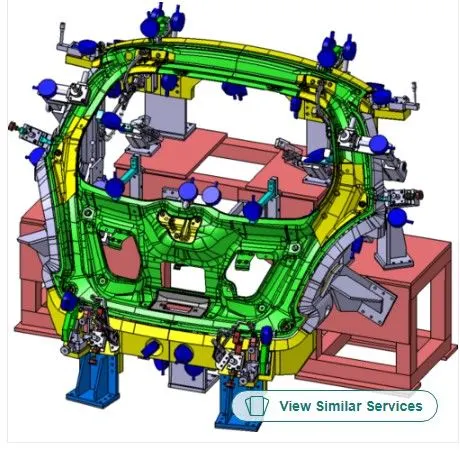
- Checking Fixtures
- It is used for checking the workpiece
- We check the dimension , positons and tolerance of the workpiece
- Basically it used for the inspection purpose
- this consist of gauge for checking fixture
Question 4:What is the basic principle of fixture design?
Answer 4:
For a fixture designer, the major portion of design time is spent deciding how to locate the work piece in the fixture.
You know that any free body has a total of twelve degrees of freedom as below:
6 translational degrees of freedom: +X, -X, +Y, -Y, +Z, -Z
And 6 rotational degrees of freedom:
- Anticlockwise around X axis (ACROT-X)
- Clockwise around Y axis (CROT-Y)
- Anticlockwise around Y axis (ACROT-Y)
- Clockwise around Z axis (CROT-Z)
- Anticlockwise around Z axis (ACROT-Z)
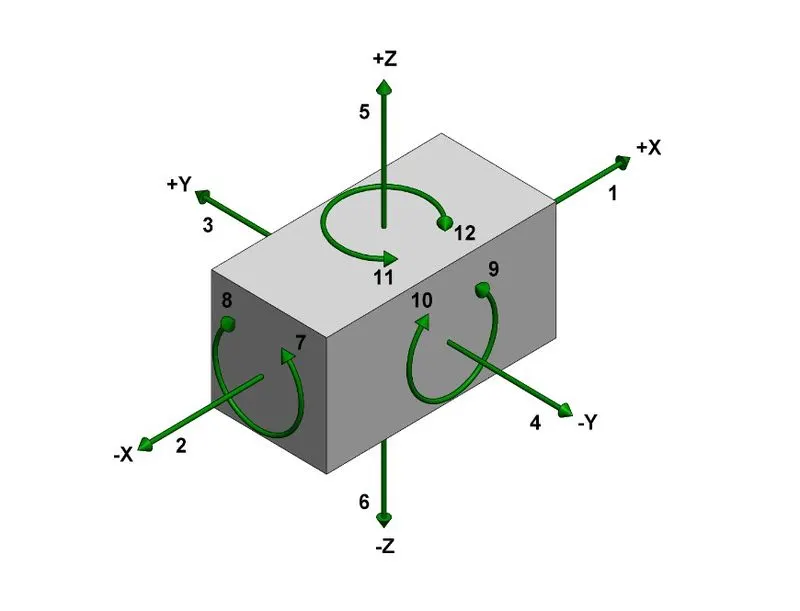
You must fix all the 12 degrees of freedom except the three transitional degrees of freedom (-X, -Y and -Z) in order to locate the work piece in the fixture. So, 9 degrees of freedom of the work piece need to be fixed.
But, how? By using the 3-2-1 method as shoon below:
Rest the work piece on three non-collinear points of the bottom surface (XY), and you will be able to fix the +Z, CROT-X, ACROT-X, CROT-Y and ACROT-Y degrees of freedom
Now, rest the work piece at two points of side surface (XZ), and you will be able to fix the +Y and ACROT-Z degrees of freedom.
Now, rest the work piece at one point of the adjacent surface (YZ), and you will be able to fix the +X and CROT-Z degrees of freedom.
So, you can successfully fixate 9 required degrees of freedom by using the 3-2-1 principle of fixture design.
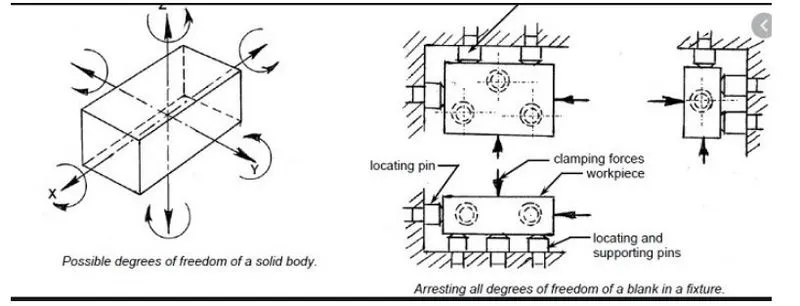
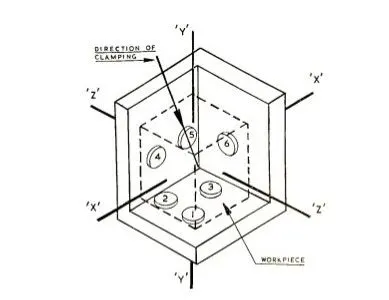
The 3-2-1 method is a work-holding principle where three pins are located on the 1st principle plane, i.e., either XY, YZ, ZX. And two pins are located on the 2nd plane perpendicular to the 1st plane, and at last, one pin on the plane is mutually perpendicular to the 1st and 2nd planes. The aim is to constrain the movement of the workpiece along all three axes
Question 5:Elaborate types of BIW Stations?
Answer 5:
The BIW assembly line is where different types of panels are joined together in each specified zone like Underbody zone, Hood zone Etc.
These zones are further subdivided into stations, where various processes like welding gluing and inspection are done to the part of that particular zone before they are being assembled together. For instance, in the roof zone, various reinforcement is to be added before they are married to the side zone.
- Tool stations.
- Gripper stations.
- Stand station.
- Miscellaneous stations.
An assembly line is a process in which car panel/car body parts are joined as the semi finished assembly moves from one station to another station until the final product is produced.
In the process of joining in assembly line , panels are moved from one section to another sections.Those sections are called Station.
In BIW fixture designing we have various stations which are used to locate the panels so that joining processes can be done.
- Geo Station
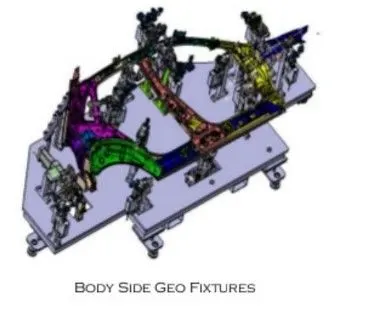
- In this station geometry of two parts are fixed. it can be either using welding or riveting . In this station precision and geomatry of the finished product is defined Locating pins have closer tolerence of 0/-0.15.
- Suppose the hole dia of panel is 16mm then the pin dia minimum can be 15.85.
- Diameter of locating pins should be lesser than the panel hole dia. So Tolrence in locating pin is given in negative value.
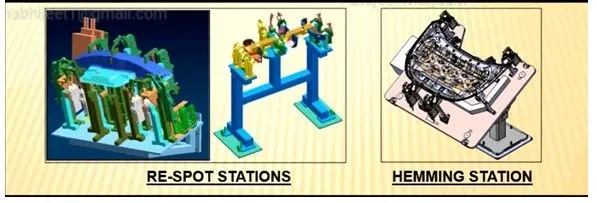
2. Re-spot Tool:
- Once product comes out of the Geo Station and there are left out spots where spot welding or riveting is to be done. then it is moved to another station , that station is called Re-spot station.
- These left out spots may be the due to clamp plan, cycle time,robot reach ability or any other various reasons.
- In this station pins ahve tolrence upto 0/-0.28.
3.Marriage or hemming tool:
- Marriage or hemming tool is a fixture in which the inner panel and outer panel is joined together.
- Hemming is not done for every part but only for those parts where we want to join two panels without other joining process as it may affect the aesthetics of the car.
- Hemming can be found on Hood, Back door etc
Checking stations:
It is used to check the automotive part or assembly to ensure all the coordinated, relative dimensions and positions are as per tolerance. It can be classified as follows:
- Gauge type checking fixture is where the work piece is held and various gauges are introduced to ensure the dimensions and repeatability.
- Fixed type checking fixture is where the work piece is fixed using clamps and pins and the Coordinate Measuring Machine is used to measure the coordinates of different points of the panel and compare it with the nominal value and give its report to rectify any errors.
- Automated checking fixture is where the automated setting are being done through sensors, PLCs, switches etc, to give a signal in case of any irregularities which can be rectified. As it is expensive, it is not widely used.
 Grippers Stations
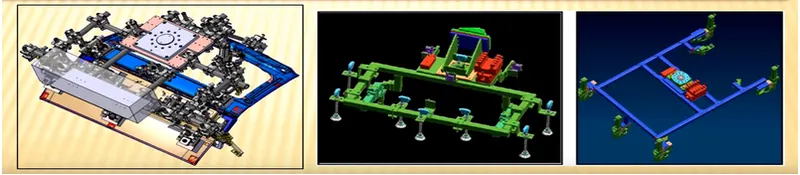
A gripper is a device that enables the holding of an object to be manipulated. The easier way to describe a gripper is to think of the human hand. Just like a hand, a gripper enables the holding, tightening, handling, and releasing of an object. A gripper is just one component of an automated system. A gripper can be attached to a robot or it can be part of a fixed automation system.
Different grippers are used in BIW as follows,
A) Material handling gripper
- As the name suggests These grippers are used for material
- These grippers can pick assembly from one station & will drop the assembly at another
 Â
Â
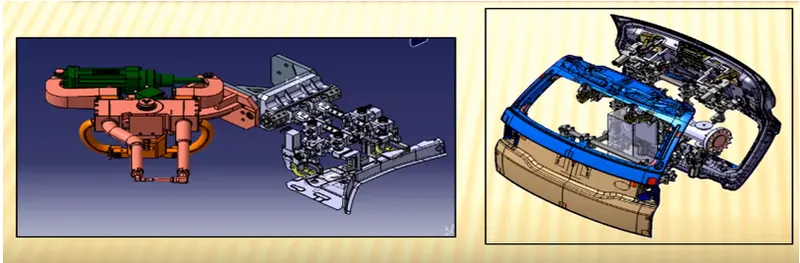
B)Process grippers
- These grippers are used to carry out some specific processes like gluing, welding, riveting in addition to material handling.
- The gripper will go under gluing stand in case of gluing process & will goes under the pedestal weld stand in case of the welding process.
C)Combo GripperÂ
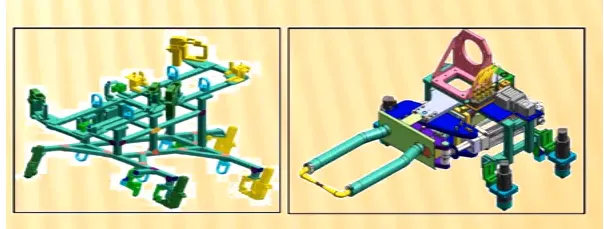
- Combo grippers are the ones which can carry out multiple tasks like it can do material handling & also it can carry out some specific process like gluing, welding as well.
- Weld gun + Gripper
- D) Dual Gripper
- These are two-sided In case when we want one LH & one RH part, these grippers are used. It can handle the material from one station to another station
- Gripper + Gripper
3) Stands Stations
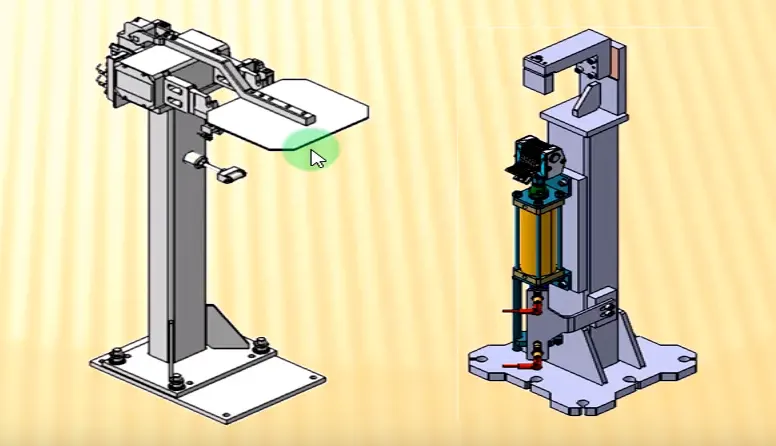
Stands are used to hold the part when not in use or also it is used to mount some parts or bodies on it.
 Â
Â
Different stands are used in BIW
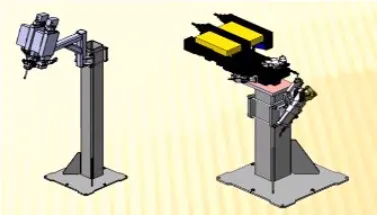
- A) Pedestal stands
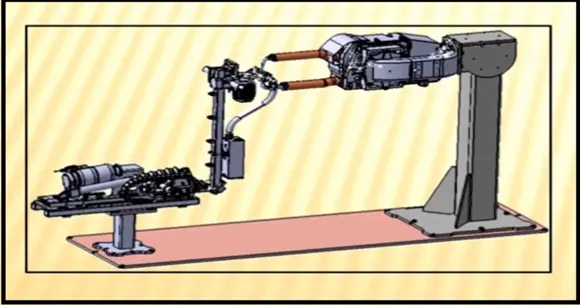
- Weld gun is mounted on the fixed stand which is mounted to the floor The gripper can carry the panel under the stand to do the operation.
B) Gluing & sealer stand
- Gluing gun or sealer gun is fixed to a welded or a standard stand which is grouted to the floor
C) Docking stand
- The robots have some limitations such as the payload capacity of the robot & also due to lack of
- When we select the robot for multitasking it can't do both the task simultaneously due to
- In this kind of case, we add a docking stand to put some equipment that is not in use for the current operation but will be required for next
- Hence the robot can drop a gripper or gun & pick the next operation equipment to complete the task from the docking
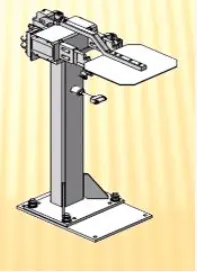
D) Date stamp stand
- Every manufactured product has some data to stamped or to be embossed on it like serial no, batch no, Date for some future reference, or for data collection.
- The required data is stamped or embossed by using the stamping device mountedÂ
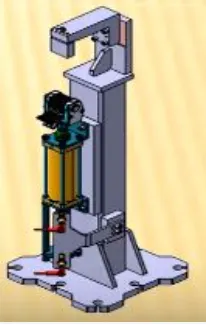
4) Miscellaneous stand
A) Curing
- After gluing it needs some time to cool down, so we put the assembly on some belts & it will take the panel to another station & meanwhile gluing will cool down.
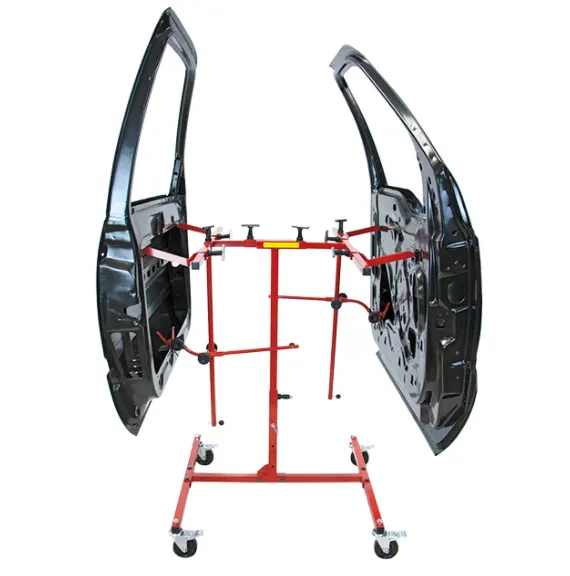
B) Buffer stand
- After some operation, we can put the no. of assemblies in this stand which is buffer stock & it can be transported to another station in easy They are also used to store the inventory while the machine is undergoing some maintenance.
 C) Take out trolleys
- It used to take out some panels for inspection to rectify the process is going in the right or not between the cycle.
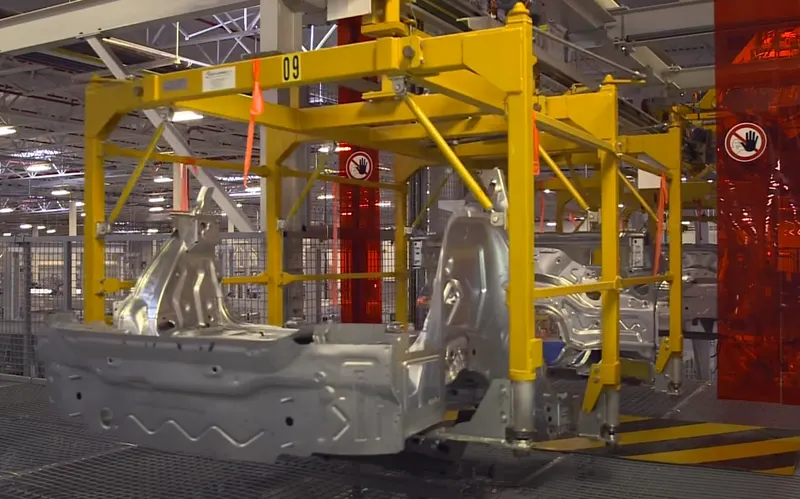
 D) Conveyor
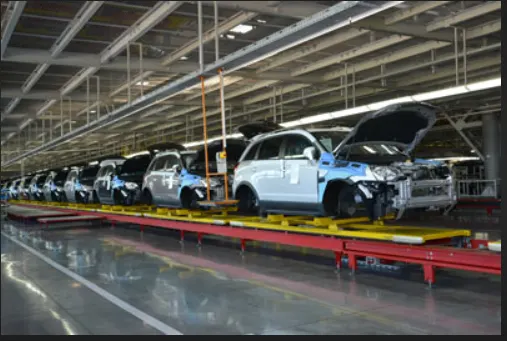
- The conveyor is the rotating path that transports the parts to the next station which are kept over it.
Question 6:-What are the basic terminologies used in the BIW fixture?
Answers 6:-
- The following terminologies are used in BIW
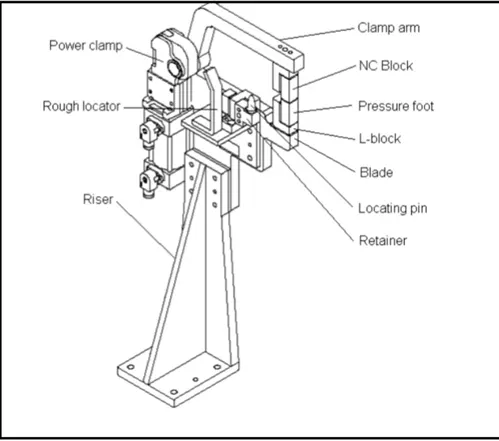
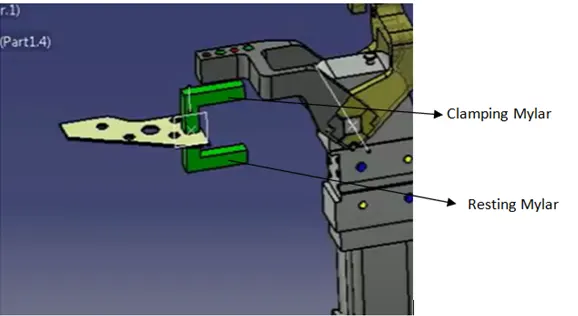
- A) NC/Mylars/Fingers:-Mylars are the component that holds the panel while These are placed from topside & from the bottom side also. The top side Mylars called Clamping Mylars & the bottom side Mylars called Resting Mylars. Every clamping Mylars have resting Mylars. It doesn't allow deformation of the part due to welding stresses.
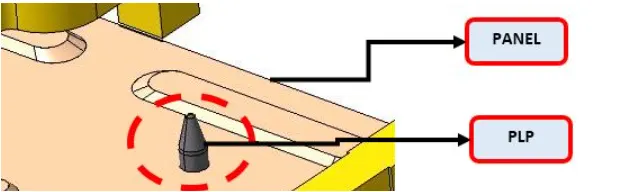
B) Principle locating point (PLP):-These are the points that are used for the accurate location of the part to maintain the geometry of the part. There is lots of holes on the panel which are not accurate due to stamping operation. The PLP are defined in the drawing. The positional dimensions or relative dimensions are very precise in stamping & in fixtures also.
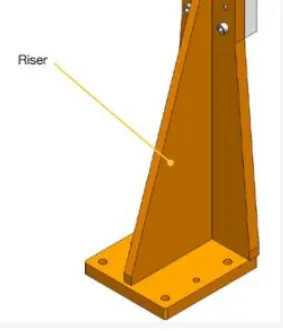
C)Â Risers:-Risers are of different types like L-typer rises, Square tube riser Riser is the manufacturing part which gives height to the assemblies.
D)Â Blade:-Blades are plates mounted on the Other parts like cylinder, arms, etc are mounted on the blade.
E)Â Shims:-Shims are the small part that comes with the thickness of 0.1mm, 0.2mm, 0.5mm, etc. These will compensate for the stackup tolerance which reflects at the panel holding part called We give tolerance to all the parts of the fixture. Due to this tolerance, the Mylars will either lift up or goes down from their defined position.
If the Mylars go down from the defined height it will make an impression or dent on the panel.
If the Mylars lift up then there will be a distorsion due to welding stress. To adjust the Mylars At its defined position we use shims so the panel won't be deformed & also don't get any impression on it.
F)Â Rough locators:-The operator can place the part in the wrong orientation The rough locator will work as a guide while placing the part in the fixture & the part will be loaded in the desired orientation. It is a part of foolproofing.
G)Â Hardware:-Hardware is like the Hex head bolts, Allen Bolts, Hex nuts, Spring washers, Self-locking nuts
H)Â CMM:-CMM stands for coordinate measuring machine. It is a device that measures the geometry of physical objects by sensing discrete points on the surface of the object with a probe. It generates a report by comparing the data with the CAD file data.
I)Â Unit:-The fixture is the assembly of different types of units to form a part. There are different units like pin unit, base unit, clamping unit, etc.
J) Number plates:-The number plate is the aluminum embossed plate placed on each unit for easily recognizing the part unit.
K) Nameplate:-The data like manufacturing company name, fixture type, Fixture weight is embossed on the plate & joined to the fixture.
L) Clamp Arm:-The clamp arm is the part of the clamp unit which moves an Over clamp arm the Mylars are mounted.
M) Pivot:-It is an axis about which the clamp arm will rotate
N) Class A Surface/Skin surface:-The outer panels of the car like a hood, door, backdoor, fender, roof are visible to the customer.
The outer panels should be aesthetically very good. No scratches or dent is acceptable over it.
While designing the fixture to the skin surface the clamping material should be soft, so that it could not able to left any impression or dent over the skin. generally, nylon or PU material is used for clamping purposes.
O)Reed switches & sensors:-These are the electric components used in automated The reed switch is an electrical switch operated by an applied magnetic field. The detects the panel is loaded or not is done by sensors.