Week 1 Challenge
1.original equipment manufacturer
2.Automotive designer responsibilities include
- Drafting layouts of automobile components, assemblies and systems using sketches, models, prototypes and CAD software
- Designing and testing various components of automobiles, such as fuel technologies, safety systems, brackets and torsion bars
- Providing design concepts and renderings to customers for approval during the design process
- Communicating with other design team members such as interior designers, engineers, and marketing specialists to ensure that designs meet functional requirements
- Managing documentation of existing projects and performing ECN resolutions
- Performing repairs and inspections on new cars after they have been sold
- Fixing and maintaining the vehicle’s interior and exterior components
3.Farms,Live stock farms,Cotton plantation
4.1889
5.Bench seats
6.The 3D coordinate system allows us to represent a quantity in a space that contains three mutually perpendicular axes. Through the 3D coordinate system, we can now visualize points and surfaces with respect to three axes.
7.uses these coordinate systems to calculate the vehicle dynamics and position objects in the 3D visualization environment.
8.The X plane runs from front to back of vehicle when viewed in side view ( front of vehicle pointing left).
9.In the context of vehicle seating, terms like "zero-gravity seat" or "neutral posture" are sometimes used to describe a seating position that minimizes stress and strain on the body
10.This point used by the manufacturers to define dimension dimensions and locations on a seat component or assembly.
11.(0,0,0)
12.Work line is a single,specific line used as referance for defining key dimensions and locations on seat component assembly.Grid line is a network of evenly spaced lines that creates a referance system for positioning and dimensioning element within larger araea.
13.Work line and grid lines are interconnected.Sometimes ,a specific grid line can be designated as the "work line"for a perticular feature or component.Grids provides a convenient referance system for defining work line location and direction
14.Body position in vehicle seating plays a crucial role in both confort and safety.The key aspects are-Back,neck,Knees ,feet.with respect to humen body
15. Some my have the seath fully forward,While others may have it set in mid-range position.
16.Centerlines acts as a mirror axis for designing symmetrical components like the chasis,body ,panels,wheels,and suspension.
17.Midpoint of the floor pan or between driver and passenger seat.
18.Poiny upward ,perpendicular tothe ground as per ENU system.
19.Points to the drivers left when sitting in the car
20.Left hand drive-Steering wheel on left side
Right hand drive-Streering wheel on right side
21.Left side
22.xy direction
23.Left
24.Y
25.Right side
26.Left side
27.Center line based system
28.IB-Inboard,OB-Out board
29.Fore movement
30.fore movement
31.Negative x movement
32.Chaina
33.Chaina
34.Chaina is the country which is going to get Replaced by india in next 10 years.
35.Maruthi suzuki
36.Countries like UK, Australia and New Zealanders drive right-hand drive cars on the left-hand side of the road.
37.India, Japan, Cyprus, South Africa, and Malta
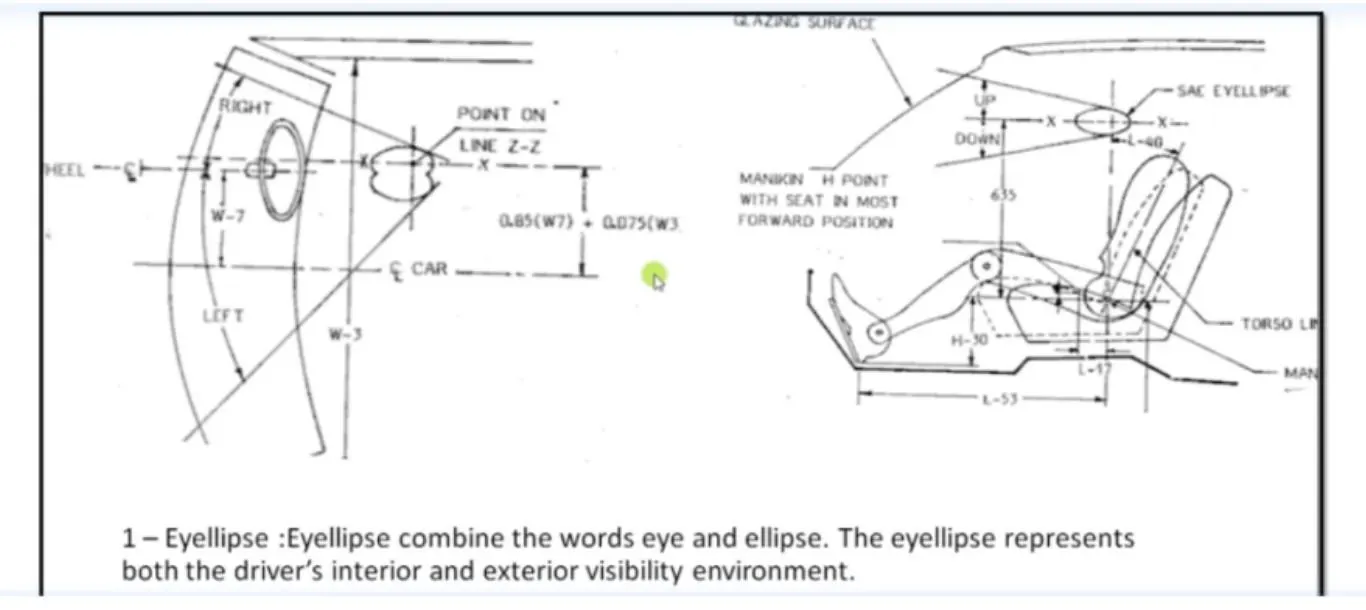
1.What is Eyellipse and how it important from OEM purpose?
It is combining word of eye and ellipse and this word refers the interior and exterior visibility of the driver.
2.Draw the complete Eyellipse Zone in an OEM environment?
3.What is E – Point?
E point refers left and right eye of the driver it’s vital thing to calculate eyellipse and there will be a 65 mm of gap between of both and this value will be match with 95% of population of the world then each eye will have the own representation.
4.What is P – Point?
This also used by oem’s to calculate the eyellipse so this point refers the pivot point of neck which is mark over the neck exactly from the between of e point 98 mm down. And it does have 4 varieties.
5.Correlation between E Point and P Point?
Both these point helps to calculate the eyellipse of the occupant.
6.Eyellipse calculation as per E – Point and P – Point?
7.What is full form of “SgRP” ?
Seating reference point
8.What is H – Point?
It is pivot point of torso and thigh angle this is called design H point this value should be match with sgrp which is given by OEM.
9.Difference between “SgRP” and “H – Point “?
It is point which created by taking a centroid line between E points and project where the occupant's hip and back joints meet, this is called as seat reference point or SgRP and this value given by oem’s.
It is pivot point of torso and thigh angle this is called design H point this value should be match with sgrp which is given by OEM.
10.What is heel point?
Oscar's heel point on the heel with shoe on unpressed condition on accelerator pedal
It should be in 87 degrees of angle.
11.What is Oscar?
It is 2D and 3D device which can be used to define how the person’s going to sit in the vehicle and measure the seating accommodation.
12.Difference between Oscar and Oscar Templet?
Oscar is 3d machine and Oscar template is 2D device.
12.What is the purpose of Oscar?
It does give the designer idea of how the occupant will sit into the vehicle
From that approximation a point will determine that is pivot point of torso and thigh angle this is called design H point this value should be match with sgrp which is given by OEM.
And the seat can be adjusted fore and after up and down at any time through H- point so it can be done with in window this is called as H-point window.
Once the Oscar placed according to the oem packaging drawing requirement the seat can be ready design around the Oscar.
13.What is Design H – Point and Actual H - Point?
It is pivot point of torso and thigh angle this is called design H point this value should be match with sgrp which is given by OEM.
Actual H-point can be recorded through the 3D Oscar machine.
14.What is H-Point Window?
the seat can be adjusted fore and after up and down at any time through H- point so it can be done with in window this is called as H-point window.
15.Type of Oscar?
There're two types of Oscars are there one is 2D Oscar template and other one is 3D Oscar machine.
Small woman 104 lbs. 5% of drivers
Midsized man 169 Lbs. 50% of drivers
Large sized man 226 Lbs.95% of drivers
16.What is the weight (in Kg) of 95 % Oscar?
102.512 kgs
17.What is the Importance of H – Point?
Seating design is directly created effect to the occupant’s relationship to controls
And careful measurements should’ve taken while positioning the seats and adheres with specs of OEM.
And H-point might vary because of deterioration of seats notably the foams.
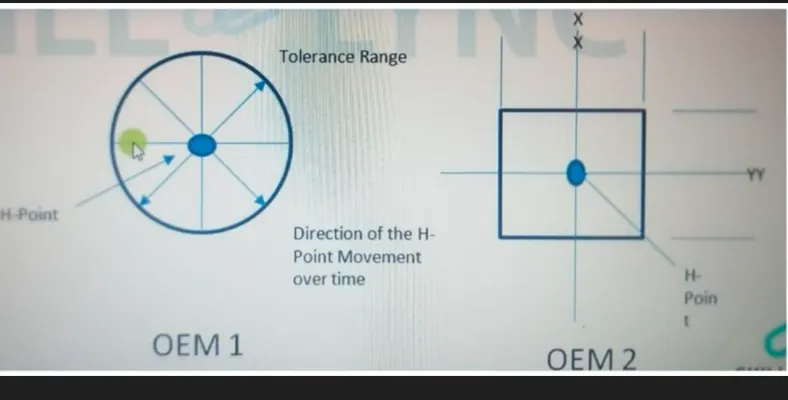
18.How the tolerance of H -point Given?
As we seen in this pic this is tolerance range of seats it can be in circular shape or square shape the seat reference point should never cross that limit when the foam is compressing state this how the tolerance zone should’ve created.
19.What is D – Point regarding a Seat?
It is lowest point of buttock contour of the seated when the Oscar template and machine installed.
20.What is the full form of AHP? Define its usage for seats?
It’s Acceleration heel point
And it’s Oscar's heel point on the heel with shoe on unpressed condition on accelerator pedal
It should be in 87 degrees of angle.
21.What is Hand Reach Envelop?
Driver must feel easy reach the vital controls in a car while vehicle in moving condition this is what called as hand reach envelop.
22.Types of Hand Reach Envelop? And how it is categories?
Primary DHC: Secondary DHC:
Steering Air conditioning
Headlight Audio controls
Turn signals Accessory controls.
Gear shifting
Horn
Wiper then
Hand brake.
23.What is Back/Cushion Angle?
The back angle is the angle of recline of torso line relative to vertical
Then the cushion angle of incline for the cushion relative to horizontal this helps to find the amount of thigh support the occupant will have.
24.What is Ischium?
The ischium is a paired bone of the pelvis that forms the lower and back part of the hip bone, as well as the posterior and inferior boundary of the obturator foramen.
25.What is Tail Burn?
This condition will happen when driver sits on seat for long time so seat should be designed to prevent this condition.
26.How lumber help driver?
Lumber origin is lowest vertebrae in spinal column located between ribs and the pelvis
27.During RFQ what is expected from OEM?
Seat reference point
Foot angle
Knee angle
Heel point
Hip point
Back angle.
1.What is the function of a seat?
Support the occupant
Provide comfort to the occupant
Protect the occupant
Position the occupant
2.How the seat Support the Occupant?
Support the occupant is essential thing of seats because improper support will affect the comfort and safety of the occupant.
3.How the seat Position the Occupant?
There’re three essential key factors are there when it comes to seat design that are
- Hand, arm, and leg room:
Hand arm and leg room is vital for safety and control to the occupant
- Field of vision:
This one calculated by eyellipse driver should've minimal abstraction by steering wheel, instrument panel, roof line and he should be able to see clearly through the side mirrors as well.
- Driver proximity to hand controls:
Occupant must’ve been able to reach appropriate controls when the vehicle is moving condition.
4.How seat provide comfort for the occupant?
- Determine the amount of seat padding
- Avoiding hard points on seat
- Determine angle seat back and cushion
- Deciding the lumber and thigh support
- Establishing seat height and width
5.What is the full form of ILD? And how it is defined?
Indentation load defection (ILD)
The load required to compress seat pad 50% of its original thickness so there’s a load which required to compress the foam is hardness of the foam.
If a seat is too firm it will be uncomfortable and if it's too soft occupant will contact with hard point or fatigue.