Week 1 Challenge
ANSWERS.
1. Original Equipment Manufacturer.
2.
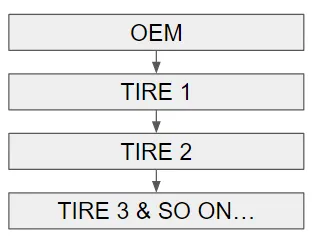
- The Automotive hierarchy will be followed as given below,
- The Design Responsibilities go from the lower level tier to the OEM. Because the parts/sub-assemblies are designed by the tier companies and finally assembled by the OEM
3.
- Tire 4 suppliers are basically the companies that manufacture the required Raw Materials for the OEM.
- The following are some of the Tire 4 Suppliers,
- Continental International - Chassis & safety ADAS, hydraulic brake systems components, passive safety & sensonics, vehicle dynamics, powertrains, fuel & exhaust management
- ZF Friedrichshafen - Transmission systems, steering systems, braking systems, axles components, clutches, dampers, car powertrain technology
- Electronics Automotive Products Pvt Ltd
- Sri Sairam Auto Components.
4. The First Car was made in 1886 with Wooden Seats.
5. The First Car was made with Wooden Seats.
6. The 3D reference system was the axis system that is used to define a location in the automobile. It consists of an X-axis in the longitudinal direction of the automobile, a Y-axis along the width of the automobile, and a Z-axis along with the height of the automobile.
7. The 3D reference system is needed to locate/position the parts in the correct place in the Automotive.
8. The X-axis is the longitudinal axis of the Automotive. The positive-X means the axis system towards the rear from the driver seat to the front portion is called the positive-X.
9. The plane of the point where one of the coordinates is Zero is called the Zero Plane.
10. The place where all the coordinate points are Zero is called the point of origin.
11. Most OEMs will take the Bumper as the point of origin.
12. Gridlines are formed by intersections of planes located at 100 mm increments parallel to the X-Z, Y-Z, and X-Y planes.Gridlines are used basically to package and locate objects and spaces in a vehicle Gridlines are also referred to as body Lines.
13. Work lines and Gridlines are not interconnected.
14. It refers to where the part is located in the vehicle with respect to the body.
15. When a car comes out of OEM Yard, the Seat will be at Body position.
16. It is the longitudinal axis of the vehicle that divides it into haves. It has positive and negative Y. It is used to position the part in the Inboard/outboard.
17. Center console running vertically to the downward position from the front bumper to rear bumper.
18. The positive Z direction refers to the height of the vehicle from the seat to the top of the vehicle.
19. The positive Y direction refers to the Right-hand side of the driver.
20.
- LHD - Left Hand Drive
- RHD - Right Hand Drive
21. LHD - Left Hand Side of the Car.
22. Negative Y Direction.
23. LHD - Left Hand Side of the Car.
24. Negative Left Side.
25. The left side of the seat.
26. Right side of the seat.
27. Reference Based System.
28.
- IB - Inboard
- OB - Outboard
29. Fore.
30. Aft.
31. Positive X.
32. China.
33.
- Volkswagen
- BMW
- Toyota
- Hyundai
34. Unaited states.
35.
- Renault – 92000
- Honda -82000
- Ford – 48000
- TATA -222000
- Maruti Suzuki -1293000
- Hyundai- 471000
36. US, Canada, Australia, New Zealand.
37. India, Japan, South Africa, UK.
1.
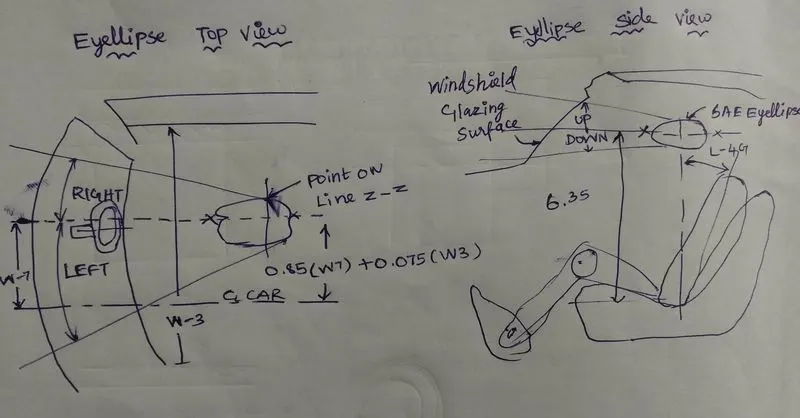
- Eyellipse represents both the driver’s interior and exterior visibility environment. Eyellipse combines the words eye and ellipse.
- Eyellipse is very basic for an automotive car design. In any automotive design, we must take care that the eye of a person, should not be hindered or obstructed inside the car or any equipment fitted outside the car like the dashboard -there should not be any parts on the dashboard that obstructs a person's eye.
- Eyellipse should be considered in such a way that it allows a person to drive properly or safely and will have a proper visibility zone.
2.
3.
- The E-point is also known as Eye point. That represents the left and right eye of the driver.
- The distance between the E-point is 65mm.
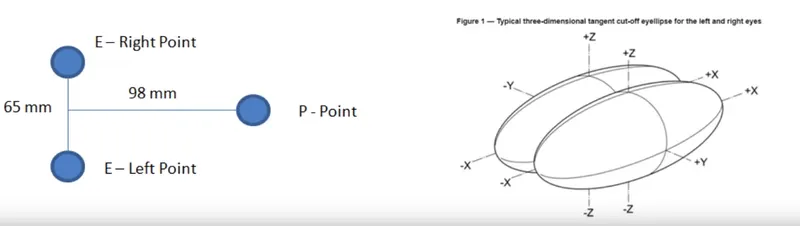
4. P-point represents the Neck pivot point.
5. The distance between the P-point to the center of the E-points is 98mm.
6. For a 95 percentile of the driver's population, the E-point are spaced at 65mm apart and the P point for the same is space below a normal line drawn from the middle centroid of the Points at a distance of 98 mm.
7. Seat Reference Point.
8. The seat reference point and the H-point both are the same points. The tier-1 suppliers call the SgRP an H-point.
9.
- H-point is nothing but the same as the Seat reference point.
- The only difference between H-point and seat reference point is that the Seat reference point is used for the OEM’s because they have to define a lot of points and a lot of locations from a seat reference point.
- The tier-1 suppliers call the SgRP as H-point.
10. A Heel point is a point of contact of the occupant’s heel with the floor of the vehicle. A heel point for a driver is called an accelerator heel point or for a passenger is called a passenger heel point.
11. Oscar is the name given to the 2D or 3D device used to define and measure vehicle-seating accommodation.
12.
- Oscar is the name given to the 2D or 3D device used to define and measure vehicle-seating accommodation.
- The 2D device is called as Oscar template
- The 3D device is called an Oscar or Oscar machine.
- To calculate the H-point we basically used the Oscar or Oscar Template.
- The Oscar/Oscar template gives the seat designer an approximation of how the vehicle occupant will sit in the seat.
13.
- The 3D Oscar machine allows testing of the design H-point which is calculated using the Oscar template.
- The H-point recorded through Oscar machine testing is called the Actual H-point.
14. If the designated seating position can be adjusted, the path of the design H-point through the full seat adjustment range establishes the design H-point travel line. The point along the H-point travel is called the H-point window.
15.
- Small Women Type: 104 lbs (represents 5th percentile of drivers)
- Mid Sized Man: 169 lbs (represents the 50th percentile of drivers)
- Large Size man: 226 lbs (represent the 95th percentile of drivers)
16.
- The weight (in kg) of 95% Oscar-
- Large Size man: 102.5 kgs (represent the 95th percentile of drivers)
17.
The following are some of the importance of H-Points,
- To understand the driver's position.
- Careful measurements & testing are required to ensure the occupant positioning adheres to OEM specifications.
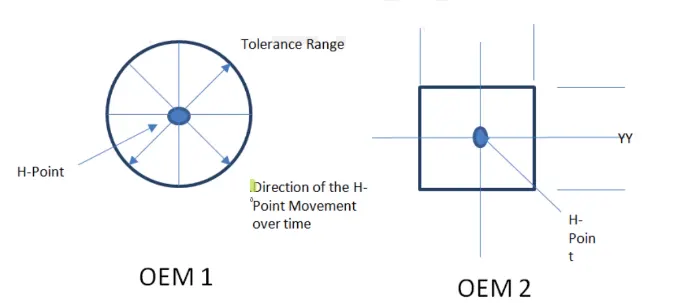
- Over time the H-point shifts because of deterioration.
18. The Tolerance of the H-point is given using an H-point tolerance band either in circular form or square form.
19. D-point is the lowest point on the buttock contour of the seated Oscar template or Oscar machine in the installation position.
20.
- AHP - Acceleration Heel point
- It refers to Oscar’s heel point with a shoe on the un-depressed accelerator pedal and the foot angle at a min of 87 deg.
21. The reaching position for a specific driver population is called the Hand reach Envelope.
22.
- There are two types of HDR, They are,
- Primary DHC: Steering, Gearshift, Turn Signal, Ignition.
- Secondary DHC: Climate, Radial, Accessory Control.
23.
- Back Angle is back angle is the angle of recline of the torso line relative to the vertical.
- Cushion Angle is the angle of incline for the cushion relative to the horizontal.
24.
- Is the lowest of the major bones comprising each half of the pelvis.
- It is a part of the body that supports you when you sit in the seat.
25. Is it a type of condition, When the occupant is seated for an extended period of time, the condition is called tail burn.
26.
- The lumbar region is the lower vertebrae in the spinal column located between the lowest ribs and the pelvis.
- The lumber helps support the back of the occupant.
27.
- The following details are expected by the OEM during RFQ,
- SgRP
- Foot Angle
- Knee Angle
- Heel Point
- Hip Point
- Back Angle
1.
- There are four main functions of the automotive seat-
- Support the occupant
- Position the occupant
- Provide comfort for the occupant
- Protect the occupant.
2.
- The seat helps the occupant by providing the necessary support to keep him in the driving position.
- Providing support to the occupant is the most basic function of the seat. Improper support will adversely affect the position, comfort, and safety.
3.
- The position of the occupant is extremely important for safe vehicle operations. There are three key elements of occupant position,
- Hand-arm and Legroom: These are important for both the safety and control of the occupant.
- Field of Vision: The driver’s field of vision as defined by the eyellipse should have minimal obstruction from the steering wheel, instrument panel, roofline, beltline, and pillar. The driver should be able to clearly see in all the mirrors while in driving position.
- Driver’s proximity to hand Control: The occupant must be able to reach appropriate controls while in the driving position.
4. The Seat padding (foam) used in the seat if used in an efficient way, helps eliminate the uneasiness and pain caused due to hard points in the seat. A correct amount of thigh and lumbar support make the seat more comfortable for use.
5.
- ILD - Indentation Load Deflection.
- It is known as the amount of load required to compress the seat/foam to 50% of the thickness from its original thickness.