Week 1 Challenge
Objective:
In the growth of the technological advancement various automobile vehicles are comes into society depending upon the various areas of usage. One of the advancement is Electric Vehicles(EV). It runs on the electric power which can be supplied from batteries,grid connected and from regenerative breaking. There are other advanacements which are Hybrid Electric Vehicles(HEV). It is the combination of battery and fuel engine.It runs on both fuel engine and electric power. The batteries of EV's and HEV's can be charged various ways like static charging,Dynamic motion charging and Parking charge lots. Under present situtaion, usage of EV's and HEV's are considering a best solution in public and private organisation.Due to Fuel consumption vehicles , there is broad range of Carbon compounds emission.Top most carbon emitimg countries are China,USA,India,Russia,Japan etc.To elimate these effects EV and HEV provides a crucial role.They provide much energy transfer to the system.
History and Theory:
Combustion Engine
Combustion engine is a heat engine that transfers fuel engine to heat energy to mechanical. Based on fuel combustion,it is categorised as 2 types
1) External Combustion Engine(ECE)
2) Internal Combustion Engine(ICE)
1)External Combustion Engine(ECE)
ECE engine has combustion external of the vehicle.This type of process are used in Steam turbines,Gas turbines,Stirling Engines.It has the Simple mechanism and process takes place in individual components.It can provide High speed and easier in balancing.It can achieve more llife span but provides less thermal efficiency compared to ICE is of 12% to 30%.
2)Internal Combustion Engine(ICE)
IC engine was first created by Etienne Lenoir around 1860 and first modernised by Nicolaus Otto in 1876.In this type of Engines combustion occurs internally and remain constant throughout the cycle i.e., Working fluid equals to Combustion fluid.This process takes place in single unit .Cost of IC engine vehicles are less and user friendly.These type of engines used in general automobiles,Rockets engines,Jet engines etc.It is sustainable for less power generation vehicles.Unlike the ECE , it is easy to start even under cold conditions.Based on fuel used, it is categorised as Petrol engines,Diesel engines,Gasoline etc.General power transfer from fuel to wheels can be shown below.
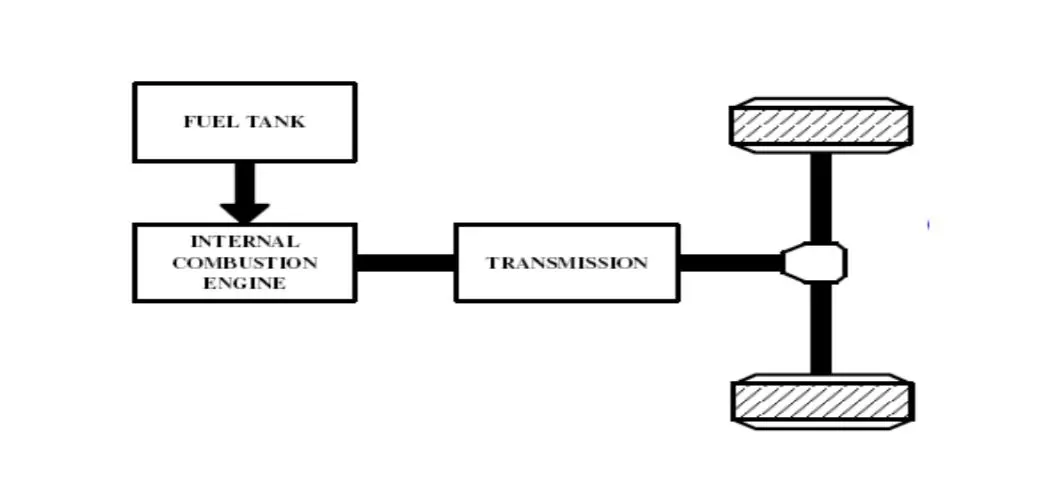
From the block we observe that , Fuel will combust in the IC engine and its get transmitted to wheels.For this process the engine should be complex bulky structure. Along with that it requires cooling reactor to cool down the system.From all this process it leads to the loss on energy in the system.
General losses of the system as follows
1) Engine losses - which consists of thermal or radiator exhaust heat,combustion,pumping,friction etc overall around - 68% to 72%
2) Drive train losses - which consists gear losses,inertial losses,breaking losses,friction etc overall around - 5% to 6%
3) Parasitic losses - which consists water,fuel,oil pumps,ignition system,engine control system etc overall around - 4% to 6%
4) Idle losses - which is around - 3%
5) Accessory or auxilary losses - cooling fans,steering wheels,warmers,head lights etc overall around - 2% to 4%
Taking round off overall total loss can be equal to 88% (neglecting regenerative gain from braking which can add upto 17% power)
This result to power transmitted to wheel will be around 12% of energy produced. Along with that due to combustion of fossil fuels , it results to emission of harmful pollutants like derivatives of COx,green house gases,smoke,smog results in increase of air pollution which causes several infections,air-bourne diseases.
In order to get over this impact Electric vehicles provides best solution.
Electric Vehicle:
Electric Vehicles are the vehicles which runs on the electric power which is supplied from batteries,grid etc without combustions of any fuels.It is one of the efficient innovation which can provide maximum power which can transferred to wheels helps in providing smooth flow.
First Electric vehicle was built in 1834 with a non-rechargeable battery. After the invention of rechargeable batteries,David Salomons invented rechargeable based electric vehicles in 1886. It became popularised and spread wide range of EV's till 1930s due to invention of Automobile Starter motor which helps easy ignition of fuel in IC engine and making affordable price for IC engine vehicles.It makes a user friendly and causes decline of EV's.But in a gap of time by 1970s,there is shortage of fuels in arab countries and also increase in pollution in america which makes to look back towards Electric Vehicles imrovement.It leads to rise in many automobile makers across USA,UK,China,Japan etc.Early popular EV's are GM EV1, Nissan Altera EV, NIES-Luciole, HKU-U2001, Reva etc.Present trending vehicles are Tesla Road Star Models, Nissan leaf, Chevy Bolt, BMW i3 etc.
General power transmision can be shown below.
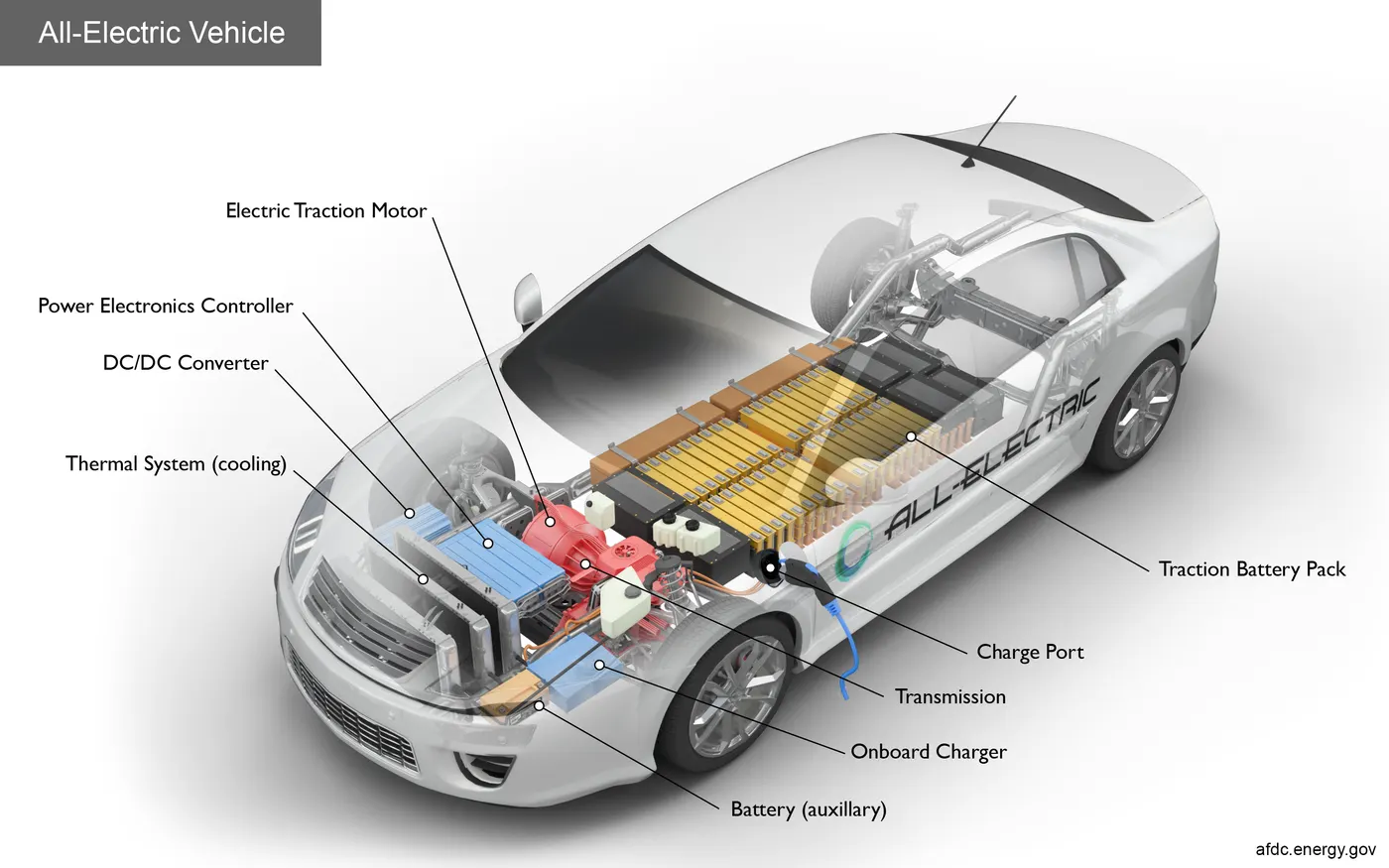
In this system,EV's contains reachargeble battery packs which are connected to the power controllers which converts DC-DC voltage with required amount and transfered to Motor which makes to move the vehicle.It can be charged by Static Chargers which is usually at home and charging stations,Dynamic charging stations which can charge the batteries while in motion and Parking Slots charging stations.For more efficiency of the vehicle requires more voltage which makes to increase in more battery packs.EVs provides smooth flow of the vehicle with noiseless environment and pollutant free environment.And the electricity is cheaper than petrol or diesel.The electric power can be obtained to charging stations by combustion of coal in thermal power plants,through regional power grids,micro grids,from renewable power projects etc. Power usage and losses in this system as follows.
1) Electric drive System losses - which consists gear losses,inertial losses,braking,friction etc overall around - 18 to 20%
2) Charging losses - which consists of ohmic losses,electronic circuit losses etc overall around - 10%
3) Accessory or auxilary losses - which consists of cooling fans,steering wheels,warmers,head lights etc overall around - 8%
Considering these total losses are around 38% (neglecting regenerative gain from braking which can add upto 17% power).Thus it provides 62% of generated power to wheels which is 50% more power than general IC engine vehicles.
One of the important component of the electric vehicle is Batteries.EVs requires rechargeable batteries which can provide high voltage to the system.Depending upon the electrochemistry different batteries are used.
| S.No | Electro Chemistry | Battery |
| 1. | Lead | Lead - Acid Battery(PbO2) |
| 2. | Nickel |
Nickel - Iron (Ni-Fe) Nickel - Cadmium Battery(Ni-Cd) Nickel - Metal Hydride (NiMH) |
| 3. | Lithium |
Lithium ion Battery Lithium ion Silicon Battery Lithium air Battery |
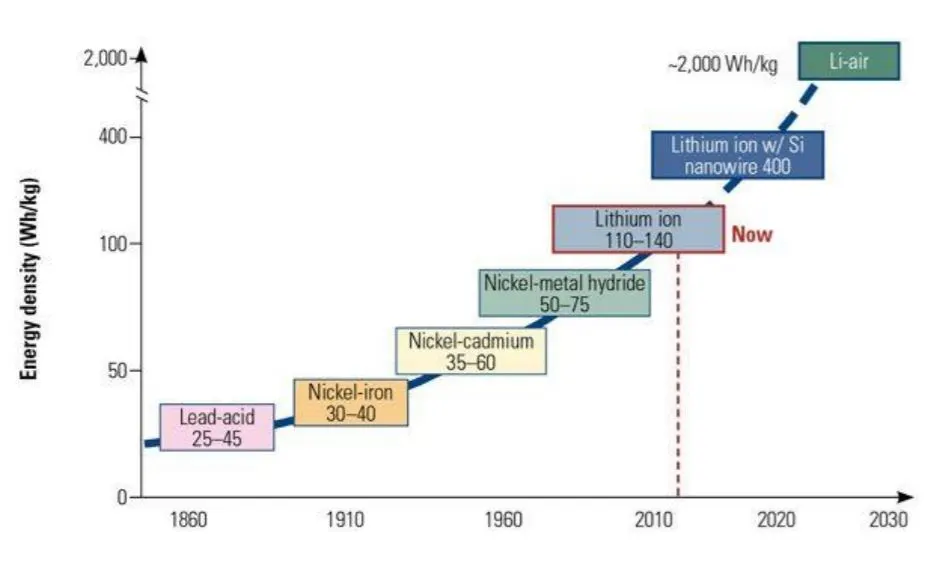
Currently Lithium based electro chemistry is more popular and also provide much power. It has the specific energy and energy density very low around 75 times and 25 times respectively compared to Petrol in SI engine.This gives that for same energy content, the mass of the lithium ion battery will be 75 times more compared to petrol and it requires 25% more volume compared to Petrol.And it makes high intial cost.The increment usage of batteries with respective to timeline as follows.
Conclusion:
Electric Vehicles are the evolving technologies in the present trend.It leads to revolutionary change across all over the world.Different companies emerging variable areas of research in EVs and HEVs.A very wide range of projects going on providing highly efficient and much power transfer system.It plays a crucial role in achieving domestic goals,increasing economic growth,ensuring in mitigation with current global climate conditions.It is providing feasible way to make help in developing nations.It also helps in elimination of noise,air pollution and providing sustainable energy.China,Europe,India,USA and Japan became top most countries providing wide range of efficient energy transfer from electricty to vehicles.
References:
1) H. Pratab,Modern Electric Traction
2) IEEE Smart Grid Battery Storage Working Team,Battery Storage System,White Paper
3) Electric Vehicles Part 1,NPTEL Course
4) Monzer Al Sakka,Hamid gaulas,Noshin Omar,Joeri van meirlo,New generation of electric vehicles
5) Electric Vehicles.wikipedia.com