Week 1 Challenge
Aim - To Perform a literature review of research relevant to energy chain analysis.
Introduction - The increase in number Electrical vehicles are increasing (present it's 3%) and mean while it is replacing IC engines. More over last thousands of years IC engines were ruled in the transportation area and now gradually Electrical vehicles are replacing them. It's all because due to the increase in the pollution the electrical vehicles are becoming more in numbers. Electrical engines are having advantages as well as disadvantages when comparing to IC engines.
An electric vehicle (EV) is one that operates on an electric motor, instead of an internal-combustion engine that generates power by burning a mix of fuel and gases. Therefore, such as vehicle is seen as a possible replacement for current-generation automobile, in order to address the issue of rising pollution, global warming, depleting natural resources, etc. Though the concept of electric vehicles has been around for a long time, it has drawn a considerable amount of interest in the past decade amid a rising carbon footprint and other environmental impacts of fuel-based vehicles.
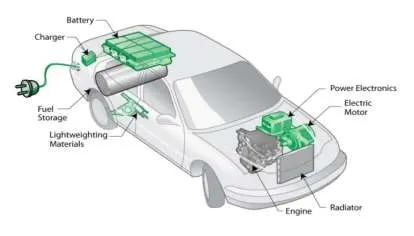
Outline of an Electric Vehicles -
Energy Storage : Energy for the working of the electrical motor is been stores inside the battery. According to efficiency of battery the distance of travelling will also vary. generally lithium battery are used as storage device in these type of vehicles. In developed countries the method of charging on the EV vehicles are developing more faster when compared to other countries.
Reliability: Having less moving parts, compared with an internal combustion engine, an electric motor has fewer sources of possible failures. Also, due to the high torque and high speed characteristic of the electric motor, there is no need for a multi-stage gearbox, a single-step mechanical gearbox is enough for propulsion.
Efficiency and Power : Electric vehicles are powered by electric motors and single speed gearboxes which, depending on the operating point (speed and torque), have an overall efficiency between 75 to 95 %. This means that, for the same amount of power at the wheel, less energy is used from the high voltage battery compared with an internal combustion engine vehicle.
Method of driving : As IC engine vehicle have IC engines as the power producing unit for the vehicle to be driven . Here the Engine is replaced and electrical motor are added instead , the fuel for the electrical motor is electrical energy which are stored inside the battery. When the power is been driven from the battery It is been connected into the electrical motor and been driven.
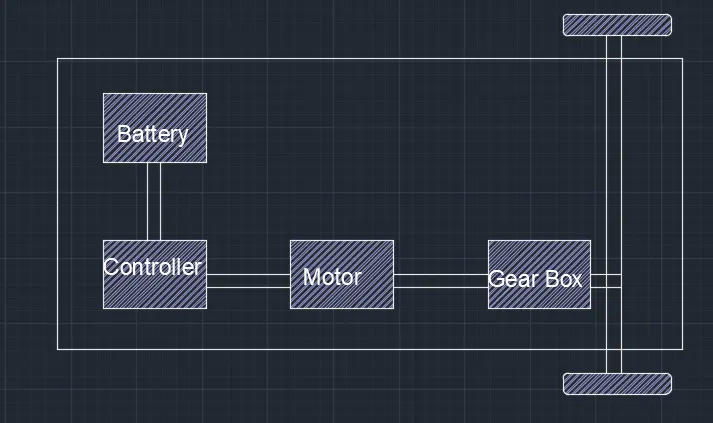
Architechture -
The flow charge above shows the system of working of and electrical vehicle .The main components of a BEV can be divided into the electric battery, the electric motor, and a motor controller The battery charges with electricity either when plugged in the electricity grid via a charging device or during braking through recuperation. The charger is a crucial component since its efficiency can vary today between 60% and 97%, wasting 3% to 40% of the grid energy as heat. The motor controller supplies the electric motor with variable power depending on the load situation. The electric motor converts the electric energy into mechanical energy and, when used within a drivetrain, to torque.
Development of Electrical vehicle Infrastructure and Technology
There are lot of obstacles been facing by electrical vehicles in terms of in fracture energy storage , recharging, etc. Larger amount of research and development are going on this area. So this can be seen in US the development of charging points of electrical vehicles are increased year by year in a larger amount.
Since there is no internal combustion engine present, electric vehicles have zero exhaust gas emission. Also, depending on the source of the electric energy (e.g. renewable) the overall CO2 impact of an electric vehicle is smaller compared with a internal combustion engine vehicle. SO this impact on the Electrical vehicle will over all increase its efficient and will decrease the pollution. Pollution is the main disadvantages of the IC engines and by the development of EV engines this problem will be solved.
Comparison electrical Vehicle to IE vehicles -

Conclusion or Results -
EVs are always a better option to go with because several reasons like Health benefits. Reduced harmful exhaust emissions is good news for our health. Better air quality will lead to less health problems and costs caused by air pollution. EVs are also quieter than petrol/diesel vehicles, which means less noise pollution. Electric car seems to be a suitable instrument and a sustaining measure towards a more sustainable mobility future since it is four times more energy efficient compared to IE. Therefore, it is seen as a milestone towards a ‘Great Transformation. The TTW efficiency advantage of BEV over ICEV, together with the efficiency jump by Li-ion batteries, enable the electrification of the automobile as long as it is moved in regional ranges of up to 100 km per day. However, WTW efficiency of electric cars can reach exemplary figures only when electricity is provided by very efficient power plants and infrastructure, best with renewable energy production. Also, electric cars should be incorporated into a variety of modern mobility concepts.
References -
- https://www.researchgate.net/figure/Outline-of-Electric-Vehicle_fig1_313455712
- https://www.ergon.com.au/network/smarter-energy/electric-vehicles/benefits-of-electric-vehicles#:~:text=Health%20benefits,which%20means%20less%20noise%20pollution.
- https://www.intechopen.com/books/new-generation-of-electric-vehicles/energy-efficiency-of-electric-vehicles
- https://www.adlittle.de/sites/default/files/viewpoints/ADL_BEVs_vs_ICEVs_FINAL_November_292016.pdf