Week 1 Challenge
ANSWER 1:
AIM:The purpose is to find the most efficient truss in carrying gravity load from the trusses given in the question
OBSERVATION:From the given trusses ,Truss A is Pratt Truss and Truss B is Howe Truss .
- Pratt Truss:
- This truss is made up of vertical and diagonal memebers that form N shape
- The diagonal members are arranged in such a way that they only develop tensile forces
- The diagonal members are designed to resist axial tension only
- The vertical members in pratt truss develop compression forces such that they are capable of resisting compression buckling
- This truss has diagonal members towards the middle
- The Tension and compression members are as shown
- In the figure blue color lines shows compression members and black colour lines shows tension members and grey colour indicates zero force members i.e.,neither compression nor tension
B.Howe Truss:
- This truss is looking like upside down of pratt truss when we visualize in terms of geometry
- The entire structure is similar to pratt truss but in a reverse manner i.e.,the diagonal members are now occupying the opposite joints
- It also consists of alternate vertical and inclined members
- This truss has diagonal members slant down away from the middle
- This truss has no force on the center and the tension members are vertical and daigonal members are in compression
- From the figure black members are in tension and blue members are in compression and grey points are zero forces i.e., neither compression nor tension
RESULT:On application of gravity loads at the joints of the top chord, Prutt trusses have their vertical members in compression and diagonal members in tension
Where as in Howe trusses,this is reverse to pratt truss i.e., diagonal members are in compression and vertical members are in tension
Hence pratt trusses are efficient for the loads in gravity direction and howe trusses are efficient for the uplift loads i.e., loads opposite to gravity
ANSWER 2:
Deflection shape and bending moment for the frame given:
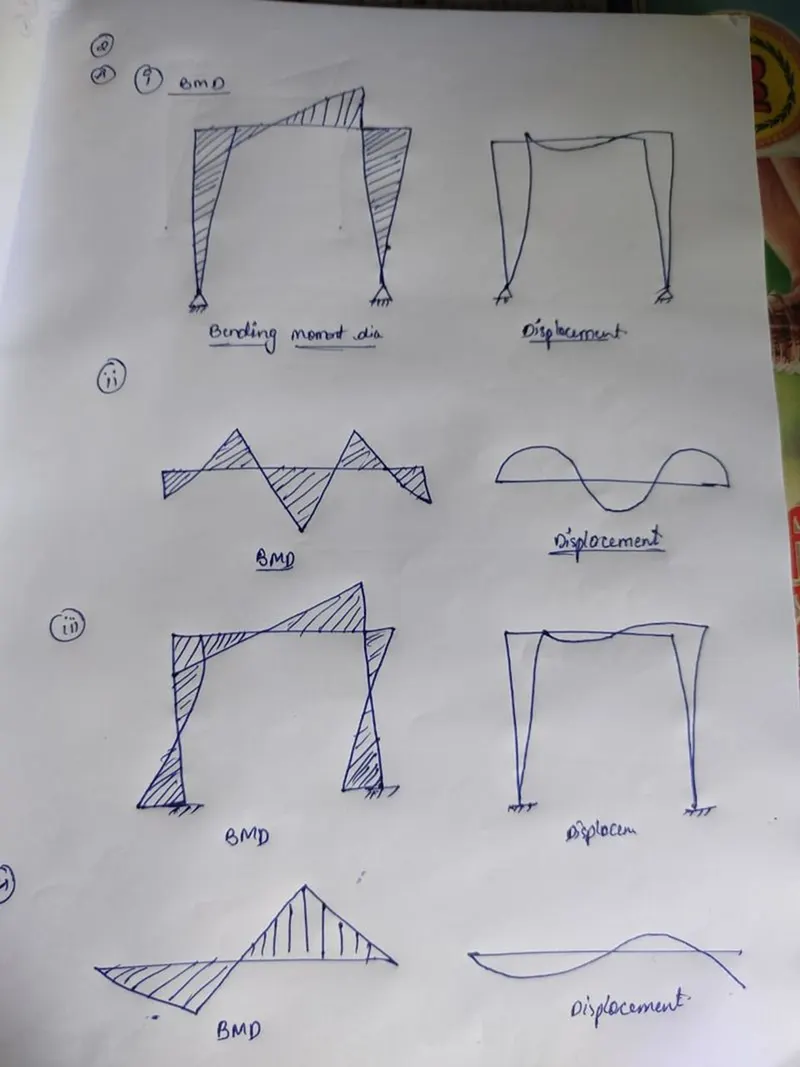
QUESTION 3 ANSWER
a)MOI ALONG Iz=18341333.3333 mm4
MOI ALONG ly=1843244.9123 mm4
Weight per meter= 23.84kg/m
b)MOI ALONG Iz=5442066666.6667 mm4
MOI ALONG ly=135042666.6667 mm4
Weight per meter= 204.1 kg/m
c)MOI ALONG Iz=18540000 mm4
MOI ALONG ly=1420000 mm4
Weight per meter= 74.34 kg/m
d)MOI ALONG Iz=64180000 mm4
MOI ALONG ly=81630000 mm4
Weight per meter= 74.34 kg/m
QUESTION 4 ANSWER
Floor width = 10kN/m2
Tributary width of exterior girder = 0.5(0+8) = 4m
Tributary width of interior girder = 0.5(8+8) = 8m
Tributary width of exterior beam = 0.5(0+2) = 1m
Tributary width of interior beam = 0.5(2+2) = 2m
Load on beam = tributary width x floor load
Load on exterior girder = 4 x 10 = 40Kn/m
Load on beam interior girder = 8 x 10 = 80 Kn/m
Load on beam exterior beam = 1 x 10 = 10Kn/m
Load on beam interior beam = 2 x 10 = 20 Kn/m
QUESTION 5 ANSWER
Given, Initial total length= 2000 m
Temperature difference = 60 degrees
Coefficient of Thermal expansion of steel = 12x10-6/°C
Length difference = 2000*60*12x10-6 =1.44m
Total length = 2001.44 m