Week 1 Challenge
1.Orginal Equiment manufacture.
2.OEM>Tire 1>Tire 2>Tire 3
3. Tata steel -Steel.
Rubfila International -Rubber
steel authority of india (SAIL)-Steel
GRP- Rubber.
Dow chemical company -Plastic
Supreme Indudtries - Rubber.
4. 1886
5. Wooden seats.
6.Used to locate the all the components in the vehicle.
7.-To define individual parts.
-Define exact location of the parts.
8. X represent the point along the length of vehicle and positive x is toward the rear of vehicle.
9. The plane of point where the one of the co-ordinate is zero.
10.Intersection point of the three planes,where all the co-ordinates are zero.
11. Bumper of vehicle.
12.Grid lines- Formed by intersection of planes located at 100mm increments parallel to the X-Z,Y-Z and X-Y planes.
Work lines - Located on individual parts.
13.yes
14.Where a part is located in the vehicle w.r.t the body.
15.Upright position.
16.LOngitudinal axis of the vehicle that divides it into two haves.
17.Middle of vehicle,from front bumber to rear bumper.
18.Right of central plane.
19.D-Point is the lowest point on the buttocks contour of the seated Two-or Three-Dimensional Device in the installed position.
20.LHD- Design element or seat system component on the left hand side of the centerline when facing forward in the vehicle.
RHD - Design element or seat system component on the right hand side of the centerline.
21.left hand drive
22.positive
23.LHD
24.Inboard
25.Inboard.
26.Inboard.
27.3D referance system.
28.IB-Inboard OB- outboard.
29.Fore.
30.Fore.
31.Positive.
32.China
33.1.Totota
2.Volkswagen Group
3.Hyundai/Kia
4.General Motors
5.Ford
34.Germany
35.1.Maruti Suzuki
2.Hyundai
3.Tata
4.Mahindra
5.Kia
36.Australia,New Zealand,India.Japan,England
37.Argentina,Brazil,Canada,China,France
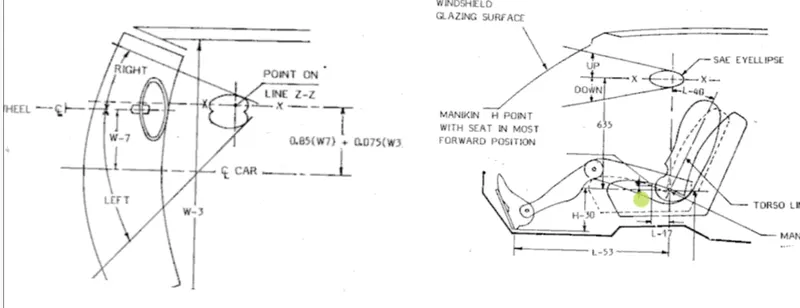
1.Represents both the driver's interior and exterior visibility environment. it allow for proper vision and reduce the obstruction.
2.
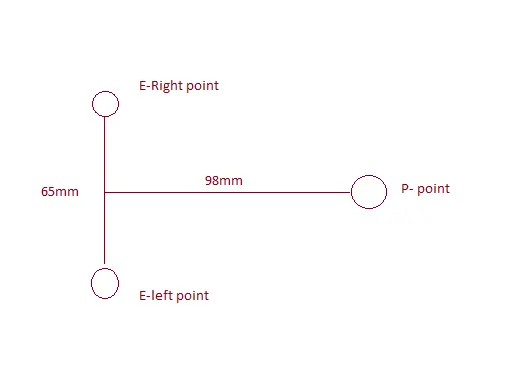
3.E-Points are two points that represents the left and right eye of a driver
4.P-Point represents the neck pivot point, the P-point is the point around which the driver neck turns horizontally to the left and right.
5.Used to calculate the eyellipse.
6.
7.Seating Reference Point
8.H-point is defined as the actual hip point of the seated crash test dummy itself
9.H-point (or hip-point) is the theoretical, relative location of an occupant's hip. It is the pivot point between the torso and upper leg portions of the body .
seating reference point means a design point defined by the vehicle manufacturer for each seating position and established with respect to the three-dimensional reference system.
10. Heel point-Point where the foot is placed on the pedal.
11.Oscar is the name given to the 2D and 3D device used to define and measure vehicl-seating accommodation
12.2D device is called the oscar template and 3D Device is called the oscar Machine.
12.Replication of human to approximation of how the vehicle occupant will sit in the seat
13.A point is determined that represents the pivot point of Oscar torso and thigh.It should match the seat referance point given by the OEM -Design H-Point.
The H-Point recorded throough Oscar machine and it is determined using the 95% leg size installed in any designated seating position -Actual H-Point
14.If the designated seating position can be adjusted,the path of the design H-point through the full seat adjustment range establishes the design H-Point travel calledas H-Point Window.
15.There are 3 type of Oscar :
1.Small Women Type :104lbs(Represents the 5th Percentile of driver).
2.Mid Sized Man : 169 lbs (Represents the 50th Percentile of driver).
3.Large Size Man : 226 lbs (Represents the 95th Percentile of driver)
16. 102.512kg
17.-Seat design has a direct effect on the occupant's relatioship to other vehicle controls.
-Careful measurements & testing are required to ensure occupamt positioning adheres to OEM specification.
-Over the time H-point shift because of deterioration of seat.
18.Using the 95% lef size installed in any designated seatign position.
19.D-point -Lowest point on the buttock cotour of the seated Oscar template.
20.Accelerator Heel Point - Oscar's heel point with the shoe on the un-depressed accelerator pedal & the foot angle at a min of 87 deg.
21.Hand Reach Envelope: Reaching distance for specific driver population.
22. 2 type of Hand Reach Envelope :
Primary Driver Hand Controls and Secondary Driver Hand Controls.
They are categoried based on the necessary of the needs.
Primary DHC -Steering ,Gearshift,turn signal, ignition ,horn,Headlamp,hand Break .
Secondary DHC - Climate ,Radio,Accessory control.
23.Back angle : Angle of recline of the torso line relative to the vertical,it doesn't measure the angle of the seat structure.
Cushion Angle : Angle of incline for the cushion relative to horizontal.It helps in determining the amount of thigh support the occupant will have.
24.Ishium: Lowest of 3 major bones comprising each half of the pelvis.
25.Tail Burn: When an occupant is seated for an extented period of time.
26.Lumber support is the back support of the seat. It help in the ergonomic comfort.
27.1.Seating referance point
2.Fooot angle.
3.Knee Angle.
4.Heel Point.
5.Hip Point
6.Back Angle.
1. There are 4 main function of the automotive seat:
1.Support the occupant
2.Position the occupant
3.Provide comfort for the occupant .
4.Protect the occupant.
2.Seat support is the basic function of the seat system.Improper support will affect the position,Comfort and safety of occupant.
3.Position of seat affect the safety of vehicle operation.Hand,arm and leg room should be suficent to drive.Field of vision should be clear there should be no obstruction while driving and driver proximity to hand control driver should be able to reach to do primary operations.
4.Factors affecting the comfort are:
1.Determing the amount of seat padding
2.Locating and avoiding hard points in the seat
3.Determining the angle of the seat back and cushion.
4.Deciding on the correct amount of Thigh & Lumber support
5.Establishing seat width and Height.
5.Indentation Load Deflection- Measurement taken to assess the firmness of the seat.