Week 1 Challenge
- What is the full form of OEM-
OEM stands for original equipment manufacturer. BMW, HP, TATA
- How the Design Responsibilities goes in Automotive?
At the top of the Automotive Hierarchy the main Design Responsibility lies with the OEM. They are one who design the car.
Secondly, to the Design Responsibility like with the Tier 1. Tier 1 are organizations whose part directly fitted in the car. The design responsibility for those individual parts lies with the Tier 1 if the complete part is designed by them.
- Name Some Tire 4 supplier and what they manufacture?
The number of tiers involved in a product depends largely on its complexity. If Tier 1 provides Individual whole components that are directly assembled in the product, Tier 2 provides subassembly components for those individual components, Tier 3 supplier deal with the Sub- parts like dies and stamped parts designers required for those sub-assemblies, then, Tier 4 may be the one supplying the raw materials like steel or plastic, thus making them the end of the supply chain.
- When was the first Car Made?
The First Car was made in 1886
- What kind of seats are used in the First Car?
Wooden Seat were used in the first car.
- Define 3D reference System?
A standard global reference system which can be used to locate all the components in the vehicle can be referred as 3-dimensional Reference System.
- Why 3D reference system is needed?
A car contains a lot of parts. To locate all individual parts in the car there should be a reference system for all to follow, as different organizations, different tier suppliers and different teams will be involved. So, in order to make is easy to communicate and locate these components in a car a 3D reference system is needed. It helps the designers to locate the individual components and helps them to understand where different parts are going to fit in an assembly. It also, helps to communicate with different tier 1 suppliers, e.g., a seating team needs to discuss about mechanisms with the console team.
- What is X plane and in a Car what is positive “X”?
X plane is a plane normal to the x -direction of a 3D reference system. X represents a point along the length of the car. Positive x co-ordinate is towards the rear side of the car.
- What is zero plane?
The plane of points where one of the co-ordinates is “0” is called the zero plane.
- Define point of origin?
The point of origin of the 3D system is the intersection point of the three planes, where all co-ordinates are “0”.
- Where do most OEM point of origin keep?
The point of origin may differ from OEM to OEM. Sometimes it can lie on bumper, sometimes it can lie on roof. It totally depends on the OEM how they are going to define it.
Most Often it is placed on the front Bumper of the vehicle, though it is not a standard that has to be followed.
A point of origin should be known by the designer to ensure proper use of co-ordinate points in the drawing while producing it.
- Difference between work line and grid lines?
Grid lines are formed by intersection of planes located at 100 mm increments parallel to the X-Z, Y-Z and X-Y planes. Grid line are used basically to package and locate objects and spaces in a vehicle Grid lines are also referred as Body Lines.
Work Line are located on individual parts.
Work lines doesn’t generally run parallel to grid line.
In general, work line are provided for an individual component while grid line is provided for a complete car.
It is not necessary that work lines should be 100 mm apart, but to make it easier we usually keep it that way.
Work line are basically given to individual tier1 suppliers whereas grid lines are used for whole vehicle.
- Are Work line and Grid lines are interconnected?
Work are generally not interconnected. Work lines doesn’t generally run parallel to grid line. In general, work line are provided for an individual component while grid line is provided for a complete car.
Grid lines are formed by intersection of planes located at 100 mm increments parallel to the X-Z, Y-Z and X-Y planes
Work Line are located on individual parts.
It is not necessary that work lines should be 100 mm apart, but to make it easier we usually keep it that way.
- What is Body Position?
Body position refers to where is part is located in a vehicle with respect to the body.
Also called as inbody or in vehicle position
- When a car comes out of OEM Yard, Seat will be at what position?
When a car comes out of OEM Yard , Seat will be at Body position.
- How centreline is used in terms of Car Design?
Centreline is used to divide the car into two equal halves, one which has a positive Y value and other which has a negative y value, thus helping to locate a point or component in space.
- Usually centreline is placed at Center console running vertical to downward position from front bumper to rear bumper.
- What is Positive Z direction?
The upside of the centreline of the car parallel to the ground is the positive Z direction.
- What is Positive y direction?
Right hand side of the driver/ centreline when facing forward in the vehicle is the positive y direction.
- What is LHD and RHD?
LHD- Left Hand Drive
RHD- Right Hand Drive
- A driver driving a Car in US will be sitting which side of Car?
A driver driving a Car in US will be sitting on the left side of Car.
- Driver in US is in Negative Y Direction.
- A Indian Cab Driver went to USA and started driving a Car, which side of the Car he will be sitting?
He will be sitting on the Left side of the car.
- I opened the Door of my car and saw my room keys on center console, so my keys are negative left side against the Door.
- Belt Buckle attached on the Left Side of the Seat.
- The Recliner handle is placed Right side of the seat.
- Inboard/ Outboard is a Reference based system.
- IB: Inboard OB: Outboard
- Going from rear bumper to forward is Fore
- C-Pillar to B – Pillar movement is Fore
- A aft movement of seat is Positive X movement.
- Volume wise which country produce max number of cars ?
China
- Volume wise production please place all OEM in global?
Volkswagon – 9.7 million units/ annum
BMW –
Toyota –
Hyundai –
Daimler –
The Suzuki Motor Corporation-
Peugeot-
Honda-
Nissan
Ford-
Renault-
General Motors-
Tesla
- Which country India will replace in next 10 year in terms of Volume production?
India (4.51 million) may replace Germany (4.66 million), then Japan (9.68 million) and hopefully later US (10.88 million) in the 10 years. China has 25.72 million so in 10 years I don’t think that will be possible.
- Volume wise production please place all OEM in India?
Maruti Suzuki -1293000
Hyundai- 471000
TATA -222000
Kia - 155000
Mahindra – 155000
Toyota- 93000
Renault – 92000
Honda -82000
Ford – 48000
MG- 36000
Volkswagon- 20000
Nissan – 19000
Skoda- 11000
- Name countries which follow LHD Drive?
US, Australia, New Zealand, UAE, Canada
- Name Countries which follow RHD Drive?
India, Japan, South Africa, United Kingdom, Bangladesh, Nepal
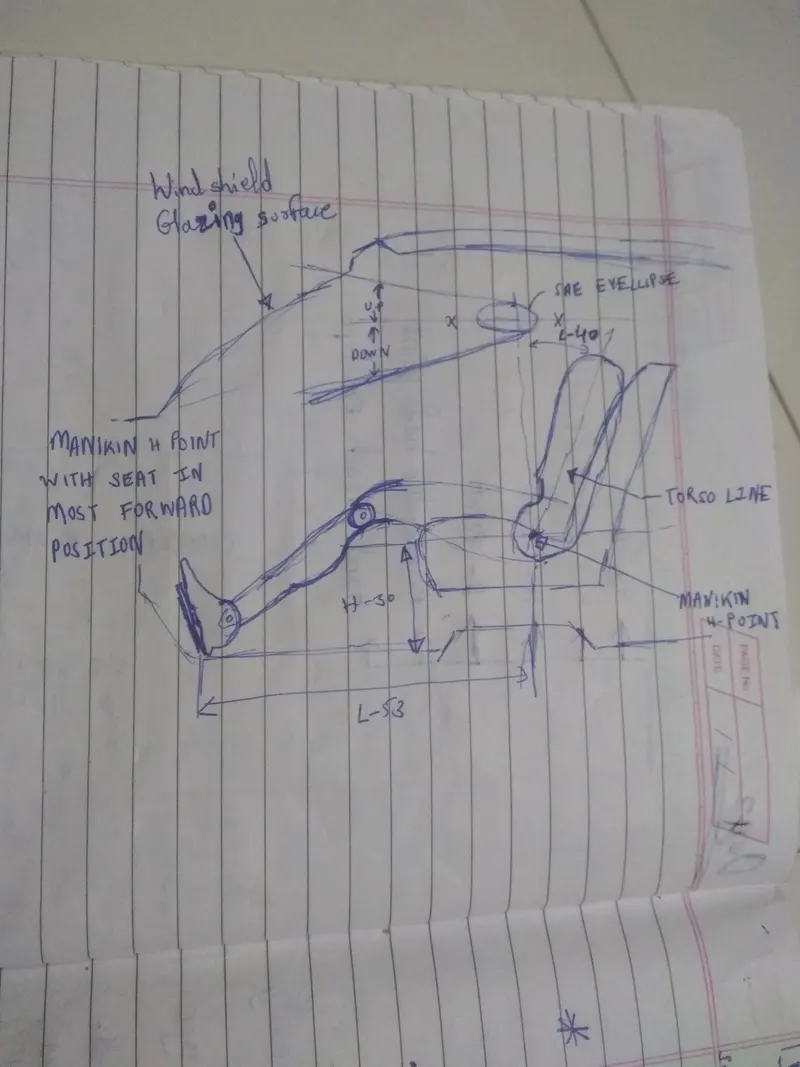
- What is Eyellipse and how it is important from OEM purpose?
Eyellipse represents both, the driver’s interior and exterior visibility environment. Eyellipse combine the words eye and ellipse.
Eyellipse is very start or very basic for an automotive car design. In any automotive design, we must take care that the eye of a person, it should not be hindered or obstructed inside the car or any equipment fitted outside the car like dashboard -there should not be any parts on dashboard that obstructs a person eye.
Eyeliipse should be considered in such a way that it allows a person to drive properly or safely and will have a proper visibility zone.
Purpose of eyellipse-
Alllow the driver to view oncoming vehicle and objects
Allow to view internal gauges and instrument panel
Allows to view the side of the vehicle and all mirrors without obstruction.
(Possible obstructions are the steering wheel, support pillars in the vehicle , shadow and light disturbance in the cockpit.)
Its is important from OEM perspective because it is very important for the occupant to be placed properly in the vehicle to allow for proper vision.
Once an Oem decide to made a car-
Firstly it should place a person in the car
Secondly the OEM should place all other components inside the car in such a way that his eyeliipse is always free and without any obstruction. And he is able to see all the mirrors without obstructions, the view outside of oncoming vehicles and internal gauge and instrument panel.
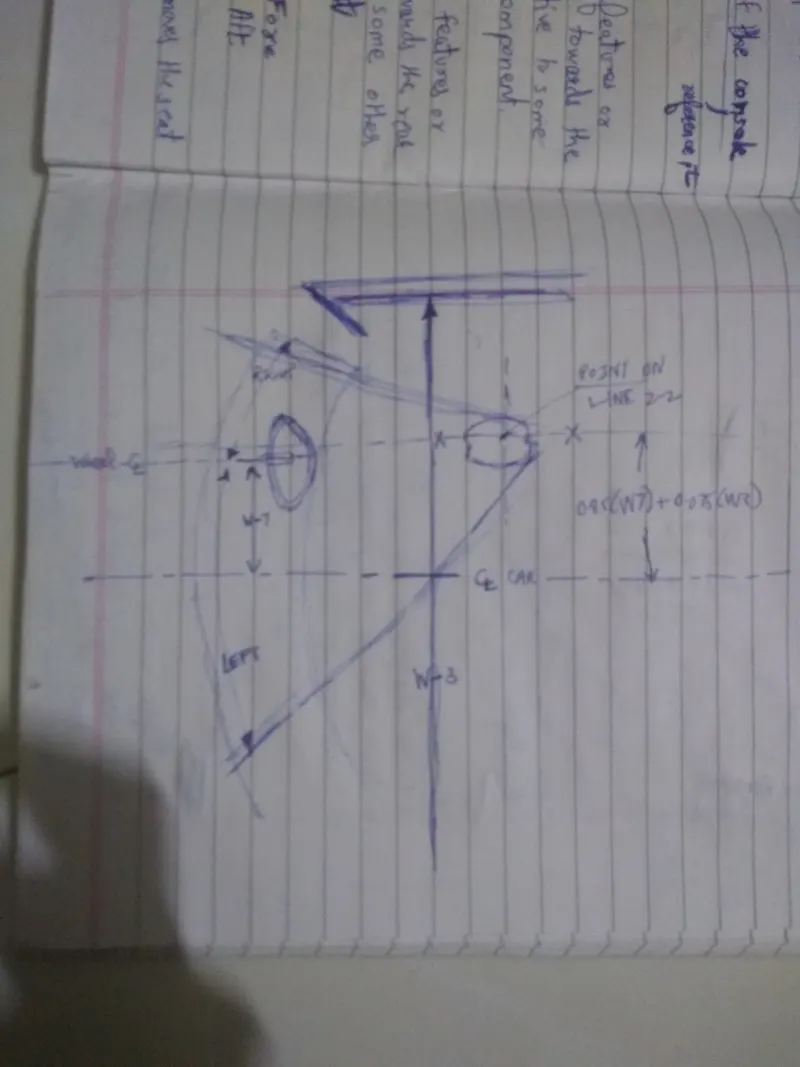
- Draw the complete Eyellipse Zone in a OEM environment?
- What is E-Point?
E point are two points that represent the left and right eye of a driver. They are space 65mm apart and fit 95% od driver population.
- What is P-Point?
The P-point represent the neck pivot point. The P-point is the point around which the driver neck turns horizontally to the left and right.
- Correlation between E Point and P Point?
For a 95 percentile of the drivers population the E-point are spaced at 65mm apart and the P point for the same is space below a normal line drawn from the mideye centroid of the Epoints at a distance of 98 mm.
- Eyellipse calculation as per E-Point and P-Point?
For a 95 percentile of the drivers population the E-point are spaced at 65mm apart and the P point for the same is space below a normal line drawn from the mideye centroid of the Epoints at a distance of 98 mm.
- What is full form of “SgRP”?
SgRP stands for Seating Reference Point
- What is H-point?
A point is determined which represents the pivot point of Oscar torso (backline) and the thigh (thigh line) is called the “Design H-point”.
H-point should match the seat reference point given by the OEM.
- Difference between “SgRP” and “H-point”?
H-point is nothing but same as Seat reference point.
The only difference between H-point and seat reference point is that Seat reference point is used for the OEM’s because they have to define a lot of points and a lot of locations from seat reference point. So usually they define it as seat reference point.
While, a tier 1 supplier who is supplying seat, for him seat reference point is not logical because he doesn’t have the complete car with him and seat is his only component. Therefore, for him seat reference point will not support or fulfil all his requirements.
To avoid any confusion between Oem’s and tier 1, OEM’s provide them with a H-point. Therefore, a tier 1 supplier will use seat reference point as H-point because they don’t have the complete car for reference.
In short, they are not different, only that OEM always use seat reference point while Tier 1 uses H-point.
Basically H-point will be checked from Front mounting or rear mounting or a location within the seat while, seat reference point will be checked from Front Bumper, rear bumper or where the origin co-ordinates of the car are.
- What is heel point?
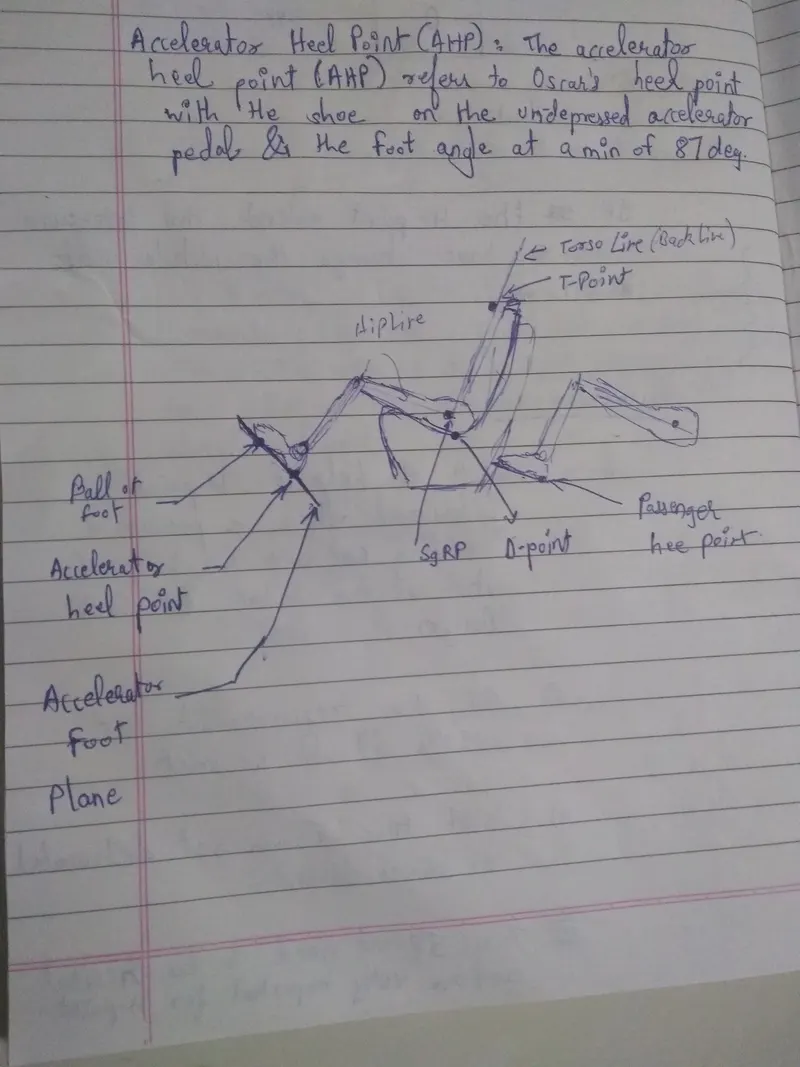
A Heel point is a point of contact of the occupant’s heel with the floor of the vehicle. A heel point for a driver is called as accelerator heel point or for a passenger is called as passenger heel point.
- What is Oscar?
“Oscar is the name given to the 2D and 3D devices used to define and measure vehicle seating accommodation.”
In Short, Oscar is a 2D or 3D representation of human being. When we replicate a human in machine form it is called as Oscar template or Oscar machine.
- Difference between Oscar and Oscar templet?
Oscar is a 2D or 3D representation of human being. When we replicate a human in machine form it is called as Oscar template or Oscar machine.
The 2D representation is called as Oscar Template or Manikin.
The 3D representation is called as Oscar Machine or Oscar.
- What is the purpose of Oscar?
The Oscar templet gives the seat designer an approximation of how the vehicle occupant will sit in the seat.
From this approximation, a point is determined that represents the pivot point of Oscar torso (backline) and the thigh (thigh line). This is called the “Design H-point” and should match the seat reference point given by the OEM.
If the designated seating position can be adjusted, the path of the design H-point through the full seat adjustment range establishes the design H-point travel line. The point along the H-point travel called as H-point window.
Once the Oscar is positioned in space according to the OEM packaging drawing requirement, the seat can be designed around the Oscar.
- What is Design H-point and Actual H-point?
The 3D Oscar machine it allows testing of the design H-point which is calculated using the Oscar templet.
The H-point recorded through Oscar machine testing is called as Actual H-point.
- What is H-point Window?
If the designated seating position can be adjusted, the path of the design H-point through the full seat adjustment range establishes the design H-point travel line. The point along the H-point travel called as H-point window.
The H-point window in short means, H-point can lie anywhere within this region.
- Type of Oscar?
There are three types of Oscars templet.
- Small Women Type: 104 lbs (represents 5th percentile of drivers)
- Mid Sized Man: 169 lbs (represents the 50th percentile of drivers)
- Large Size man: 226 lbs (represent the 95th percentile of drivers)
- What is the weight (in kg) of 95% Oscar?
The weight (in kg) of 95% Oscar-
Large Size man: 226 lbs = 102.5 kgs (represent the 95th percentile of drivers)
- What is the importance of H- point?
The H-point is needed to keep a check on the below three points-
- With the help of H-point we understand where a person is seating and with the help of which we can initiate the seat design. Seat design has a direct effect on the occupants relationship to other vehicle controls.
- Careful measurement & testing are required to ensure occupant positioning adheres to OEM specifications among which includes H-point given by OEM, envelope condition given by the OEM.
- Overtime the H-point shifts because of deterioration of seat, particularly of the foam. Therefore H-point should be known and restricted within the tolerance band to increase the life of the seat.
- How the Tolerance of H-Point Given?
The Tolerance of H-point is given using a H-point tolerance band either in circular form or square form.
It could be seen that, with time the foam get reduced in thickness. Due to this the h-point would shift and come down, lower and lower accordingly. Because of this, the OEM’s make use of H-point tolerance band. It should be noted that H-point should not extend beyond this zone.
Few OEM’s use tolerance band in a circular form while few OEM’s use H-point tolerance in a square form.
If the H-point extends this tolerance zone we then have to change the vehicle seat.
- What is D-point regarding a Seat?
The D-point is the lowest point on the buttock contour of the seated Oscar template or Oscar machine in the installed position.
- What is the full form of AHP? Define its usage for seats?
The full form of AHP is Accelerator Heel Point. Accelerator heel point is used to define the position of the foot with the shoe touching the floor on an un depressed accelerator pedal. It has a min of 87 deg foot angle.
- What is Hand Reach Envelop?
Access to control is as important as clear field of vision. The occupant must be able to reach the appropriate controls while in driving position or while the car moves.
The reaching distance for a specific driver population is called the Hand Reach Envelope.
- Types of Hand Reach Envelope? And how it is categories?
There are two types of driver hand controls
- Primary Driver hand control: Wearing lap and shoulder belt in driving position.
It includes steering control, gearshift control, Turn signal control, Ignition control, Audible control, Headlamp Control, Hand Break control, Wiper / Defroster Control.
- Secondary Driver hand controls: Wearing a lap belt
It includes climate control, Radio Control, Accessory Control.
- What is Back/ Cushion Angle?
Back Angle: the back angle is the angle of recline of the torso line relative to the vertical.
Cushion Angle: the cushion angle is the angle of incline for the cushion relative to the horizontal.
- What is Ischium?
Ischium is lowest of the three major bones comprising each half of the pelvis. It is part of the body that support you when you sit in the seat.
- What is Tail Burn?
A tail Burn is a condition when an occupant is seated for an extended period of time. Therefore, the cushion should be designed to prevent tail burn.
- How lumber help driver?
The lumber region is the lower vertrbrae in the spinal column located between the lowest ribs and the pelvis.
The lumber helps support the back of the occupant.
- During RFQ what is expected from OEM?
The Oem is expected to provide with the following basic specifications to be used in seat design-
- Seating reference Point
- Foot Angle
- Knee Angle
- Heel Point
- Hip Point
- Back Angle
Apart from this we may require few other details like if the seats move forward and backward, upwards and downwards etc.
- What is the function of a seat?
There are four main functions of automotive seat-
- Support the occupant
- Position the occupant
- Provide comfort for the occupant
- Protect the occupant.
- How the seat Support the Occupant?
The seat helps the occupant by providing the necessary support to keep him in the driving position. Providing support to the occupant is the most basic function of the seat. Improper support will adversely affect the position, comfort and safety
- How the seat Position the Occupant?
The position of the occupant is extremely important for safe vehicle operations. There are three key elements of occupant position-
- Hand arm and Leg room : These are important for both safety and control of the occupant.
- Field of Vision :The driver’s field of vision as defined by the eyellipse should have minimal obstruction from steering wheel, instrument panel, roofline, belt line and pillar. The driver should be able to clearly see in all the mirrors while in driving position.
- Driver’s proximity to hand Control : The occupant must be able to reach appropriate controls while in the driving position.
- How seat provide comfort for the occupant?
The Seat padding (foam) used in the seat if used in an efficient way, it helps eliminate the uneasiness and pain caused due to hard point in the seat. A correct amount of thigh and lumber support makes the seat more comfortable for use.
- What is the full form of ILD? And how it is defined?
The Full form of ILD is indentation Load Deflection.
ILD is defined as the load required to compress the seat pad to 50% of its original thickness
ILD value assess the firmness of a seat.