vehicle dynamics week 6
Question:
How different slip angles (0 deg, 2 deg, 4 deg and 6 deg) influence the force (Fx and Fy) vs slip ratio relationship (sweep from 0 to 60%).
- How different slip ratios (0%, 3%, 6% and 9%) influence the force (Fx and Fy) vs slip angle relationship (sweep from 0 to 20 deg).
Use the modified slip approach. Develop your script based on the algorithm we looked at in class. These are your deliverable's:
- Plot (use sub-plots) showing the effect of different slip ratios on lateral force vs slip angle relationship (5 points)
- Plot showing the effect of different slip ratios on longitudinal force vs slip angle relationship (5 points)
- Plot showing the effect of different slip angles on longitudinal force vs slip ratio relationship (10 points)
- Plot showing the effect of different slip angles on lateral force vs slip ratio relationship (10 points)
- Error free Octave code (5 points) 6. Explanation of the concept using the generated plots (5 points)
Answer:
Matlab code:
clear all
close all
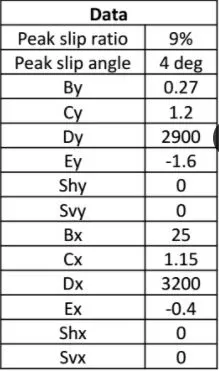
sx_p = 0.09;
alpha_p = 4;
By = 0.27; Cy = 1.2; Dy = 2900; Ey = -1.6; shy = 0; svy = 0;
Bx = 25; Cx = 1.15; Dx = 3200; Ex = -0.4; shx = 0; svx = 0;
sx=[0:0.03:0.09]
alpha=linspace(0,20,100)
for i=1:length(sx)
sx_star=sx(i)/sx_p
for j=1:length(alpha)
alpha_star=alpha(j)/alpha_p
s_star=sqrt((sx_star)^2+(alpha_star)^2)
sx_modified=s_star*sx_p
alpha_modified=s_star*alpha_p
ALPHA_final=alpha_modified+shy
fy(i,j)=(alpha_star/s_star)*(Dy*sin(Cy*atan((By*ALPHA_final-Ey*(By*ALPHA_final-atan(By*ALPHA_final))))))
Fy(i,j)=fy(i,j)+svy
sx_final=sx_modified+shx
fx(i,j)=(sx_star/s_star)*(Dx*sin(Cx*atan((Bx*sx_final-Ex*(Bx*sx_final-atan(Bx*sx_final))))))
Fx(i,j)=fx(i,j)+svx
j=j+1
end
i=i+1
end
figure(1)
subplot(1,2,1)
plot(alpha,Fy)
grid on
subplot(1,2,2)
plot(alpha,Fx)
grid on
alpha1=[0:2:6]
sx1=linspace(0,0.6,100)
for k=1:length(alpha1)
alpha_star1=alpha1(k)/alpha_p
for w=1:length(sx1)
sx_star1=sx1(w)/sx_p
s_star1=sqrt((sx_star1)^2+(alpha_star1)^2)
sx_modified1=s_star1*sx_p
alpha_modified1=s_star1*alpha_p
ALPHA_final1=alpha_modified1+shy
fy1(k,w)=(alpha_star1/s_star1)*(Dy*sin(Cy*atan((By*ALPHA_final1-Ey*(By*ALPHA_final1-atan(By*ALPHA_final1))))))
Fy1(k,w)=fy1(k,w)+svy
sx_final1=sx_modified1+shx
fx1(k,w)=(sx_star1/s_star1)*(Dx*sin(Cx*atan((Bx*sx_final1-Ex*(Bx*sx_final1-atan(Bx*sx_final1))))))
Fx1(k,w)=fx1(k,w)+svx
w=w+1
end
k=k+1
end
figure(2)
subplot(1,2,1)
plot(sx1.*100,Fx1)
grid on
subplot(1,2,2)
plot(sx1.*100,Fy1)
grid on
steps:
-Inputs are declared
-then Slip ratio array specified for 0,0.03,0.06,0.09 slip ratio values
-then Slip angle sweep is made using linspace command from 0 to 20 and 100 values inbetween
-Then a for loop is made with its counter having the same value as the number of elements in the slip ratio array
-Then sx star is calculated using sx star=sx/speak
-Then another for loop is made with its counter having the same value as the number of values in the slip angle array
-The alpha star is calculated using alpha star=alpha/alpha peak
-Then resultant is calculated using s_star=sqrt((sx star)^2+(s peak)^2)
-Then the modified slip is calculated using sx_modified=s _star*s_peak
-Then alpha modified is calculated using alpha_modifiend=s_star*alpha_peak
-Then final alpha is calculated using final_alpha=alpha_modified +shy
-Then lateral force is calculated using fy=(alpha_star/s_star)*(Dy*sin(Cy*tan^-1((By*ALPHA_final-Ey*(By*ALPHA_final-tan^-1(By*ALPHA_final))))))
- Then final lateral force is calculated using F_final=fy+svy
-Then final is sx_final is calculated using sx_final=sx_modified+shx
-then longitudinal force is calculated using fx=(sx_star/s_star)*(Dx*sin(Cx*atan((Bx*sx_final-Ex*(Bx*sx_final-atan(Bx*sx_final))))))
-Then final longitudinal force is calculated using Fx_final=fx+svx
-Then inner loop is increased by one and then ended
-Then the outer loop is increased by one and ended
-Then a figure is constructed using subplot command which has one row and two column s and the first element is plotting the lateral force with slip angle and second elment is the longitudanl force with slip angle plot
- Then Slip ratio array is specified for 0,2,4,6 angle values
-Then Slip ratio sweep is made using linspace command from 0 to 0.6 and 100 values inbetween
-Then a for loop is made with its counter having the same value as the number of elements in the slip angle array
-Then alpha star is calculated using alpha star=alpha/alpha peak
-Then another for loop is made with its counter having the same value as the number of values in the slip ratio array
-Then sx star is calculated using sx star=sx/speak
-Then resultant is calculated using s_star=sqrt((sx star)^2+(s peak)^2)
-Then the modified slip is calculated using sx_modified=s _star*s_peak
-Then alpha modified is calculated using alpha_modifiend=s_star*alpha_peak
-Then final alpha is calculated using final_alpha=alpha_modified +shy
-Then lateral force is calculated using fy=(alpha_star/s_star)*(Dy*sin(Cy*tan^-1((By*ALPHA_final-Ey*(By*ALPHA_final-tan^-1(By*ALPHA_final))))))
- Then final lateral force is calculated using F_final=fy+svy
-Then final is sx_final is calculated using sx_final=sx_modified+shx
-then longitudinal force is calculated using fx=(sx_star/s_star)*(Dx*sin(Cx*atan((Bx*sx_final-Ex*(Bx*sx_final-atan(Bx*sx_final))))))
-Then final longitudinal force is calculated using Fx_final=fx+svx
-Then inner loop is increased by one and then ended
-Then the outer loop is increased by one and ended
-Then a figure is constructed using subplot command which has one row and two column s and the first element is plotting the lateral force with slip ratioand second elment is the longitudanl force with slip ratio plot
plots:
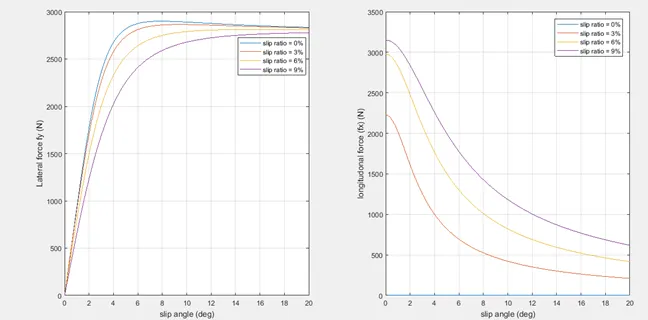
The plots show that at zero slip ratio there will be no longitudnal force while the lateral force will be maximum and as slip ratio is increased the longitudinal force generated at any slip angle is increased ,but on the other hand , the lateral force is decreased on any slip angle because of the friction circle limit,also it shows that that maximum lateral force occurs at around 6 degrees and then it flattens out,and it general longitudnal forces decreases with the increase of slip angle.
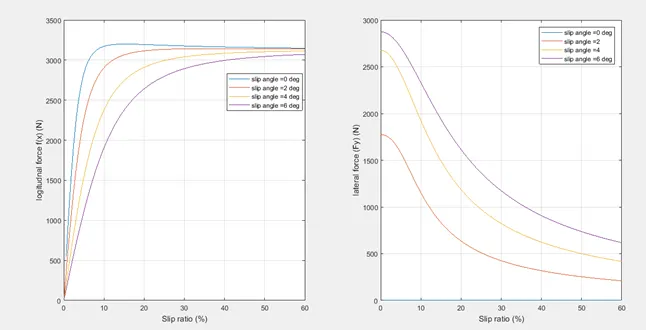
The plots show that at zero slip angle,there will be zero lateral or cornering force while the longitudnal force will be maximum and as slip angle is increased, the longitudinal force is decreased on any slip ratio , and the lateral force is increased because of the friction circle limit,and generally,as slip ratio increases the lateral force decreases and longitunal force increases reaching a peak value at 15%then it flattens out that’s why the ABS braking system operates in this region.
Files:
https://drive.google.com/file/d/1a4R4sQl2IADpFGCkFpE38GtZkjoZIJ-V/view?usp=sharing