vehicle dynamics week 11A
Questions:
- In a K&C testing/simulation , does damper characteristics matter? Why or why not?
- If the steer angle needed to negotiate a turn equals Ackermann angle, is this understeer or oversteer?
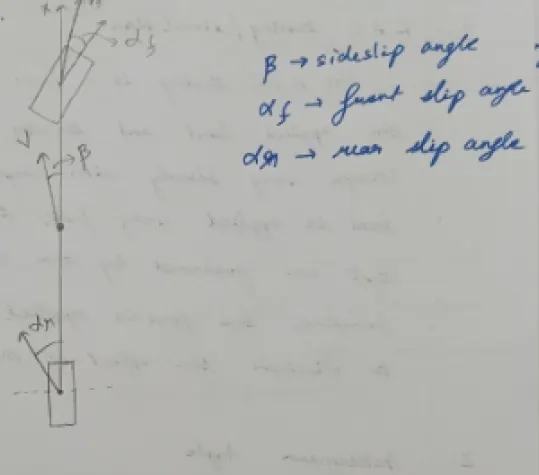
- What is body side slip angle?
- Define settling time
- Calculate rise time for the system f(t)=20/(s+20)
- What happens to overshoot when you increase damping?
- A major component of understeer is lost in a vehicle with 50/50 weight distribution (like a BMW). Explain this
- Why can’t rear wheel steering not be used at high speed?
- State one reason why a suspended vehicle rollover model is more accurate that a rigid vehicle model
- State one reason why a transient rollover model is more accurate than a steady state model
Answers:
1)The damping characteristics K and c testing doesn’t matter because it is a form of quasi static testing whereby the applied load and therefore system behavior change very slowly, only if the load is applied in a very rapid manner the damping characteristics can have effects and this is not done in k and c testing.
2)If the angle required to negotiate a turn equals the acherman angle, then it means the vehicle has neutral steer ,since the front and rear slip angle will be equal so they will cancel each other
Steering angle=l/r + alpha_f- alpha_rear
If alpha_front=alpha_rear then
Steering angle=l/r
3)the side slip angle is the angle between vehicle longitudinal velocity and vehicle longitudinal axis measured from the vehicle center of gravity
4)Settling time is the time taken for the output signal to reach be within 2% from the final steady state value
Ts= 4/theta*wn
theta is the damping ratio
5)Rise time calculation:
F(t)=20/s+20
For a unit step response y(t)=0 t=0
Y(t)=1 t0<
C(s)=g(s).R(s)
Where Rs….is the input
Gs……..is the transfer function
Rs.Gs=L(1).(20/s+20)
Rs.G(s)=(1/s).(20/s+20)
Taking inverse laplace
20/s^+20s=A/s +B /s+20
20=A(s+20)+Bs
20=AS+20*A+BS
20*A=20
So A=1
A+B=0
So B=-1
So L^-1(1/s)-L^-1(1/s+20)
=1-e^-20t
Rise time :it is the time needed by system to go from 10% to 90% of the final value
0.1=1- e^-20t
So t=5.26*10^-3 s
0.9=1- e^-20t
T=0.115 s
Rise time=0.115-5.26*10^-3=0.1097 Sec
6)overshot damping: when damping is increased overshoot is reduced as overshoot decreases with the increase in damping
% overshoot=e^-(theta*pi)/sqrt(1-theta^2)*100
Theta=damping coefficient /2*sqrt(k*m)
7)50/50 weight distribution results in k equal zero if the tyres have the same cornering stiffness which makes the vehicle has neutral steering characteristics ,this is because one significant contribution to understeer gradient is made by the having front weight bias in order to overload the front tyres first which makes them loose grip first resulting in understeer, also this will result in a positive understeering gradient coefficient as
K=wf/cf-wr/cr
8) four wheel steering cann’t be used at high frequencies because it will have non minimum phase response which will result in a lag to the inputs of the driver
9) because in suspended vehicle model ,body roll is taken into account which reduces the moment arm in which gravity act to reduce the roll over ,and this is more realistic as the threshold is reduced by taking that into account
10) transient roll over model represents vehicle roll with time and it is accurate since it can represent the car going into a slide because of brakes locking up and then the return of cornering forces when brakes are released, it can also represent the forces that result from going from low friction to high friction surface,it also can predict roll over more accurately because in transient case wheels can be raised from the ground at a lower lateral acceleration due to the overshooting second order behavior which can result in a vehicle roll over at threshold lower than predicted in the quasi static case as it doesn’t take this overshooting behavior into account.