vehicle dynamics week 10D
Question:
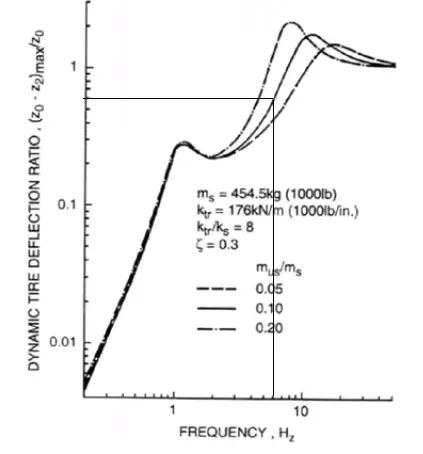
An independent front suspension of a passenger car carries a mass (sprung mass) of 454.5 kg (or an equivalent weight of 1000 Ib). The suspension spring rate is 22 kN/m (125 lb/in.). The mass of the tire wheel assembly (unsprung mass) is 45.45 kg (or an equivalent weight of 100 lb) and the equivalent tire stiffness is 176 kN/m (1000 lb/in.). The damping ratio of the suspension produced by the shock absorber is 0.3. If the car is traveling on a sinusoidal road profile with a wavelength of 5 m (16.4 ft) and an amplitude of 5 cm (2 in.), estimate the lowest vehicle speed at which the tire may lose contact with the road. Use the plot shown below (20 points)
Maltlab code:
% Dynamic tire deflection
clear all
Ms = 454.5; % kg
Mus = 45.45; % kg
Ks = 22000; % N/m
Kt = 176000; % N/m
Cs = 0.3 % damping ratio
wavelength = 5; % m
Z0 = 5; % cm
%% Static tire deflection
del_s = (Ms+Mus)*9.81/Kt
%% Dynamic tire deflection
del_dyn = (del_s*10^2)/Z0
%% Speed calculation
freq = 6 % Hz
Velocity = freq * wavelength * 3.6 % km/hr
Steps:
-first static tyre deflection calculated delta s= (ms+mus)*9.81/k_tyre
-then dynamic deflection is calculated using=dyn def=(static deflection*10^2)/z0 and z0 is the given bump amplitude
-then from the graph frequency will be equal 6 hz
-and therefore the velocity=freq*wavelength*3.6
Results:
Static tyre deflection=0.0279m
Dynamic tyre delection has to be greater than z0-z2/z0= 0.5573
This corresponds to frequency from the chart(mus/ms=0.1) = 6 hz
Velocity=108km/h
Files:
https://drive.google.com/file/d/1yLFcpTi-WHZ79nJho1ucpb3lDQ9ObbwC/view?usp=sharing