Understanding the concepts on Degrees of Freedom
AIM: To calculate the effective modal mass Mn* and the modal mass participating ratio for the 5 modes using mass matrix
PROCEDURE:
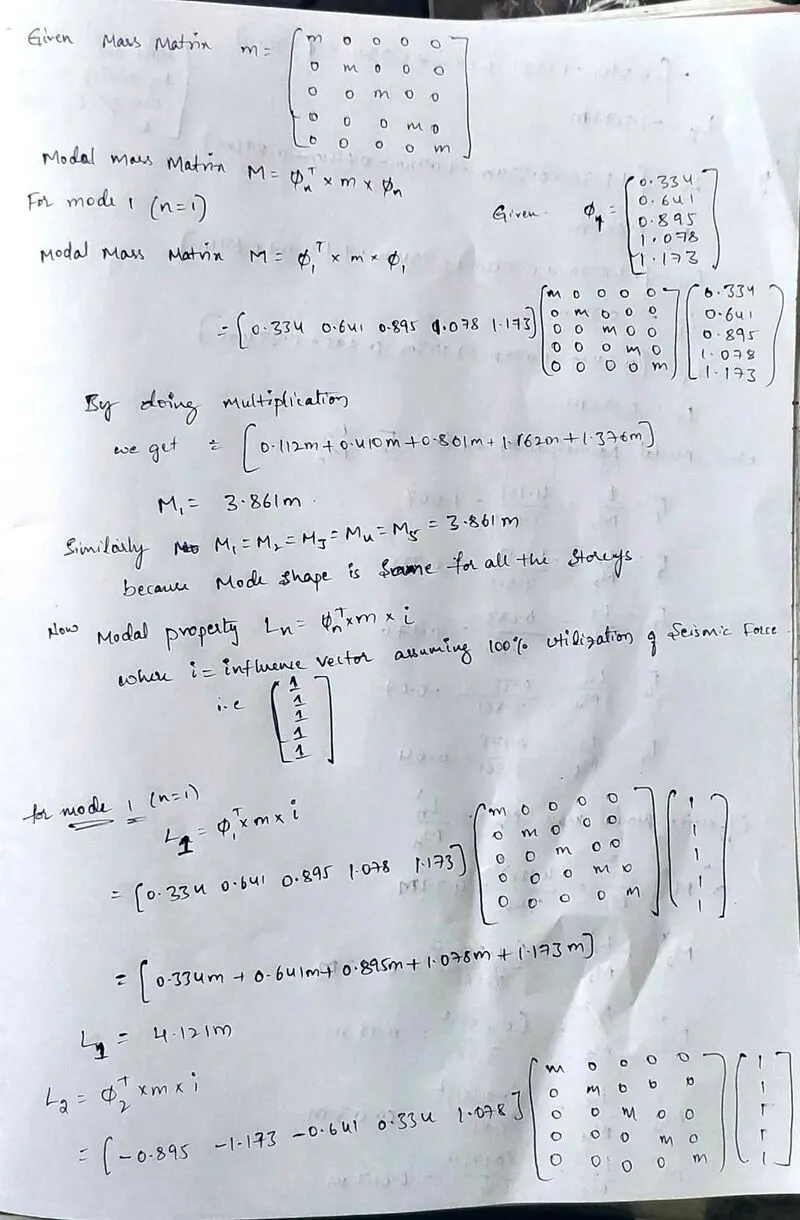
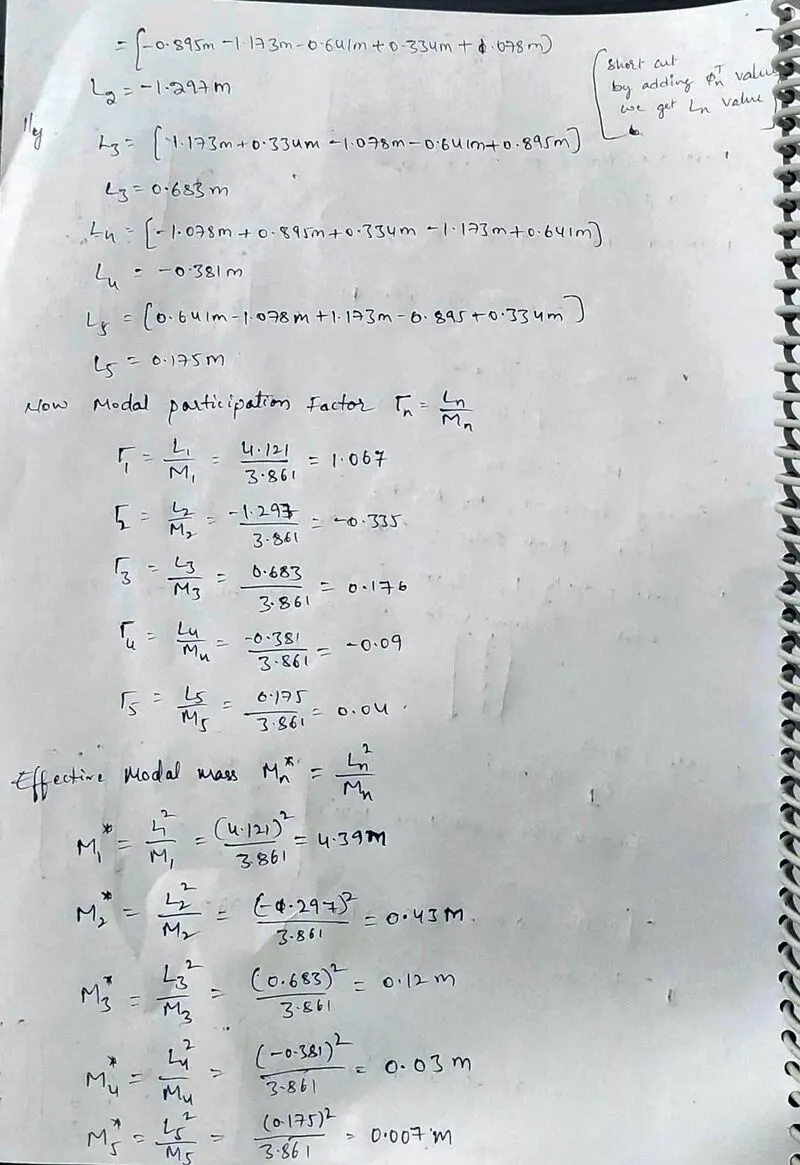
Modal mass participating ratio calculation:
=Mn*/Mj
where Mj=Total mass=m+m+m+m+m=5m
Mode 1:
=4.39m/5m=0.88=88%
Mode 2:
=0.43m/5m=0.086=8.6%
Mode 3:
=0.12mm/5m=0.024=2.4%
Mode 4:
=0.03m/5m=0.006=0.6%
Mode 5:
=0.007m/5m=0.001=0.1%
Base shear (Vb) calculation:
Vb=Mn* x An
where An is the pseudo-acceleration which is obtained using the time acceleration graph and obtained using the time given
- T1 = 2 seconds, A1= 0.27g
- T2 = 0.6852 seconds,A2= 0.76g
- T3= 0.4346 seconds,A3= 1.03g
- T4 = 0.3383 seconds,A4= 1.03g
- T5= 0.2966 seconds,A5= 0.76g
Mode 1:
=4.39m x 0.27g
V1=1.18 mg
Mode 2:
=0.43m x 0.76g
V2=0.32 mg
Mode 3:
=0.12m x 1.03g
V3= 0.12 mg
Mode 4:
=0.03m x 1.03g
V4=0.03 mg
Mode 5:
=0.007m x 0.76g
V5=0.005 mg
Total base shear calculation using SRSS rule
V= √(V1)^2+(V2)^2+(V3)^2+(V4)^2+(V5)^2
= √(1.18)^2+(0.32)^2+(0.12)^2+(0.03)^2+(0.005)^2
Total shear = 1.29 mg
Results:
- The modal mass participating ratio is also computed for all the modes and to achieve 90% of modal mass participating ratio the first two modes are enough.
- Base shear for each modes and total base shear using SRSS rule are computed.