Understanding the concepts on Degrees of Freedom
Understanding the concepts on Degrees of Freedom
TASK:
A five-storey structure with 5 translational DOF is shown here. Each storey has mass ‘m’. The eigenvalue problem has been solved and the 5 periods of vibration Tn and their corresponding mode shapes, φn has been derived.
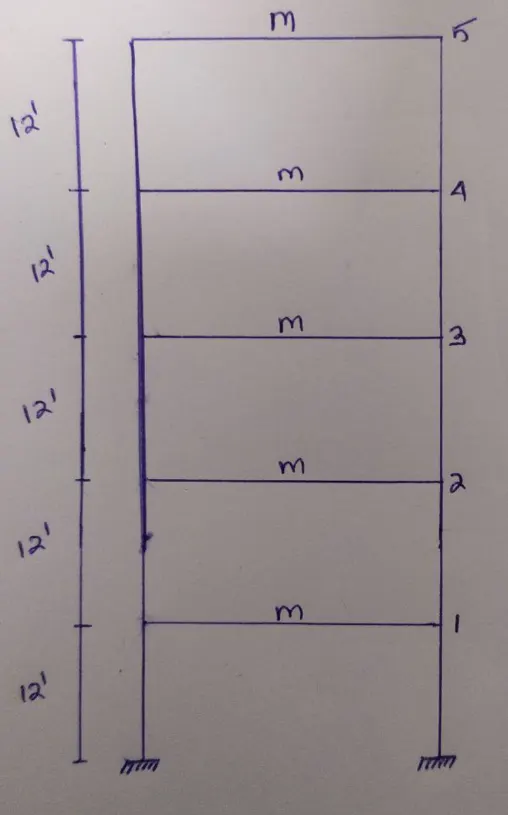
The fundamental period of frequency, T1=2T1=2 seconds and its associated mode shape: Φ1=⎡⎢ ⎢ ⎢ ⎢ ⎢ ⎢⎣0.3340.6410.8951.0781.173⎤⎥ ⎥ ⎥ ⎥ ⎥ ⎥⎦Φ1=[0.3340.6410.8951.0781.173]
The second mode of vibration, T2=0.6852T2=0.6852 seconds and its associated mode shape: Φ2=⎡⎢ ⎢ ⎢ ⎢ ⎢ ⎢⎣−0.895−1.173−0.6410.3341.078⎤⎥ ⎥ ⎥ ⎥ ⎥ ⎥⎦Φ2=[-0.895-1.173-0.6410.3341.078]
The third mode of vibration, T3=0.4346T3=0.4346 seconds and its associated mode shape: Φ3=⎡⎢ ⎢ ⎢ ⎢ ⎢ ⎢⎣1.1730.334−1.078−0.6410.895⎤⎥ ⎥ ⎥ ⎥ ⎥ ⎥⎦Φ3=[1.1730.334-1.078-0.6410.895]
The forth mode of vibration, T4=0.3383T4=0.3383 seconds and its associated mode shape: Φ4=⎡⎢ ⎢ ⎢ ⎢ ⎢ ⎢⎣−1.0780.8950.334−1.1730.641⎤⎥ ⎥ ⎥ ⎥ ⎥ ⎥⎦Φ4=[-1.0780.8950.334-1.1730.641]
The fifth mode of vibration, T5=0.2966T5=0.2966 seconds and its associated mode shape: Φ5=⎡⎢ ⎢ ⎢ ⎢ ⎢ ⎢⎣0.641−1.0781.173−0.8950.334⎤⎥ ⎥ ⎥ ⎥ ⎥ ⎥⎦Φ5=[0.641-1.0781.173-0.8950.334]
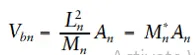
- Ln, Mn, and Γn for each of the five modes are to be computed from the Equations below.
- Also, calculate the effective modal mass Mn* and the modal mass participating ratio for the 5 modes. The mass matrix will be required to evaluate these parameters.

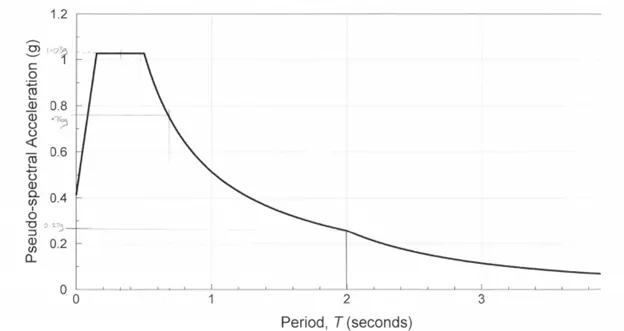
- Finally, obtain the base shear for each of the 5 modes of vibration and the combined base shear as per the SRSS rule. The pseudo acceleration design spectrum to obtain the base shear for each mode is provided below.
- How many modes are to be considered such that a modal mass participating ratio of 90% is obtained?
AIM:
- To calculate Ln,MnLn,Mn and ΓnΓn for each of the five modes
- To calculate the effective modal mass MnMn* and the modal mass participating ratio for the 5 modes.
- To find the base shear for each of the 5 modes of vibration and the combined base shear as per the SRSS rule.
Calculations:
Calculating the entire parameters for mode 1:
Mass matrix, m=⎡⎢ ⎢ ⎢ ⎢ ⎢ ⎢⎣m00000m00000m00000m00000m⎤⎥ ⎥ ⎥ ⎥ ⎥ ⎥⎦m=[m00000m00000m00000m00000m]
Now, we have to obtain the transformed mass matrix for mode 1: M1=ΦT1mΦ1M1=Φ1TmΦ1
I.e., M1=[0.3340.6410.8951.0781.173]⋅⎡⎢ ⎢ ⎢ ⎢ ⎢ ⎢⎣m00000m00000m00000m00000m⎤⎥ ⎥ ⎥ ⎥ ⎥ ⎥⎦⋅⎡⎢ ⎢ ⎢ ⎢ ⎢ ⎢⎣0.3340.6410.8951.0781.173⎤⎥ ⎥ ⎥ ⎥ ⎥ ⎥⎦M1=[0.3340.6410.8951.0781.173]⋅[m00000m00000m00000m00000m]⋅[0.3340.6410.8951.0781.173]
M1=[0.334m0.641m0.895m1.078m1.173m]⋅⎡⎢ ⎢ ⎢ ⎢ ⎢ ⎢⎣0.3340.6410.8951.0781.173⎤⎥ ⎥ ⎥ ⎥ ⎥ ⎥⎦M1=[0.334m0.641m0.895m1.078m1.173m]⋅[0.3340.6410.8951.0781.173]
M1=3.86mM1=3.86m
Now, we need to find the modal property, LnLn.
Ln=ΦTnmιLn=ΦnTmι
Where, ι=ι= Influence matrix which is a unit matrix, ⎡⎢ ⎢ ⎢ ⎢ ⎢ ⎢⎣11111⎤⎥ ⎥ ⎥ ⎥ ⎥ ⎥⎦[11111]
L1=[0.3340.6410.8951.0781.173]⋅⎡⎢ ⎢ ⎢ ⎢ ⎢ ⎢⎣m00000m00000m00000m00000m⎤⎥ ⎥ ⎥ ⎥ ⎥ ⎥⎦⋅⎡⎢ ⎢ ⎢ ⎢ ⎢ ⎢⎣11111⎤⎥ ⎥ ⎥ ⎥ ⎥ ⎥⎦L1=[0.3340.6410.8951.0781.173]⋅[m00000m00000m00000m00000m]⋅[11111]
L1=[0.334m0.641m0.895m1.078m1.173m]⋅⎡⎢ ⎢ ⎢ ⎢ ⎢ ⎢⎣11111⎤⎥ ⎥ ⎥ ⎥ ⎥ ⎥⎦L1=[0.334m0.641m0.895m1.078m1.173m]⋅[11111]
L1=4.12mL1=4.12m
The modal participation factor, Γn=LnMnΓn=LnMn
Γ1=4.12m3.86m=1.067Γ1=4.12m3.86m=1.067
Seismic force for mode 1:fn=mΦnΓnAnfn=mΦnΓnAn
f1=mΦ1Γ1A1f1=mΦ1Γ1A1
Where A1=0.27gA1=0.27g for a time period of 2 seconds.
f1=⎡⎢ ⎢ ⎢ ⎢ ⎢ ⎢⎣m00000m00000m00000m00000m⎤⎥ ⎥ ⎥ ⎥ ⎥ ⎥⎦⋅⎡⎢ ⎢ ⎢ ⎢ ⎢ ⎢⎣0.3340.6410.8951.0781.173⎤⎥ ⎥ ⎥ ⎥ ⎥ ⎥⎦⋅1.067⋅0.27gf1=[m00000m00000m00000m00000m]⋅[0.3340.6410.8951.0781.173]⋅1.067⋅0.27g
f1=⎡⎢ ⎢ ⎢ ⎢ ⎢ ⎢⎣0.334m0.641m0.895m1.078m1.173m⎤⎥ ⎥ ⎥ ⎥ ⎥ ⎥⎦⋅1.067⋅0.27gf1=[0.334m0.641m0.895m1.078m1.173m]⋅1.067⋅0.27g
f1=⎡⎢ ⎢ ⎢ ⎢ ⎢ ⎢ ⎢⎣0.096mg0.185mg0.258mg0.310mg0.338mg⎤⎥ ⎥ ⎥ ⎥ ⎥ ⎥ ⎥⎦f1=[0.096mg0.185mg0.258mg0.310mg0.338mg]
We know that Weight(newton), W=mg, and this can be substituted in the above equation.
f1=⎡⎢ ⎢ ⎢ ⎢ ⎢ ⎢⎣0.096W0.185W0.258W0.310W0.338W⎤⎥ ⎥ ⎥ ⎥ ⎥ ⎥⎦f1=[0.096W0.185W0.258W0.310W0.338W]
Now, to find out the base shear for mode1, all the values of the seismic forces can be added.
I.e., Vb1=0.096W+0.185W+0.258W+0.310W+0.338W=1.187WVb1=0.096W+0.185W+0.258W+0.310W+0.338W=1.187W
Similarly, we need to find out the base shear for all the modes.
Vb1Vb1 can also be calculated by finding out the effective modal mass, MnMn*
M1M1*=(Ln)2Mn=(4.12m)23.86m=4.397m(Ln)2Mn=(4.12m)23.86m=4.397m
Hence, modal mass participating ratio, Mn∗mMn∗m for mode 1 = 4.397m5m=0.88=88%4.397m5m=0.88=88%
Vb1=MnVb1=Mn*⋅An=4.397m×0.27g=1.187mg=1.187W⋅An=4.397m×0.27g=1.187mg=1.187W
For mode 2:
Mass matrix, m=⎡⎢ ⎢ ⎢ ⎢ ⎢ ⎢⎣m00000m00000m00000m00000m⎤⎥ ⎥ ⎥ ⎥ ⎥ ⎥⎦m=[m00000m00000m00000m00000m]
Now, we have to obtain the transformed mass matrix for mode 2: M2=ΦT2mΦ2M2=Φ2TmΦ2
I.e., M2=[−0.895−1.173−0.6410.3341.078]⋅⎡⎢ ⎢ ⎢ ⎢ ⎢ ⎢⎣m00000m00000m00000m00000m⎤⎥ ⎥ ⎥ ⎥ ⎥ ⎥⎦⋅ ⎡⎢ ⎢ ⎢ ⎢ ⎢ ⎢⎣−0.895−1.173−0.6410.3341.078⎤⎥ ⎥ ⎥ ⎥ ⎥ ⎥⎦M2=[-0.895-1.173-0.6410.3341.078]⋅[m00000m00000m00000m00000m]⋅ [-0.895-1.173-0.6410.3341.078]
M2=[−0.895m−1.173m−0.641m0.334m1.078m]⋅⎡⎢ ⎢ ⎢ ⎢ ⎢ ⎢⎣−0.895−1.173−0.6410.3341.078⎤⎥ ⎥ ⎥ ⎥ ⎥ ⎥⎦M2=[-0.895m-1.173m-0.641m0.334m1.078m]⋅[-0.895-1.173-0.6410.3341.078]
M2=3.86mM2=3.86m
Now, we need to find the modal property, LnLn.
Ln=ΦTnmιLn=ΦnTmι
Where, ι=ι= Influence matrix which is a unit matrix, ⎡⎢ ⎢ ⎢ ⎢ ⎢ ⎢⎣11111⎤⎥ ⎥ ⎥ ⎥ ⎥ ⎥⎦[11111]
L2=[−0.895−1.173−0.6410.3341.078]⋅⎡⎢ ⎢ ⎢ ⎢ ⎢ ⎢⎣m00000m00000m00000m00000m⎤⎥ ⎥ ⎥ ⎥ ⎥ ⎥⎦⋅⎡⎢ ⎢ ⎢ ⎢ ⎢ ⎢⎣11111⎤⎥ ⎥ ⎥ ⎥ ⎥ ⎥⎦L2=[-0.895-1.173-0.6410.3341.078]⋅[m00000m00000m00000m00000m]⋅[11111]
L2=[−0.895m−1.173m−0.641m0.334m1.078m]⋅⎡⎢ ⎢ ⎢ ⎢ ⎢ ⎢⎣11111⎤⎥ ⎥ ⎥ ⎥ ⎥ ⎥⎦L2=[-0.895m-1.173m-0.641m0.334m1.078m]⋅[11111]
L2=−1.297mL2=-1.297m
The modal participation factor, Γn=LnMnΓn=LnMn
Γ2=−1.297m3.86m=−0.336Γ2=-1.297m3.86m=-0.336
Seismic force for mode 2: `f_n=mPhi_nGamma_nA_n`
f2=mΦ2Γ2A2f2=mΦ2Γ2A2
A2=0.76gA2=0.76g for a time period of 0.6852 seconds.
f2=⎡⎢ ⎢ ⎢ ⎢ ⎢ ⎢⎣m00000m00000m00000m00000m⎤⎥ ⎥ ⎥ ⎥ ⎥ ⎥⎦⋅⎡⎢ ⎢ ⎢ ⎢ ⎢ ⎢⎣−0.895−1.173−0.6410.3341.078⎤⎥ ⎥ ⎥ ⎥ ⎥ ⎥⎦ ⋅−0.336⋅0.76gf2=[m00000m00000m00000m00000m]⋅[-0.895-1.173-0.6410.3341.078] ⋅-0.336⋅0.76g
f2=⎡⎢ ⎢ ⎢ ⎢ ⎢ ⎢⎣−0.895m−1.173m−0.641m0.334m1.078m⎤⎥ ⎥ ⎥ ⎥ ⎥ ⎥⎦⋅−0.336⋅0.76gf2=[-0.895m-1.173m-0.641m0.334m1.078m]⋅-0.336⋅0.76g
f2=⎡⎢ ⎢ ⎢ ⎢ ⎢ ⎢ ⎢⎣0.228mg0.299mg0.164mg−0.085mg−0.275mg⎤⎥ ⎥ ⎥ ⎥ ⎥ ⎥ ⎥⎦f2=[0.228mg0.299mg0.164mg-0.085mg-0.275mg]
We know that Weight (newton), W=mg, and this can be substituted in the above equation.
f2=⎡⎢ ⎢ ⎢ ⎢ ⎢ ⎢⎣0.228W0.299W0.164W−0.085W−0.275W⎤⎥ ⎥ ⎥ ⎥ ⎥ ⎥⎦f2=[0.228W0.299W0.164W-0.085W-0.275W]
Now, to find out the base shear for mode 2, all the values of the seismic forces can be added.
I.e., Vb2=0.228W+0.299W+0.164W−0.085W−0.275W=0.331WVb2=0.228W+0.299W+0.164W-0.085W-0.275W=0.331W
Vb2Vb2 can also be calculated by finding out the effective modal mass, MnMn*
M2M2*=(Ln)2Mn=(−1.297m)23.86m=0.436m(Ln)2Mn=(-1.297m)23.86m=0.436m
Hence, modal mass participating ratio, Mn∗mMn∗m for mode 2 = 0.436m5m=0.087=8.7%0.436m5m=0.087=8.7%
Vb2=MnVb2=Mn*⋅An=0.436m×0.76g=0.331mg=0.331W⋅An=0.436m×0.76g=0.331mg=0.331W
For mode 3:
Mass matrix, m=⎡⎢ ⎢ ⎢ ⎢ ⎢ ⎢⎣m00000m00000m00000m00000m⎤⎥ ⎥ ⎥ ⎥ ⎥ ⎥⎦m=[m00000m00000m00000m00000m]
Now, we have to obtain the transformed mass matrix for mode 3: M3=ΦT3mΦ3M3=Φ3TmΦ3
I.e., M3=[1.1730.334−1.078−0.6410.895]⋅⎡⎢ ⎢ ⎢ ⎢ ⎢ ⎢⎣m00000m00000m00000m00000m⎤⎥ ⎥ ⎥ ⎥ ⎥ ⎥⎦⋅ ⎡⎢ ⎢ ⎢ ⎢ ⎢ ⎢⎣1.1730.334−1.078−0.6410.895⎤⎥ ⎥ ⎥ ⎥ ⎥ ⎥⎦M3=[1.1730.334-1.078-0.6410.895]⋅[m00000m00000m00000m00000m]⋅ [1.1730.334-1.078-0.6410.895]
M3=[1.173m0.334m−1.078m−0.641m0.895m]⋅⎡⎢ ⎢ ⎢ ⎢ ⎢ ⎢⎣1.1730.334−1.078−0.6410.895⎤⎥ ⎥ ⎥ ⎥ ⎥ ⎥⎦M3=[1.173m0.334m-1.078m-0.641m0.895m]⋅[1.1730.334-1.078-0.6410.895]
M3=3.86mM3=3.86m
Now, we need to find the modal property, LnLn.
Ln=ΦTnmιLn=ΦnTmι
Where, ι=ι= Influence matrix which is a unit matrix, ⎡⎢ ⎢ ⎢ ⎢ ⎢ ⎢⎣11111⎤⎥ ⎥ ⎥ ⎥ ⎥ ⎥⎦[11111]
L3=[1.1730.334−1.078−0.6410.895]⋅⎡⎢ ⎢ ⎢ ⎢ ⎢ ⎢⎣m00000m00000m00000m00000m⎤⎥ ⎥ ⎥ ⎥ ⎥ ⎥⎦⋅⎡⎢ ⎢ ⎢ ⎢ ⎢ ⎢⎣11111⎤⎥ ⎥ ⎥ ⎥ ⎥ ⎥⎦L3=[1.1730.334-1.078-0.6410.895]⋅[m00000m00000m00000m00000m]⋅[11111]
L3=[1.173m0.334m−1.078m−0.641m0.895m]⋅⎡⎢ ⎢ ⎢ ⎢ ⎢ ⎢⎣11111⎤⎥ ⎥ ⎥ ⎥ ⎥ ⎥⎦L3=[1.173m0.334m-1.078m-0.641m0.895m]⋅[11111]
L3=0.683mL3=0.683m
The modal participation factor, Γn=LnMnΓn=LnMn
Γ3=0.683m3.86m=0.177Γ3=0.683m3.86m=0.177
Seismic force for mode 3: fn=mΦnΓnAnfn=mΦnΓnAn
f3=mΦ3Γ3A3f3=mΦ3Γ3A3
A3=1.03gA3=1.03g for a time period of 0.4346 seconds.
f3=⎡⎢ ⎢ ⎢ ⎢ ⎢ ⎢⎣m00000m00000m00000m00000m⎤⎥ ⎥ ⎥ ⎥ ⎥ ⎥⎦⋅⎡⎢ ⎢ ⎢ ⎢ ⎢ ⎢⎣1.1730.334−1.078−0.6410.895⎤⎥ ⎥ ⎥ ⎥ ⎥ ⎥⎦⋅0.177⋅1.03gf3=[m00000m00000m00000m00000m]⋅[1.1730.334-1.078-0.6410.895]⋅0.177⋅1.03g
f3=⎡⎢ ⎢ ⎢ ⎢ ⎢ ⎢⎣1.173m0.334m−1.078m−0.641m0.895m⎤⎥ ⎥ ⎥ ⎥ ⎥ ⎥⎦⋅0.177⋅1.03gf3=[1.173m0.334m-1.078m-0.641m0.895m]⋅0.177⋅1.03g
f3=⎡⎢ ⎢ ⎢ ⎢ ⎢ ⎢ ⎢⎣0.214mg0.061mg−0.196mg−0.177mg0.163mg⎤⎥ ⎥ ⎥ ⎥ ⎥ ⎥ ⎥⎦f3=[0.214mg0.061mg-0.196mg-0.177mg0.163mg]
We know that Weight (newton), W=mg, and this can be substituted in the above equation.
f3=⎡⎢ ⎢ ⎢ ⎢ ⎢ ⎢⎣0.214W0.061W−0.196W−0.177W0.163W⎤⎥ ⎥ ⎥ ⎥ ⎥ ⎥⎦f3=[0.214W0.061W-0.196W-0.177W0.163W]
Now, to find out the base shear for mode 3, all the values of the seismic forces can be added.
I.e., Vb3=0.214W+0.061W−0.196W−0.177W+0.163W=0.125WVb3=0.214W+0.061W-0.196W-0.177W+0.163W=0.125W
Vb3Vb3 can also be calculated by finding out the effective modal mass, MnMn*
M3M3*=(Ln)2Mn=(0.683m)23.86m=0.121m(Ln)2Mn=(0.683m)23.86m=0.121m
Hence, modal mass participating ratio, Mn∗mMn∗m for mode 3 = 0.121m5m=0.024=2.4%0.121m5m=0.024=2.4%
Vb3=MnVb3=Mn*⋅An=0.121m×1.03g=0.125mg=0.125W⋅An=0.121m×1.03g=0.125mg=0.125W
For mode 4:
Mass matrix, m=⎡⎢ ⎢ ⎢ ⎢ ⎢ ⎢⎣m00000m00000m00000m00000m⎤⎥ ⎥ ⎥ ⎥ ⎥ ⎥⎦m=[m00000m00000m00000m00000m]
Now, we have to obtain the transformed mass matrix for mode 4: M4=ΦT4mΦ4M4=Φ4TmΦ4
I.e., M4=[−1.0780.8950.334−1.1730.641]⋅⎡⎢ ⎢ ⎢ ⎢ ⎢ ⎢⎣m00000m00000m00000m00000m⎤⎥ ⎥ ⎥ ⎥ ⎥ ⎥⎦⋅ ⎡⎢ ⎢ ⎢ ⎢ ⎢ ⎢⎣−1.0780.8950.334−1.1730.641⎤⎥ ⎥ ⎥ ⎥ ⎥ ⎥⎦M4=[-1.0780.8950.334-1.1730.641]⋅[m00000m00000m00000m00000m]⋅ [-1.0780.8950.334-1.1730.641]
M4=[−1.078m0.895m0.334m−1.173m0.641m]⋅⎡⎢ ⎢ ⎢ ⎢ ⎢ ⎢⎣−1.0780.8950.334−1.1730.641⎤⎥ ⎥ ⎥ ⎥ ⎥ ⎥⎦M4=[-1.078m0.895m0.334m-1.173m0.641m]⋅[-1.0780.8950.334-1.1730.641]
M4=3.86mM4=3.86m
Now, we need to find the modal property, LnLn.
Ln=ΦTnmιLn=ΦnTmι
Where, ι=ι= Influence matrix which is a unit matrix, ⎡⎢ ⎢ ⎢ ⎢ ⎢ ⎢⎣11111⎤⎥ ⎥ ⎥ ⎥ ⎥ ⎥⎦[11111]
L4=[−1.0780.8950.334−1.1730.641]⋅⎡⎢ ⎢ ⎢ ⎢ ⎢ ⎢⎣m00000m00000m00000m00000m⎤⎥ ⎥ ⎥ ⎥ ⎥ ⎥⎦⋅⎡⎢ ⎢ ⎢ ⎢ ⎢ ⎢⎣11111⎤⎥ ⎥ ⎥ ⎥ ⎥ ⎥⎦L4=[-1.0780.8950.334-1.1730.641]⋅[m00000m00000m00000m00000m]⋅[11111]
L4=[−1.078m0.895m0.334m−1.173m0.641m]⋅⎡⎢ ⎢ ⎢ ⎢ ⎢ ⎢⎣11111⎤⎥ ⎥ ⎥ ⎥ ⎥ ⎥⎦L4=[-1.078m0.895m0.334m-1.173m0.641m]⋅[11111]
L4=−0.381mL4=-0.381m
The modal participation factor, Γn=LnMnΓn=LnMn
Γ4=−0.381m3.86m=−0.099Γ4=-0.381m3.86m=-0.099
Seismic force for mode 4: fn=mΦnΓnAnfn=mΦnΓnAn
f4=mΦ4Γ4A4f4=mΦ4Γ4A4
A4=1.03gA4=1.03g for a time period of 0.3383 seconds.
f4=⎡⎢ ⎢ ⎢ ⎢ ⎢ ⎢⎣m00000m00000m00000m00000m⎤⎥ ⎥ ⎥ ⎥ ⎥ ⎥⎦⋅⎡⎢ ⎢ ⎢ ⎢ ⎢ ⎢⎣−1.0780.8950.334−1.1730.641⎤⎥ ⎥ ⎥ ⎥ ⎥ ⎥⎦⋅−0.099⋅1.03gf4=[m00000m00000m00000m00000m]⋅[-1.0780.8950.334-1.1730.641]⋅-0.099⋅1.03g
f4=⎡⎢ ⎢ ⎢ ⎢ ⎢ ⎢⎣−1.078m0.895m0.334m−1.173m0.641m⎤⎥ ⎥ ⎥ ⎥ ⎥ ⎥⎦⋅−0.099⋅1.03gf4=[-1.078m0.895m0.334m-1.173m0.641m]⋅-0.099⋅1.03g
f4=⎡⎢ ⎢ ⎢ ⎢ ⎢ ⎢ ⎢⎣0.109mg−0.091mg−0.034mg0.119mg−0.065mg⎤⎥ ⎥ ⎥ ⎥ ⎥ ⎥ ⎥⎦f4=[0.109mg-0.091mg-0.034mg0.119mg-0.065mg]
We know that Weight (newton), W=mg, and this can be substituted in the above equation.
f4=⎡⎢ ⎢ ⎢ ⎢ ⎢ ⎢⎣0.109W−0.091W−0.034W0.119W−0.065W⎤⎥ ⎥ ⎥ ⎥ ⎥ ⎥⎦f4=[0.109W-0.091W-0.034W0.119W-0.065W]
Now, to find out the base shear for mode 4, all the values of the seismic forces can be added.
I.e., Vb4=0.109W−0.091W−0.034W+0.119W−0.065W=0.038WVb4=0.109W-0.091W-0.034W+0.119W-0.065W=0.038W
Vb4Vb4 can also be calculated by finding out the effective modal mass, MnMn*
M4M4*=(Ln)2Mn=(−0.381m)23.86m=0.037m(Ln)2Mn=(-0.381m)23.86m=0.037m
Hence, modal mass participating ratio, Mn∗mMn∗m for mode 4 = 0.037m5m=0.0074=0.74%0.037m5m=0.0074=0.74%
Vb4=MnVb4=Mn*⋅An=0.037m×1.03g=0.038mg=0.038W⋅An=0.037m×1.03g=0.038mg=0.038W
For mode 5:
Mass matrix, m=⎡⎢ ⎢ ⎢ ⎢ ⎢ ⎢⎣m00000m00000m00000m00000m⎤⎥ ⎥ ⎥ ⎥ ⎥ ⎥⎦m=[m00000m00000m00000m00000m]
Now, we have to obtain the transformed mass matrix for mode 5: M5=ΦT5mΦ5M5=Φ5TmΦ5
I.e., M5=[0.641−1.0781.173−0.8950.334]⋅⎡⎢ ⎢ ⎢ ⎢ ⎢ ⎢⎣m00000m00000m00000m00000m⎤⎥ ⎥ ⎥ ⎥ ⎥ ⎥⎦⋅ ⎡⎢ ⎢ ⎢ ⎢ ⎢ ⎢⎣0.641−1.0781.173−0.8950.334⎤⎥ ⎥ ⎥ ⎥ ⎥ ⎥⎦M5=[0.641-1.0781.173-0.8950.334]⋅[m00000m00000m00000m00000m]⋅ [0.641-1.0781.173-0.8950.334]
M5=[0.641m−1.078m1.173m−0.895m0.334m]⋅⎡⎢ ⎢ ⎢ ⎢ ⎢ ⎢⎣0.641−1.0781.173−0.8950.334⎤⎥ ⎥ ⎥ ⎥ ⎥ ⎥⎦M5=[0.641m-1.078m1.173m-0.895m0.334m]⋅[0.641-1.0781.173-0.8950.334]
M5=3.86mM5=3.86m
Now, we need to find the modal property, LnLn.
Ln=ΦTnmιLn=ΦnTmι
Where, ι=ι= Influence matrix which is a unit matrix, ⎡⎢ ⎢ ⎢ ⎢ ⎢ ⎢⎣11111⎤⎥ ⎥ ⎥ ⎥ ⎥ ⎥⎦[11111]
L5=[0.641−1.0781.173−0.8950.334]⋅⎡⎢ ⎢ ⎢ ⎢ ⎢ ⎢⎣m00000m00000m00000m00000m⎤⎥ ⎥ ⎥ ⎥ ⎥ ⎥⎦⋅⎡⎢ ⎢ ⎢ ⎢ ⎢ ⎢⎣11111⎤⎥ ⎥ ⎥ ⎥ ⎥ ⎥⎦L5=[0.641-1.0781.173-0.8950.334]⋅[m00000m00000m00000m00000m]⋅[11111]
L5=[0.641m−1.078m1.173m−0.895m0.334m]⋅⎡⎢ ⎢ ⎢ ⎢ ⎢ ⎢⎣11111⎤⎥ ⎥ ⎥ ⎥ ⎥ ⎥⎦L5=[0.641m-1.078m1.173m-0.895m0.334m]⋅[11111]
L5=0.175mL5=0.175m
The modal participation factor, Γn=LnMnΓn=LnMn
Γ5=0.175m3.86m=0.045Γ5=0.175m3.86m=0.045
Seismic force for mode 5: fn=mΦnΓnAnfn=mΦnΓnAn
f5=mΦ5Γ5A5f5=mΦ5Γ5A5
A5=1.03gA5=1.03g for a time period of 0.2966 seconds.
f5=⎡⎢ ⎢ ⎢ ⎢ ⎢ ⎢⎣m00000m00000m00000m00000m⎤⎥ ⎥ ⎥ ⎥ ⎥ ⎥⎦⋅⎡⎢ ⎢ ⎢ ⎢ ⎢ ⎢⎣0.641−1.0781.173−0.8950.334⎤⎥ ⎥ ⎥ ⎥ ⎥ ⎥⎦⋅0.045⋅1.03gf5=[m00000m00000m00000m00000m]⋅[0.641-1.0781.173-0.8950.334]⋅0.045⋅1.03g
f5=⎡⎢ ⎢ ⎢ ⎢ ⎢ ⎢⎣0.641m−1.078m1.173m−0.895m0.334m⎤⎥ ⎥ ⎥ ⎥ ⎥ ⎥⎦⋅0.045⋅1.03gf5=[0.641m-1.078m1.173m-0.895m0.334m]⋅0.045⋅1.03g
f5=⎡⎢ ⎢ ⎢ ⎢ ⎢ ⎢ ⎢⎣0.029mg−0.049mg0.054mg−0.041mg0.015mg⎤⎥ ⎥ ⎥ ⎥ ⎥ ⎥ ⎥⎦f5=[0.029mg-0.049mg0.054mg-0.041mg0.015mg]
We know that Weight (newton), W=mg, and this can be substituted in the above equation.
f5=⎡⎢ ⎢ ⎢ ⎢ ⎢ ⎢⎣0.029W−0.049W0.054W−0.041W0.015W⎤⎥ ⎥ ⎥ ⎥ ⎥ ⎥⎦f5=[0.029W-0.049W0.054W-0.041W0.015W]
Now, to find out the base shear for mode 5, all the values of the seismic forces can be added.
I.e., Vb5=0.029W−0.049W+0.054W−0.041W+0.015W=0.008WVb5=0.029W-0.049W+0.054W-0.041W+0.015W=0.008W
Vb5Vb5 can also be calculated by finding out the effective modal mass, MnMn*
M5M5*=(Ln)2Mn=(0.175m)23.86m=0.0079m(Ln)2Mn=(0.175m)23.86m=0.0079m
Hence, modal mass participating ratio, Mn∗mMn∗m for mode 5 = 0.0079m5m=0.0016=0.16%0.0079m5m=0.0016=0.16%
Vb5=MnVb5=Mn*⋅An=0.0079m×1.03g=0.008mg=0.008W⋅An=0.0079m×1.03g=0.008mg=0.008W
Hence, Base shear has been obtained for 5 modes of vibration.
Now, Combined base shear by SRSS Rule.
Vb=√(Vb1)2+(Vb2)2+(Vb3)2+(Vb4)2+(Vb5)2=√(1.187W)2+(0.331W)2+(0.125W)2+(0.038W)2+(0.008W)2=1.239WVb=(Vb1)2+(Vb2)2+(Vb3)2+(Vb4)2+(Vb5)2=(1.187W)2+(0.331W)2+(0.125W)2+(0.038W)2+(0.008W)2=1.239W
Vb=1.239WVb=1.239W
Total mass of building= 5m
Total effective modal mass= 4.397+0.436+0.121+0.037+0.0079= 4.9989m ≈≈5m
Hence Total mass of the building is verified.
Now, The Modal mass participation ratios obtained is:
Mode 1- 88%
Mode 2- 8.7%
Mode 3- 2.4%
Mode 4- 0.74%
Mode 5- 0.16%
From the above values, it is clear that the sum of mode 1 & mode 2 will exceed 90% .
I.e., 88% + 8.7% = 96.7%