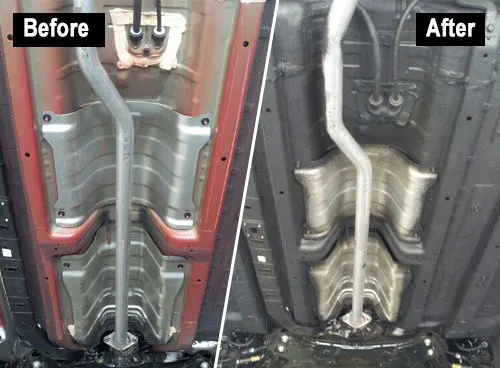
Underbody Coating
UNDERBODY COATING
INTRODUCTION
Underseal is a thick resilient coating applied to the underbody or chassis of an automobile to protect against impact damage from small stones, which would rapidly chip ordinary paint, allowing rusting to begin.
Historically, a bitumen-based compound was used, but after approximately a decade, this becomes brittle and water can become trapped between the underseal and body metal, counterproductively creating a more favorable environment for rust than if no underseal was applied at all. Wax-based underseals do not have this disadvantage but can be eroded and eventually washed off by the enthusiastic use of a hot pressure washer. Rubber-based underseals are also sometimes used.
Vehicles for sale in some territories are not undersealed, because the climate is not sufficiently aggressive to warrant it. If such a vehicle is subsequently imported into a country with high rainfall, cold winters, and where salting of the roads is common, the application of underseal is strongly recommended to ensure the vehicle has a long life.
PROCESS
A car’s underbody is exposed to the most wear and tear caused by muddy water, potholed roads, stones, and other obstacles on the road. Because it’s not in plain sight, we often do not see the damage.
Underbody Treatments offers you a long-term solution for issues related to corrosion and rust. First, the car under body is washed and degreased. Then, the 3M™ Protective Coat is applied with Body Schutz Gold Gun (5-year Warranty) or Undershield gun (2-year warranty). The 3M™ Body Schutz/Undershield is a hard coating on the underbody of the car, that is fast-drying, paintable, rubberized, non-toxic, and chip-resistant. It also minimizes sound from underneath the vehicle and insulates against the heat and cold.
Underbody Treatment protects the car underbody from rust, increasing the longevity of the car and thus enhancing its resale value.
TYPES
Rubberized Underbody Coating
This is generally thought of as the best underbody coating for your car. It preserves the underbody well, protecting it from scratches. Applying this to the undercarriage is not much of a hassle either.
Wax-Based Underbody Coating
This – more or less – ephemeral undercoating will wear away in a few months’ time. On the upside, wax-based undercoating puts up a big fight against moisture. It is also the most affordable option out there.
Asphalt-Based Automotive Undercoating
Best suited for lorries, trucks, and large vehicles this provides a greater degree of protection compared to rubber-based coatings. However, asphalt-based coatings contain little amount of rubber for sound-insulation purposes. The process of applying this coating is a bit time-consuming though.
Polyurethane Underbody Coating
This coating closes up splits and fractures on the underbody of the vehicle. It offers up good protection against corrosion and also bonds with the metal. Unlike in the case of asphalt-based coating, you can paint over the polyurethane coating.
Pros of Underbody coating
The obvious pros of undercoating are the protection it provides to the carriage of your vehicle. If you live in an area where salt and sand are used on the roadways in cold weather, these materials can be corrosive to your vehicle. Undercoating gives you an extra layer of protection against rust and corrosion, protecting your car. Undercoating will eventually wear out, but you can get years of protection from it. Even vehicles in warmer climates gain protection as debris is repelled and kept away from eating at the vehicle.
Cons of Underbody coating
When examining the vehicle undercoating pros and cons, you do want to look at potential downsides to getting undercoating. Undercoating will work best on new vehicles that have not been exposed to road conditions. A used vehicle may already have residue on the bottom of the car or even have spots of rust and corrosion. Undercoating will not help you if corrosion already exists and the corrosion needs to be removed first before it can be applied, which can be expensive for you.