Underbody Coating
UNDERBODY COATING
In Indian road conditions, a cars underbody is most prone to corrosion. Underbody coating provides long term protection from corrosion to car’s underbody. It also protects parts like internal body panels, frame rails and other inner cavities that are not physically accessible but are prone to corrosion.
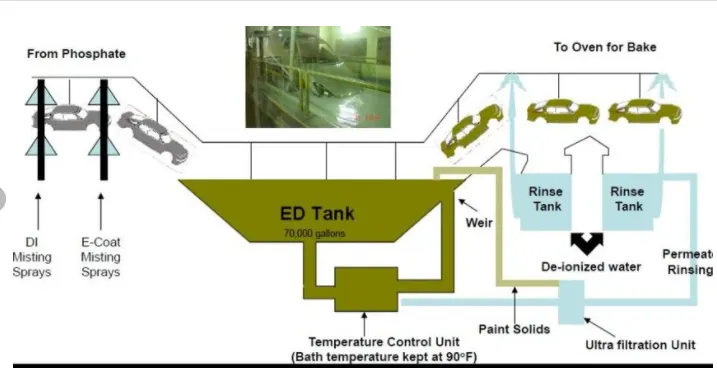
The first step in the process of underbody coating of the car is to dip the car completely in the Electrophoretic deposition tank. The car is dipped completely in the tank and then rotated inside the tank so that the adequate amount of ED is coated on the complete car.
Electro-deposition of primer coating has become universal for a modern automotive paint shop. In ED, charged particles from the paint emulsion move to Anode (AED) or Cathode (CED) under electrical forces. The direct current established through the bath makes the pigment and resin base of the paint wander towards the body surfaces. Coating reaches all the recessed area. Deposited film does not re-dissolve. However, the un-deposited material is rinsed. Ultra filtrate (UF) equipments are used for ED paint ingredients separation of those not forming film and recovery of Paints. Deposited film after stoving becomes hard, durable polymeric film.
The factors that make Underbody Anti-Rust Coating essential
1. Protects Against Rust & Corrosion
The primary objective of getting underbody coating done is preventing metal components that are exposed on the bottom side of the car to damage from corrosion. You can shut out the adverse effects of corrosion on your car by simply applying a rubberised anti-rust coating all over the belly of your car.
2. Reduces NVH (Noise Vibrations Harshness) Levels
Our country is filled with roads having uneven patches and potholes and while we manoeuvre our cars through such sections, the unpaved crumbs, and pebbles hit the car from underneath or get stuck in the wheel wells. The underbody coating’s consistency is so thick that the layer it creates absorbs all the unpleasant noises and vibrations and marginally improves the driving experience.
3. Prevents Paint Chipping
Running on the highway or while pacing through a city road, you will often encounter sharp gravel or any other unattended object hitting the belly of your car with high momentum. This scrapes and chips off the metal from down below. A thick layer of Underbody Coating definitely comes to aid and minimises the effects of such contacts on the body.
4. Protects Vital Components
Underneath a car is somewhere a lot of indispensable parts of a car are left exposed like the Engine, silencer, etc. One simply can’t afford to let these parts go bad due to rusting and hence in order to save yourself from a hefty repair bill, a considerably less expensive Anti-Rust Coating is a must.
There are different types of underbody coatings.
1. Rubberized Undercoating
Rubberized undercoating is easy to apply, and generally offers the best protective coating for your car’s undercarriage. It cushions surfaces against moisture, rust, dings, and dents. Rubberized undercoating is safe to use on quarter panels and wheel wells and dries with a soft rubbery finish.
2. Asphalt- based undercoating
Asphalt-based undercoating offers a higher level of protection suitable for large trucks, recreational vehicles, and heavy machinery. It’s formulated with some bits of rubberized material to aid in noise reduction. It offers extra protection against chips and moisture but is not paintable and, therefore, only suitable for undercarriages.
3. Polyurethane Undercoating
Polyurethane coating is easy to apply and works by sealing up cracks and seams. The compound displaces salt and moisture and protects the unoxidized metal from rust. It’s often sold in canisters that are ready to preload into an application gun. It, however, requires some surface prep work before application, like degreasing, and applying an etching primer to the bare metal.
4. Wax or paraffin-based undercoating
Wax or paraffin-based undercoating sprays are the cheapest and quickest options available. However, their results don’t last long, and you may have to apply a fresh coat after only a few months. In addition, the wax isn’t very adhesive on a metal surface. Its main advantage is that it seeps quickly into cracks and seams, and offers moderate protective properties against moisture.
PROS AND CONS OF UNDERBODAY COATING
PROS
1. It will help to reduce interior noise
2. It can be self applied
3. It will extend the life and value of the vehicle
4. Strength of the vehicle increases
5. It provides a layer of protection against corrosion
CONS
1. Depending upon the usage of vehicle underbody coating needs to be reapplied every 3 to 5 years for serving its purpose effectively.
2. Cost of vehicle increases.
3. It is less helpful if corrosion is already present.
4. IT works best on new cars.
5. It adds weight to the vehicle.