Underbody Coating
UNDERBODY COATING
Underbody Coating is a sprayable coating, which protects the under surface of the vehicle from corrosion.
Underbody coating provides long term protection from corrosion to car's underbody. It also protects parts like internal body panels, frame rails and other inner cavities that are not physically accessible but are prone to corrosion.
Protecting the underbelly of the car should be our top priority. Especially during monsoon when heavy precipitation causes the roads to become mini-rivers and our cars are left stranded there. This makes them prone to heavy corrosion in the underbody region.
It protects the underbody substrates from:
-
Environmental conditions
-
Impacts
-
Dampens sound and vibration
-
Insulates against cold and heat
-
Protects against Corrosion
-
Seals off seams
-
Hides welds, repairs & bodywork with spray
Modern automotive coating process:
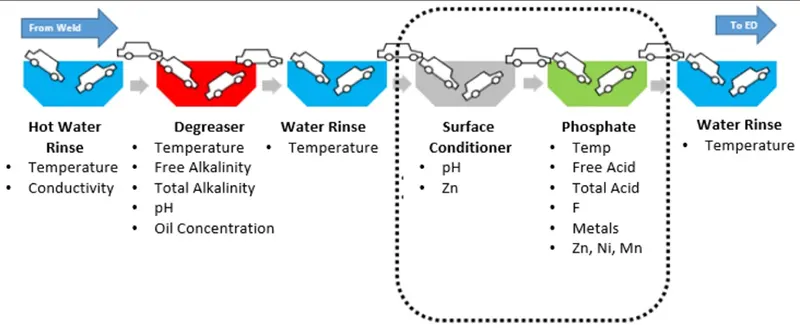
- PRE-TREATMENT - Pre-treatment is the initial step in preparing the BIW for subsequent coating (see Fig.2). Pre-treatment eliminates and cleans superfluous metal and creates a suitable surface structure for the application of a corrosion protection layer. Through three key liquid dip operations of degreasing, conditioning, and phosphating, the body surface is cleaned to remove leftover oils from the stamping process as well as welding residues.
- Pre-treatment aids the primer's adhesion to the metal. A phosphate treatment coats the surface with an inert coating of metal phosphate, which prevents corrosion from spreading. The degreasing solution contains alkaline salts and surfactants, as well as caustic soda and sodium carbonate.
- Surfactants are detergents that are used to emulsify oils and lubricants on the BIW. Surface conditioner that produces nucleation sites for the development of phosphate crystals. It increases the number of crystallization nuclei on the metal surface, which improves the phosphate sequence's bonding mechanism. Phosphate ions, nitrate ions, zinc ions, and hydrogen ions are all present in the liquid dip. The free acid corrodes the steel surface, releasing hydrogen and causing metal phosphate ions to precipitate in crystalline form on the surface.
- ELECTRO-DEPOSITION
- Dipping automotive bodywork in a coating solution and transmitting an electric current through the body and the liquid ED paint solution is what e-coating is all about. The ED paint penetrates locations where a spray would not. This is due to the charged nature of the coating process. A combination of resin, binder, and a paste comprising the pigments is fed into the ED tank during operation. The car body is lowered into the tank and an electric current is applied; the tank solution contains 80-90 percent deionized water and 10-20 percent paint solids. The resin is the foundation of the final paint coat, providing corrosion resistance, durability, and toughness. Color and shine are provided by pigments.
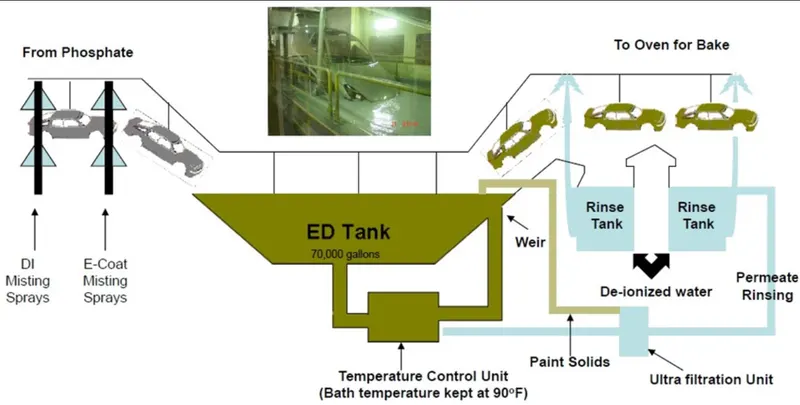
- Following E-coat, the vehicle body is placed in a bake oven, where film curing is achieved by heating and maintaining a temperature of 160°C for 10 minutes to encourage optimal performance attributes. Chip resistance and film adherence to the body are significantly impacted by oven temperature and heating duration; corrosion protection is less affected by these circumstances. Because the smoothness and brightness of the topcoat are affected by surface roughness, some sanding of the surface is normally done to remove or eliminate imperfections before the body moves on to the next application process. Water sports that contaminate coated surfaces are a major problem in the current E-coating process. If there are any wet stains, they have been removed by sanding. As a result, it's critical to utilize well-deionized water and evaluate its conductivity regularly. To eliminate or control water spots, operators can additionally add surfactants or ultrafiltrates to the water rinse zone.
- Dipping automotive bodywork in a coating solution and transmitting an electric current through the body and the liquid ED paint solution is what e-coating is all about. The ED paint penetrates locations where a spray would not. This is due to the charged nature of the coating process. A combination of resin, binder, and a paste comprising the pigments is fed into the ED tank during operation. The car body is lowered into the tank and an electric current is applied; the tank solution contains 80-90 percent deionized water and 10-20 percent paint solids. The resin is the foundation of the final paint coat, providing corrosion resistance, durability, and toughness. Color and shine are provided by pigments.
- RUST-PROOF MATERIALS: SEALER/PVC
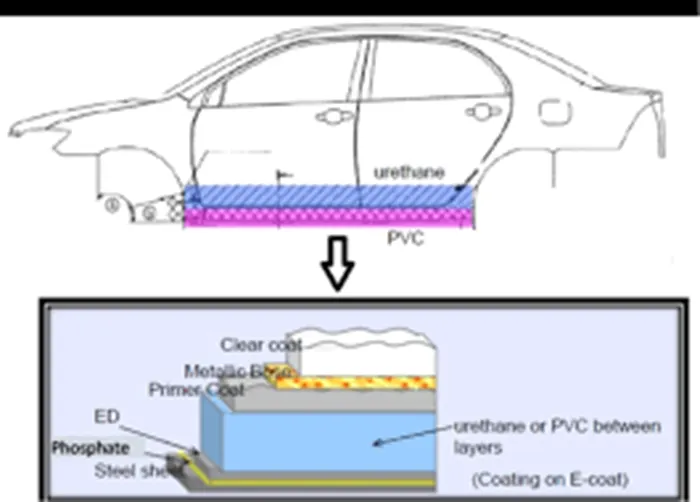
- The next stage is to use PVC to coat the underbody and seal the seams. Figure depicts the lower door sections and rocker panel places where anti-chipping PVC or urethanes are placed, as well as the cross-section of this layer about the other coatings on the body components. A soft tip priming coat, which enhances chipping resistance, is usually applied during this third phase. Using a high elastic resin that rests between the ED and primer layers, this layer is placed to the front edge of the hood, which is prone to chipping stress. The radiator supports, wheel housing, other under Car parts of the body are also covered with a somewhat dull black pigment called a blackout coating during the third process.
- PRIMER
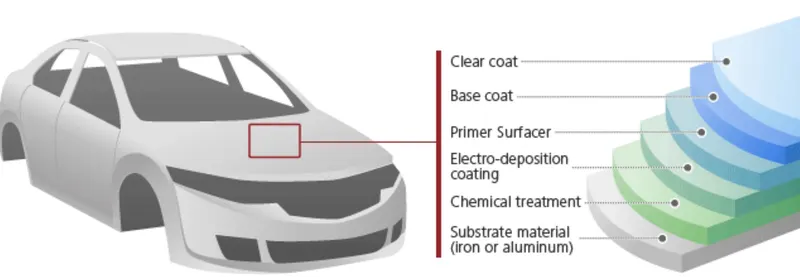
- The primer is the fourth coating phase. It can be water-based, solvent-based, or powder-based. The primer fills and smoothens any flaws and scratches that may have occurred during previous phases or as a result of intermediary sanding or grinding to eliminate minor faults.
- It also offers extra corrosion protection and enhances adhesion between the primer and the E-coat and basecoat, resulting in increased paint endurance. In an automotive assembly factory, primer coating activities are normally carried out in three stages: interior coating, exterior coating, and oven cutting.
- The inside coating of the doors, engine compartment, and baggage or trunk area is done by hand spray painting. The basecoat isn't applied to all of the regions. To be able to impart color, our primer color must match the basecoat uniform coating appearances between interior & exterior coats.
- TOPCOAT
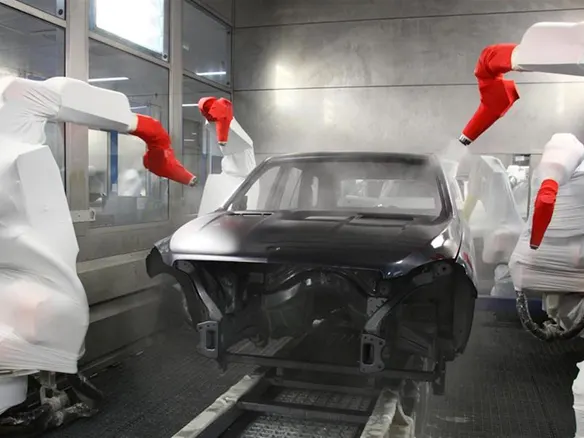
- The top coat, which is made up of two layers of basecoat and clearcoat, is the final phase in the body coating process. The principal coloring pigments are contained in the basecoat. The basecoat is the third layer applied to the automobile after the primer and before the clearcoat as part of the topcoat. It gives the car its color; there are now around 40,000 base coat colors available, and about 1000 new colors are added to the list each year.
- For autos, three main types of basecoats are used: solvent-borne medium solids (MS), solvent-borne high solids (HS), and water-borne. Clearcoat: The clearcoat is the last coating on an automobile's surface; it gives the overall coating longevity, environmental etch resistance and scratch resistance.
- It protects against damage such as fading caused by UV radiation from the sun and adds a sheen and depth that would otherwise be lacking. Repairs and maintenance are also made easier with the clear coat. Environmental etch is a cosmetic issue caused by the production of persistent wet spots or non-removable stains on an automobile's surface as a result of contact with bird droppings, tree resin, or other substances.
- The physical damage caused by etching includes localized material loss as well as distortion or pitting of the clear coat surface.
Different Types of Underbody coating
- Rubberized Underbody Coating -This is widely considered to be the best underbody coating for your vehicle. It protects the underbody from scratches and keeps it nicely. It's also not difficult to apply this to the undercarriage.
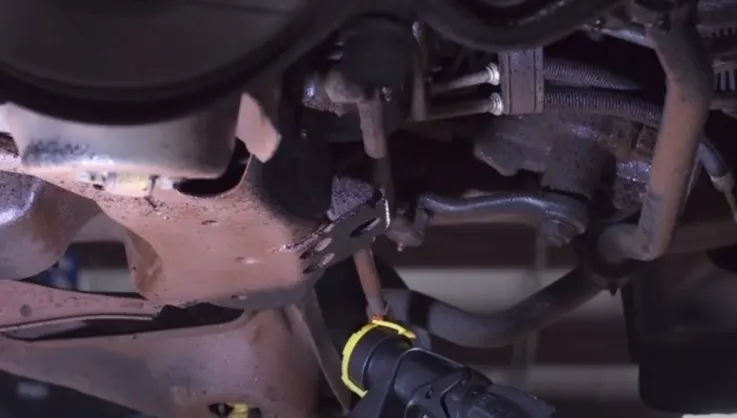
- Wax Based Underbody Coating-This transitory undercoating will, on the whole, fade away after a few months. On the plus side, wax-based undercoating is extremely resistant to moisture. It is also the most cost-effective choice available.
- Asphalt Based Automotive Undercoating-Suitable for lorries, trucks, and other heavy vehicles. When compared to rubber-based coatings, this gives a higher level of protection. Asphalt-based coatings, on the other hand, include a little percentage of rubber in them for sound insulation. The application of this coating, however, takes some time.
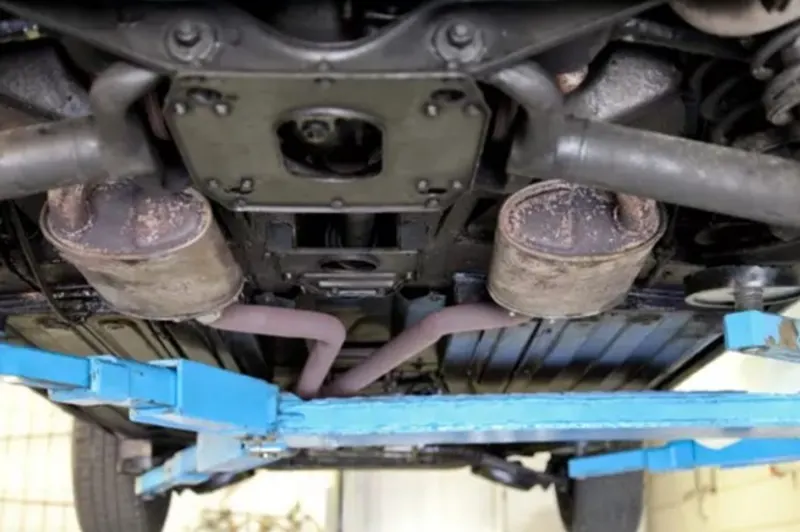
- Polyurethane Underbody Coating
-
This covering seals breaks and fractures in the vehicle's underbody. It provides excellent corrosion resistance while also forming a strong connection with the metal. Unlike an asphalt-based coating, the polyurethane coating may be painted over.
-
-
Pros of Undercoating
- Fights Rust
It has a crucial function in preventing corrosion. Underbody coating is especially useful if you live near the sea, where there is a lot of humidity and corrosion is a common occurrence. If you live somewhere where it snows in the winter, you should seriously consider undercoating.
- Absorbs Noise
Noises that reach the cabin can be muffled with a thick undercoating. The undercoating, which is frequently made of rubber, absorbs part of the rackets. The car's occupants could avoid the road sounds — at least to some extent.
- Reinforcement
If your automobile already has a factory-installed underbody coating, adding additional isn't going to hurt. It will give support to the underbody, protecting it against water, road debris, gravel, and tiny stones. The factory coat would also have a lower risk of flaking away.
- Prolong Car’s Life
A good undercoat protects not just the underbody from corrosion, but also the engine and gearbox! Less corrosion, along with less wear and tear, can extend the life of your car by many years. On the undercarriage, there would be fewer dents, dings, and scratches to worry about.
-
Cons of Underbody Coating
-
Apllying underbody coating will not have any effect to the already corroded part.
-
Undercoating is costly.
-
Since the corrosion itself starts after few year, underbody coating is not preferable to ower who change their car after few year.
-