Underbody Coating
UNDERBODY COATING
Underbody coating is a thick cladding (typically made of rubber) that is placed uniformly to the car’s underside.
PURPOSE
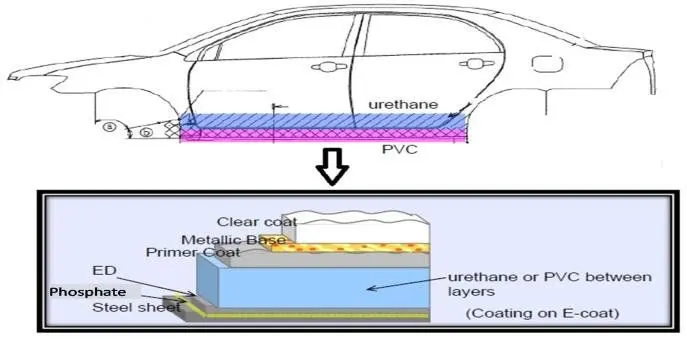
Pre-treatment: removes and cleans excess metal and forms an appropriate surface structure enabling bonding of a corrosion protection layer. The next step is Electrodeposition (ED) of the anti-corrosion or rust prevention layer. A sealer like Poly Vinyl Chloride (PVC) is applied for anti-corrosion, elimination of water leaks, and minimization of chipping and vibrational noise. A primer is then applied to promote adhesion between the surface and the basecoat; it also imparts a smoother surface for subsequent layers and has anti-chipping properties. ‚ Finally, the topcoats that include a basecoat and clearcoat are applied; they provide surface properties that are sought after, including colour, appearance, gloss, smoothness, and weather resistance.
TYPES
- Rubberized Underbody Coating. This is generally thought of as the best underbody coating for your car. Rubberized coating is ideal if you want to keep the road noise to a minimum and rust and corrosion away.
- Wax Based Underbody Coating. ... wax-based undercoating is resistant to dampness. It is also the most cost-effective alternative.
- Asphalt Based Automotive Undercoating. ... Suitable for lorries, trucks, and other heavy vehicles. In comparison to rubber-based coatings, this gives a higher level of protection.
- Polyurethane Underbody Coating… covers seal brakes and fractures in underbody and provides strong corrosion resistance and binds to the metal.
PROS: Fight rust, Absorb noise , Reinforcement and Prolong car’s life.
CONS: Need to clean the rust area to apply new coating. Nothing comes for free in this world. However, it is nothing when you compare it with the cost of replacing a vehicle after corrosion.
*****