Underbody Coating
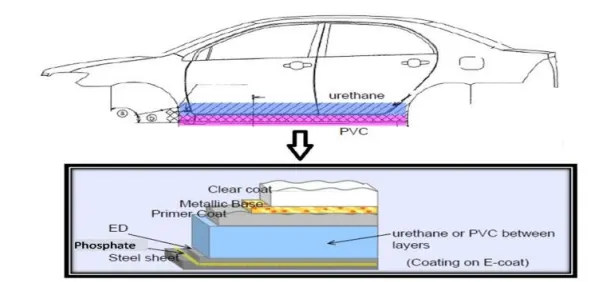
Undercoating is a protective layer that is applied to the under layer of a car where the parts are not coated with a protective layer of paint and thus more susceptible to rust damage.
Seals on the underbelly parts have gotten a lot tighter and more effective at keeping out dust and moisture, but there are other but factors to consider. Thus we need undercoating which helps to protect your vehicle against rust and corrosion.poor road,rocks getting thrown from the tires and denting the metal,and corrosion from road salt in the winter all play a huge part in the damge or decay of vehicle's underbelly.
MODERN AUTOMOTIVE COATING
PROCESSES:-
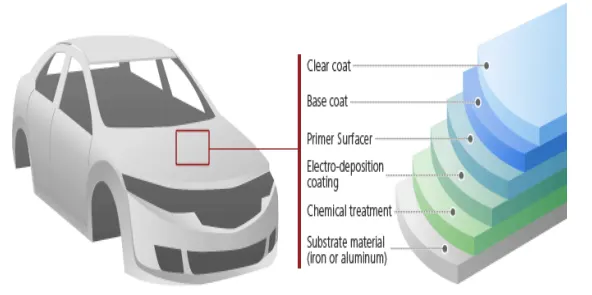
Modern automotive coating methods consists of five main steps. They include the following:
1) PRETREATMENT
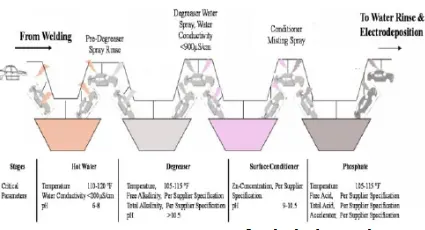
The first sequence in preparing the BIW for subsequent coating is pretreatment sees removes & clean excess metal & forms an appropriate surface structure enabling bonding of a corrosion protection layer. It consists of cleaning the body surface to remove remaining oils from the staming process & welding residues
conditioning, & phosphating.
Pretreament helps the primer to bond onto the metal. A phosphate treatment applies an inert layer of metal A phosphate treatment applies an inert layer of metal phosphate, providing resistance to corrosion spread. The phosphate, providing resistance to corrosion spread. The degreasing solution is composed of alkaline salts & surfactants & can include caustic soda, sodium carbonate.surfactants & can include caustic soda, sodium carbonate.The surfactants are types of detergents for emulsifying oils &lubricants on the BIW. In surface conditioner which creates nucleation sites for phosphate crystal growth. It increases the number of crystallization nuclei on the metal surface that enchance bonding mechanism for the subsequent phosphate sequence. Finally, the liquid dip phosphate ions, nitrate ions,zinc & hydrogen ions. The free acid etches the steel surface,causing hydrogen to be released while metal phosphate ions
2) ELETRODEPOSITION
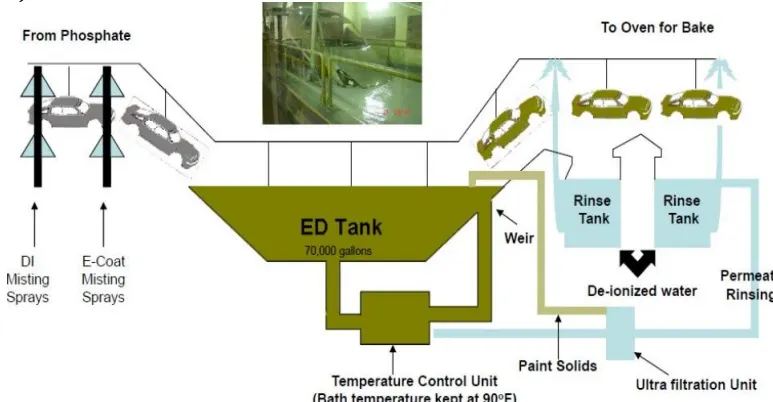
E-coating involves dipping automobile bodies into the coating solution & passing an electric current through the body & the liquid ED paint solution. Because of the charged nature of this coating process, the ED paint penetrates into
places a spray would not reach.During operation, a mixture of resin, binder, & a paste containing the pigments is fed into the ED tank. The automobile body is lowered into the tank, & an electric current applied; the solution in the tank consists of 80-90% deionised water & 10-20% paint solids.The resin is the backbone of the final paint film & provides corrosion protection, durability, & toughness. Pigments are used to provide color & gloss. After E-coat, the automobile body enters a bake oven, in which heating & keeping at a temperature of 160C for 10 min causes film curing to promote maximum performance properties. The oven temperature & heating time primarily enchance chip resistance & film adhesion to the body; corrosion protected is affected less by these conditions. Because surface roughness influences the smoothness & brilliance of the topcoat, some sanding of the surface is usually performed to remove or eliminate defects before the body enters the next application step.A common challenge in the cureent E-coating process is that of water spots that contaminate coated surfaces. If water spots are present, they have removed any sanding. Hence, it is necessary to use well-deionoised water
& routinely monitor its conductivity. Alternstely, operators also add surfactants or ultrafiltrates to the water rinse zone to
eliminate or manage water spots
3) RUST-PROOF MATERIALS: SEALER
4) PRIMER
places a spray would not reach.During operation, a mixture of resin, binder, & a paste containing the pigments is fed into the ED tank. The automobile body is lowered into the tank, & an electric current applied; the solution in the tank consists of 80-90% deionised water & 10-20% paint solids.The resin is the backbone of the final paint film & provides corrosion protection, durability, & toughness. Pigments are used to provide color & gloss. After E-coat, the automobile body enters a bake oven, in which heating & keeping at a temperature of 160C for 10 min causes film curing to promote maximum performance properties. The oven temperature & heating time primarily enchance chip resistance & film adhesion to the body; corrosion protected is affected less by these conditions. Because surface roughness influences the smoothness & brilliance of the topcoat, some sanding of the surface is usually performed to remove or eliminate defects before the body enters the next application step.A common challenge in the cureent E-coating process is that of water spots that contaminate coated surfaces. If water spots are present, they have removed any sanding. Hence, it is necessary to use well-deionoised water
& routinely monitor its conductivity. Alternstely, operators also add surfactants or ultrafiltrates to the water rinse zone to
eliminate or manage water spots
3) RUST-PROOF MATERIALS: SEALER
4) PRIMER
This all are use undercoating body