Underbody Coating
UNDERBODY COATING
UNDERBODY COATING: Underbody coating provides long term protection from corrosion to a car’s underbody. It also protects parts like internal body panels, frame rails, and other inner cavities that are not physically accessible but are prone to corrosion.
Modern Automotive Coating Processes
Modern automotive coating methods consist of five main steps. They include the following:
- Pretreatment: removes and cleans excess metal and forms an appropriate surface structure enabling bonding of a corrosion protection layer.
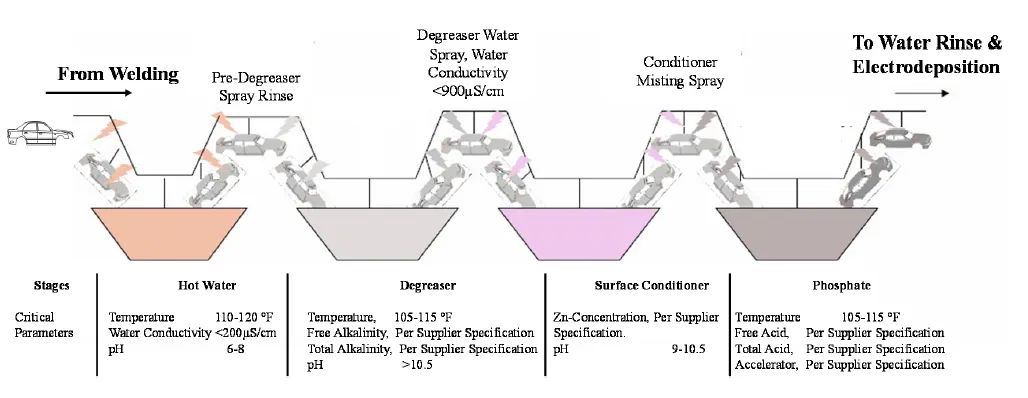 Figure1: Pretreatment sequence for BIW.
- The next step is electrodeposition (ED) of the anti-corrosion or rust prevention layer.
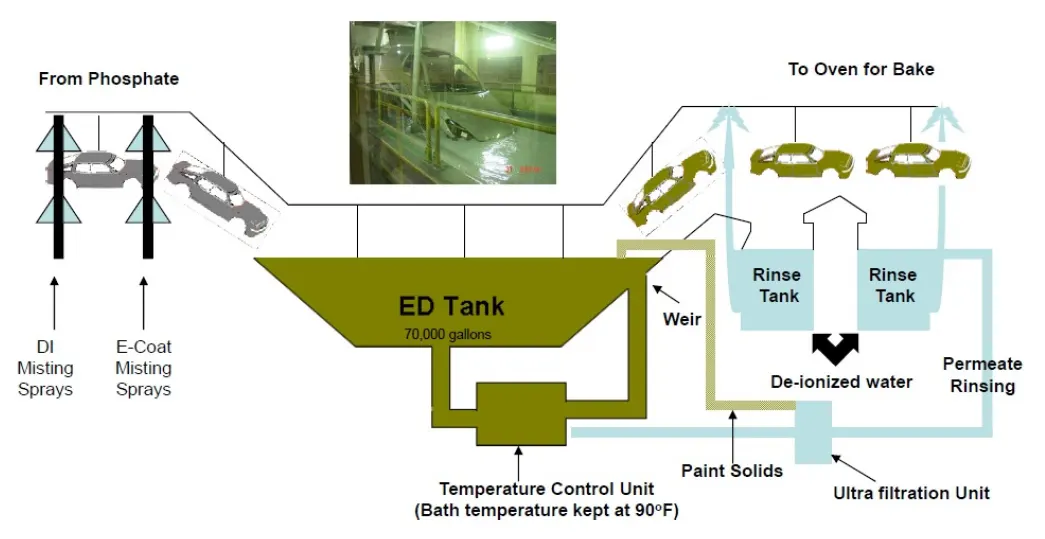 Figure 2: Electrodeposition process.
- A sealer like Poly Vinyl Chloride (PVC) is applied for anti-corrosion, elimination of water leaks, and minimization of chipping and vibrational noise.
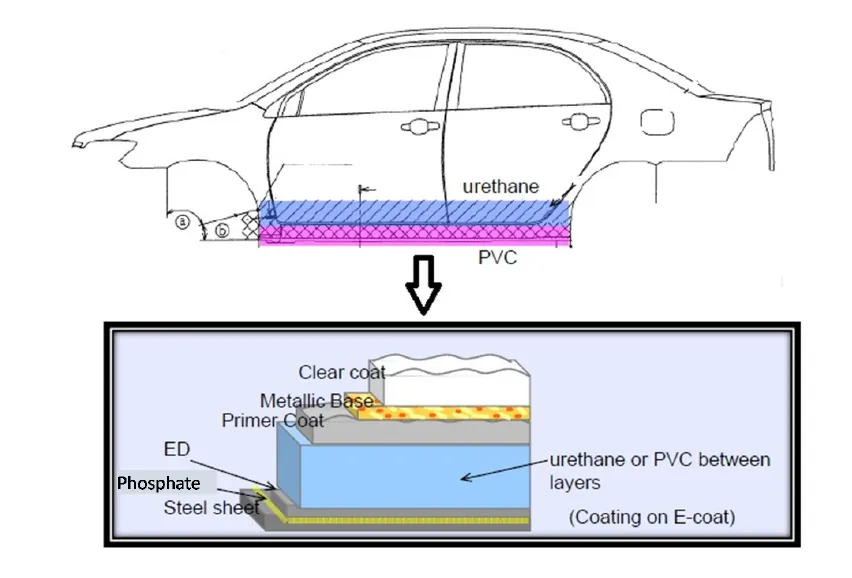 Figure 3: The anti‐chipping material coating on lower doors and rocker panels.
- A primer is then applied to promote adhesion between the surface and the basecoat; it also imparts a smoother surface for subsequent layers and has anti-chipping properties.
- Finally, the topcoats that include a basecoat and clearcoat are applied; they provide surface properties that are sought after, including color, appearance, gloss, smoothness, and weather resistance.
The areas of an automobile depicted in Figure 4 shows where these five steps of coating and other additional coatings are used. As can be realized when examining this figure, a significant number of specific coatings and materials are needed in addition to the above-listed steps to manufacture a salable automobile.
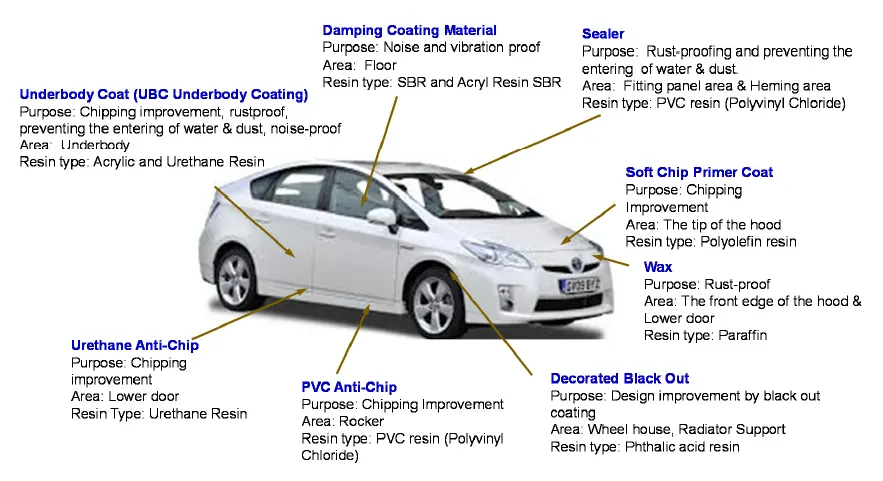 Figure 4: Summary of coating areas.
For the external surfaces of an automobile to be easily visualized, the five main steps of coating produce a layered structure depicted in Figure 5. These coatings are applied in a particular order and have different material and protection or finishing functionalities; also, each layer relates to the others and imparts a desired balance of properties.
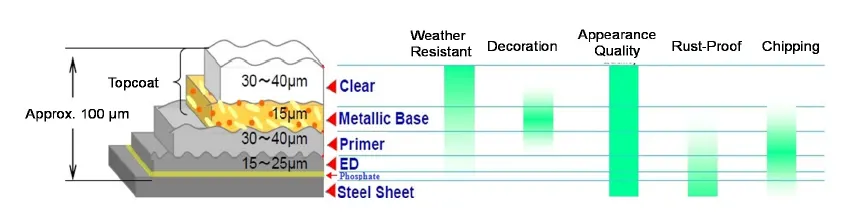 Figure 5: Automotive coating layers, their thicknesses, and purposes for an exterior surface.
CONCLUSION
The technologies employed in automotive coatings have become much more sophisticated and efficient, and are evolving rapidly. The pace of performance improvement over the past 100 years has been dramatic, and it will continue to accelerate. Coating compositions and application processes are inseparable and mutually dependent. As such, the final coating is an elaborate assembly of multiple coatings layers that perform in unison. A coating composition, together with application procedures, film formation processes, and coated surface characteristics, determines the appearance of a coating film.
Automotive coatings confront an almost limitless variety of environments and environmental assaults. Targeting customers’ expectations, together with maximizing efficiencies and meeting environmental regulations with new processes, has brought automotive coating to a level not imagined 100 years ago. The appearance (color, gloss, and texture) of the surface significantly affects a customer’s perception of product quality. Additionally, customer expectations for the attributes given by the appearance of coatings continue to increase as manufacturers compete to provide surfaces that offer enhanced surface characteristics.