Underbody Coating
Underbody Coating.
Underbody coating are those which provides shielding for a bottom of the car body against deterioration of its coating. They provide layer of protection between a vehicle's endangered side and damaging forces such as rust & moisture access.
Since cars are uncovered to constant climate changing in our country, specially during monsoon season, additional care has to be given for car's underbody. A car's underbody is revealed to dirty terrains, waste (dry & wet), earthen particles, submerged roads that leads to rust of underbody. As underbody of car is inflexible for an individual to examine by themselves, hence underbody coating plays a important role during these times.
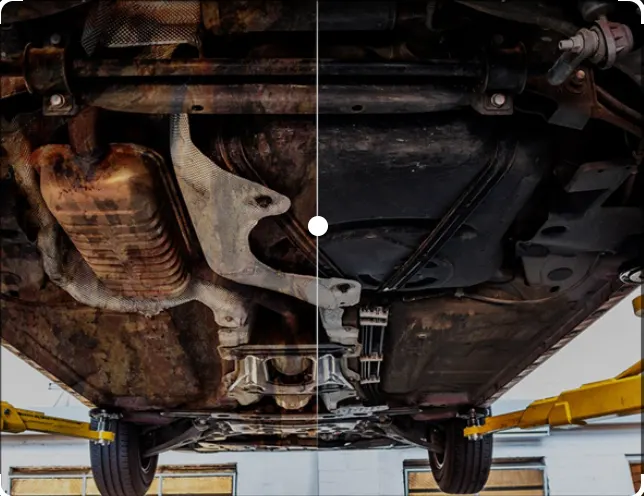
car without protection and car with protection
Now we have a few lists of reasons on why you should get a underbody coating :-
1) Shelter against rust or corrosion.
The major reason to opt for or go for underbody coating is to prevent rusting and corrosion. Monsoon season is not only the necessary time but it is also a must in damp and hot weather condidtions. For example the activity of corrosion accelerate for the cars used in the coastal region where the climatic conditions are hot and humid hence coating becomes essential. It can be avoided by applying rubberised anti-rusting coat, by getting it done at a car service centre.
2) Protection of fundamnetal componets.
Components like silencer, engine, and numerous other wires and small engine components used for different purposes should not let to be corroded and cause any extra accident while driving in any climatic condition. Therefore, to avoid any major problems antirust coating has to done. Now this becomes a vital in moderately high rainy regions as undebody coating is much needed.
3) Resaling value of a car could be affected.
Car is not fully about just inside and outside looks. The corrosion underneath a car could cause larger damage if neglected and lower the exchanging value of car, So greater & equal importance has to be provided. Do execute the periodic inspection of a car underbody to maintain its resale value.
4) Reduction of NVH(noise vibration harshness) levels.
We are in a country where roads are not upto its standards. Frequently coming across unbalanced road surface, small potholes sometimes even bigger one's, stones hitting bottom of car body etc., the underbody coating help and absorbs all the noise produced during this action, when coming in contact of surface of the road, by reducing this.
5) Chipping of paint.
This occurs when a car is driven at a high speed on a highway for a longer distance where underbody of the car comes in contact with sharp objects, stones, dirt etc. Thus, thick layer of under body coating is recommended.
Therefore, To resist the above mentioned factors getting underbody coating for car from time to time plays an very important role.
MODERN AUTOMOTIVE COATING PROCESS.
Modern automotive coating methods consists of five main steps :-
1) Pretreatment.
First step in laying the BiW for following coating is pretreatment as shown in below figure. Preatrament eliminate & clean extra metal & forms an proper surface structure allowing bonding of a corrosion protection layer. It consists of cleaning the body surface to clear away remaining oils from the staming process & welding residues through three primary liquid dip processes of degreasing, conditioning, & phosphating.
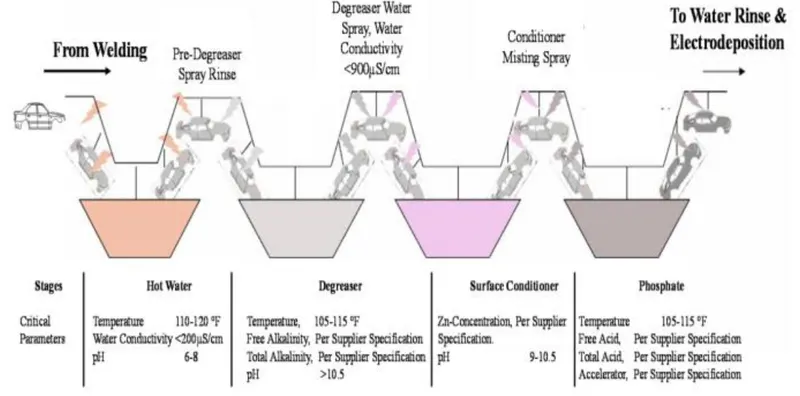
Figure:- Pretreatment sequences for the body-in-white
This process support the primer to bond onto the metal. A phosphate treatment bid an inert layer of metal phosphate, giving resistance to corrosion spread. The scrubbing solution is composed of alkaline salts & detergents & can include caustic soda, sodium carbonate. The detergents are for emulsifying oils & lubricants on the BiW. In surface conditioner which generate nucleation sites for phosphate crystal growth. It boost the number of crystallization nuclei on the metal surface that enrich bonding mechanism for the following phosphate sequence. Finally, the liquid dip phosphate ions, nitrate ions, zinc & hydrogen ions. The free acid ingrain the steel surface, causing hydrogen to be released while metal phosphate ions are precipitated onto the surface in a crystalline form.
2) Electrodeposition.
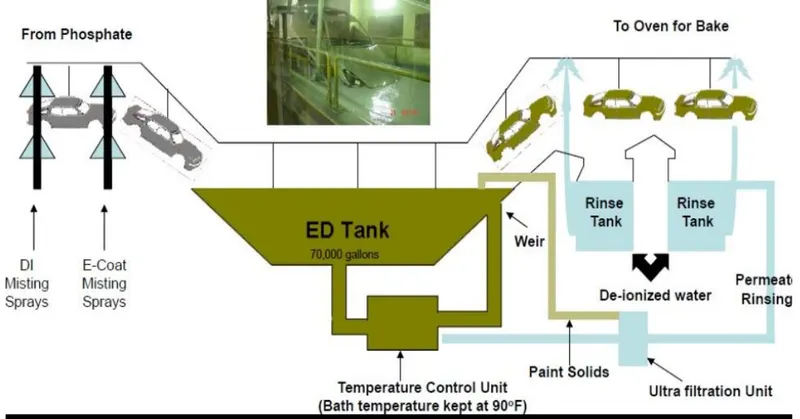
Figure:- Electrodeposition coating process.
E-coating involves immersing automobile bodies into the coating solution & passing an electric current through the body & the liquid ED paint solution. Because of the charged nature of this coating process, the ED paint pierce into places a spray would not reach.
During operation, a mixture of adhesive, binder, & a paste containing the pigments is fed into the ED tank. The automobile body is dropped slowly into the tank, & an electric current applied; the solution in the tank consists of 80-90% deionised water & 10-20% paint solids.The adhesive is the backbone of the final paint film & provides corrosion protection, durability, & toughness. Pigments are used to provide color & gloss.
The present-day challenge in E-coating process is water spots pollute coated surfaces. If water spots are present, they have removed ny sanding, so it is necessary to use well-deionoised water & regualarly monitor its conductivity. Alternatively, operators also add detergents to the water rinse zone to get rid of water spots.
3) Rust Proof Materials: Sealer/PVC.
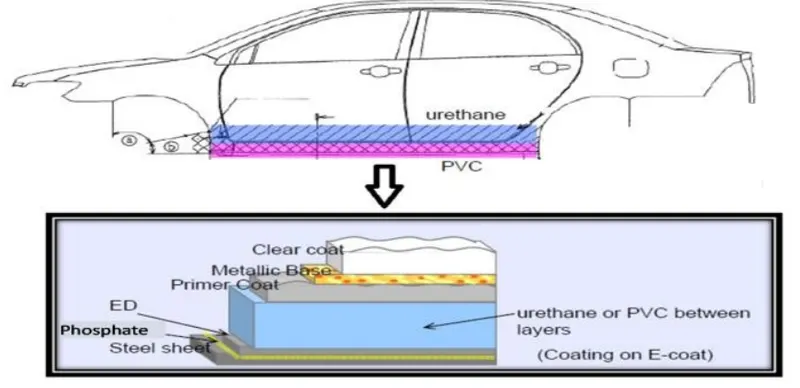
Figure:- Underbody coating.
The third step is underbody coating & seam sealing using PVC. The above figure displays the lower door sections & rocker panel locations where PVC or urethanes are applied as an anti-chipping protection, & displays the cross section of this layer with respect to the other coatings on the body parts. In this process it is also typical to apply a soft tip primer coat that enhance the chipping resistance . This layer is applied to the front edge of the hood , which is an area prone to chipping shock, using a high elastic resin that resides between the ED & primer coats and also the radiator supports, wheel housing, & under rar
areas of the body are coated with a relatively dull black pigment called a blackout coating.
4) Primer.
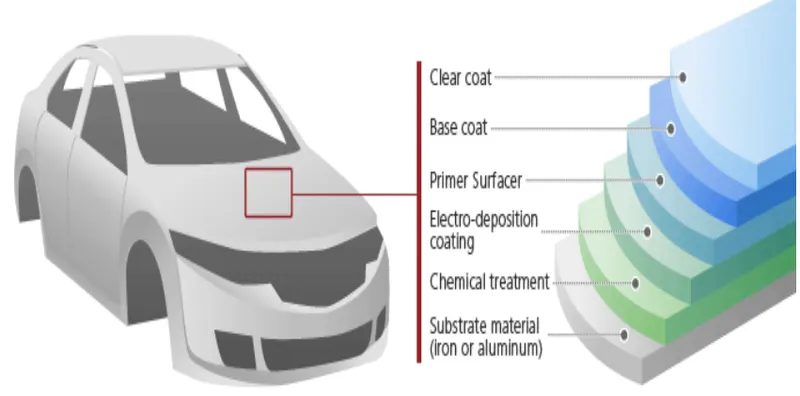
Figure: Primer Coating.
The Primer Coating is fourth step. It can be water-borne, solvent-borne, or a powder. The primer fills & smoothes minor defects & scratches that may be produced during prior steps & by the intermediate sanding or grinding used to remove small cracks. It also delivers additional stability against corrosion & maximizes adhesion between it & the E-coat & basecoat, thereby, the primer add up to paint durability. Primer coating operations are usually implemented in three stages: Interior coating, Exterior coating, & then cutting in an oven.
Manual spray painting is used for the interior coating of the doors, engine compartment, & luggage or trunk space. Some of the areas are not sprayed with basecoat. It is vital the primer color matches the basecoat to be suitable to impart unvarying coating appearances between interior & exterior coats.
5) Topcoat.
The fifth step is to apply the topcoat, which consists of two layers the basecoat & clearcoat.
Basecoat:
It contains the primary coloring pigments. As part of the topcoat, the basecoat is third layer added to the car after the primer & before the clearcoat. It transmit the automobiles color; today approximately 40,000 base coat color are known & 1000 new colors are added to this list each year. Three different types of basecoats are used for automobiles, including solvent-borne medium solids (MS), solvent-borne high solids (HS), & water-borne.
Clearcoat:
This will be the final coating process in an automobile. it provides endurance, environmental etch, & scratch resistance to the overall coating. It protects against damage such as fading that is caused by UV rays from the sun & imparts a gloss & depth that otherwise are not as vivid. The clearcoat also makes repairs & maintenance easier. Environmental etch is an appearance issue associated with the formation of permanent water spots or non-removable marks from bird droppings, tree resin, or other chemicals after contact with an automobiles surface.