Underbody Coating
Use of Underbody coating:
Underbody coating provides long term protection from corrosion to car's underbody. It also protects parts like internal body panels, frame rails and other inner cavities that are not physically accessible but are prone to corrosion
Coating process for BIW in industries :
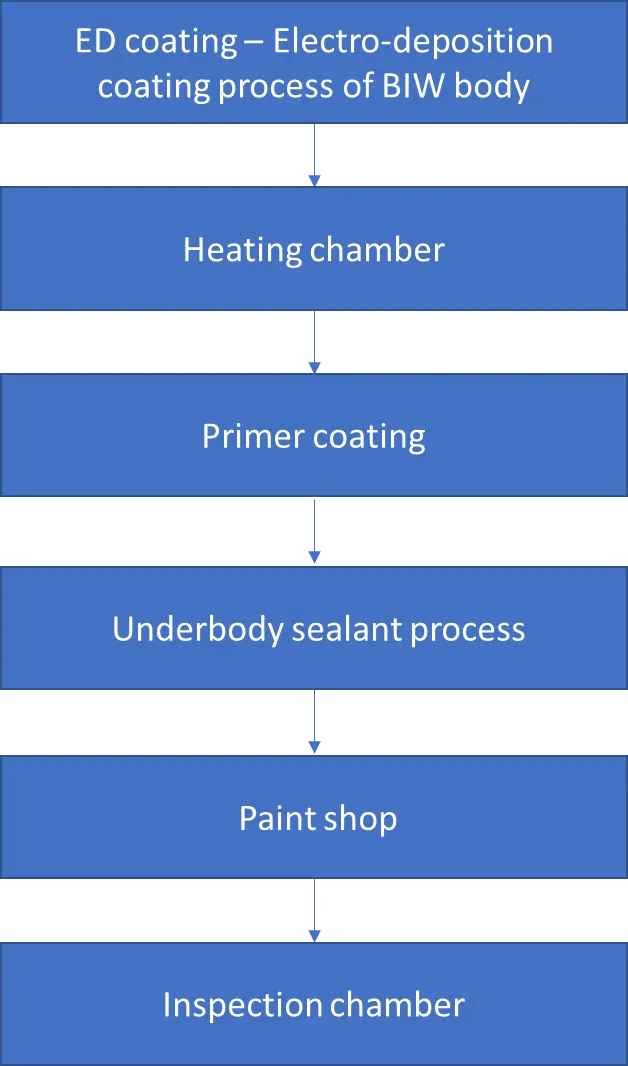
ED coating - Electro-deposition coating process of BIW :
This Electro-deposition coating is the process of trasporting the metal ions from one metal to the another metal . Where in the base metal there forms a thin layer of coating from the base metals . This thin layer formation in the base metal is known as the electro-deposition coating or electro-plating process
This process is based on the principle of electrolysis.
The main objective of this type of coating is for corrosion resistance of the metal bodies , aesthatics/decorative purposes . This ED for BIW will be done in the industries by use of heavy automated motorized rails which carries the BIW body and it will immerse the BIW into the electrolyte bath . The frame will rotate the BIW inside the bath in order to deposit the ions from the electrolyte solution .
After this every droplets will be drained out from the BIW by twisting the BIW 360° also there are some holes purposely designed in the BIW body for draining the ED.
Heating chamber :
After the ED coating the BIW will be moved to this heating chamber inorder to dry the BIW body . So, after drying process inside this hot chamber BIW will comes out from this chamber for the next deposition process
Primer coating :
Primer coating / preliminieary coating is the process of deposition of primer in the BIW body . This acts as the preliminary process of sealing/ painting . Primer coating acts as an adhesive between base coat & the paint. This process will be same like ED coating like immersing the body into the primer bath & rotating it .
Underbody sealant process:
The next step is underbody sealant process using PVC (Poly vinyl chloride) and urethane. The sealant is applied around and inside the doors, hood, trunk, and front dash and onto the exterior and interior of metal joints and outer area of the back wheel well.This process is for anti-corrosion, elimination of water leaks, and minimization of chipping and vibrational noise.
Paint shop:
The next step in the body coating process is to apply the topcoat, which consists of two layers—the basecoat and clear coat. The basecoat contains the primary colouring pigment and the clear coat provides a protective coating against environmental effects, corrosion, and UV light degradation promotes unmatched colour retention and provides a smooth unblemished even finish.
This process may be fully automated / semi-automated based on the manufacturer facility / investment.
Inspection chamber:
This is the final stage of coating process where the BIW body reaches this inspection chamber where this chamber is fully made of rich lightings in order to inspect all the characters of the BIW coating/painting areas . If there is any mistakes in the coatings / paintings will be highlighted in this chamber clearly .
Types of underbody coating:
1. Rubberized underbody coating:
These coatings are easy to apply and offer sound-cushioning as well as protection from dust, moisture and dents. .
2. Polyurethane underbody coating:
This type of undercoating is a lit a bit quicker and easy to apply. This type of undercoating often comes in a canister ready to preload into application gun. This type of undercoating always requires surface preparations before applying.
3. Wax or paraffin-based underbody coating:
Wax or paraffin-based undercoating will be the cheapest and quickest option available in the market. But these coatings last only for one year of duration.
4. Asphalt-based underbody coating:
The above-mentioned undercoating is mainly used for light commercial vehicles. For vehicles such as trucks, buses, vans etc. asphalt-based undercoating is used for sufficient protection against rock chips and moisture. These asphalt-based undercoatings have a little bit of rubberised material that set up firmly and also helps in reduction in noise.
Advantages of underbody coating:
Minimizes sound: It minimizes the sound from underneath the car.
Heat insulation: It insulates the interior of the car from the extreme temperature from beneath the vehicle.
Anti-chipping property: The coating does not chip away when hit by stones