Thermal Management of Battery
1. Thermal Management Techniques for EV
Electric vehicles (EVs) develop fast and have become popular due to their zero-emission and high tank-to-wheels efficiency. However, some factors limit the development of the electric vehicle, especially the performance, cost, lifetime and safety of the battery. Therefore, the management of batteries is necessary in order to reach maximum performance when operating under various conditions.
Lithium-ion cells performance depends on both the temperature and the operating voltage. Lithium-Ion cells work well when cells operate within limited voltage and temperature. Otherwise, the damage will occur to the cells and will be irreversible.
In over-voltage situations the charging voltage exceeds the bearable cell voltage, resulting in excessive current flows and at the same time, it causes two problems. At excessive currents the Lithium-ions are deposited more rapidly than intercalation to the anode layers, Lithium ions are then deposited on the surface of the anode as metallic Lithium. This is Lithium plating. It gives rise to the reduction in the free Lithium ions and an irreversible capacity loss.
As with over-voltage, under-voltage also brings about problems that give rise to the breakdown of the electrode materials. For the anode, the copper current collector breaks down. It causes the increase of battery discharge rate and battery voltage, however, the copper ions are precipitated as metal copper which is irreversible. The situation is dangerous for it can result in short-circuit between anode and cathode. For the cathode, the cobalt oxide or manganese oxide will be decomposed after many cycles under low voltage. Meanwhile, oxygen will be released and the battery suffers from capacity loss. The battery temperature should be controlled carefully. Both excess heat and lack of
heat will bring about problems.
Chemical reaction rates have a linear relation to temperature. The decrease of the operating temperature will reduce the reaction rate and the capacity of carrying current during charging or discharging. In other words, the battery power capacity is decreased. Moreover, the reduction of reaction rate makes it harder to insert lithium ions into intercalation spaces. The result is the reduction of power and lithium plating causing capacity loss.
High temperature increases the reaction rate with higher power output, however, it also increases the heat dissipation and generates even higher temperatures. Unless the heat is dissipated quicker than heat is generated, the temperature will be higher and finally, a thermal runaway will result.
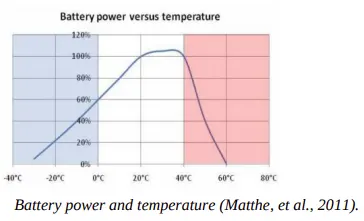
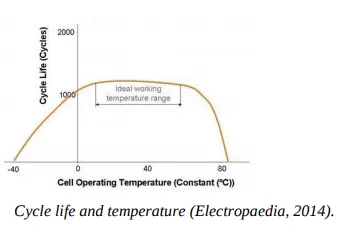
When the temperature ranges from 20°C to 40°C, battery power reaches a maximum, Cycle life, and temperature. The cycle life goes down slowly below 10°C because of anode plating and drops off quickly above 60°C due to the breakdown of electrode materials. Generally, the temperature must be controlled between 20°C and 40°C to ensure the performance and cycle life
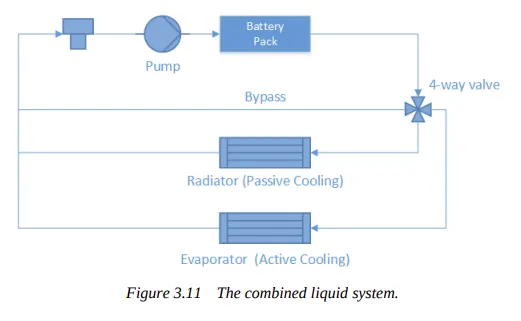
The battery thermal management system (BTMS) plays a vital role in the control of the battery thermal behavior. The BTMS technologies are air cooling system, liquid cooling system, direct refrigerant cooling system, phase change material (PCM) cooling system, and thermo-electric cooling system as well as heating. These systems are analyzed through a trade-off between performance, weight, size, cost, reliability, safety, and energy consumption. According to the analysis two prime battery, thermal management systems are recommended: a combined liquid system (CLS) and a variant
system with PCM. The models of the CLS and PCM system were built and simulated using the software MATLAB/Simulink. The simulation results predict the battery temperature variation and the energy consumption of BTMS. Through simulating the PCM system model, the effect of PCM on battery temperature variation was investigated and the proper PCM mass was estimated.
Air Cooling and Heating
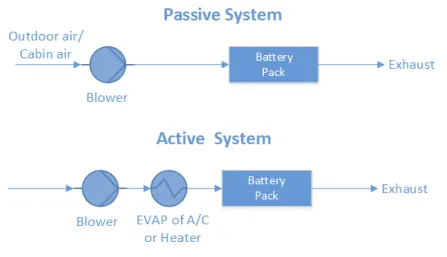
Air systems use air as the thermal medium. The intake air could be direct either from the atmosphere or from the cabin and could also be conditioned air after a heater or evaporator of an air conditioner. The former is called a passive air system and the latter is an active air system. Active systems can offer additional cooling or heating power. A passive system can offer some hundreds of watts of cooling or heating power and active system power is limited to 1 kW.
Liquid Cooling and Heating
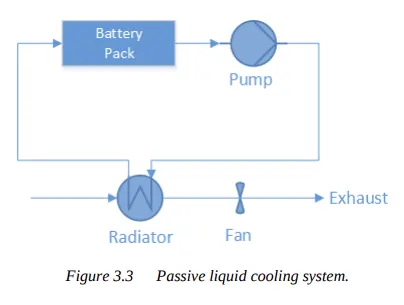
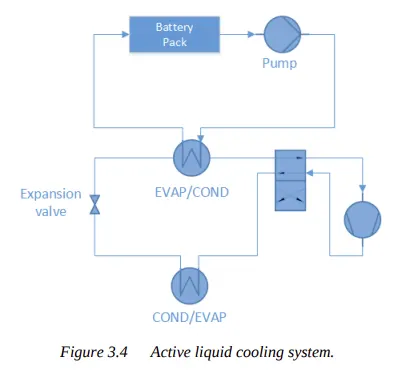
Besides air, the liquid is another heat transfer fluid to transfer heat. There are generally two groups of liquids applied for thermal management systems. One is dielectric liquid (direct-contact liquid) which can contact the battery cells directly, such as mineral oil. The other is conducting liquid (indirect-contact liquid) which can only contact the battery cells indirectly, such as a mixture of ethylene glycol and water. Depending on the different liquids, different layouts are designed. For direct-contact liquid, the normal layout is to submerge modules in mineral oil. For indirect-contact liquid, a possible layout can be either a jacket around the battery module, discrete tubing around each module, placing the battery modules on a cooling/heating plate, or combining the battery module with cooling/heating fins and plates. Between these two groups, indirect contact systems are preferred in order to achieve better isolation between battery module and surroundings and thus better safety performance.
Direct Refrigerant Cooling and Heating
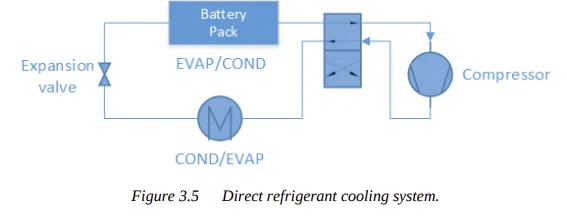
DRS consists of an A/C loop, but DRS uses refrigerant directly as heat transfer fluid circulating through the battery pack.
PCM
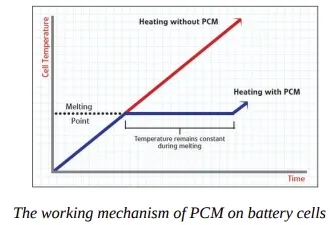
During melting, heat is absorbed by PCM and is stored as latent heat until the latent heat is up to the maximum. The temperature is kept at the melting point for a period and the temperature increase is delayed. Therefore, PCM is used as a conductor and buffer in battery thermal management systems.
Thermo-electric Module
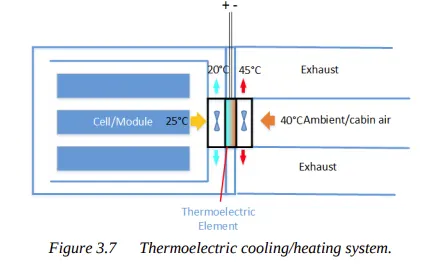
The thermoelectric module can convert electric voltage to temperature difference and vice versa. Here the former effect is adopted. That means it transfers heat through the module by consuming electricity directly. Two fans are installed to improve heat transfer by forced convection. To combine a passive air system with the thermoelectric module, the combined system is able to cool down the battery even lower than the intake air temperature, but the power is still limited to around some hundreds of watts and less than one kW. It’s easy to switch between cooling and heating operations. To achieve that, the poles of electrodes need to be reversed.
Combined Liquid System (CLS)
The first is the liquid cooling system, which has four working modes: bypass with heater working; bypass without heater working; passive cooling system; and active cooling system. The cooling system takes advantage of both passive cooling systems and active cooling systems. A passive cooling system has a simple structure and is able to dissipate heat under normal conditions with low energy consumption. Under extreme conditions, the active cooling system has good thermal performance to keep the battery temperature in the required range.
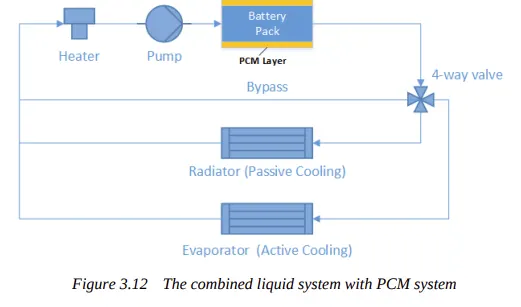
PCM Model (CLS+PCM)
The other preferred system is the combination of PCM material and CLS. PCM layers are inserted into the battery pack. It uses the advantage of PCM to have good thermal performance, and CLS compensates for the limited operating temperature of PCM.
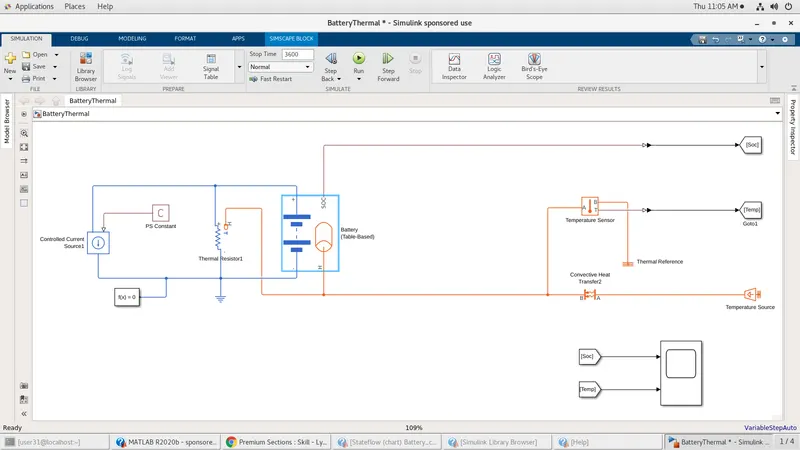
2. Simple simscape model with a battery to show the temperature dependence in the performance.
In our case we have kept the model design very simple and specific, the battery is connected to a temperature source and the connection type is convective heat transfer. As in the real scenario also we don't have conductive heat transfer rather it is convective heat transfer is happening.
Now to show load type we connected the thermal resistor in parallel to the battery pack. Now because while driving the battery discharging happens in a controlled current manner. So we used a controlled current source to show discharging of the battery.
So this simple model will help us understanding battery dependence on temperature.
Generally if the temperature increase we see the SOC drops at higher rates. If the temperature is maintained at ambient temperature then it is seen that the battery performs at its best threshold values.
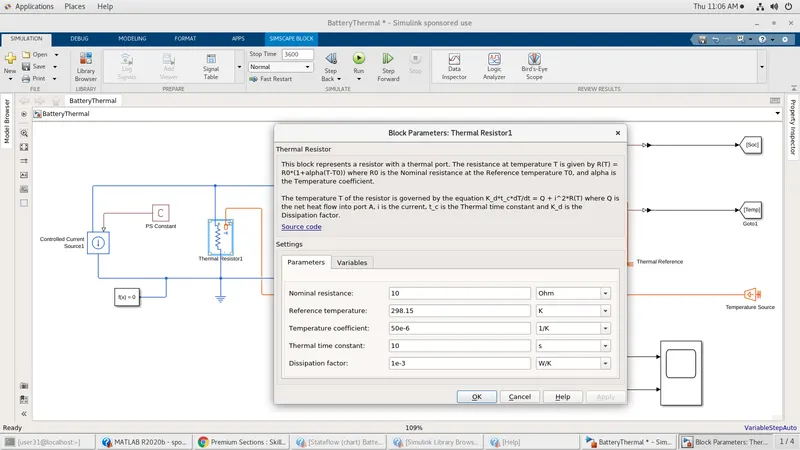
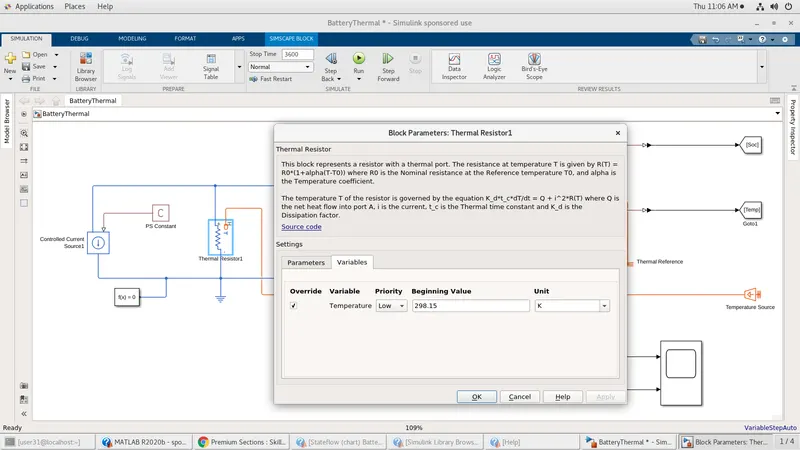
Parameters passed for Thermal Resistor
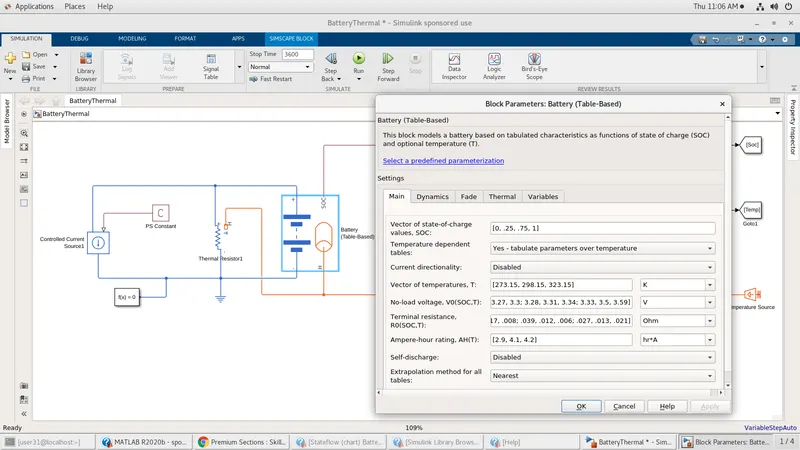
Parameters passed for Battery
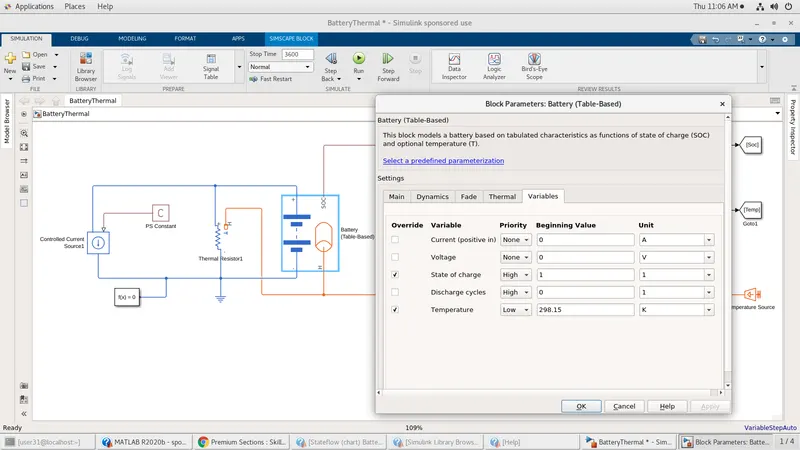
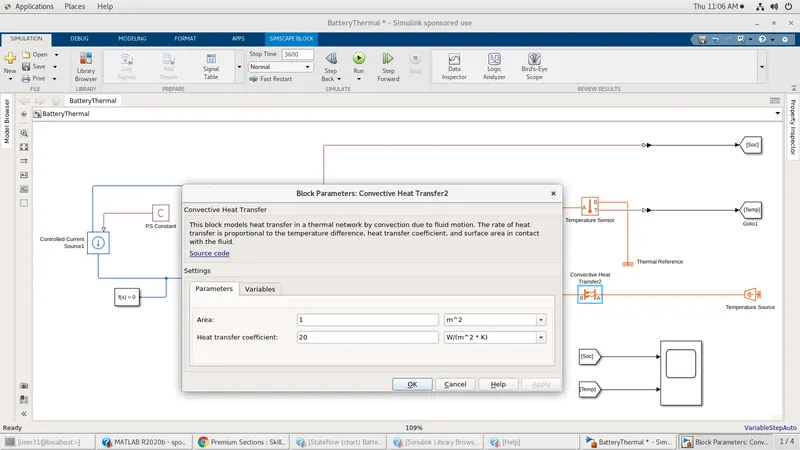
Parameters passed for Convective Heat Transfer.
Parameters passed for Temperature source.
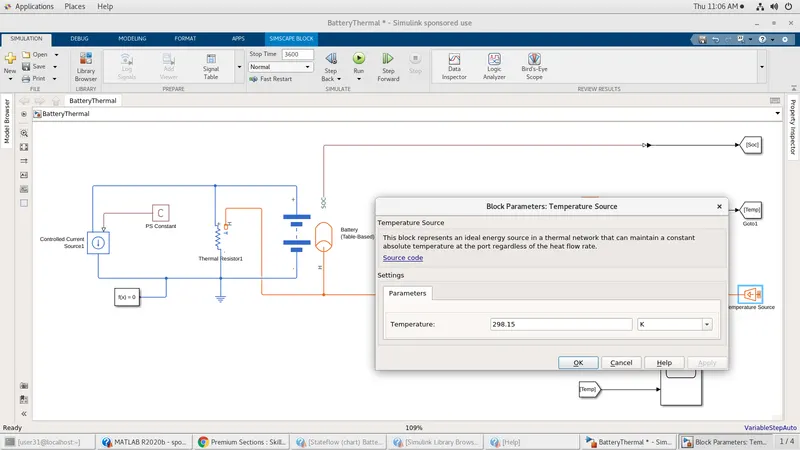
As it can be seen through images we have kept the temperature source value 298.15K, and also we have fixed the beginning value of battery pack temperature same. It will ensure that the plot of temperature rises in the plot if we keep it below 298.15K in temperature source then in the plot we will see that with a decrease in temperature SOC decreases which happens but at a very low-temperature value like -25C. So we have to be very specific while passing parameters for every block otherwise we will get wrong results.
Results:
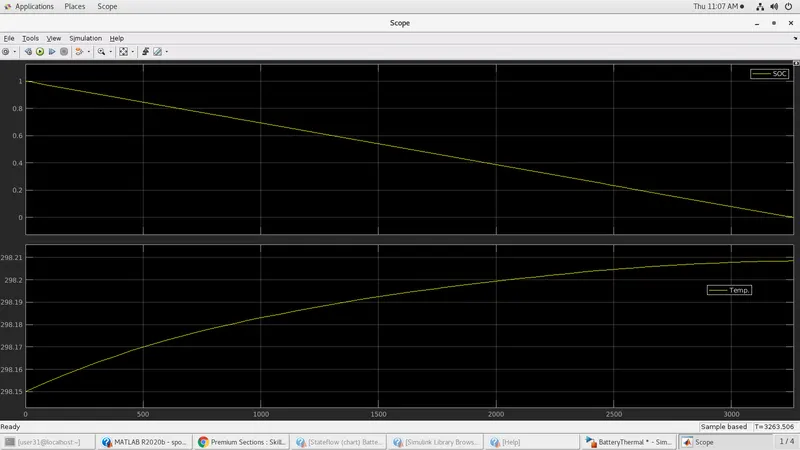
Here as we can clearly see that SOC decreases with an increase in temperature, so this clearly states if we are not maintaining the battery pack temperature near to ambient temperature then battery life reduces, also performance gets affected.
References:
https://publications.lib.chalmers.se/records/fulltext/200046/200046.pdf