Supervised Learning - Classification Week 9 Challenge
Question 1: What is a Neural Network?
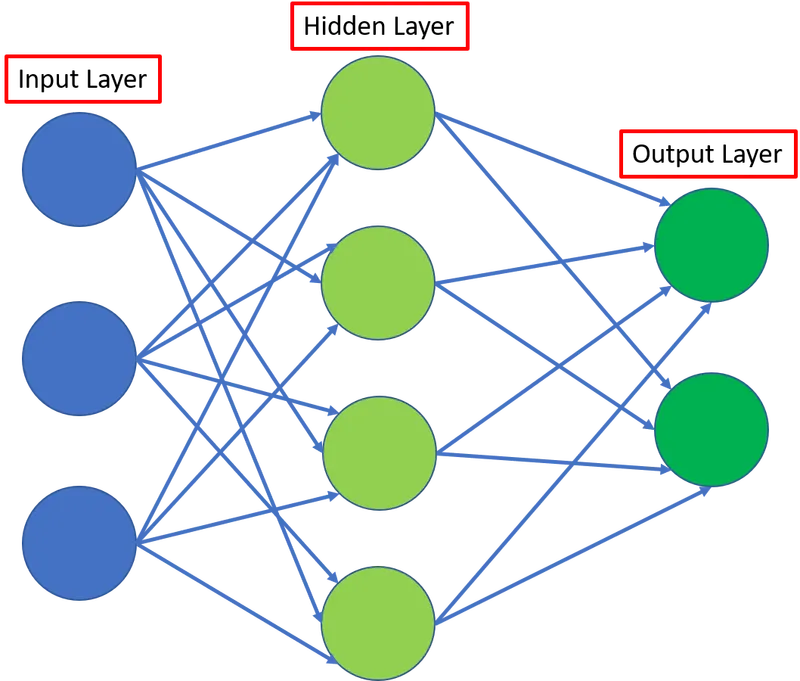
Answer: A neural network is a series of algorithm that endevors to recognize underlaying relationship in a set of data through a process that mimics the way of human brain operates.
Question 2: What is deep learning?
Answer: Deep Learning is a subset of machine learning, which is essentially a neural network with three or more layers.
Deep learning drives many arificial intelligance applications and services that improves automation, performing analytical and physical tasks without human intervention.
Question 3: What is the role of the activation function?
Answer:
Definition: Activation function decides wheather a neuron should be activated or not by calculating weighted sum and further adding bias with it. The purpose of the activation function is to introduce non-linearity into the output of a neuron.
A neuraal network without an activation function is essentially just a linear regression model. The activation function does the non -linear tranformation to the input making it capable to learn and perform more complex tasks.
Activation function also helps to normalize the output of any input in the range between 1 to -1 or 0 to 1.
Question 4: What are the different types of activation functions?
Answer: There are five types of activation function.
1. Linear Function: it has the equation similar to as of a straight line.
Y=ax
Value Range: `-infty to +infty`
2. Sigmoid Function: It is a function which is plotted as 'S' shaped graph.
`A=1/(1+e^-x)`
Value Range: 0 to 1.
3. Tanh Function: The activation function that works almost always better than sigmoid function is a Tangent hyperbolic function.
`f(x)=tanh(x)=2/((1+e^-2x)-1)`
or
`tanh(x)=2*sigmoid(2x)-1`
Value Range: -1 to +1
4. RELU: Stands for rectified linear unit.It is the most used activation function.
A(x)=max(0,x)
Value Range: [0,`infty`)
5. Softmax Function: The softmax function is also type of sigmoid function but is handy when we are trying to handle classification problems.
Question 5: What do you understand by backpropagation?
Answer: We know, neural network has neurons that work in correspondance of weight, bias and their respective activation function. In a neural network, we should update the weights and biases of the neurons on the basis of the error at the ouput. This process is called as the back-propagation. Activation functions make the back-propagation possible since the gradients are supplied along with the error to update the weights and biases.
It is the essence of neural net training. it has two types.
1. Static-back propagation.
2. Recurrent back propagation.