Supervised Learning - Classification Week 7 Challenge
1. Pros and cons of SVM.
| Pros | Cons |
| - It works really well with a clear margin of separation |
- It doesn’t perform well when we have large data set because the required training time is higher. |
| - It is effective in high dimensional spaces. | - It also doesn’t perform very well, when the data set has more noise i.e. target classes are overlapping. |
| - It is effective in cases where the number of dimensions is greater than the number of samples. | - SVM doesn’t directly provide probability estimates, these are calculated using an expensive five-fold cross-validation. |
| - It uses a subset of training points in the decision function (called support vectors), so it is also memory efficient. | - better understanding of hyper parameters is required to optimize the algorithm. |
2. Apply SVM to the “Surface defects in stainless steel plates” dataset and evaluate it.
- labeled the dependent variables to a single dimentioanal array.
- droped TypeOfSteel_A400 column because its just the distinction from TypeOfSteel_A400 and TypeOfSteel_A300. this helps avoiding co_linearity among features and value 1 and 0 in TypeOfSteel_A300 is enough to differentiate the two.
- confusion matrix:
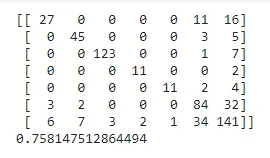
- tried different kernels and rbf returned high accuracy values.
program and data files are attached below.