Structural dynamics
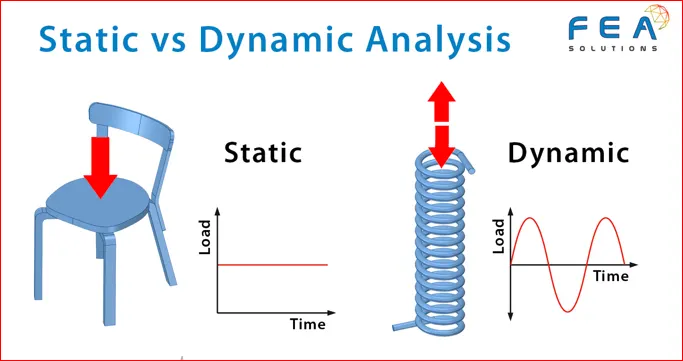
1. Differentiate Static analysis and Dynamic analysis by proper representing pictures
|
STATIC ANALYSIS |
DYNAMIC ANALYSIS |
|
|
|
|
|
|
|
|
2. Explain the following with the relevant force-displacement graph
- Elastic behavior
- Inelastic behavior
- Plastic behavior
- Non-linear Inelastic behavior
Elastic behavior
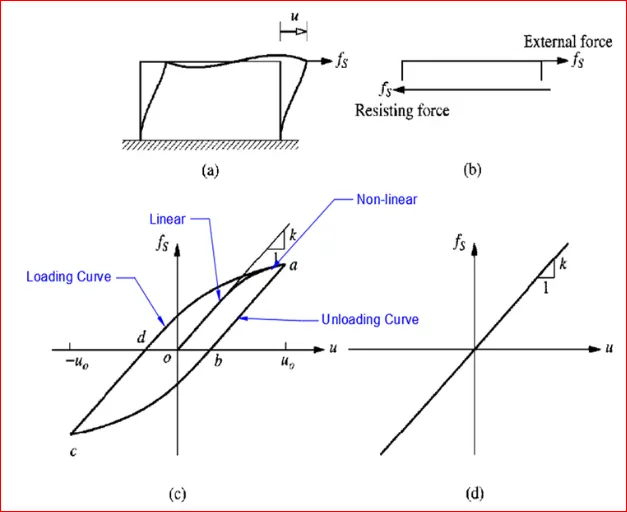
- The ability of a deformed material body to return to its original shape and size when the forces causing the deformation are removed. A body with this ability is said to behave (or respond) elastically. From the force-displacement graph at point O to a certain point, it shows a linear path, hence the body shows elastic properties at a certain limit with the forces applied.
Inelastic behavior
- The deformation of a material that does not disappear on the removal of the force that produces it. From the force-displacement graph, inelastic behavior corresponds to the nonlinear path. Inelasticity is experienced by the body as soon as the path goes out of the linear curve.
Plastic behavior
- The behavior of plastic structures beyond the bending collapse load is influenced by the changes in the geometry of a structure during the process of plastic deformation. In the present paper, an investigation of the load-deflection relationship for simply supported rectangular reinforced concrete plates is presented
Non-linear Inelastic behavior
- Materials have elastic behavior usually only up to a certain load, which is called the ‘yield point’. After that, the deformations are plastic. From the force-displacement graph, this behavior occurs when the line from point “O” tends to bend to point “a”.
3. Explain Mass, Stiffness & Damping components in the equation of motion
- The Single Degree of Freedom System is a combination of 3 pure independent systems such as the stiffness, the damping, and the mass component.
- The Stiffness Component – the frame without damping or mass. The external force fs on the stiffness component is related to displacement u by fs = Ku if the system is linearly elastic.
- The Damping Component – the frame with its damping property with no stiffness or mass. The external force on the damping component is related to velocity by FD = ců, where fd is the damping force, c is the viscous damping coefficient and ů is the velocity.
- The Mass Component – the roof mass without the stiffness or damping of the frame. The external force fi on the mass component is related to the acceleration by fi = mű
- Then, mű + fd + fs = p(t) --à mű + ců+ ku = p(t)
4. Provide the relationship between Natural period (Tn) & Natural frequency (f) and provide their definitions
- Natural period (Tn) – the vibration of the system (Tn) is the time required for the undamped system to complete one cycle of free vibration (Unit is in seconds). It is related to the natural circular frequency of vibration, ωn, in units of radians per second. With, Tn = 2π/ωn or ωn = 2π/Tn
- Natural frequency (f) - number of the cycle (or one complete revolution) executed by the system in one second with units in hertz. Where f=1/Tn
- Natural vibration properties ωn, Tn, and f depend only on the mass and stiffness of the structure.
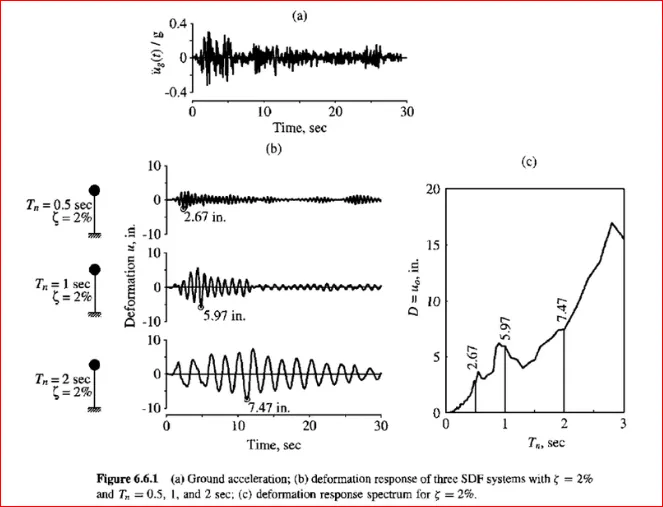
5. Explain in detail about Response spectrum & its Graph
- A response spectrum is a function of frequency or period, showing the peak response of a simple harmonic oscillator that is subjected to a transient event. The response spectrum is a function of the natural frequency of the oscillator and of its damping. Thus, it is not a direct representation of the frequency content of the excitation (as in a Fourier transform), but rather of the effect that the signal has on a postulated system with a single degree of freedom (SDOF).
- Response spectrum analysis is a method to estimate the structural response to short, nondeterministic, transient dynamic events. Examples of such events are earthquakes and shocks. Since the exact time history of the load is not known, it is difficult to perform a time-dependent analysis. Due to the short length of the event, it cannot be considered as an ergodic ("stationary") process, so a random response approach is not applicable either.
- The response spectrum method is based on a special type of mode superposition. The idea is to provide an input that gives a limit to how much an eigenmode having a certain natural frequency and damping can be excited by an event of this type.
The equation of motion for the mass can, if there are no external forces, be written as

Dividing by the mass, and using customary notation,

Here, the undamped natural (angular) frequency is

and the damping ratio is

For given values of
 ,
, , and
, and 
this equation can be solved for a sufficiently long time. The displacement, velocity, and acceleration response spectra are defined as the maximum values caused by the acceleration history