Structural dynamics
Answers-
1]
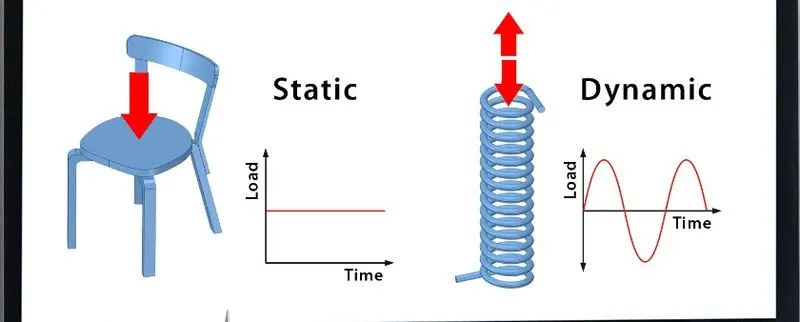
Static Analysis
-It is in linear state and does not vary with time
-It does not depend on time
-Static force does not change in sixe, position or direction
-In this inertia forces are produced due to their masses
-Example: Hydraulic lifting cranes, stone on ground, etc.
Dynamic Analysis
-It is acts as a non linear and does vary with time
-It is depenf on time
-Dynamic forces chnage in either size, postitin or direction
-In this inertia forces are considerd in the analysis
-Example:Earthquake, moving car, hammering a metal, etc.
2]
a.Elastic Behaviour-Ability of deformed matrrial body to return to its original shape and size when force causing the deformation are removed
Example:Rubber band. spring. etc.
b.Inelastic Behaviour-Deformatoion material that does not disappear on removal of force that produced it
Example:wood, fabric, etc.
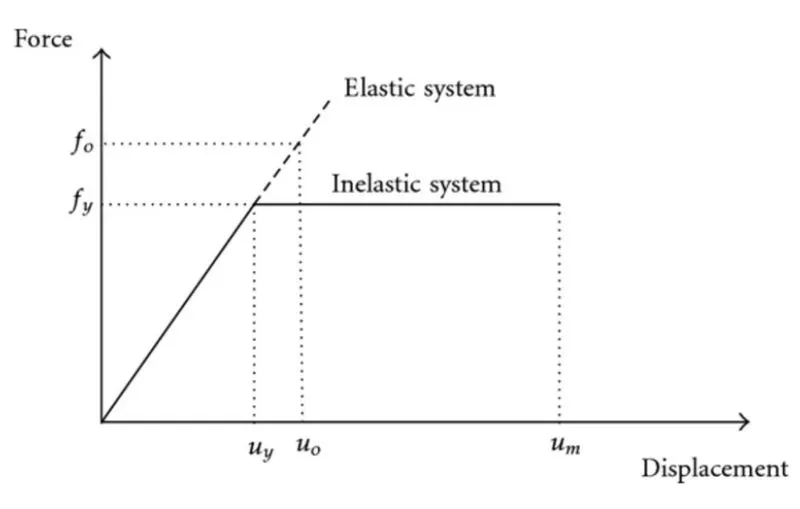
c.Plastic Behaviour-The material deforms irreversibly and does not return to its original shape and size even whe load is removed.
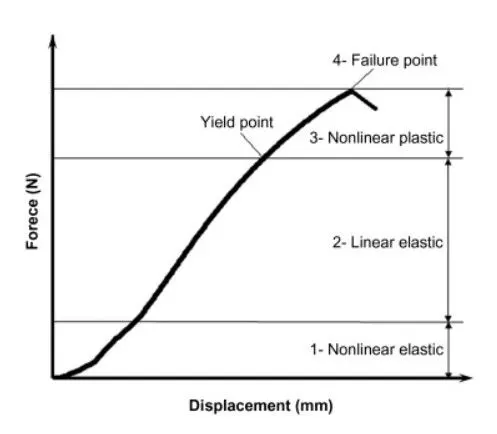
d.Non-linear elastic behaviour-Materials have elastic behaviour usually only upto a certain point after that deformation are plastic and relation in this is not linaer i.e. non linear elsatic behaviour.
3]Equation of motion
P-fs-fD=m*u(acceleration)
m*u+fD+fs=P(t)
m*u+c*u(velocity)+k*u=P(t)
where,
m-Mass
k-Stiffness
fD-Damping force
-Damping force is related to velocity across linear viscous damper by
fD=c*u c-viscous damping coeff u-velocity
Equation of motion:Earthquake excitation
m*u(acceleration)+c*u(velocity)+k*u=-m*ug(t)
4]
Natural Period(Tn):-Time required for undamped system to complete one cycle of free vibration.
-Unit is Seconds
Tn=2π/Wn
Natural Frequency(f):-Number of cycle (or one complete revolution) executed by system in one second
-Unit is hertz
f=1/Tn
Natural vibration properties Wn, Tn and f are depend only on mass and stiffness of structure.
5]
Response Spectrum-
-A plot of peak value of response quantity (u, v and a) as a function of natural vibration perod(Tn) of system is called Response Spectrum for that quantity.
-Pseudo acceleration for an SDF system with natural frequency is related to its peak deformation, D=uo
due to earthquake ground motion
A=(Wn)
=(2π/Tn)
-Steps involve in construction of Response Spectrum
Step1-Numerically define ground acceleration
Step2-Select natural vibration period and damping ratio at SDF system
Step3-Compute deformation rsponse of this SDF system due to ground motion
Step4-Determine uo, peak value u(t)
Step5-Spectral ordinates are D=uo, V=(2π/Tn)*D and A=(2π/Tn)