Structural dynamics
AIM-:1. Differentiate Static analysis and Dynamic analysis
Ans.-
| Static Analysis | Dynamic Analysis |
| static analysis time invariant analysis of forces like Stress, strain and displacement etc. | Dynamic analysis is time dependent analysis |
| The results are a consequence of the applied constraints and loads, for example, bearings, gravity, forces, etc. | Inertia and damping forces taken into account |
| Static loads applied on structure slowy | Dynamic Loads applied on the structures Suddenly |
| Example- Dead Load , Live load | Example- Earthquake load , Wind Load |
| Static analysis done with minimum three degree of freedom | Dynamic analysis of structure done with single degree of freedom |
| Static analysis done where the structure deformations behave linear | Dynamic analysis done where structure behaves non-linear deformations |
.In dynamic analysis we assume the mass is concentrated at a point with single degree of freedom as see in below picture
Ans 2.
AIM-
Elastic behavior
For the linear system relation between static force and displacement is linear
That is
fs=ku where K is lateral stiffness of the structure
and u is Displacement
the loading and unloading curves are identical such the system is said to be linear elastic
\
Conside the frame a with shown parameters L,h,E and second moment of area about the axis of bending
when the flexural rigidity of Beam is infinty
k=
=
if stiffness of the beam is Zero of no stiffness
EIb=0
Inelastic Behaviour
Determined by experiments, the force–deformation relation for a structural steel component
undergoing cyclic deformations expected during earthquakes.
The initial loading curve is nonlinear at the larger amplitudes of deformation, and the un-
loading and reloading curves differ from the initial loading branch; such a system is said
to be inelastic. This implies that the force–deformation relation is path dependent, i.e., it
depends on whether the deformation is increasing or decreasing.
Plastic Behaviour of structure
Plastic behiviour known as permanent deformation after that member can not attains its original shape or position of deformation or displacement
Non-Linear Inelastic behaviour
Force displacement relation Becomes Non-linear and inelastic at large deformations
For fs corresponding to the deformation is not single valued and depends on history of deformations and whether deformation is increasing or decreasing thus the resisting force can be expressed as
fs=fs(u,v)
Ans.3
AIM-:Explain Mass, Stiffness & Damping components in the equation of motion
Single degree of freedom system can be viewed as combination of three pure independent system
The stifffness component- ; the frame without damping or mass , the external forces fs on the stiffness componenet is relaed to displacement by u by fs=ku if the system is linearly elastic
The Damping component -: the frame with its damping property but no stiffness or mass the external force on the damping component is related to velocity by fd=cv
The mass component = The roof mass without the stiffness or damping of the frame the external force fi on the mass component is related to acceleration by fi=mu
Ans 4
AIM-Provide relationship between Natural period (Tn) & Natural frequency (f) and provide their definitions
Natural period (tn)-The time required for the undamped system to complete one cycle of free vibration natural period of vibration of the system, which we denote as Tn in units of sec It is related to the natural circular frequency of vibration, ωn in units of radians per second
Tn=2π/ωn
A system executes 1/Tn cycles in 1 sec. This natural cyclic frequency of vibration is denoted by
fn=1/Tn
Ans 5
Aim- Explain in detail about Response spectrum & its Graph
Response spectrum analysis is a method to estimate the structural response to short, nondeterministic, transient dynamic events. Examples of such events are earthquakes and shocks. Since the exact time history of the load is not known, it is difficult to perform a time-dependent analysis.
A response spectrum is a function of frequency or period, showing the peak response of a simple harmonic oscillator that is subjected to a transient event. The response spectrum is a function of the natural frequency of the oscillator and of its damping. Thus, it is not a direct representation of the frequency content of the excitation (as in a Fourier transform), but rather of the effect that the signal has on a postulated system with a single degree of freedom (SDOF)
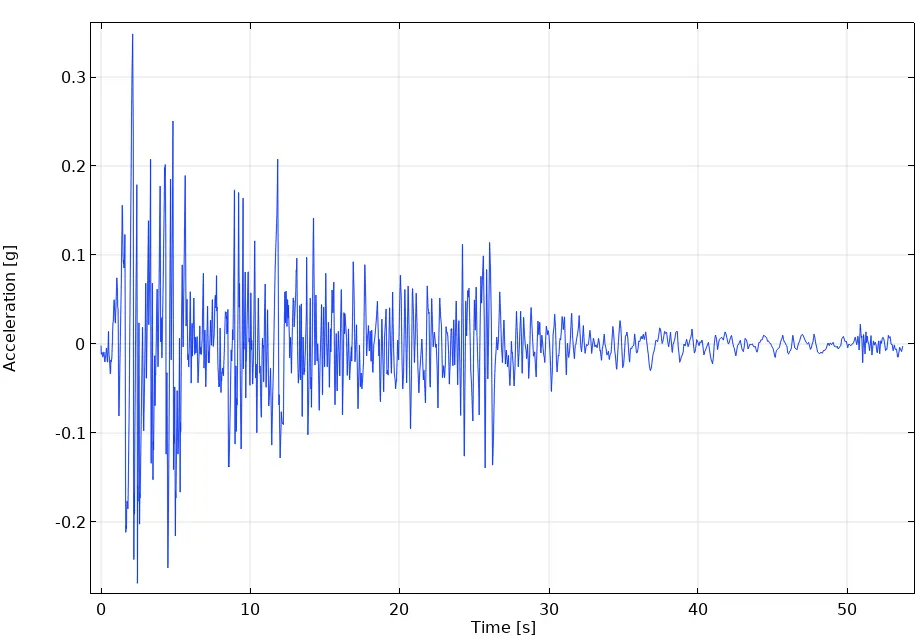
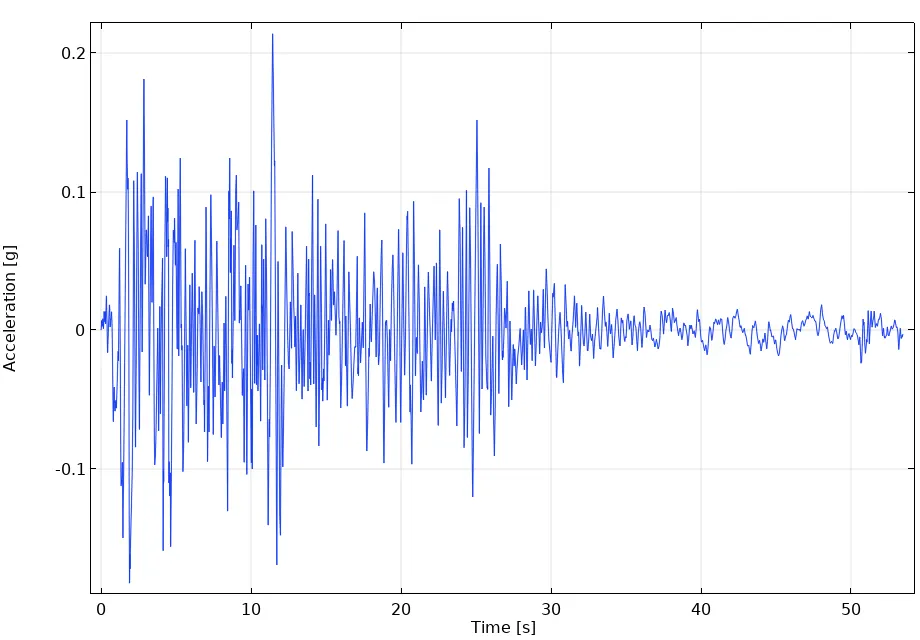
Example The El Centro Earthquake
One of the most studied earthquake recordings is that of the "El Centro" earthquake on May 18, 1940. Recorded signals (with some filtering) are shown below