Structural dynamics
1. Differentiate Static analysis and Dynamic analysis with proper representing pictures (30 marks)
Static analysis
- Represents all possible states and transition in all possible case proceedings
- superset of ideal model generalization upper bound
- conservative analysis detects illegal states and transitions
- Assume that an exception will be produced on an illegal input
Dynamic analysis
- Represents one particular case proceeding
- subset of ideal model specialization lower bound
- proof of existence and reachability analysis detects legal states and transitions
- Global state of space results in state space explosion

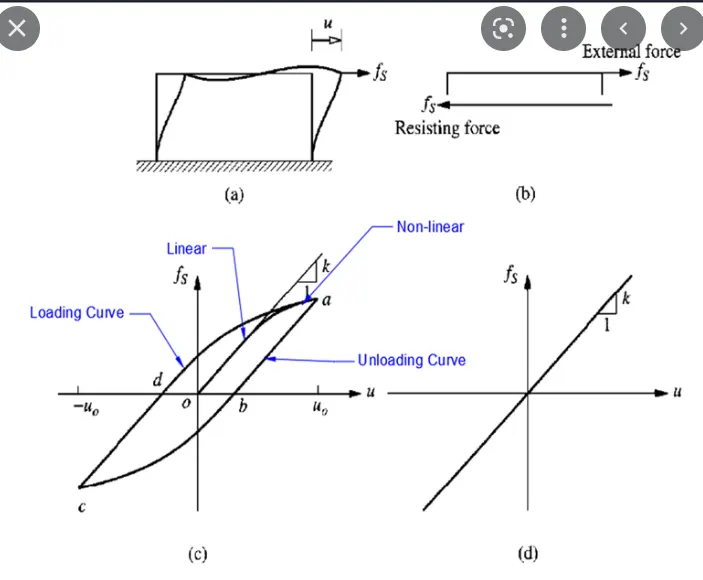
2. Explain the following with relevant force-displacement graph (40 marks)
- Elastic behavior
- Inelastic behavior
- Plastic behavior
- Non-linear Inelastic behavior
- Elastic behavior
Elastic behaviour can be defined as the ability of a component to return to its original shape when an application of external loading is removed. The explanation is that any component under loading like compression or tension loses its original shape and tends act according to the load and when the load is removed the component restores to its original shape when the loading is removed.For linear system force can be expressed as fs=ku where k is lateral stiffness constant.
- Inelastic behavior
Inealstic behaviour of materials is defined as the inability of the material to return to its original shape when the load is removed and tend to be in the deformed shape.The material undergone deformation acts opposite to elastic behaviour hence, called as inelastic behaviour.
- Plastic behavior
The property of the material which has the deformed shape and permanent strain in it when the loading is removed is called the plastic behaviour of structure. The plastic behaviour of the structure occurs beyond the yield point of the structure and the deformation is irreversible even when the loading is removed. It occurs beyond point 'a' after unloading as represented in the curve.
- Non-linear Inelastic behavior
When large deformations occur at the material, the force displacement relationship of the material becomes non linear. Force corresponding to displacement is not single valued in non linear behaviour and depends on the history of deformations of the material. For non linear system force can be expressed as fs=fs(u,v). The bend from O to a represents the non linear.
3. Explain Mass, Stiffness & Damping components in the equation of motion (30 marks)
The equation of motion in single degree of freedom system consists of three indepenedent system components acting on the frame.
Mass component: The mass componenet in equation of motion considers only the mass of the frame and stiffness and damping are considered to neglected. The force is related with mass component with the equation of fi=mu¨.
Stiffness component: The rigidity of the material to resist deformation is called as the stiffness and in this component only stiffness is considered in the frame and other mass and damping components are neglected. The force is related with stiffness componet with the equation of fs=ku.
Damping component: Damping is the dissipiation of energy due to vibrations over time and distances. It occurs due to the friction between structural and non stuctural elements. The force is related with damping component with the equation of fd=cu˙
mu¨+ fd + fs = p(t) that is mu¨ + cu˙ + ku = p(t)
where,
p(t) is the external force.
4. Provide relationship between Natural period (Tn) & Natural frequency (f) and provide their definitions (25 marks)
Natural period: The time taken for undamped system to complete one cycle of free vibration is called as the natural period of vibration and it is denoted by the formula Tn = 2π/ωn and the unit is seconds.
Natural frequency: The frequency or rate that it vibrates naturally when disturbed. Objects can possess more than one natural frequency and we typically use harmonic oscillators as a tool for modeling the natural frequency of a particular object
fn=1/Tn.
5. Explain in detail about Response spectrum & its Graph (25 marks)
Response spectrum:
- It is a central concept in earthquake engineering, response spectrum is a practical means of characterizing ground motions and their effects on structures of different Tn
- It provides a convenient means to summarize the peak response of all possible linear SDF systems to a particular component of ground motion
- It also provides a particular approach to apply the knowledge of structural dynamics to the design structures and development of lateral force requirements in building codes
- A plot of the peak value of a response quantity (u,v and a) as a function of the natural vibration period Tn of the system,is called the response spectrum for that quantity
- Each such plot is for SDF systems having a fixed damping ratio ζ and several such plots for different values ζ are included to cover the range of damping values encountered in actual structures
- The response spectrum can be of 3 types , the deformation response spectrum is a plot of peak u, against Tn for fixed ζ . A similar plot for peak ú, is the relative velocity response spectrum, and for peak üT ,is the accelaration response spectrum