Structural dynamics
- Differentiate Static analysis and Dynamic analysis with proper representing pictures
Static analysis and Dynamic analysis
- Billions of loads with time
- Motion cannot be disregarded
- Two additional forces must be accounted
- Inertia forces
- Damping forces
- Structural such as pergola and water tank
- This can be idealized as a concentrated mass M supported by a massless structure with lateral stiffness key in the lateral direction
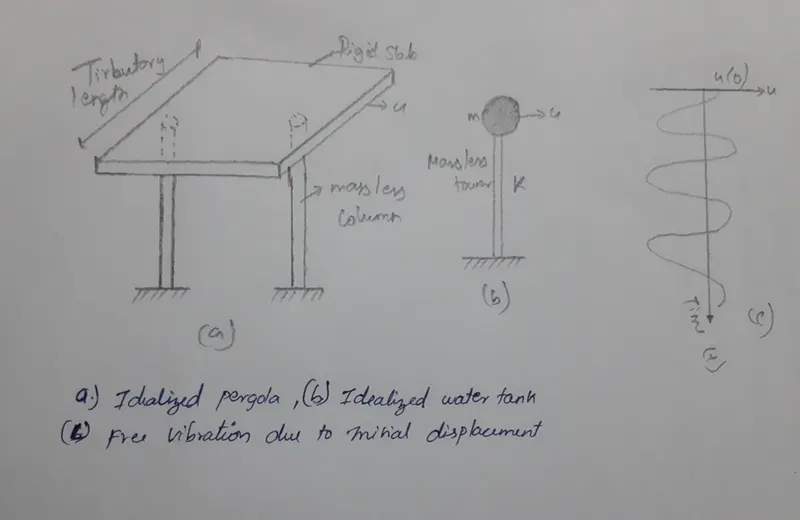
- The different equation governing the lateral displacement u(t) of these idealize structure without any external exhibitions (or free vibration) is
mu + ku = 0
- The solution of the upper equation is simple harmonic motion
- There are two forces participating in the EOM
- In reality, damping forces exist, leading to an ever decreasing amplitude and eventually coming to rest
- System consisting of Mars YM stiffness K and the viscous damper
- An idealization of one story structure
- The number of independent displacements required to define the displaced position of all the mass relative to their original position is called the number of degree of freedom DOFs the dynamic analysis
- What is the difference in the DOFs in the dynamic analysis vs DOFs in static analysis?
- More DOFs art typically necessary to define the stiffness property of a structure compared to DOFs necessary for dynamic analysis
- Explain the following with relevant force-displacement graph
- SDOF system subjected to externally applied static force with no dynamic excitations
- What is the relationship between the force fs and the relative displacement u?
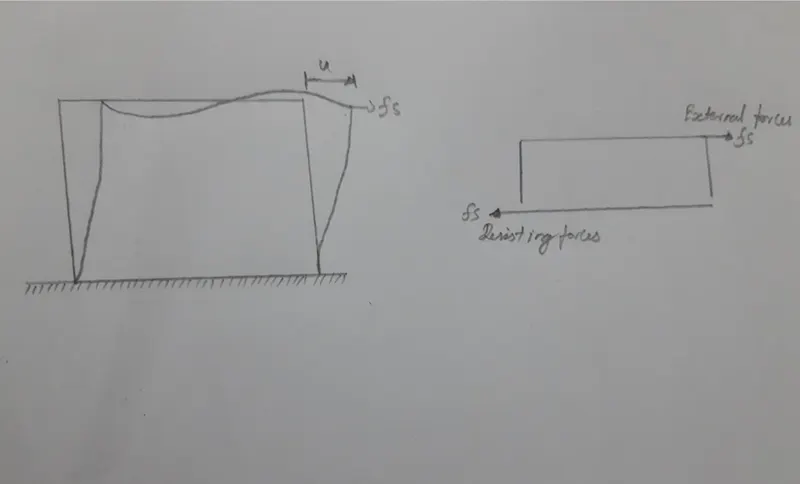
- For a linear system the relationship between the lateral forces fs and resulting deformation u is linear, that is,
fs=ku
where K is the lateral stiffness of the system, its unit are force / length
a. Elastic behaviour
b. Inelastic behaviour
c. Plastic behaviour
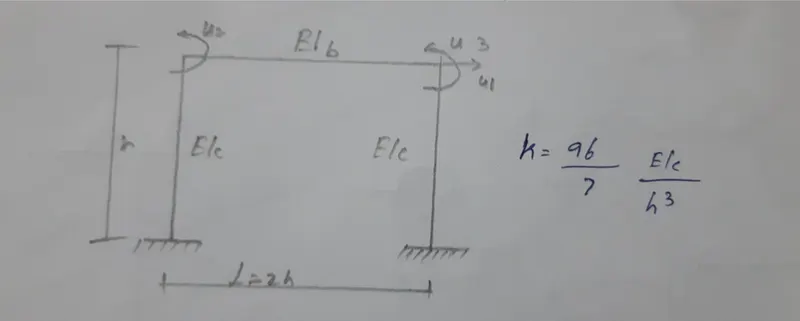
- Consider the frame below with L height H Elastic Modulus E and second moment of the cross sectional area about the axis of bending is equal to lb and lc the beam and the column respectively ; columns are fixed at the base
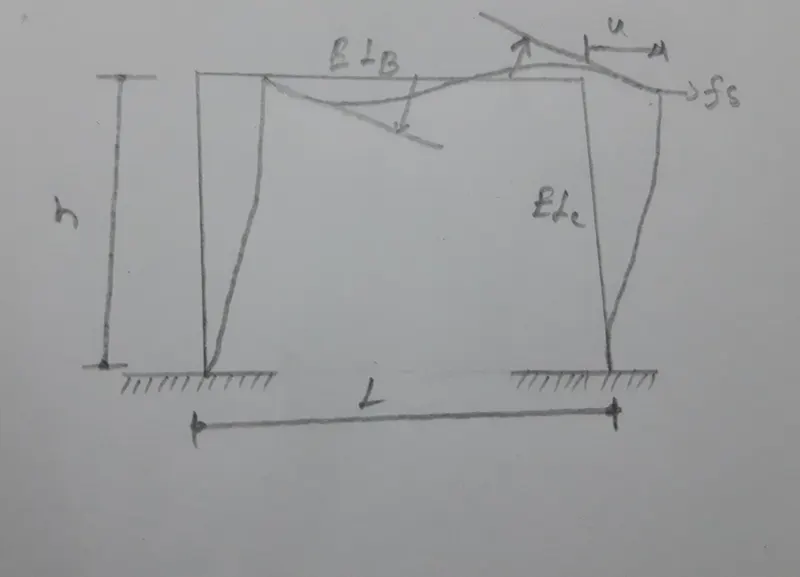
- The lateral stiffness of the frame can be rigidly readily by determining for the two extremes cases; if the beam is rigid (i.e., with the flexural rigidity Elb = infinity) and for a beam with no stiffness (i.e., Elb = 0)
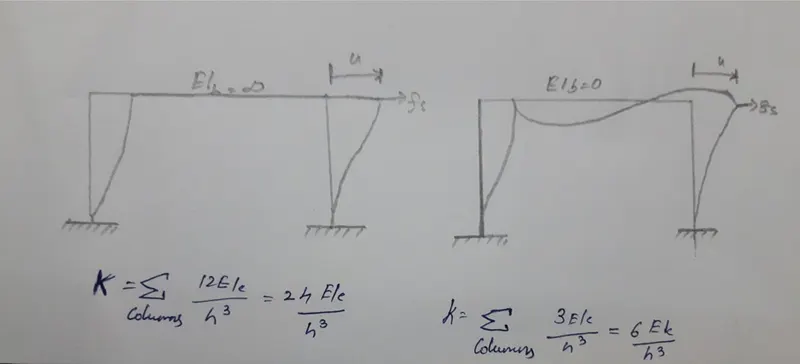
- Computer lateral stiffness of the frame with an intermediate relaxed stiffness of the beam Assumed L = 2h & Elb equals Elc
d. Non-linear Inelastic behaviour
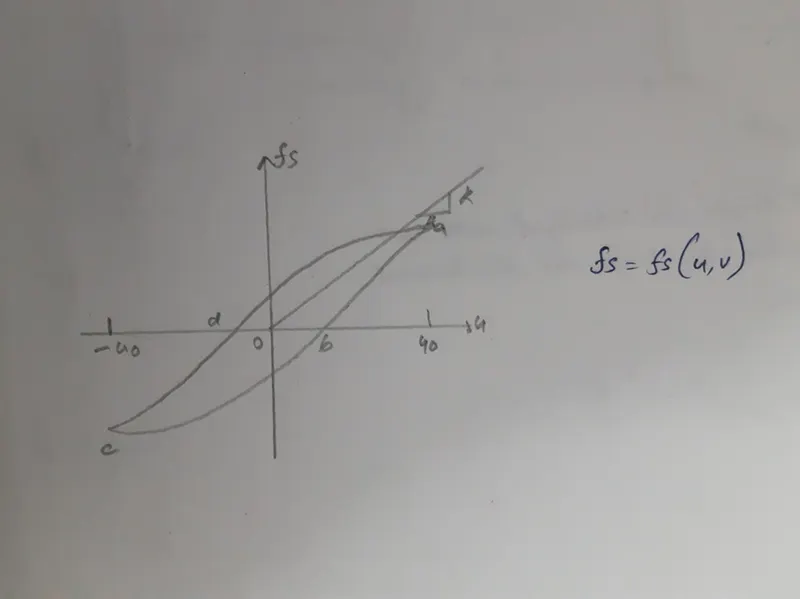
- Sports displays on relationship becomes nonlinear and inelastic at large deformation
- Force FS corresponding to deformation is not single valued and depends on history of deformation and whether deformation is increasing or decreasing. Thus the resisting force can be expressed as:
- Explain Mass, Stiffness & Damping components in the equation of motion
- Which dumping is evidence from the steady decline in amplitude of vibrating body
- Source of damping in vibration structures
- Friction at steel connections
- Opening and closing of micro cracks in concrete
- Friction between the structure and non-structural and immense such as partition walls
- Damping in structures is represented in all idealized manner called equivalent viscosity
Mass, Stiffness & Damping components
- The SDOF system can be viewed as a combination of three pure, independent system
- The system components; the frame without damping or Moss the external force FS on the stiffness component is related to the displacement U by fs = ku , if the system is linear elastic
- The damping components; the frame with its damping property but no stiffness or moss the external force on the damping component is related to velocity by fd = cv
- The mass component; the roof mass without the stiffness or damping of the frame. The external force fi on the mass component is related to the acceleration by fi = mu
- Provide relationship between Natural period (Tn) & Natural frequency (f) and provide their definitions
- Central concept in earthquake engineering, response spectrum is an practical means of characterization crown motions and their effects on structures of different Tn
- it provides a convenient means to summarize the peak response of all possibilities linear SDF system to a particular component of good motion
- it is also provide a particular approach to apply the knowledge of structural dynamics to the design of structures and development of lateral force requirements in building codes. (How?
- a plot of a peak value of a response quality u,v, and a as a function of the natural vibration. Tn of the system, is called the response spectrum for that quantity
- each such plot is the for SDF system having a fixed damping ratio and several such plot for different values of are called included to cover the range of damping values encountered in actual structures
- the response spectrum can be the of three types the deformations
- response spectrum can be of 3 types, the deformation response spectrum plot of peak u, against tea and for fixed. A similar plot for a peak you is the relative velocity response spectrum And for a is acceleration response spectrum.
- Explain in detail about Response spectrum & its Graph
- Step – 1 – numerical define the ground acceleration ug(t) difficult the ground version ordinates are defined every 0.02 seconds
- Step – 2 – select and natural vibration. Tn and damping ratio of SDF system
- Step – 3 – computer deformation response UT of the SDF system due to the Gaurav motion ug(t)
- Step – 4 – determine you the peak value of u(t)
- Step – 5 – the spectral ordinates are D=u0’ V= (2∏/Tn) D, and A=(2∏/Tn)2 D