Steady Vs Unsteady flow over a cylinder
Objectives:
- Simulate a steady and unsteady flow over a cylinder for a Reynold's number 100 and find the Strouhal Number in the latter case
- Simulate the flow over a cylinder for different values of Reynold's number and calculate the coefficient of Drag and Lift
- Analyze and discuss the effect of Reynold's Number on coefficient of Drag and Lift
Theory:
Whenever a bluff body (a bluff body is one which seperates the stream lines of the incoming flow and does not allow them to meet at the body's end) obstructs the flow of a fluid which is flowing with a sufficiently high Reynold's number, boundary layer starts to form along the surface of the body in the direction of flow. This boundary layer gets seperated when the direction of pressure gradient changes (which happens due to increase in cross sectional area of the flow) or when the direction of velocity gradient in the vertical direction changes.
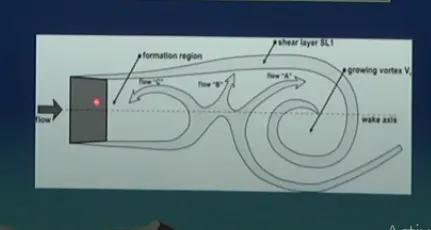
The shear layer or boundary layer from the other side of the body splits into three, which happens because some part of the flow gets sucked in behind the body (due to negative pressure gradient) and some part of the shear layer gets sucked into the previously formed vortex (the centre of a vortex has very low pressure) and this layer has direction opposite to the direction of vortex and hence decreases its circulation or strength of the vortex. The other part of the flow joins with the previously formed shear layer and succeeds in seperating the flow. The vortex is now free and goes with the flow at a velocity less than the velocity of the flow. The first shear layer which formed the vortex behind the body increases its circulation and the process repeats.
This phenomenon, which is called as Vortex shedding, can be understood clearly in the figure below,
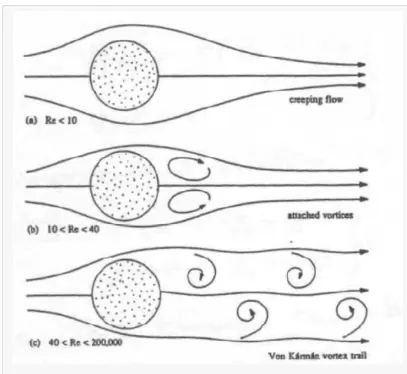
At values of Reynold's number less than 10, the stream lines, which are split apart by the body are connected behind the body in the downstream as the boundary layer will not be seperated. At values close to 40, the boundary layer is seperated and vortices does form, but are not shed and stay attached to the body. At values of Reynold's number greater than 40, the vortices are shed and the move along with the flow. Notice that even though the flow is laminar, vortex shedding does happen, which implies that voretx shedding is independent of whether the flow is laminar or turbulent. It only depends on boundary layer seperation. This can be visualised in the image below,
A force is applied on the body every time a vortex is shedded and the vertical component of this force is called as Lift Force and the horizontal component of this force is called as Drag Force. Vortex shedding induces further drag on the body by creating a adverse pressure gradient behind the body. The dimensionless form of Lift Force is called as Coefficient of lift and the dimensionless form of Drag Force is called as coefficient of drag.
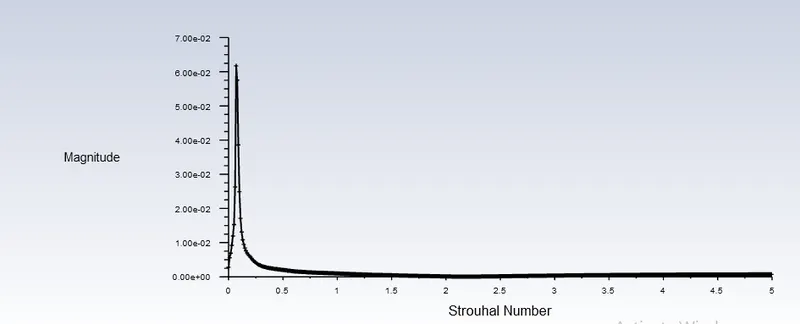
Because there are alternate formation of vortices, and when the frequency of these alternate vortex formations is equal to the natural frequency of the body, the body starts to oscillate as well. The non dimensional form of this frquency of oscllation of the body is called as Strouhal Number.
Strouhal number = `(f*D)/U`
Where,
f is the frequency of vortex shedding (Hertz)
D is the diamter of the body (in case the body is a cylinder) (mts)
U is the fluid flow velocity (mts/sec)
Introduction:
In this project, a fluid flow past a circular object is simulated for different Reynold's numbers and plots are plotted and analyzed for Strouhal Number, coefficient of drag and coefficient of lift.
To control the value of Reynold's Number, the value of coefficient of viscosity is changed.
Flow charecteristics and fluid properties are,
Inlet velocity = 1 `(mt)/(sec)`
Density = 1 `(kg)/(mt^3)`
The geometry is as follows,
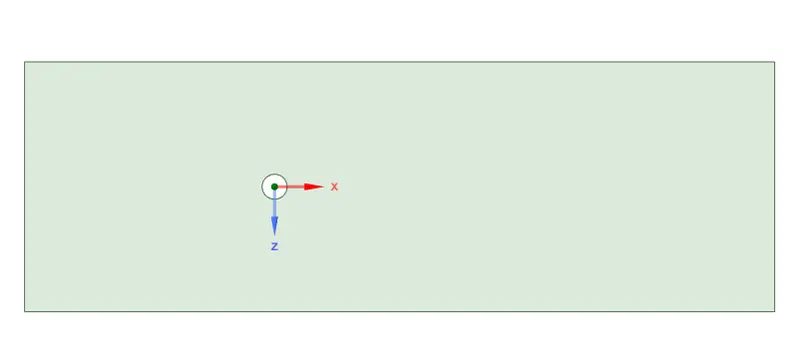
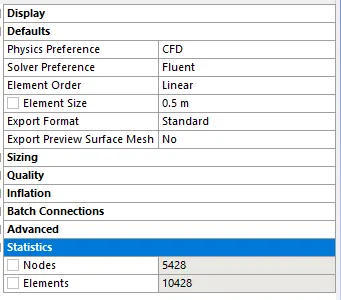
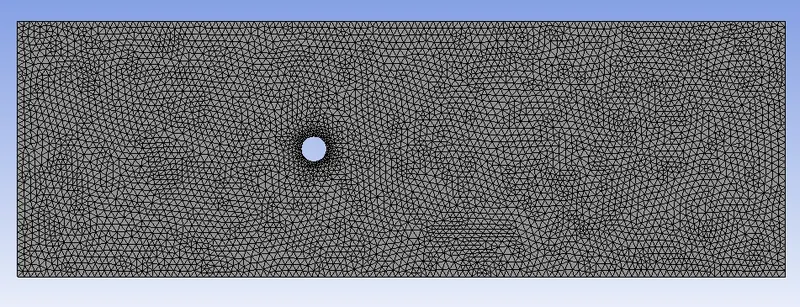
Geometry and mesh characteristics are same for all cases. The mesh characteristics and the meshed geometry are,
Part 1:
STEADY CASE:
The Reynold's number for this part is considered to be 100. It is controlled by changing the value of coefficient of dynamic viscosity. The simulation is done by considering the flow to be steady and unsteady.
The value of viscosity to maintain the Reynold's number 100 is 0.02 Pascal Second. The initialization method used is Hybrid initialization. The solution method used is SIMPLE. Simulation is done for 500 iterations.
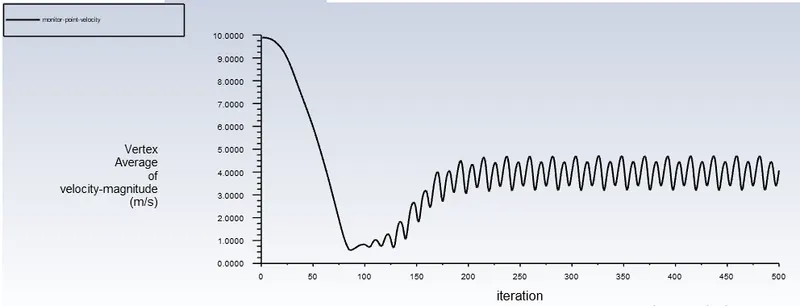
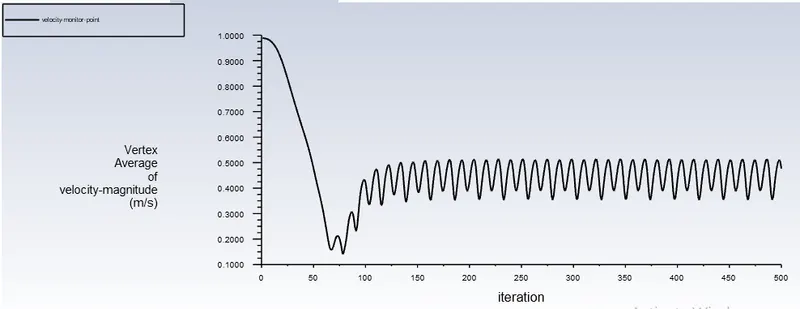
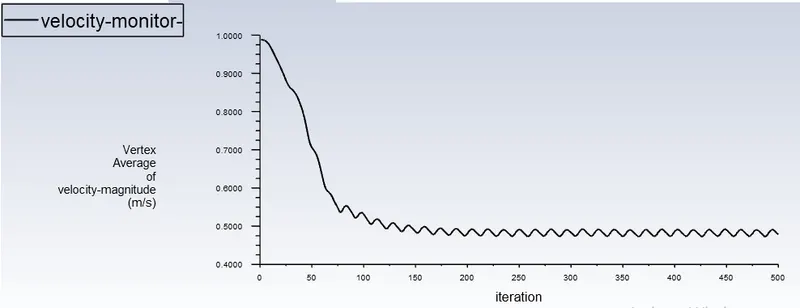
A monitor point is created at 8 mts from the centre of the body. The magnitude of velocity is plotted with respect to the number of iterations at this point.
A. Velocity magnitude at monitor point:
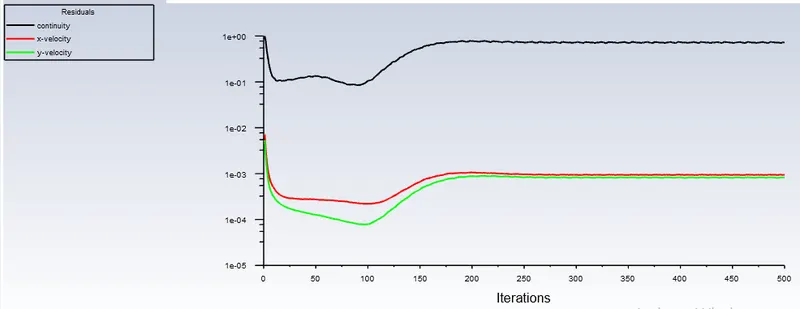
B. Residual plots:
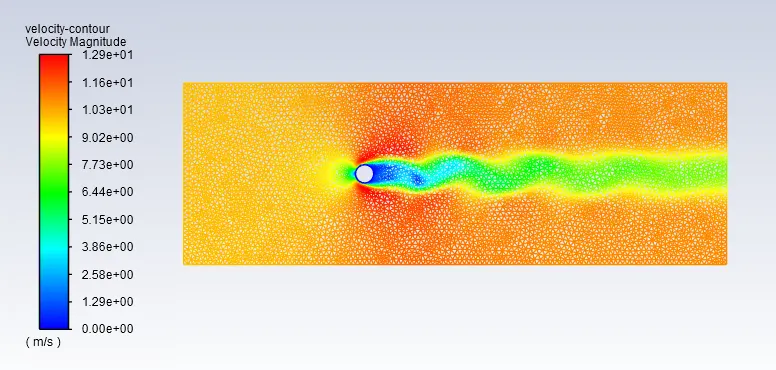
C. Velocity contour:
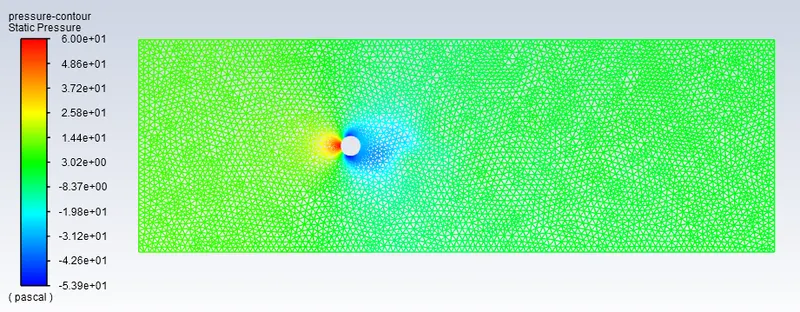
D. Pressure contour:
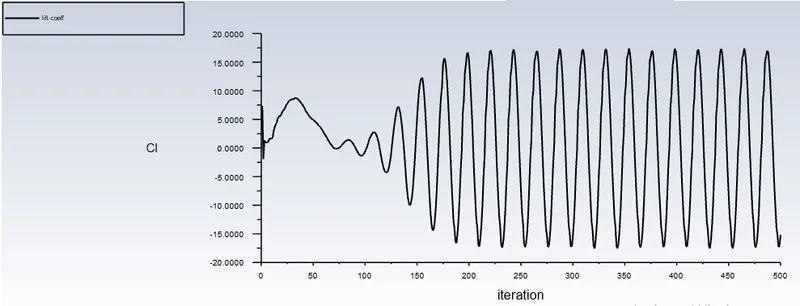
E. Lift coefficient:
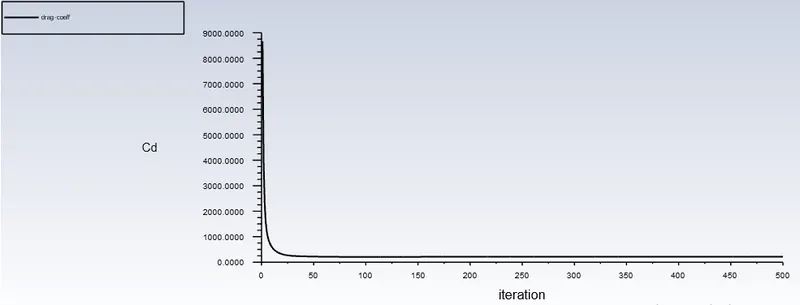
F. Drag coefficient:
NOTE: Strouhal number cannot be calculated as it is a steady state analysis and Strouhal number is a dimensionless form of frequency, which is a function of time
UNSTEADY CASE:
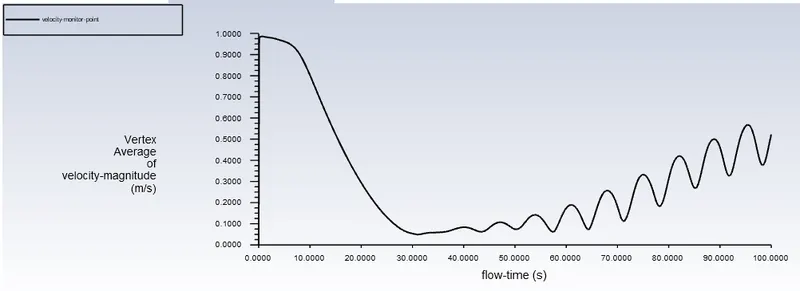
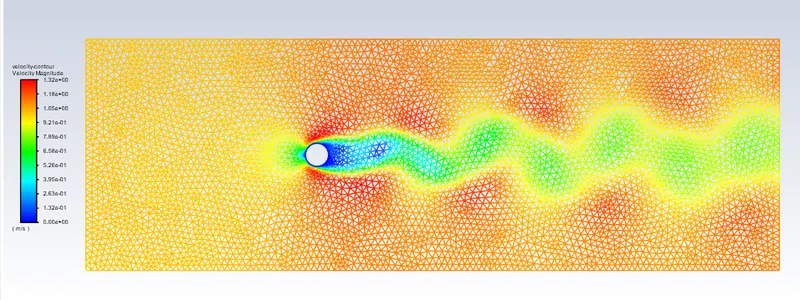
In this simulation, the fluid characteristics are considered to be changing with time and the time step size is 0.1 and the number of time steps is 1000. Iniitialization done is STANDARD initialzation and the solution method used is SIMPLE. A monitor point is created at 8 mts from the centre of the cylinder.
A. Velocity magnitude at monitor point:
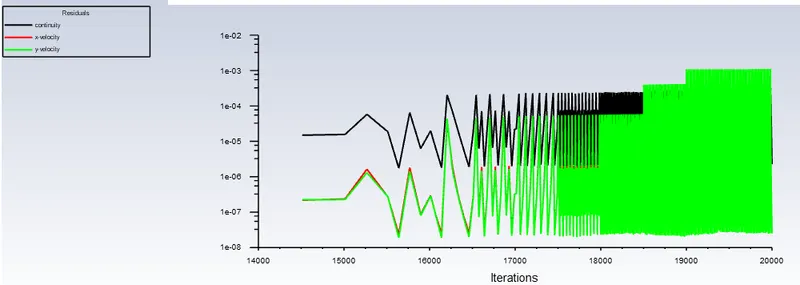
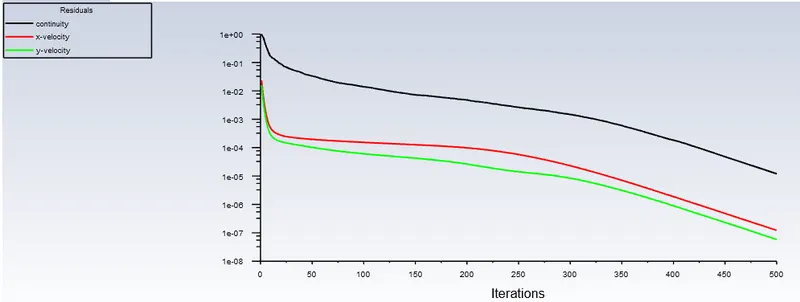
B. Residual plots:
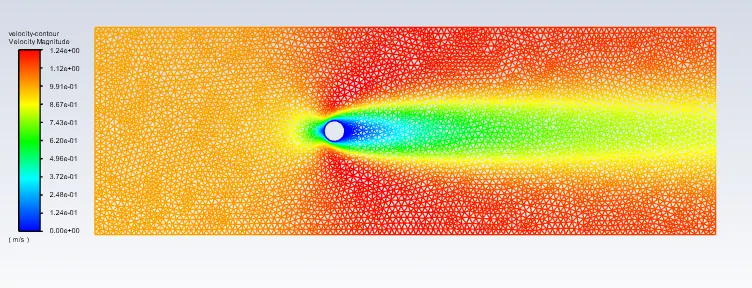
C. Velocity contour:
D. Pressure contour:
E. Strouhal number:
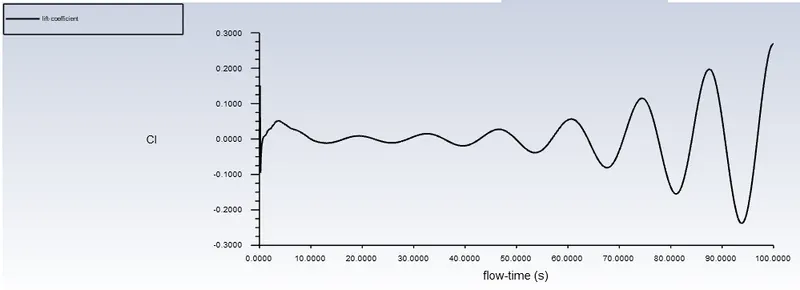
F. Lift coefficient:
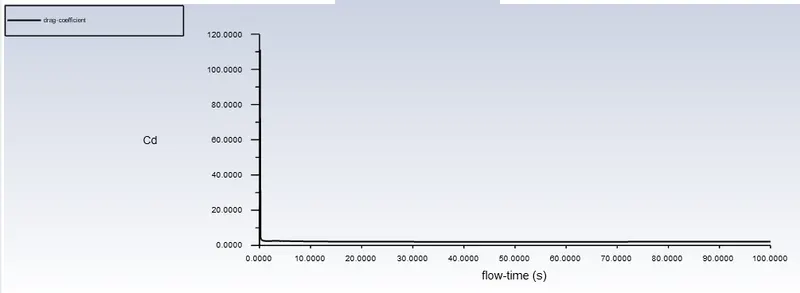
G. Drag Coefficient:
After doing a Fast Fourier Transform analysis, which converts the data into frequency domain, the maximum value of Strouhal number, which is the dimensionless form of frequency is found to be 4.9950051e+00.
Inferences:
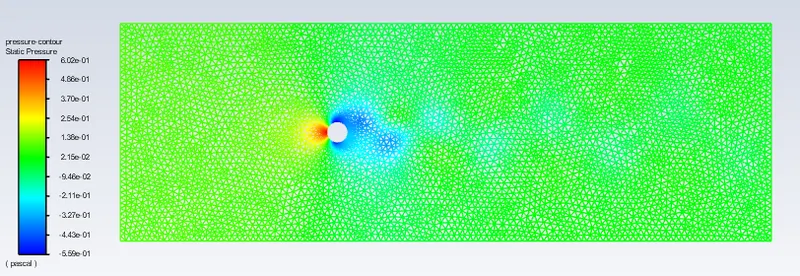
- There is a negative pressure gradient right behind the body because of seperation of boundary layer. This negative pressure gradient induces vortices, which are later shed for the reasons mentioned above
- In case of steady case, the "wave nature" in the plot of coefficient of lift has reached a steady state and the amplitude has remained constant. This implies that the system has been converged
- In case of unsteady case, the "wave nature" in the plot of coefficient of lift kept on increasing as the time progresses. The values of residuals too are increasing constantly
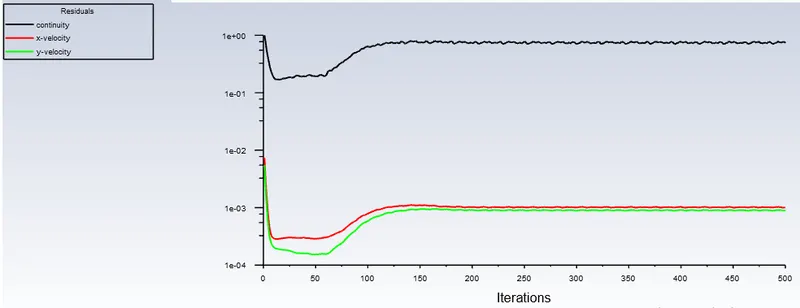
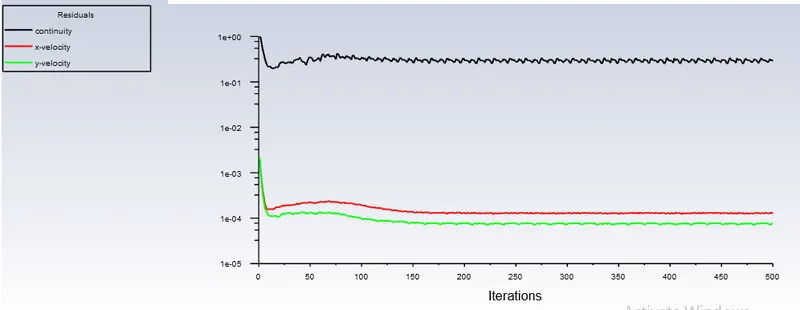
- In case of steady state, the residuals have flattened at around 200 iterations, which implies that the equations are solved and the values of fluid characteristics aren't going to change
Part 2:
In this part the simulation is done for steady state for different values of Reynold's numbers, 10, 100, 1000, 10000, 100000. Values of coefficient of Drag and coefficient of Lift are found.
The meshed geometry is same as above and the mesh characteristics are also same. The Reynold's number is controlled by changing the value of coefficient of viscosity like in part 1.
FOR REYNOLD'S NUMBER 10:
A. Residuals:
B. Velocity contour:
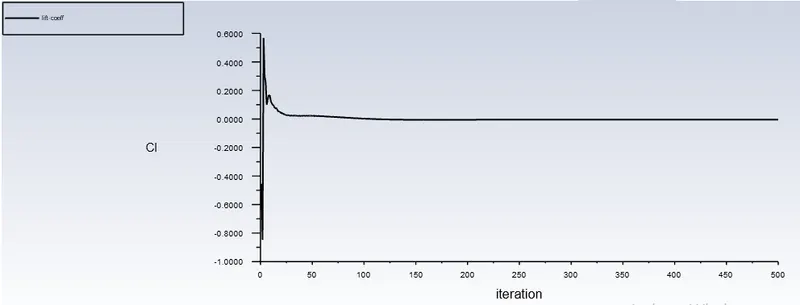
C. Lift coefficient:
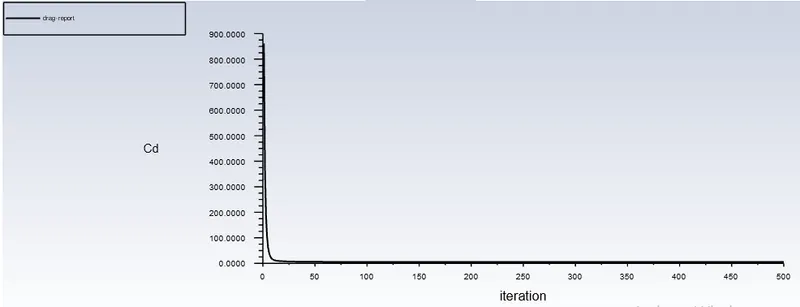
D. Drag coefficient:
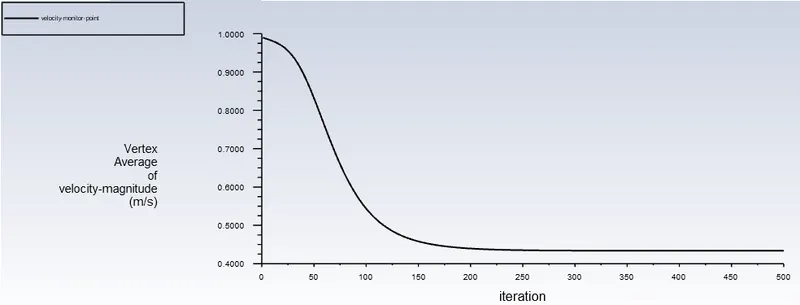
E. Monitor point velocity:
The value of coefficient of drag after the system has reached steady state is 5.393478536272687. The value of coefficient of lift is -0.004721263010476359.
FOR REYNOLD'S NUMBER 100:
A. Residuals:
B. Monitor point velocity:
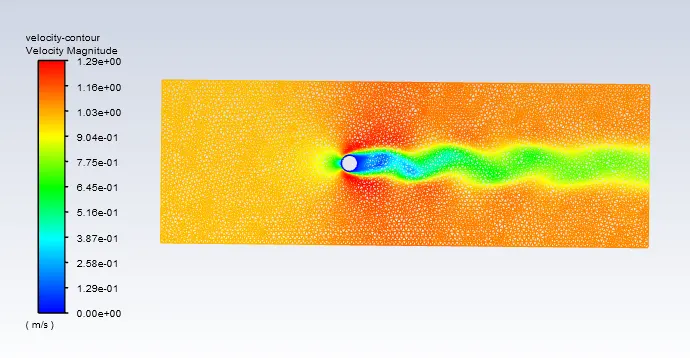
C. Velocity contour:
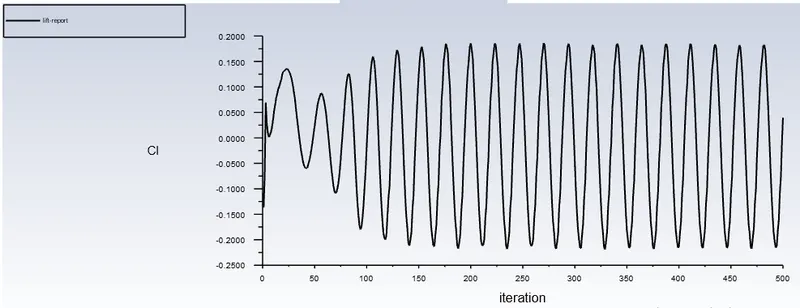
D. Coefficient of Lift:
E. Coefficient of Drag:
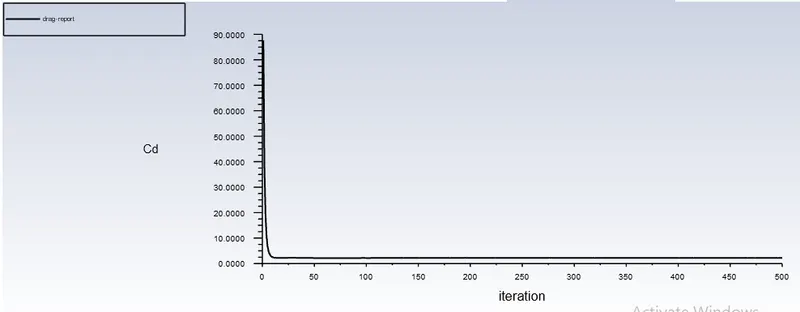
The value of coefficient of drag after the system has reached steady state is 2.186415970449588. The maximum value of coefficient of lift is 0.1857904708732027 and the minimum value of coefficient of lift is -0.2115761332659406.
FOR REYNOLD'S NUMBER 1000:
A. RESIDUALS:
B. MONITOR POINT VELOCITY:
C. COEFFICIENT OF LIFT:
D. COEFFICIENT OF DRAG:
E. VELOCITY CONTOUR:
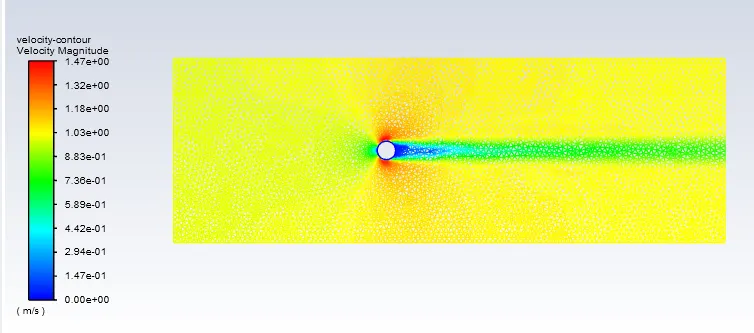
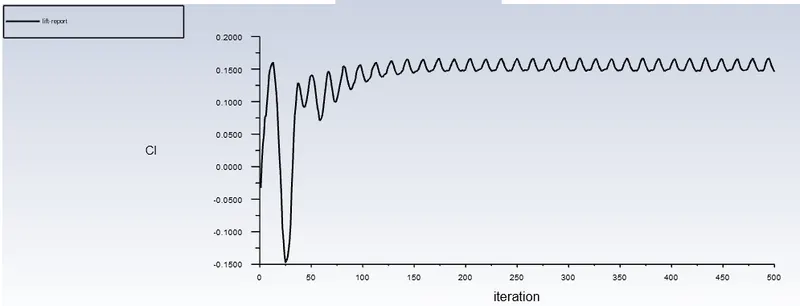
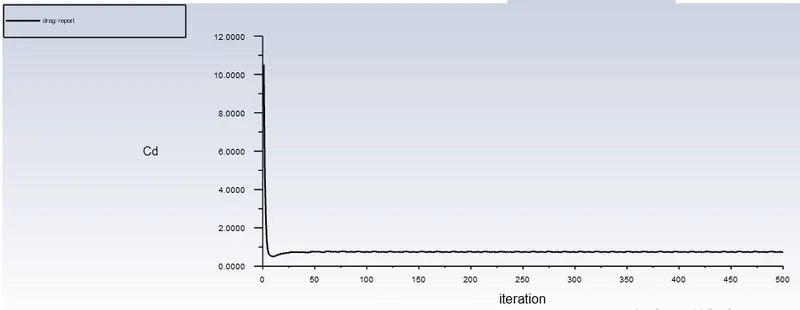
The value of coefficient of drag, after the system has reached steady state is 0.7327495614828072 and the maximum and minimum values of coefficient of lift are 0.1659044827410296 and 0.1462276965876435 respectively.
FOR REYNOLD'S NUMBER 10000:
A. RESIDUALS:
B. MONITOR POINT VELOCITY:
C. COEFFICIENT OF LIFT:
D. COEFFICIENT OF DRAG:
E. VELOCITY CONTOUR:
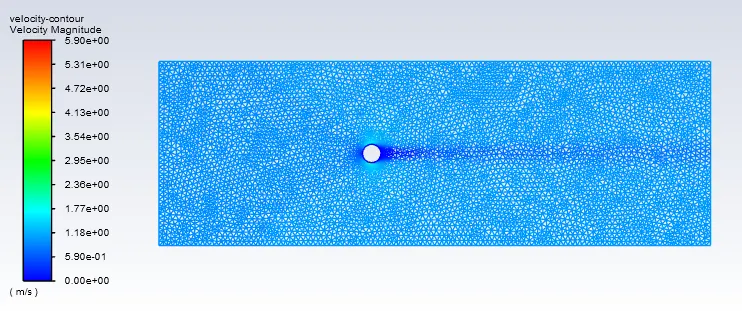
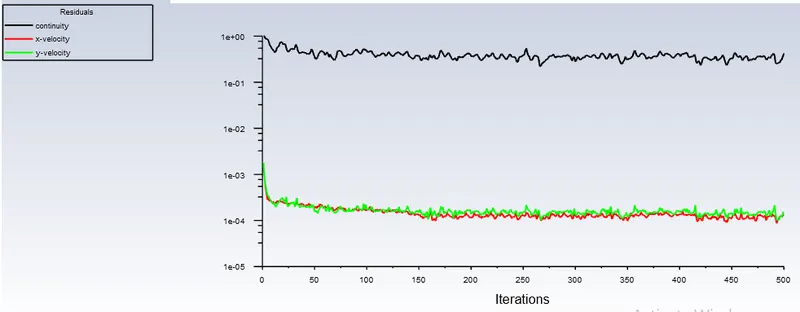
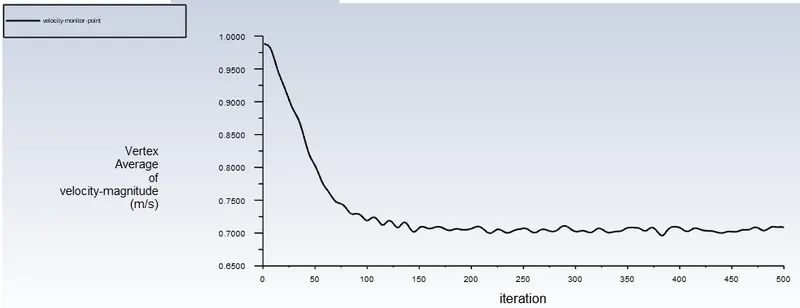
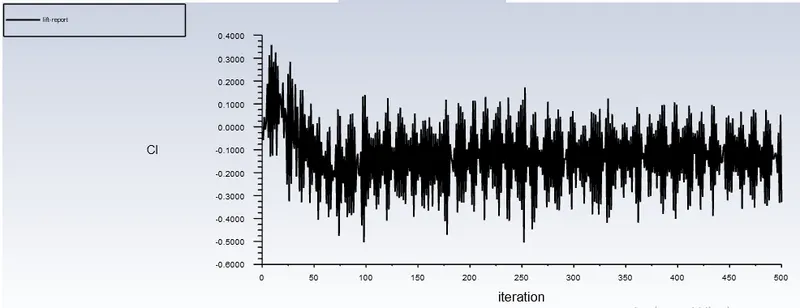
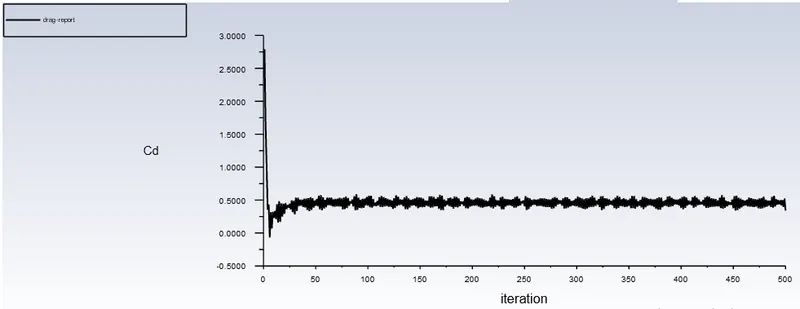
As the value of Reynold's number is large, even though the system has reached steady state, there is fluctuation in the value of coefficient of drag, and the maximum and minimum values are, 0.5248325021238236 and 0.3414972210312663 respectively. Similarly, the maximum and minimum values of coefficient of lift are, 0.05271666405437339 and -0.328440369703815 respectively.
FOR REYNOLD'S NUMBER 100000:
A. RESIDUALS:
B. MONITOR POINT VELOCITY:
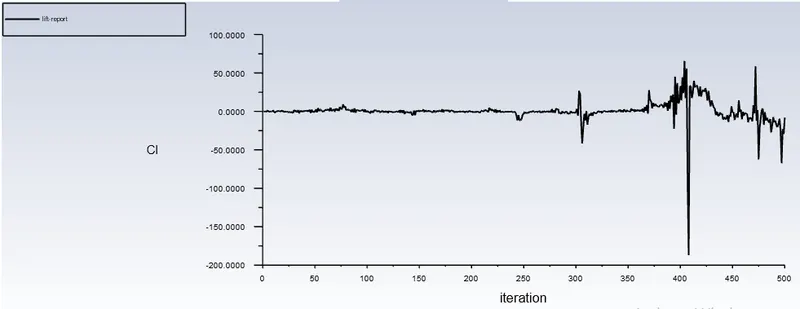
C. COEFFICIENT OF LIFT:
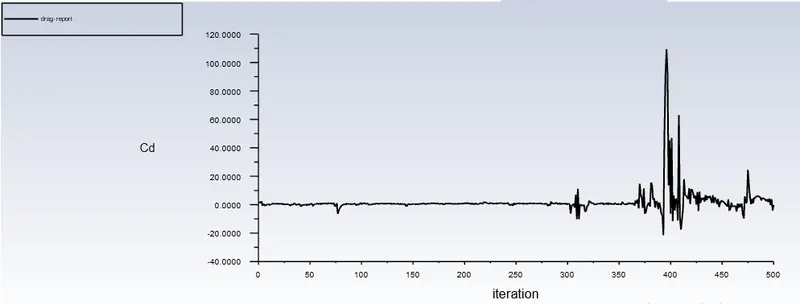
D. COEFFICIENT OF DRAG:
E. VELOCITY CONTOUR:
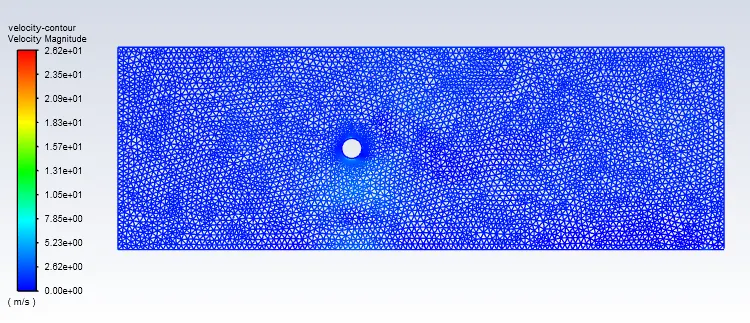
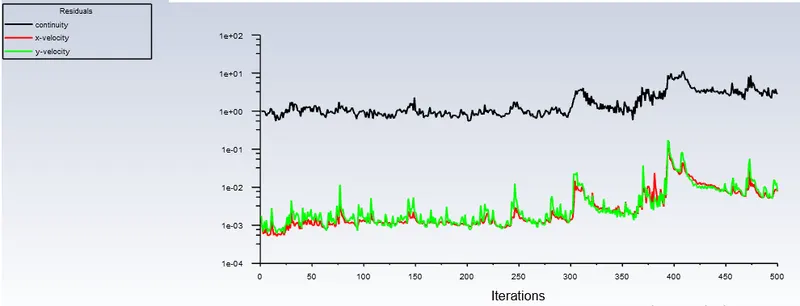
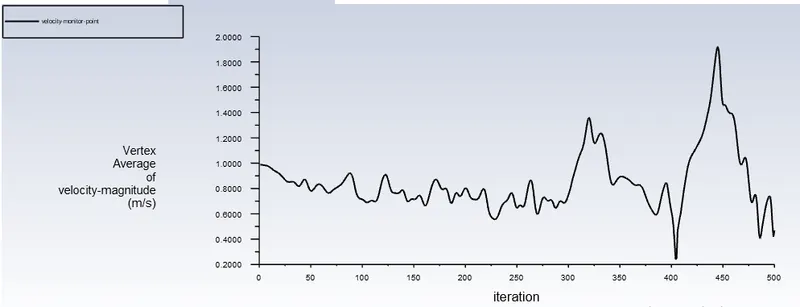
As the value of Reynold's number is at the limiting value of laminar flow over a rectangular plate, the results obtained are not accurate.
The maximum and minimum values of coefficient of drag are 109.3250554171072 and -11.65922809545543 respectively. And the maximum and minimum values of coefficient of lift are -67.49578401197935 and 65.56127913366484
Inferences:
- As the boundary layer is seperated, there will be negative pressure behind the body, which triggers vortex formations. This induces further drag on the body and pulls it back
- When the value of Reynold's number is low, the flow behaves like a potential flow and the drag on the body is all skin friction drag which is due to the viscosity of the fluid. As the value of Reynold's number increases, the drag increases
- Boundary layer seperation happens when the value of Reynold's number of the flow is low and when the flow is laminar ahead of the body. When the Reynold's number of the flow ahead of the body increases, the boundary layer sticks to the body for longer durations and hence the vortex formation is less and hence the vortex shedding
- So as the Reynold's number value is increasing, the value of coefficient lift tend to decrease, which is observed in the simulation above
Conclusions:
- Unsteady and steady case simulations are done of a flow past a cylinder with Reynold's number 100. The Strouhal number is calculated in the latter case after the system has reached steady state
- Coefficient of drag and lift are calculated for diffferent values of Reynold's numbers
- Analyzed the effect of Reynold's number on the values of coefficients of drag and lift
Methods to avoid vortex shedding:
- To avoid vortex shedding, care is to be taken to avoid the formation of vortex street, which is done by creating a disturbance in the design of the body like a spiral on the surface.
- Also, chosing the material such that the natural frequency of the body is greater, so that the body won't fluctuate perpendicular to the flow direction.
- In case of a streamlined body, the streamlines which are bifurcated by the presence of body, are joined at the end, so that no vortex formation happens and hence no vortex shedding