STEADY STATE ANALYSIS OF CYCLONE SEPARATOR
STEADY STATE ANALYSIS OF CYCLONE SEPARATOR
Objective: To perform steady state analysis of Cyclone Separator and calculate Separation Efficiency and Pressure Drop.
Empirical models used to calculate cyclone separator efficiency:
IOZIA AND LEITH MODEL
Iozia and Leith logistic model is a modified version of Barth model which is developed based on force balance. The model assumes that a particle carried by the vortex endures the influence of two forces: a centrifugal force and a flow resistance.
η = `1/(1 + ((d_(pc)) / d_p)^β )``(GτiQ)/D^3 (n+1)]^(0.5l(n+1))`
LI AND WANG MODEL
The Li and Wang (1989) model includes particle bounce or re-entrainment and turbulent diffusion at the cyclone wall. A two-dimensional analytical expression of particle distribution in the cyclone is obtained. Li and Wang model was developed based on the following assumptions:
- The radial particle velocity and the radial concentration profile are not constant, for uncollected particles within the cyclones.
- Boundary conditions with the consideration of turbulent diffusion coefficient and particle bounce re-entrainment on the cyclone wall are:
- The tangential velocity is related to the radius of cyclone by: uRn = constant
η = 1 - exp {-λθ1}
Where θ1 = 2π (S + L) / a
KOCH AND LICHT MODEL
Koch and Licht (1977) collection theory recognized the inherently turbulent nature of cyclones and the distribution of gas residence times within the cyclone. Koch and Licht describe particle motion in the entry and collection regions with the additional following assumptions:
- The tangential velocity of a particle is equal to the tangential velocity of the gas flow, i.e. there is no slip in the tangential direction between the particle and the gas.
- The tangential velocity is related to the radius of cyclone by: uRn= constant.
η = 1 - exp {-2`(GτiQ)/D^3 (n+1)]^(0.5l(n+1))` }
Where, G = `(8kc)/((ka)^2 (kb)^2 )`
LAPPLE MODEL
Lapple (1951) model was developed based on force balance without considering the flow resistance. Lapple assumed that a particle entering the cyclone is evenly distributed across the inlet opening. The particle that travels from inlet half width to the wall in the cyclone is collected with 50% efficiency.
η = `1/(1 + (d_(pc) / d_p)^2 )`
Model
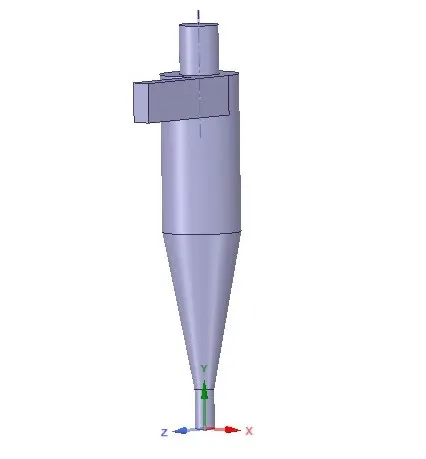
The 3D model was imported in Spaceclaim. The model of cyclone separator is of conical shape at the bottom and cylidrical at the top. The model has one inlet and two outlets one at the top for fluid to escape and another at the bottom for the particles that need to be removed.
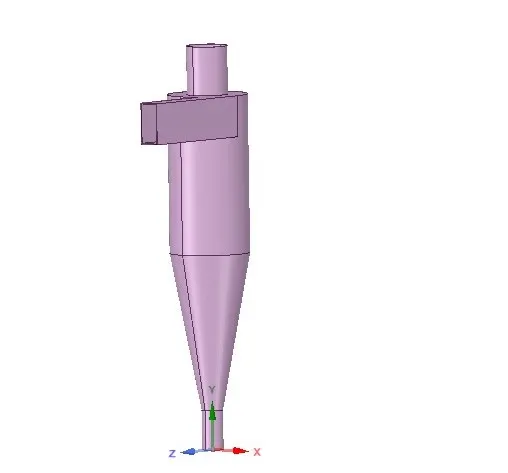
The volume of cyclone separator is extracted for analysis.
Mesh
The model was meshed using ANSYS mesher with cutcell mesh approach and element size of 15 mm.
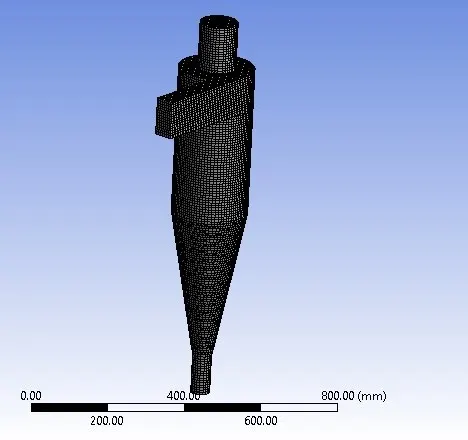
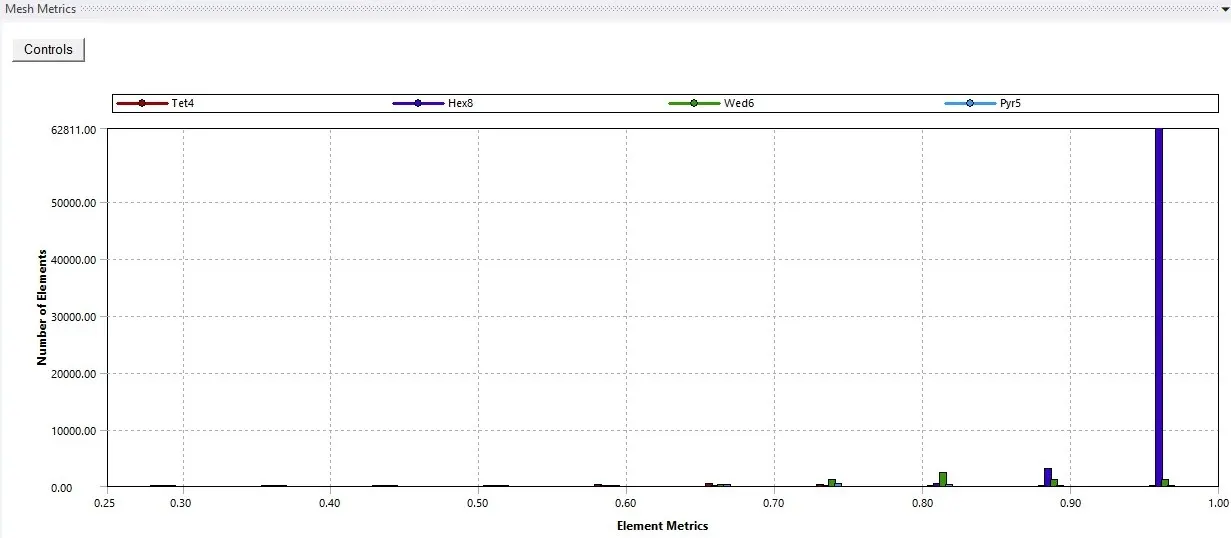
A mesh metric that identifies elements according to their quality was employed and it can be seen that the elements of lowest quality are minimal. Most of the elements have very high quality in the range of 0.9-1. Hence, the mesh is of acceptable quality. The meshed model is shown in image below. Number of Elements=73238, Nodes=76236.
CASE1
A STEADY STATE ANALYSIS of cyclone separator is done using ANSYS FLUENT to calculate separator efficiency. In this we assign the inlet velocity of fluid and the velocity of particle same and keep on varying the diameter of the particle.
SETUP
Fluid used is air and the particle used is anthracite.
Density of air (kg/m3) = 1.225
Viscosity of air (kg/m-s) = 1.7894e-05
Velocity of air (m/s) = 3
Velocity of particle (m/s) = 3
Density of particle (kg/m3) = 1506
Case a:
Diameter of particle = 1 µm.
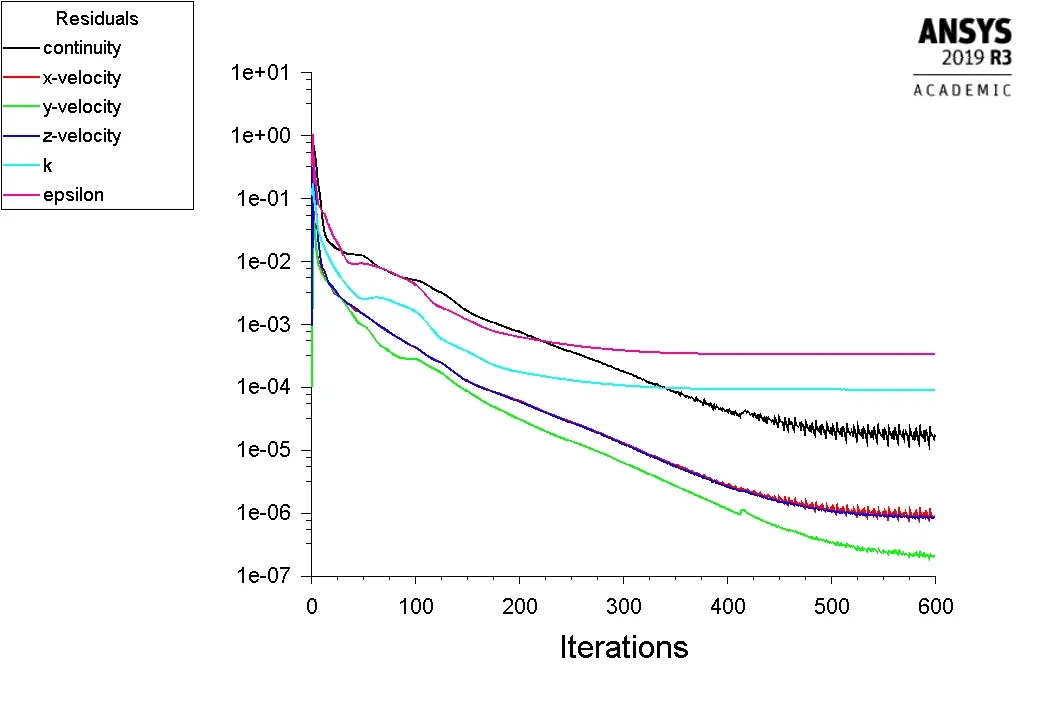
Residual
Iterations = 600 were ran. The residual plot is plotted in ANSYS FLUENT shown below.
Result
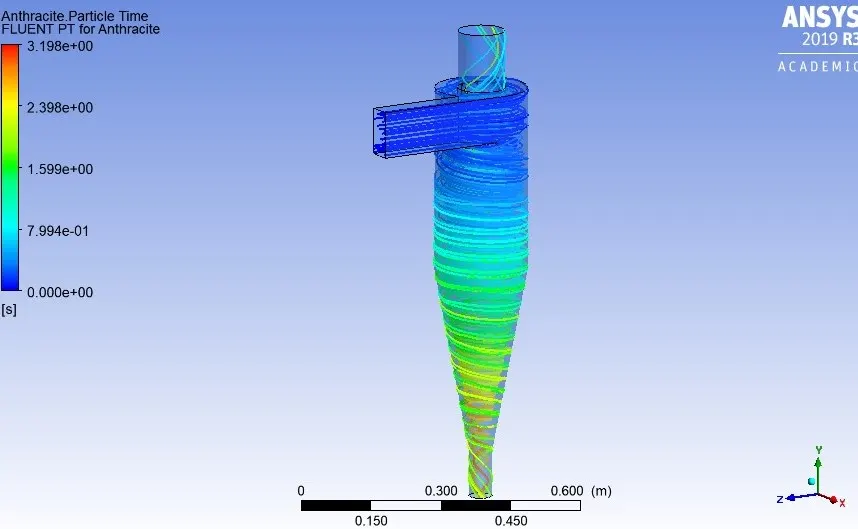
Anthracite particle time
`[((9µBc))/(2πNvi ((ρ_p)-ρ) )]^(1/2)`
DPM Iteration
Number tracked = 120, escaped = 53, aborted = 0, trapped = 23, evaporated = 0, incomplete = 44, Incomplete parallel = 0
Separation efficiency Calculation:
According Lapple model,
η = `1/(1 + ((d_(pc) / (d_p))^2 )`
dpc= diameter of particle at 50% efficiency in m, dp= diameter of particle in m
dpc= `[((9µB_c))/(2πNV_i ((ρ_p)-ρ) )]^(1/2)`
µ = viscosity (Pa.s), Bc = inlet width (m), N = effective number of turns, Vi = inlet gas velocity (m/s),
ρp = particle density (kg/m3), ρ = gas density (kg/m3)
Bc = 0.05 m
N = `1/(H) * [L_b + ((L_c)/2)]`
H= Inlet height of cyclone in m, Lb= Cyclone body length in m & Lc= Cyclone cone length in m.
H= 0.1 m, Lb= 0.4021859 m, Lc= 0.4 m
N = `1/(0.1 ) * [0.4021859 + (0.4/2)]` = 6
dpc= `[(9*1.7894e-05*0.05)/(2π*6*3 (1506-1.225) )]^(1/2)` = 6.88 µm
η = `1/(1 + ((6.88e-06) / (1e-06))^2 )` x100= 2.07%
Case b:
Diameter of particle = 2 µm.
Residual
Iterations = 600 were ran. The residual plot is plotted in ANSYS FLUENT shown below.
Result
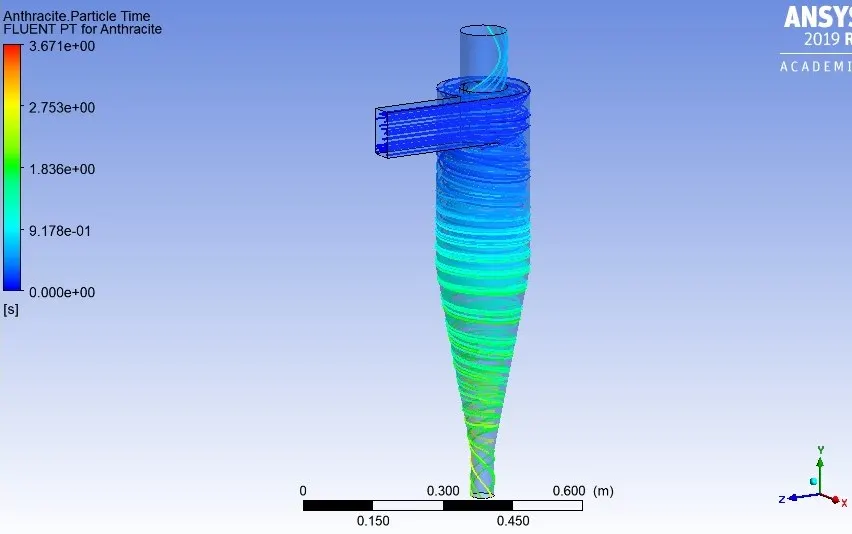
Anthracite particle time
DPM Iteration
Number tracked = 120, escaped = 43, aborted = 0, trapped = 59, evaporated = 0, incomplete = 18, incomplete parallel = 0
Separation efficiency Calculation:
According Lapple model,
η = `1/(1 + ((d_(pc) / (d_p))^2 )`
dpc= diameter of particle at 50% efficiency in m, dp= diameter of particle in m
dpc= `[((9µB_c))/(2πNV_i ((ρ_p)-ρ) )]^(1/2)`
µ = viscosity (Pa.s), Bc = inlet width (m), N = effective number of turns, Vi = inlet gas velocity (m/s),
ρp = particle density (kg/m3), ρ = gas density (kg/m3)
Bc = 0.05 m
N = `1/(H) * [L_b + ((L_c)/2)]`
H= Inlet height of cyclone in m, Lb= Cyclone body length in m & Lc= Cyclone cone length in m.
H= 0.1 m, Lb= 0.4021859 m, Lc= 0.4 m
N = `1/(0.1 ) * [0.4021859 + (0.4/2)]` = 6
dpc= `[(9*1.7894e-05*0.05)/(2π*6*3 (1506-1.225) )]^(1/2)` = 6.88 µm
η = `1/(1 + ((6.88e-06) /( 2e-06))^2 )` x100= 7.79%
Case c:
Diameter of particle = 3 µm.
Residual
Iterations = 600 were ran. The residual plot is plotted in ANSYS FLUENT shown below.
Result
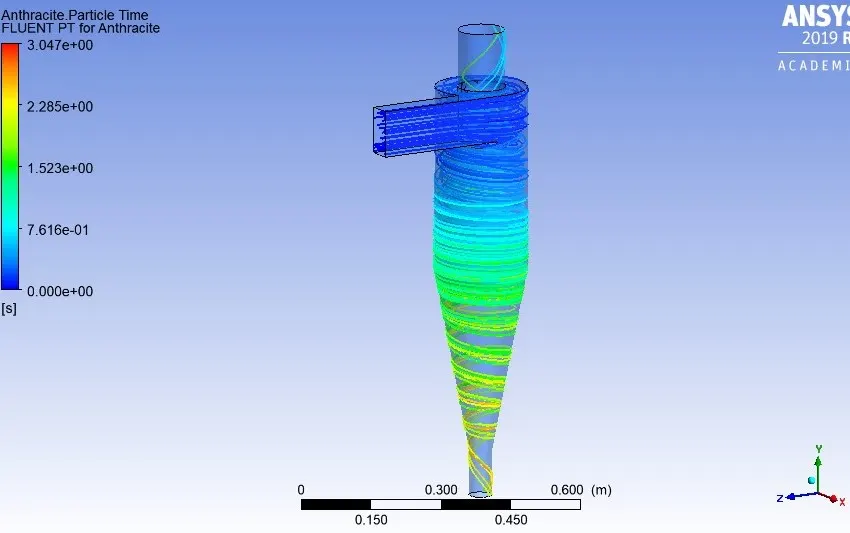
Anthracite particle time
DPM Iteration
Number tracked = 120, escaped = 31, aborted = 0, trapped = 89, evaporated = 0, incomplete = 0, incomplete parallel = 0
Separation efficiency Calculation:
According Lapple model,
η = `1/(1 + ((d_(pc) / (d_p))^2 )`
dpc= diameter of particle at 50% efficiency in m, dp= diameter of particle in m
dpc= `[((9µB_c))/(2πNV_i ((ρ_p)-ρ) )]^(1/2)`
µ = viscosity (Pa.s), Bc = inlet width (m), N = effective number of turns, Vi = inlet gas velocity (m/s),
ρp = particle density (kg/m3), ρ = gas density (kg/m3)
Bc = 0.05 m
N = `1/(H) * [L_b + ((L_c)/2)]`
H= Inlet height of cyclone in m, Lb= Cyclone body length in m & Lc= Cyclone cone length in m.
H= 0.1 m, Lb= 0.4021859 m, Lc= 0.4 m
N = `1/(0.1 ) * [0.4021859 + (0.4/2)]` = 6
dpc= `[(9*1.7894e-05*0.05)/(2π*6*3 (1506-1.225) )]^(1/2)` = 6.88 µm
η = `1/(1 + ((6.88e-06) /( 3e-06))^2 )` x100= 15.98%
Case d:
Diameter of particle = 4 µm.
Residual
Iterations = 600 were ran. The residual plot is plotted in ANSYS FLUENT shown below.
Result
Anthracite particle time
DPM Iteration
Number tracked = 120, escaped = 13, aborted = 0, trapped = 107, evaporated = 0, incomplete = 0, incomplete parallel = 0
Separation efficiency Calculation:
According Lapple model,
η = `1/(1 + ((d_(pc) / (d_p))^2 )`
dpc= diameter of particle at 50% efficiency in m, dp= diameter of particle in m
dpc= `[((9µB_c))/(2πNV_i ((ρ_p)-ρ) )]^(1/2)`
µ = viscosity (Pa.s), Bc = inlet width (m), N = effective number of turns, Vi = inlet gas velocity (m/s),
ρp = particle density (kg/m3), ρ = gas density (kg/m3)
Bc = 0.05 m
N = `1/(H) * [L_b + ((L_c)/2)]`
H= Inlet height of cyclone in m, Lb= Cyclone body length in m & Lc= Cyclone cone length in m.
H= 0.1 m, Lb= 0.4021859 m, Lc= 0.4 m
N = `1/(0.1 ) * [0.4021859 + (0.4/2)]` = 6
dpc= `[(9*1.7894e-05*0.05)/(2π*6*3 (1506-1.225) )]^(1/2)` = 6.88 µm
η = `1/(1 + ((6.88e-06) /( 4e-06))^2 )` x100= 25.263%
Case e:
Diameter of particle = 5 µm.
Residual
Iterations = 600 were ran. The residual plot is plotted in ANSYS FLUENT shown below.
Result
Anthracite particle time
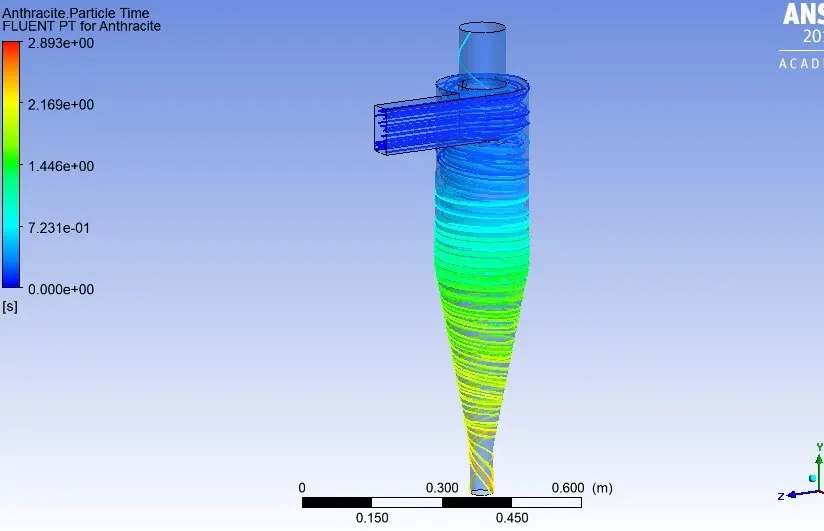
DPM Iteration
Number tracked = 120, escaped = 4, aborted = 0, trapped = 116, evaporated = 0, incomplete = 0, incomplete parallel = 0
Separation efficiency Calculation:
According Lapple model,
η = `1/(1 + ((d_(pc) / (d_p))^2 )`
dpc= diameter of particle at 50% efficiency in m, dp= diameter of particle in m
dpc= `[((9µB_c))/(2πNV_i ((ρ_p)-ρ) )]^(1/2)`
µ = viscosity (Pa.s), Bc = inlet width (m), N = effective number of turns, Vi = inlet gas velocity (m/s),
ρp = particle density (kg/m3), ρ = gas density (kg/m3)
Bc = 0.05 m
N = `1/(H) * [L_b + ((L_c)/2)]`
H= Inlet height of cyclone in m, Lb= Cyclone body length in m & Lc= Cyclone cone length in m.
H= 0.1 m, Lb= 0.4021859 m, Lc= 0.4 m
N = `1/(0.1 ) * [0.4021859 + (0.4/2)]` = 6
dpc= `[(9*1.7894e-05*0.05)/(2π*6*3 (1506-1.225) )]^(1/2)` = 6.88 µm
η = `1/(1 + ((6.88e-06) /( 5e-06))^2 )` x100= 34.562%
Case f:
Diameter of particle = 6 µm.
Residual
Iterations = 600 were ran. The residual plot is plotted in ANSYS FLUENT shown below.
Result
Anthracite particle time
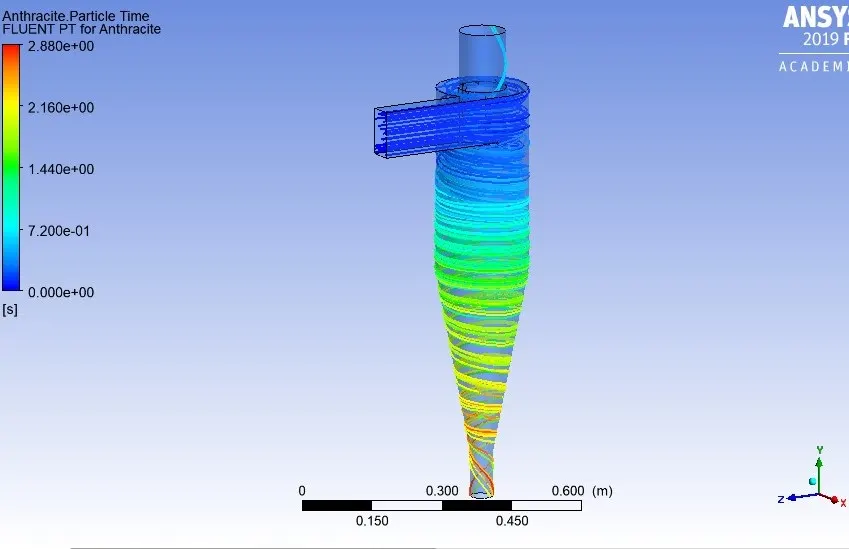
DPM Iteration
Number tracked = 120, escaped = 6, aborted = 0, trapped = 114, evaporated = 0, incomplete = 0, incomplete parallel = 0
Separation efficiency Calculation:
According Lapple model,
η = `1/(1 + ((d_(pc) / (d_p))^2 )`
dpc= diameter of particle at 50% efficiency in m, dp= diameter of particle in m
dpc= `[((9µB_c))/(2πNV_i ((ρ_p)-ρ) )]^(1/2)`
µ = viscosity (Pa.s), Bc = inlet width (m), N = effective number of turns, Vi = inlet gas velocity (m/s),
ρp = particle density (kg/m3), ρ = gas density (kg/m3)
Bc = 0.05 m
N = `1/(H) * [L_b + ((L_c)/2)]`
H= Inlet height of cyclone in m, Lb= Cyclone body length in m & Lc= Cyclone cone length in m.
H= 0.1 m, Lb= 0.4021859 m, Lc= 0.4 m
N = `1/(0.1 ) * [0.4021859 + (0.4/2)]` = 6
dpc= `[(9*1.7894e-05*0.05)/(2π*6*3 (1506-1.225) )]^(1/2)` = 6.88 µm
η = `1/(1 + ((6.88e-06) /( 6e-06))^2 )` x100= 43.1994%
Case g:
Diameter of particle = 7 µm.
Residual
Iterations = 600 were ran. The residual plot is plotted in ANSYS FLUENT shown below.
Result
Anthracite particle time
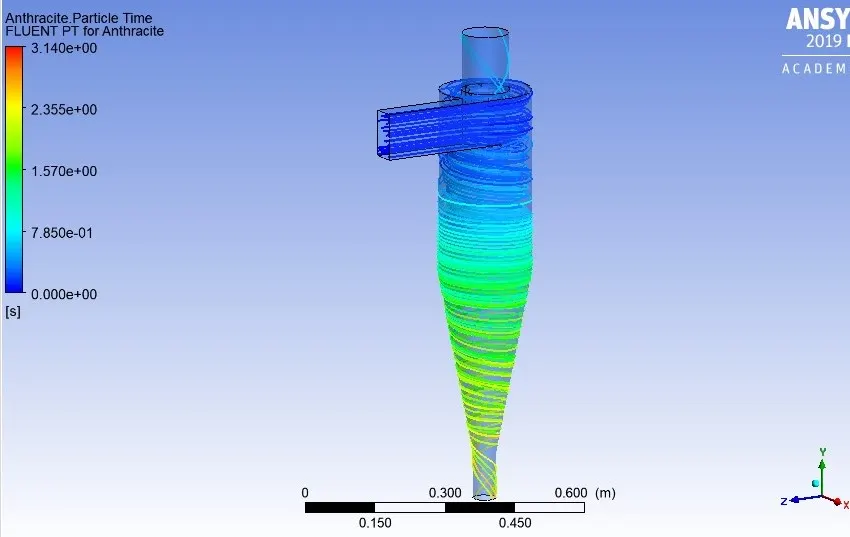
DPM Iteration
Number tracked = 120, escaped = 8, aborted = 0, trapped = 112, evaporated = 0, incomplete = 0, incomplete parallel = 0
Separation efficiency Calculation:
According Lapple model,
η = `1/(1 + ((d_(pc) / (d_p))^2 )`
dpc= diameter of particle at 50% efficiency in m, dp= diameter of particle in m
dpc= `[((9µB_c))/(2πNV_i ((ρ_p)-ρ) )]^(1/2)`
µ = viscosity (Pa.s), Bc = inlet width (m), N = effective number of turns, Vi = inlet gas velocity (m/s),
ρp = particle density (kg/m3), ρ = gas density (kg/m3)
Bc = 0.05 m
N = `1/(H) * [L_b + ((L_c)/2)]`
H= Inlet height of cyclone in m, Lb= Cyclone body length in m & Lc= Cyclone cone length in m.
H= 0.1 m, Lb= 0.4021859 m, Lc= 0.4 m
N = `1/(0.1 ) * [0.4021859 + (0.4/2)]` = 6
dpc= `[(9*1.7894e-05*0.05)/(2π*6*3 (1506-1.225) )]^(1/2)` = 6.88 µm
η = `1/(1 + ((6.88e-06) /( 7e-06))^2 )` x100= 50.864%
Case h:
Diameter of particle = 8 µm.
Residual
Iterations = 600 were ran. The residual plot is plotted in ANSYS FLUENT shown below.
Result
Anthracite particle time
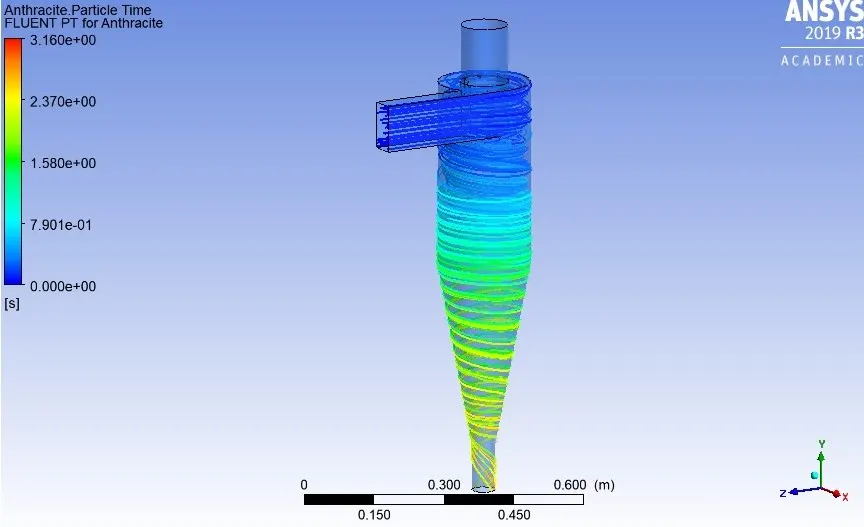
DPM Iteration
Number tracked = 120, escaped = 1, aborted = 0, trapped = 119, evaporated = 0, incomplete = 0, incomplete parallel = 0
Separation efficiency Calculation:
According Lapple model,
η = `1/(1 + ((d_(pc) / (d_p))^2 )`
dpc= diameter of particle at 50% efficiency in m, dp= diameter of particle in m
dpc= `[((9µB_c))/(2πNV_i ((ρ_p)-ρ) )]^(1/2)`
µ = viscosity (Pa.s), Bc = inlet width (m), N = effective number of turns, Vi = inlet gas velocity (m/s),
ρp = particle density (kg/m3), ρ = gas density (kg/m3)
Bc = 0.05 m
N = `1/(H) * [L_b + ((L_c)/2)]`
H= Inlet height of cyclone in m, Lb= Cyclone body length in m & Lc= Cyclone cone length in m.
H= 0.1 m, Lb= 0.4021859 m, Lc= 0.4 m
N = `1/(0.1 ) * [0.4021859 + (0.4/2)]` = 6
dpc= `[(9*1.7894e-05*0.05)/(2π*6*3 (1506-1.225) )]^(1/2)`= 6.88 µm
η = `1/(1 + ((6.88e-06) /( 8e-06))^2 )` x100= 57.4845%
Case i:
Diameter of particle = 9 µm.
Residual
Iterations = 600 were ran. The residual plot is plotted in ANSYS FLUENT shown below.
Result
Anthracite particle time
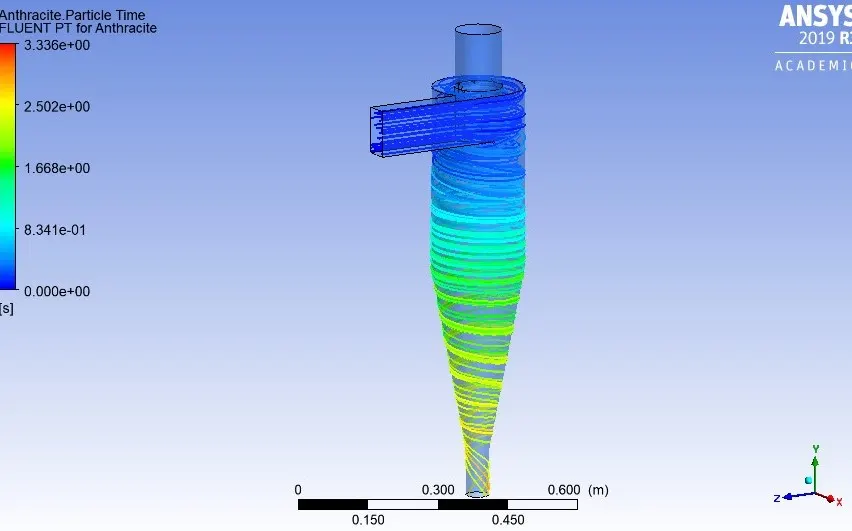
DPM Iteration
Number tracked = 120, escaped = 0, aborted = 0, trapped = 120, evaporated = 0, incomplete = 0, incomplete parallel = 0
Separation efficiency Calculation:
According Lapple model,
η = `1/(1 + ((d_(pc) / (d_p))^2 )`
dpc= diameter of particle at 50% efficiency in m, dp= diameter of particle in m
dpc= `[((9µB_c))/(2πNV_i ((ρ_p)-ρ) )]^(1/2)`
µ = viscosity (Pa.s), Bc = inlet width (m), N = effective number of turns, Vi = inlet gas velocity (m/s),
ρp = particle density (kg/m3), ρ = gas density (kg/m3)
Bc = 0.05 m
N = `1/(H) * [L_b + ((L_c)/2)]`
H= Inlet height of cyclone in m, Lb= Cyclone body length in m & Lc= Cyclone cone length in m.
H= 0.1 m, Lb= 0.4021859 m, Lc= 0.4 m
N = `1/(0.1 ) * [0.4021859 + (0.4/2)]` = 6
dpc= `[(9*1.7894e-05*0.05)/(2π*6*3 (1506-1.225) )]^(1/2)` = 6.88 µm
η = `1/(1 + ((6.88e-06) /( 9e-06))^2 )` x100= 63.12%
Case j:
Diameter of particle = 10 µm.
Residual
Iterations = 600 were ran. The residual plot is plotted in ANSYS FLUENT shown below.
Result
Anthracite particle time
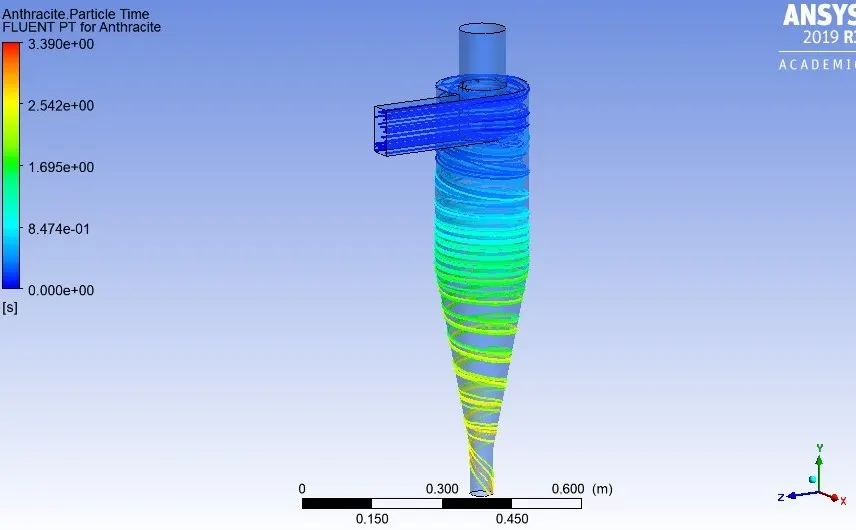
DPM Iteration
Number tracked = 120, escaped = 0, aborted = 0, trapped = 120, evaporated = 0, incomplete = 0, incomplete parallel = 0
Separation efficiency Calculation:
According Lapple model,
η = `1/(1 + ((d_(pc) / (d_p))^2 )`
dpc= diameter of particle at 50% efficiency in m, dp= diameter of particle in m
dpc= `[((9µB_c))/(2πNV_i ((ρ_p)-ρ) )]^(1/2)`
µ = viscosity (Pa.s), Bc = inlet width (m), N = effective number of turns, Vi = inlet gas velocity (m/s),
ρp = particle density (kg/m3), ρ = gas density (kg/m3)
Bc = 0.05 m
N = `1/(H) * [L_b + ((L_c)/2)]`
H= Inlet height of cyclone in m, Lb= Cyclone body length in m & Lc= Cyclone cone length in m.
H= 0.1 m, Lb= 0.4021859 m, Lc= 0.4 m
N = `1/(0.1 ) * [0.4021859 + (0.4/2)]` = 6
dpc= `[(9*1.7894e-05*0.05)/(2π*6*3 (1506-1.225) )]^(1/2)` = 6.88 µm
η = `1/(1 + ((6.88e-06) /( 10e-06))^2 )` x100= 67.873%
|
Diameter of particle (µm) |
Separation Efficiency |
|
1 |
2.07% |
|
2 |
7.79% |
|
3 |
15.98% |
|
4 |
25.263% |
|
5 |
34.562% |
|
6 |
43.1994% |
|
7 |
50.864% |
|
8 |
57.4845% |
|
9 |
63.12% |
|
10 |
67.873% |
Table 1
CASE2
A STEADY STATE ANALYSIS of cyclone separator is done using ANSYS FLUENT to calculate separator efficiency. In this we assign the inlet velocity of fluid and the diameter of the particle and keep on varying the particle velocity.
SETUP
Fluid used is air and the particle used is anthracite.
Density of air (kg/m3) = 1.225
Viscosity of air (kg/m-s) = 1.7894e-05
Diameter of particle = 5 µm.
Density of particle (kg/m3) = 1506
Case a:
Velocity of particle (m/s) = 1, Velocity of air (m/s) = 1
Residual
Iterations = 600 were ran. The residual plot is plotted in ANSYS FLUENT shown below.
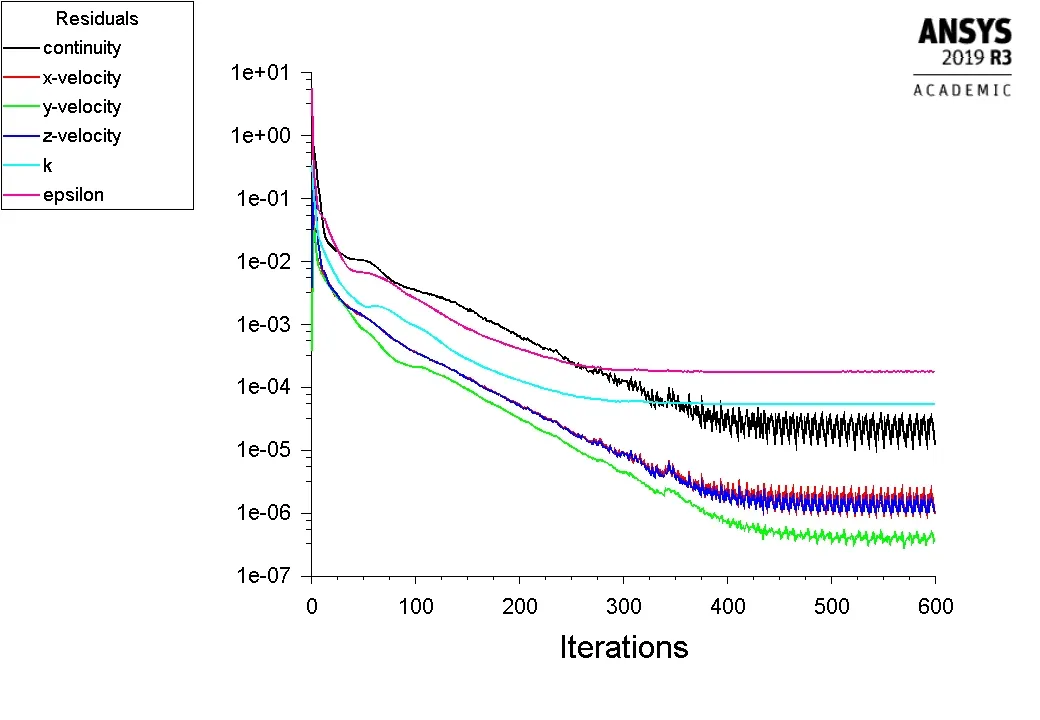
Result
Anthracite particle time
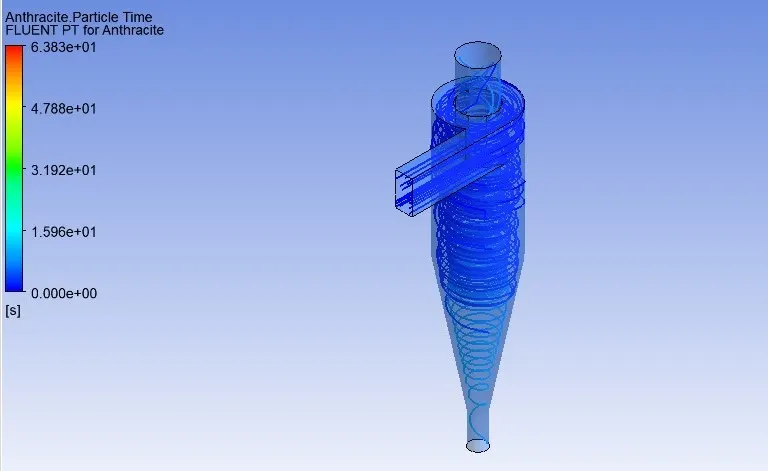
DPM Iteration
Number tracked = 120, escaped = 23, aborted = 0, trapped = 7, evaporated = 0, incomplete = 90, incomplete parallel = 0
Separation efficiency Calculation:
According Lapple model,
η = `1/(1 + ((d_(pc) / (d_p))^2 )`
dpc= diameter of particle at 50% efficiency in m, dp= diameter of particle in m
dpc= `[((9µB_c))/(2πNV_i ((ρ_p)-ρ) )]^(1/2)`
µ = viscosity (Pa.s), Bc = inlet width (m), N = effective number of turns, Vi = inlet gas velocity (m/s),
ρp = particle density (kg/m3), ρ = gas density (kg/m3)
BC = 0.05 m
N = `1/(H) * [L_b + ((L_c)/2)]`
H= Inlet height of cyclone in m, LB= Cyclone body length in m & LC= Cyclone cone length in m.
H= 0.1 m, LB= 0.4021859 m, LC= 0.4 m
N = `1/(0.1 ) * [0.4021859 + (0.4/2)]` = 6
dpc= `[(9*1.7894e-05*0.05)/(2π*6*1 (1506-1.225) )]^(1/2)` = 11.914 µm
η = `1/(1 + ((11.914e-06) / (5e-06))^2 )` x100= 14.975%
Pressure Drop
ΔP = `(0.0027q^2)/(K_cDBH(L_b/D)^(1/3) (L_c/D)^(1/3) )` = `(0.0027*0.005^2)/(0.5*0.1*0.1*0.05*0.1*((0.402)/(0.1))^(1/3) *((0.4)/(0.1))^(1/3) )` = 1.0697e-03 Pa.
Where, q = volumetric flow rate, B = inlet width, H = inlet height, D = outlet diameter, LC = cone length, LB = cylinder length. In this equation KC is a dimensionless factor express of cyclone inlet vanes. KC = 0.5 for cyclones without vanes.
Case b:
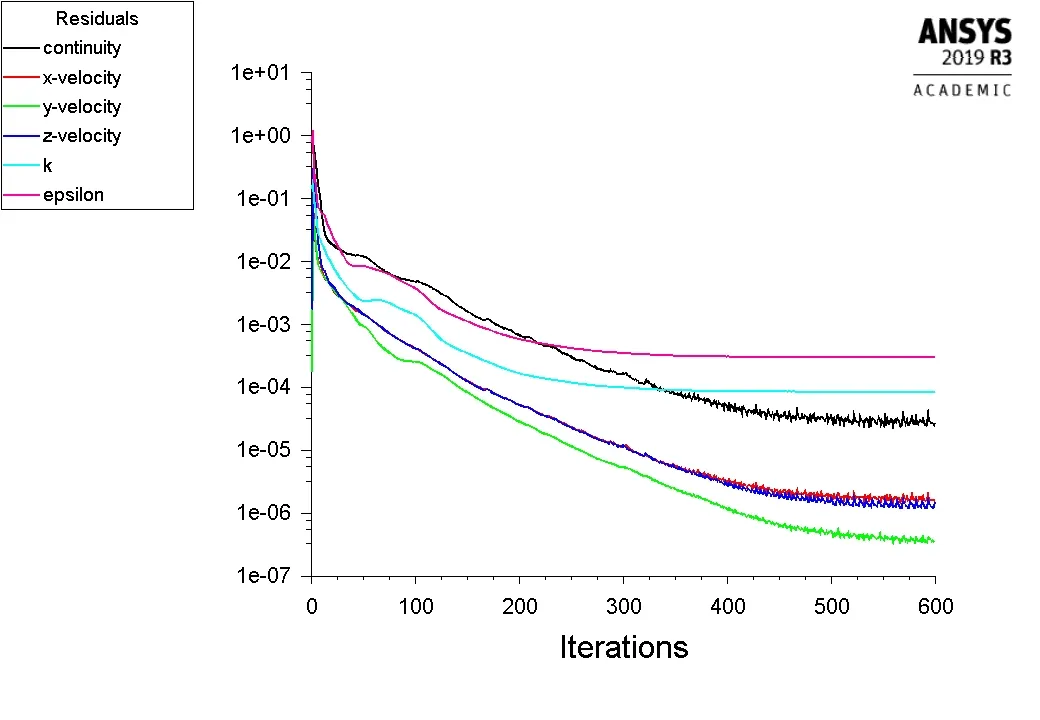
Velocity of particle (m/s) = 2, Velocity of air (m/s) = 2
Residual
Iterations = 600 were ran. The residual plot is plotted in ANSYS FLUENT shown below.
Result
Anthracite particle time
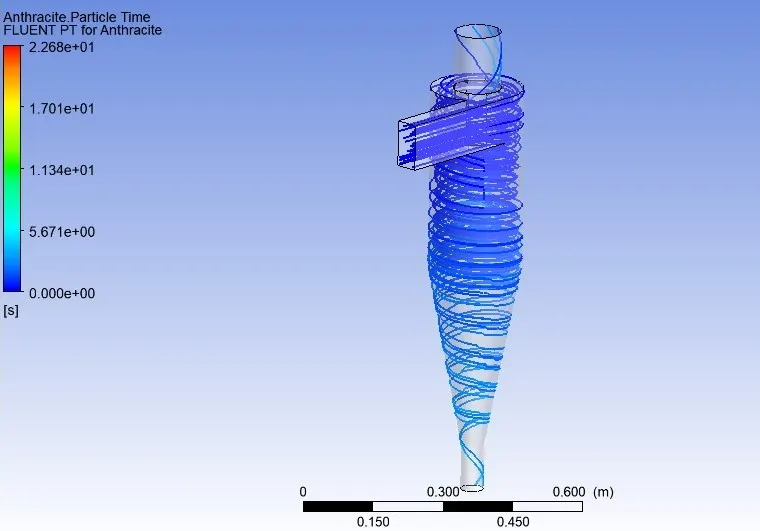
DPM Iteration
Number tracked = 120, escaped = 18, aborted = 0, trapped = 47, evaporated = 0, incomplete = 55, incomplete parallel = 0
Separation efficiency Calculation:
According Lapple model,
η = `1/(1 + ((d_(pc) / (d_p))^2 )`
dpc= diameter of particle at 50% efficiency in m, dp= diameter of particle in m
dpc= `[((9µB_c))/(2πNV_i ((ρ_p)-ρ) )]^(1/2)`
µ = viscosity (Pa.s), Bc = inlet width (m), N = effective number of turns, Vi = inlet gas velocity (m/s),
ρp = particle density (kg/m3), ρ = gas density (kg/m3)
BC = 0.05 m
N = `1/(H) * [L_b + ((L_c)/2)]`
H= Inlet height of cyclone in m, LB= Cyclone body length in m & LC= Cyclone cone length in m.
H= 0.1 m, LB= 0.4021859 m, LC= 0.4 m
N = `1/(0.1 ) * [0.4021859 + (0.4/2)]` = 6
dpc= `[(9*1.7894e-05*0.05)/(2π*6*2 (1506-1.225) )]^(1/2)` = 8.424 µm
η = `1/(1 + ((8.424 e-06) / (5e-06))^2 )` x100= 26.051%
Pressure Drop
ΔP = `(0.0027q^2)/(K_cDBH(L_b/D)^(1/3) (L_c/D)^(1/3) )` = `(0.0027*0.01^2)/(0.5*0.1*0.1*0.05*0.1*((0.402)/(0.1))^(1/3) *((0.4)/(0.1))^(1/3) )` = 4.279e-03 Pa.
Where, q = volumetric flow rate, B = inlet width, H = inlet height, D = outlet diameter, LC = cone length, LB = cylinder length. In this equation KC is a dimensionless factor express of cyclone inlet vanes. KC = 0.5 for cyclones without vanes.
Case c:
Velocity of particle (m/s) = 3, Velocity of air (m/s) = 3
Residual
Iterations = 600 were ran. The residual plot is plotted in ANSYS FLUENT shown below.
Result
Anthracite particle time
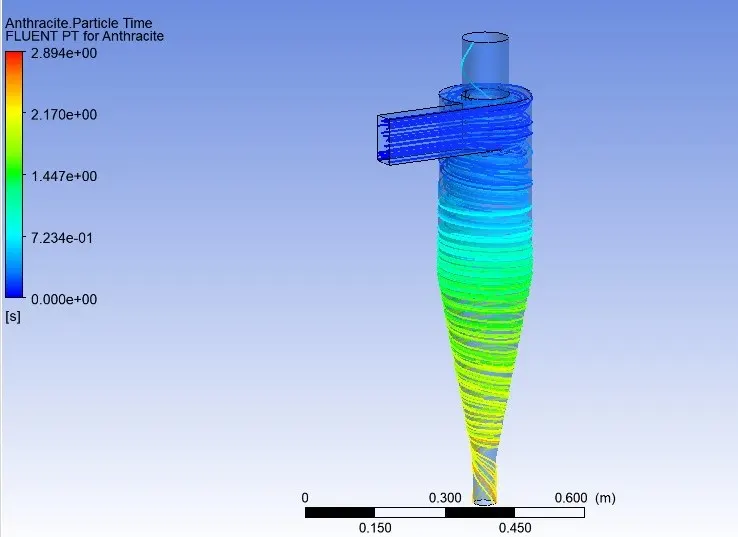
DPM Iteration
Number tracked = 120, escaped = 4, aborted = 0, trapped = 116, evaporated = 0, incomplete = 0, incomplete parallel = 0
Separation efficiency Calculation:
According Lapple model,
η = `1/(1 + ((d_(pc) / (d_p))^2 )`
dpc= diameter of particle at 50% efficiency in m, dp= diameter of particle in m
dpc= `[((9µB_c))/(2πNV_i ((ρ_p)-ρ) )]^(1/2)`
µ = viscosity (Pa.s), Bc = inlet width (m), N = effective number of turns, Vi = inlet gas velocity (m/s),
ρp = particle density (kg/m3), ρ = gas density (kg/m3)
BC = 0.05 m
N = `1/(H) * [L_b + ((L_c)/2)]`
H= Inlet height of cyclone in m, LB= Cyclone body length in m & LC= Cyclone cone length in m.
H= 0.1 m, LB= 0.4021859 m, LC= 0.4 m
N = `1/(0.1 ) * [0.4021859 + (0.4/2)]` = 6
dpc= `[(9*1.7894e-05*0.05)/(2π*6*3 (1506-1.225) )]^(1/2)` = 6.88 µm
η = `1/(1 + ((6.88 e-06) / (5e-06))^2 )` x100= 34.562%
Pressure Drop
ΔP = `(0.0027q^2)/(K_cDBH(L_b/D)^(1/3) (L_c/D)^(1/3) )` = `(0.0027*0.015^2)/(0.5*0.1*0.1*0.05*0.1*((0.402)/(0.1))^(1/3) *((0.4)/(0.1))^(1/3) )` = 9.627e-03 Pa.
Where, q = volumetric flow rate, B = inlet width, H = inlet height, D = outlet diameter, LC = cone length, LB = cylinder length. In this equation KC is a dimensionless factor express of cyclone inlet vanes. KC = 0.5 for cyclones without vanes.
Case d:
Velocity of particle (m/s) = 4, Velocity of air (m/s) = 4
Residual
Iterations = 600 were ran. The residual plot is plotted in ANSYS FLUENT shown below.
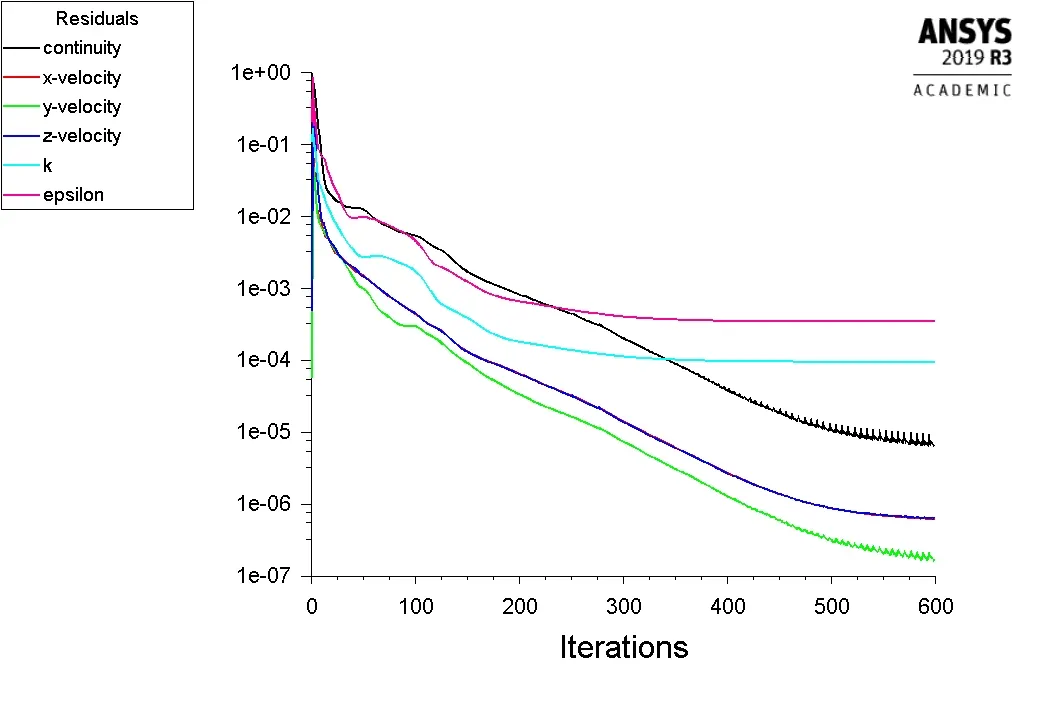
Result
Anthracite particle time
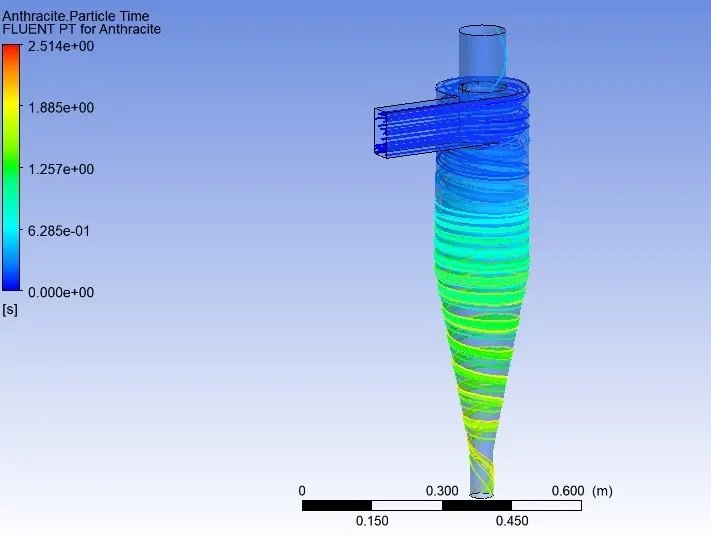
DPM Iteration
Number tracked = 120, escaped = 4, aborted = 0, trapped = 116, evaporated = 0, incomplete = 0, incomplete parallel = 0
Separation efficiency Calculation:
According Lapple model,
η = `1/(1 + ((d_(pc) / (d_p))^2 )`
dpc= diameter of particle at 50% efficiency in m, dp= diameter of particle in m
dpc= `[((9µB_c))/(2πNV_i ((ρ_p)-ρ) )]^(1/2)`
µ = viscosity (Pa.s), Bc = inlet width (m), N = effective number of turns, Vi = inlet gas velocity (m/s),
ρp = particle density (kg/m3), ρ = gas density (kg/m3)
BC = 0.05 m
N = `1/(H) * [L_b + ((L_c)/2)]`
H= Inlet height of cyclone in m, LB= Cyclone body length in m & LC= Cyclone cone length in m.
H= 0.1 m, LB= 0.4021859 m, LC= 0.4 m
N = `1/(0.1 ) * [0.4021859 + (0.4/2)]` = 6
dpc= `[(9*1.7894e-05*0.05)/(2π*6*4 (1506-1.225) )]^(1/2)` = 5.957 µm
η = `1/(1 + ((5.957 e-06) / (5e-06))^2 )` x100= 41.332%
Pressure Drop
ΔP = `(0.0027q^2)/(K_cDBH(L_b/D)^(1/3) (L_c/D)^(1/3) )` = `(0.0027*0.02^2)/(0.5*0.1*0.1*0.05*0.1*((0.402)/(0.1))^(1/3) *((0.4)/(0.1))^(1/3) )` = 0.0171 Pa.
Where, q = volumetric flow rate, B = inlet width, H = inlet height, D = outlet diameter, LC = cone length, LB = cylinder length. In this equation KC is a dimensionless factor express of cyclone inlet vanes. KC = 0.5 for cyclones without vanes.
Case e:
Velocity of particle (m/s) = 5, Velocity of air (m/s) = 5
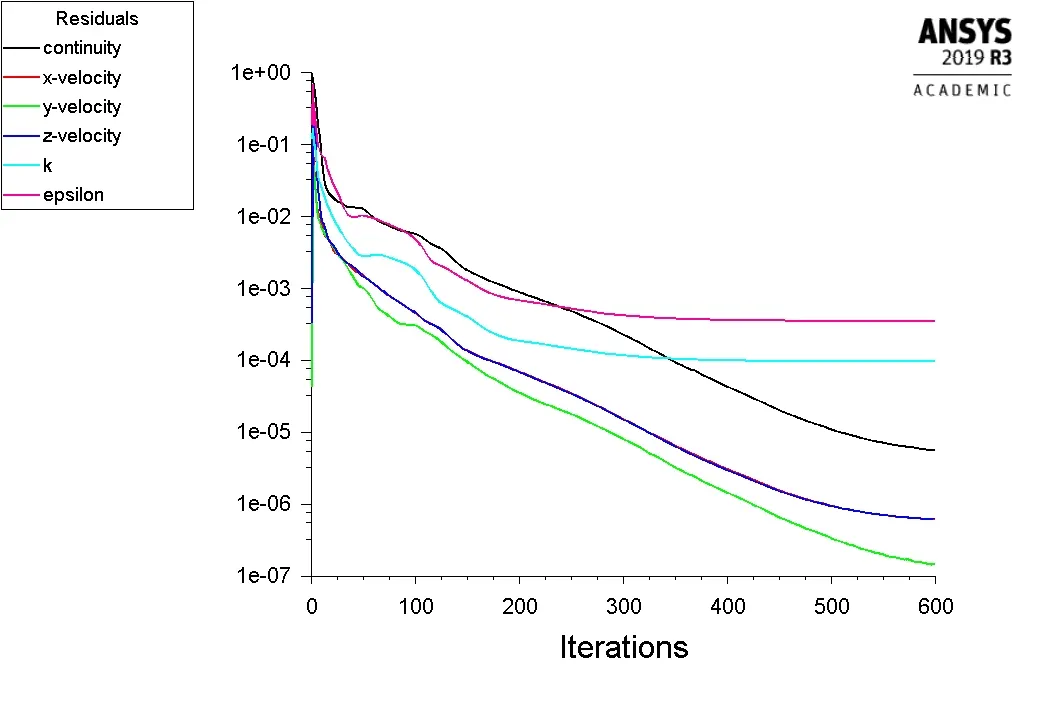
Residual
Iterations = 600 were ran. The residual plot is plotted in ANSYS FLUENT shown below.
Result
Anthracite particle time
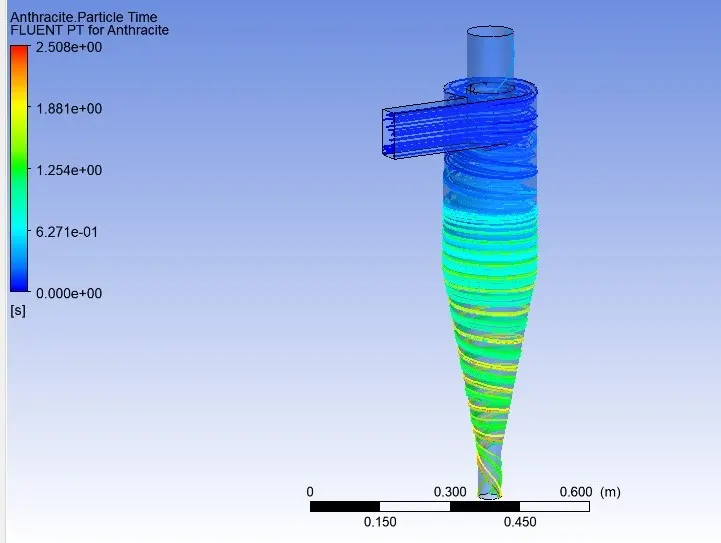
DPM Iteration
Number tracked = 120, escaped = 4, aborted = 0, trapped = 116, evaporated = 0, incomplete = 0, incomplete parallel = 0
Separation efficiency Calculation:
According Lapple model,
η = `1/(1 + ((d_(pc) / (d_p))^2 )`
dpc= diameter of particle at 50% efficiency in m, dp= diameter of particle in m
dpc= `[((9µB_c))/(2πNV_i ((ρ_p)-ρ) )]^(1/2)`
µ = viscosity (Pa.s), Bc = inlet width (m), N = effective number of turns, Vi = inlet gas velocity (m/s),
ρp = particle density (kg/m3), ρ = gas density (kg/m3)
BC = 0.05 m
N = `1/(H) * [L_b + ((L_c)/2)]`
H= Inlet height of cyclone in m, LB= Cyclone body length in m & LC= Cyclone cone length in m.
H= 0.1 m, LB= 0.4021859 m, LC= 0.4 m
N = `1/(0.1 ) * [0.4021859 + (0.4/2)]` = 6
dpc= `[(9*1.7894e-05*0.05)/(2π*6*5 (1506-1.225) )]^(1/2)` = 5.328 µm
η = `1/(1 + ((5.328 e-06) / (5e-06))^2 )` x100= 46.855%
Pressure Drop
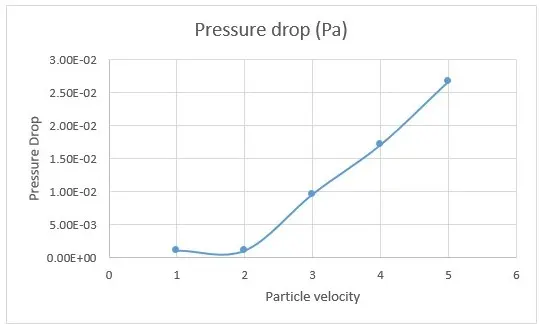
ΔP = `(0.0027q^2)/(K_cDBH(L_b/D)^(1/3) (L_c/D)^(1/3) )` = `(0.0027*0.025^2)/(0.5*0.1*0.1*0.05*0.1*((0.402)/(0.1))^(1/3) *((0.4)/(0.1))^(1/3) )` = 0.0267 Pa.
Where, q = volumetric flow rate, B = inlet width, H = inlet height, D = outlet diameter, LC = cone length, LB = cylinder length. In this equation KC is a dimensionless factor express of cyclone inlet vanes. KC = 0.5 for cyclones without vanes.
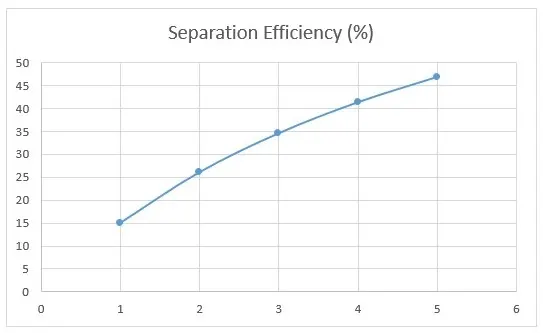
|
Particle velocity(m/s) |
Separation Efficiency (%) |
Pressure drop (Pa) |
|
1 |
14.975 |
1.0697e-03 |
|
2 |
26.051 |
1.0697e-03 |
|
3 |
34.562 |
9.627e-03 |
|
4 |
41.332 |
0.0171 |
|
5 |
46.855 |
0.0267 |
Table-2
Conclusion
- From Table-1, it concluded that separation efficiency increases with increase in particle diameter.
- From Table-2, it concluded that separation efficiency and pressure drop increases with increase in particle velocity.
References
- EVALUATION ON EMPIRICAL MODELS FOR THE PREDICTION OF CYCLONE EFFICIENCY Jolius Gimbun1, T.G. Chuah2, Thomas S. Y. Choong2 and A. Fakhru’l-Razi2
- NPTEL – Chemical Engineering – Chemical Engineering Design - II