Simulating flow over a cylinder for varying values of Reynolds numbers
AIM: To simulate the flow over a cylinder for different values of Reynolds numbers
OBJECTIVE:
- To simulate flow over a cylinder for the following cases:
- 20% of the baseline value
- 40% of the baseline value
- 100% of the baseline value
- To create animations depicting pressure and velocity of flow during each of the cases
INTRODUCTION
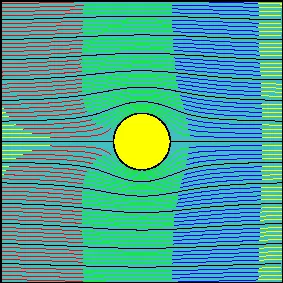
Flow over a cylinder and Fluid flow simulations
In mathematics, potential flow around a circular cylinder is a classical solution for the flow of an inviscid, incompressible fluid around a cylinder that is transverse to the flow. Far from the cylinder, the flow is unidirectional and uniform. The flow has no vorticity and thus the velocity field is irrotational and can be modeled as a potential flow. Unlike a real fluid, this solution indicates a net zero drag on the body, a result known as d'Alembert's paradox.
Fluid flow simulations are performed inorder to create a working design at maximum efficiency, inorder to manufacture real life components.It allows us to design pipes and simulate their performance in a virtual environment.This allows the designer to model the fluid’s behavior at every stage in the process and accurately predict how it will react during real life situations. It reduces the time considerably and reduces cost considerably.This is a major consideration when it comes to designing new products and it places a great deal of limitations on the designer. The science of fluid dynamics is incredibly complex and the chances of error are high. This means that the process can be an iterative one, with many repetitions and consequent impacts on the time and cost of development. With fluid flow simulation software, the entire process is much more streamlined.
THEORY
Reynolds Number
The Reynolds number (Re) is an important dimensionless quantity in fluid mechanics used to help predict flow patterns in different fluid flow situations. At low Reynolds numbers, flows tend to be dominated by laminar flow, while at high Reynolds numbers turbulence results from differences in the fluid's speed and direction, which may sometimes intersect or even move counter to the overall direction of the flow. The Reynolds number has wide applications, ranging from liquid flow in a pipe to the passage of air over an aircraft wing. It is used to predict the transition from laminar to turbulent flow.
PROCEDURE:
EQUATION USED:
`Re = (rho*v*d)/mu`
- `Re`- Reynolds number
- `rho`- density (`(kg)/m^3`)
- `v`- inlet velocity `(m/s)`
- `d`- diameter of the cylinder `(m)`
- `mu`- dynamic viscosity `(Pa*s)`
INPUTS
- `rho`= 1000`(kg)/m^3`
- `d`= 0.050`m`
- `mu`= 0.00089`Pa*s`
- `L`= 0.5 m
CALCULATED INPUT PARAMETERS
| Case No. | `Re` | `v` | Simulation time |
| 1. | 10,00,000 (baseline) | 17.8 m/s | 17.8 sec |
| 2. | 12,00,000 (20%) | 21.36 m/s | 21.36 sec |
| 3. | 14,00,000 (40%) | 24.92 m/s | 24.92 sec |
| 4. | 20,00,000 (100%) | 35.6 m/s | 35.6 sec |
RESULTS:
Case 1: 10,00,000 (baseline)
Velocity Cut Plot animation
Pressure Cut Plot animation
Case 2: 12,00,000 (20%)
Velocity Cut Plot animation
Pressure Cut Plot animation
Case 3: 14,00,000 (40%)
Velocity Cut Plot animation
Pressure Cut Plot animation
Case 4: 20,00,000 (100%)
Velocity Cut Plot animation
Pressure Cut Plot animation
OBSERVATIONS :
- Maximum pressure is observed to be experienced on the surface facing the inlet of the fluid.
- Pressure is minimum on the top and bottom of the cyclinder, which in turn is where velocity is maximum
- Velocity is maximum in regions where pressure is minimum.
- The pressure created on the surface increases as inlet velocity increases.
- Velocity of the fluid surrounding the cylinder increases progressively with increasing inlet velocity.
CONCLUSION:
Hence, using the Solidworks flow simulation tool, we were able to accurately represent the flow over a cylinder in different cases of varying Reynolds numbers