Shortest_Path_Adjacency Matrix (C++)
CODE IN C++: To find the shortest path from a source node to all the other nodes, given an adjacency matrix of 1's and 0's.
#include <iostream>
using namespace std;
int main()
{
int n, s;
cout << "Enter size of Adjacency Matrix: ";
cin >> n;
cout <<"Enter the source node 0 to "<< n-1<<": ";
cin >> s;
//G[n][n] will store the values of the adjacency matrix
int** G= new int*[n];
for(int i=0; i<=n; i++)
{
G[i]= new int[n];
}
//Adjacency Matrix only stores 0 and 1 as the path connecting every node is of 1 unit length.
cout<<"Enter the Adjacency Matrix: "<<endl;
for(int i=0; i<n; i++)
{
for(int j=0; j<n; j++)
{
cin >> G[i][j];
}
}
/*path_s[n][n] is used to store number of paths available from source
node to the particular node(indicated by column index),
The row index is indicative of the path length of concerned path*/
//path_s[2][7] is number of paths of length 3 from node 5 to node 7
int** path_s= new int*[n];
for(int i=0; i<=n; i++)
{
path_s[i]= new int[n];
}
for (int i=0; i<n; i++)
{
for (int j=0; j<n; j++)
{
path_s [i][j]= 0;
}
}
for (int i=0; i<n; i++)
{
path_s[0][i]= G[s][i];
}
/*Move through each column, and check for first occurence of atleast one path.
counter keeps track of the column(destination node)
chart [] keeps tag of the length of the shortest path(row+1)*/
int counter;
int chart[n];
for (int i=0; i<n; i++)
{
chart[i] = 0;
}
for(int i=0; i<n; i++)// i is the destination node
{ counter=0;
// The shortest path from source node to itself is zero.
if (i==s){
continue;
}
while(path_s[counter][i]==0) //As long as path_s[counter][i]==0, no path exists between the concerned nodes.
{
counter++;
for(int j=0; j<n; j++)
{
path_s[counter][i]+= path_s[counter-1][j]*G[j][i];
// computing number of paths of length (counter+1) from s to i
}
}
chart[i] = counter+1;//The first non-zero value encountered in the column is the shortest path fro s to i
}
cout << "The shortest paths from node "<< s<< " to respective nodes is: "
for (int i=0; i<n; i++)
{
cout << chart[i]<< " ";
}
cout << endl<< endl;
for(int i=0; i<n; i++) //To delete the inner arrays
{
delete [] G[i];
delete [] path_s[i];
delete [] G;
delete [] path_s;
}
return 0;
}
OUTPUT:
Enter size of Adjacency Matrix: 8
Enter the source node 0 to 7: 5
Enter the Adjacency Matrix:
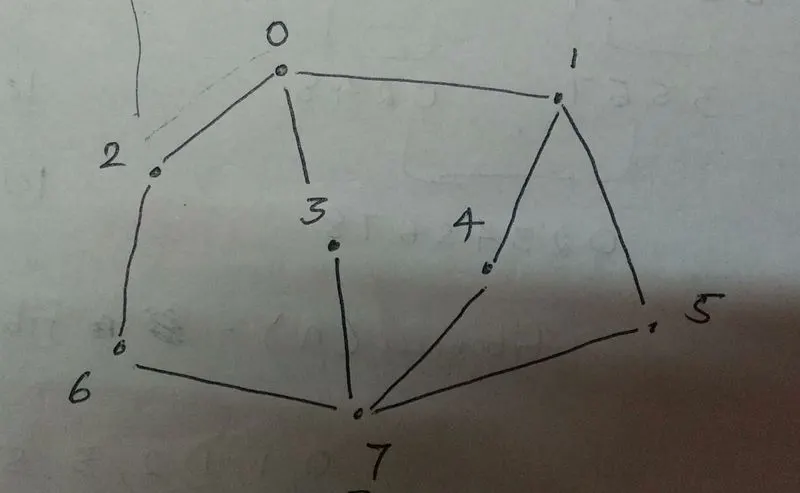
0 1 1 1 0 0 0 0
1 0 0 0 1 1 0 0
1 0 0 0 0 0 1 0
1 0 0 0 0 0 0 1
0 1 0 0 0 0 0 1
0 1 0 0 0 0 0 1
0 0 1 0 0 0 0 1
0 0 0 1 1 1 1 0
The shortest paths from node 5 to respective nodes is: 2 1 3 2 2 0 2 1
The image below is the graph representation of the above adjacency matrix: