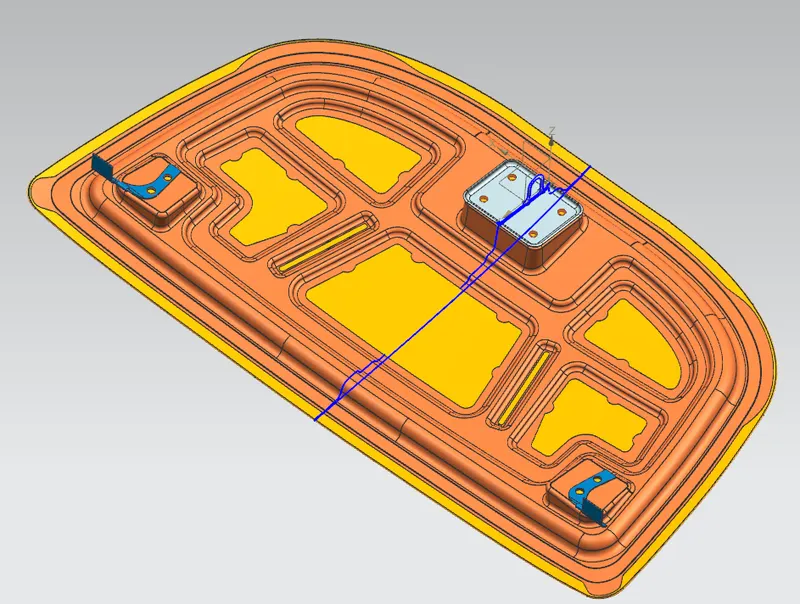
SECTION MODULUS:
Section modulus is the property of the cross-section that is used while in the design of beams.
The section modulus is classified into two types:-
1) Elastic section modulus: The elastic section modulus is applicable up to the yield point of material. It is used in most engineering applications.
2) Plastic section modulus: The plastic section modulus is generally used for material in which plastic behavior is observed.
ELASTIC SECTION MODULUS: Elastic section modulus is the ratio of moment of inertia about a neutral axis(I) and the maximum distance between the neutral axis and outermost fiber of beam (y).
The formula of elastic section modulus is given by,
S = (I/y)
Where,
S = Section Modulus
I = Moment of Inertia
y = distance between the neutral axis and the extreme end of the object.
Steps to calculate elastic section modulus:-
- Step 1:- Find location of centroid of given cross section.
- Step 2:- Find moment of inertia about neutral axis (I)
- Step 3:- Find ymax from neutral axis.
- Step 4:- Find elastic section modulus using the formula provided above.
ELASTIC SECTION MODULUS OF DIFFERENT SECTION:
There are following different elastic section modulus:
Rectangular Section
As we know the moment of inertia of the rectangular section,
I = bd³/12
And the distance from the neutral axis,
ymax = d/2
So,
Zₑ = I/ymax
Zₑ = (bd³/12)/(d/2)
After calculating them,
Section modulus of rectangular section,
Zₑ = bd²/6
Hollow Rectangular Section
As we know the moment of inertia of the hollow rectangular section,
I = (BD³/12) - (bd³/12)
ymax = D/2
After putting these values,
Zₑ = I/ymax
(BD³/12) - (bd³/12)/(D/2)
Zₑ = (BD³ - bd³)/6D
Solid Circular
For solid Circular moment of inertia,
I = (π/64) × d⁴
ymax = d/2
Then,
Zₑ = {(π/64) × d⁴}/(d/2)
After calculating then find values of section modulus of solid circular
Zₑ = (π/32) × d³
Hollow Circular
The moment of inertia of hollow Circular,
I = (π/64) × (D⁴ - d⁴)
And,
ymax = D/2
After putting these values,
Zₑ = (π/64) × (D⁴ - d⁴)/(D/2)
Zₑ = π/32 × {(D⁴ - d⁴)/D}
Symmetric I & C Section
Moment of inertia for the I & C section,
I = (BD³/12) - {(B - b)d³}/12
ymax = D/2
So,
Zₑ = [(BD³/12) - {(B - b)d³}/12]/(D/2)
Zₑ = {BD³ - (B - b)d³}/6D
Diamond
Elastic section modulus for diamond is,
Zₑ = bd²/24
PLASTIC SECTION MODULUS:
The plastic section modulus is used for materials where the elastic yield is acceptable and the plastic behavior is considered to be an acceptable range.
In this project, we will be considering elastic section modulus for hood assembly.
Hood assembly:
Calculation:
CASE 1: Before Optimization
The Hood which was already created is imported and the section inertia analysis is done.
We have to make sure that the curve obtained is a single/closed curve.

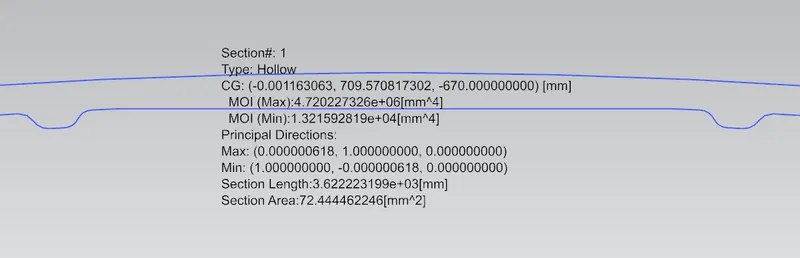
Following data is obtained.
Maximum MOI = 4.720 e+06 mm4
Minimum MOI = 1.321 e+04 mm4
Maximum distance = Total length of hood /2 = 871.9258/2 = 435.96mm.
Mimimum moment of inertia is considered for worst case condition.
Section Modulus = (I/y) = (13210/435.96) = 30.30 mm3.
S = 30.30mm3 .
CASE 2: After optimization
The hood inner panel’s curve is offset by 0.5mm outwards and section inertia analysis is done same as case 1 for a closed curve.

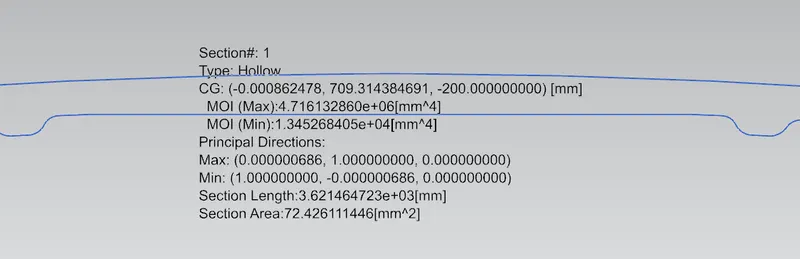
Following data is obtained.
Maximum MOI = 4.716 e+06 mm4
Minimum MOI = 1.345 e+04 mm4
Maximum distance = Total length of hood /2 = 871.9258/2 = 435.96mm.
Mimimum moment of inertia is considered for worst case condition
Section Modulus = (I/y) = (13452.68/435.96) = 30.8576 mm3.
S = 30.8576 mm3 .
As we know Bending force is given by F = M/S
Where M = Bending monent
S =Section modulus.
From the above equation, we can infer that Bending force is inversely proportional to the section modulus of the section.
Higher the section modulus , Higher is the strength of the section and higher load is required to deform the section.
Conclusion:
Hence when comparing case 1 & case 2,
1. The section modulus value of case 2 is higher than the case 1
2. As we increase the section area, the moment of inertia & section modulus increases which means strength and load bearing ability also increases.