Section Modulus calculation and optimization
For calculating the section modulus we have to calculate the value of ( I ) which is the area of moment inertia of the body and ( Y ) which is the distance between the neutral fiber and the extreme point distance of the body.
The value of the section modulus tells the strength, rigidity, and stiffness of the body
The more the value of the Section modulus the more the strength of the body, for calculating this we have to increase the value of the area moment of the body.
In this challenge, we have compared the section modulus values of two different section modulus of the same body.
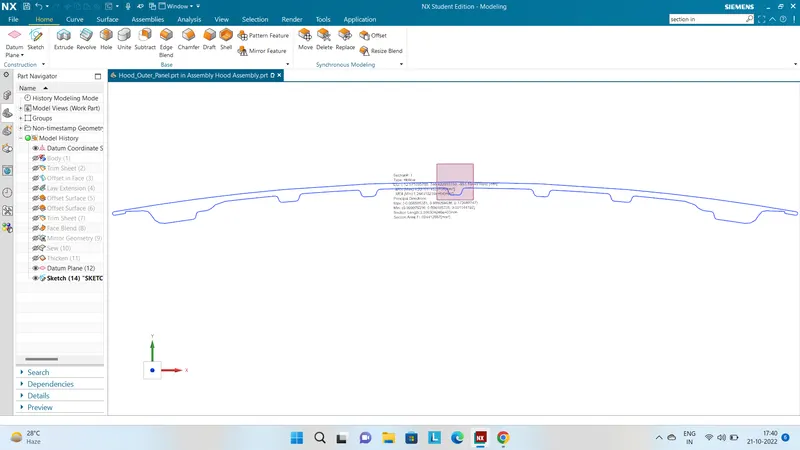
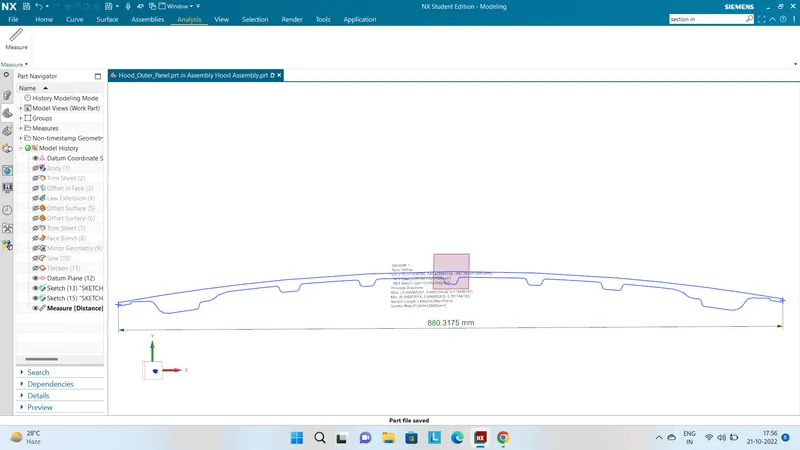
Section-1
L=880.3175 mm Total Length of the body from extreme endpoint to another extreme endpoint.
Y= Distance between the neutral axis and the extreme end of the object
Y=L/2 = 880.3175/2 = 440.15875mm
MOI ( Min)= 1.266119239e+04[mm^4]
Section Modulus=I/Y
Section Modulus= 1.266119239e+04[mm^4] / 440.15875mm
Section Modulus= 28.765059 mm^3
Section-2
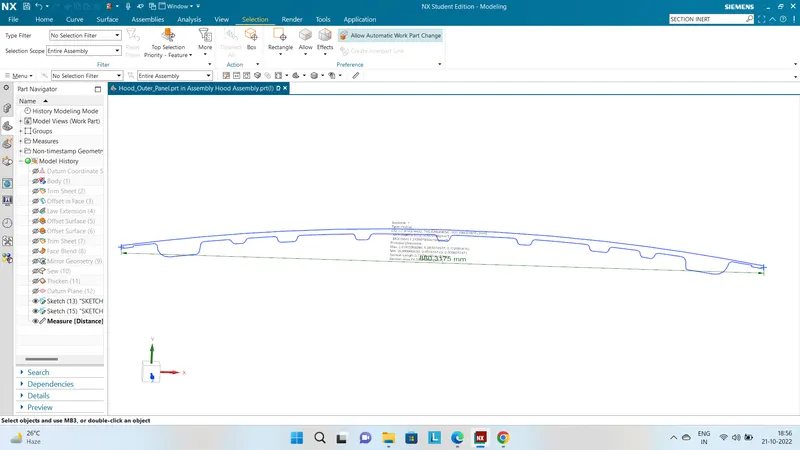
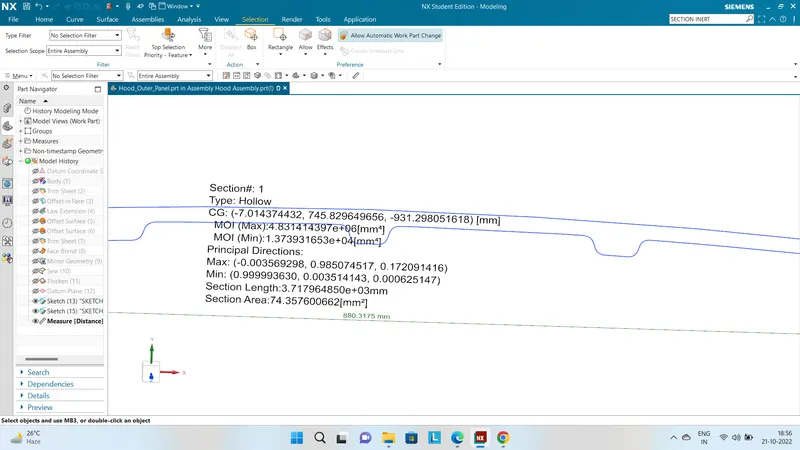
I have changed the position and shape of some embosses so that we can analyze what will happen to the section modulus if we increase the value of the area moment of the body.
L=880.3175 mm Total Length of the body from extreme endpoint to another extreme endpoint.
Y= Distance between the neutral axis and the extreme end of the object
Y=L/2 = 880.3175/2 = 440.15875mm
MOI ( Min)= 1.373931653e+04[mm^4]
Section Modulus=I/Y
Section Modulus=1.373931653e+04[mm^4]/440.15875mm
Section modulus= 31.21mm^3
Conclusion
As per the above analysis as we increase the distance between the inner and outer panels Moment of inertia will increase and simultaneously section Modulus will increase.
The value of the section modulus tells the strength, rigidity, and stiffness of the body
The more the value of the Section modulus the more the strength of the body, for calculating this we have to increase the value of the area moment of the body